
Macro: a shipping cycle meets a reporting reset
The U.S. regular equity session is open for this 9:30 a.m. CT edition. Parcel demand, business inventory, fuel costs and trade lanes all matter to a global carrier, but a stock candle cannot identify which one drove today’s move. FedEx has a more basic comparison problem ahead of its October 28 scheduled results: it changed its fiscal year-end from May 31 to December 31, and spun off FedEx Freight on June 1. The next reported period sits inside a seven-month June–December transition year. A casual comparison with an old fiscal quarter can mix different businesses and calendar periods before any operating conclusion is reached.
This is a study of comparability, not a claim that parcels accelerated today. The latest company financial results reviewed here are for the fiscal year ended May 31, 2026. The October report has not been released. FedEx’s supplemental historical filing recasts prior calendar periods and excludes the spun-off freight business from continuing operations, giving investors a better like-for-like starting point.
Fundamental: continuing operations are the relevant base
FedEx reported fiscal 2026 revenue of $94.7 billion, GAAP operating income of $5.46 billion and adjusted operating income of $6.61 billion. Its GAAP operating margin was 5.8%, versus 7.0% on the company’s adjusted definition. These were actual results for the old fiscal-year perimeter, including Freight. The June 1 spin-off means those consolidated totals should not be used unaltered as the denominator for post-spin revenue growth or margin. A narrower business can report lower absolute revenue while improving comparability or profitability; the percentage requires the corresponding recast base.
The company says the seven-month transition period runs June 1 through December 31, 2026. It recast calendar 2024 and 2025 quarterly and annual histories, and introduced Express U.S. Domestic and Express International as separate reportable segments in the transition period. Those are accounting and presentation changes. They do not, on their own, prove an increase in shipped pieces, better yield or higher network utilization. The supplemental filing also notes that some shared costs remained after Freight left. Those stranded costs matter when judging whether the slimmer company actually earns a better margin.
FedEx’s June outlook forecast roughly 11% calendar-year 2026 revenue growth and $16.55–$17.75 diluted EPS from continuing operations, with $16.90–$18.10 adjusted EPS. These are management forecasts, not reported calendar-year results. The company says the baseline is preliminary recast calendar 2025 continuing operations. Comparing the 11% guide with the old $94.7 billion fiscal 2026 total would blend the wrong time span and the pre-spin business perimeter. It also guided $3.9 billion of calendar-year capital spending. The right test after October 28 is to compare actual continuing-operations sales, segment margin and cash generation with the matching recast period, then separate operational improvement from removal of Freight and from adjustments.
One balance-sheet headline also needs a boundary. FedEx’s May 31 cash balance of $13.3 billion included a roughly $4.1 billion dividend received in the Freight spin-off and approximately $800 million of IEEPA tariff refunds held for customers. Treating all $13.3 billion as ordinary freely deployable operating cash would overstate the quality of that snapshot. The teaching point is to align period, perimeter and definition before interpreting growth: seven months versus twelve, continuing operations versus the former group, and GAAP versus adjusted measures. A constructive future report would show better segment economics on that matched base and cash conversion after restructuring. A weaker report would reveal volume or yield softness, stranded costs or continued adjustments. Neither outcome is known now.
Technical: a weak daily trend needs completed-close confirmation
The dedicated TradingView daily image was recaptured at 10:32 a.m. CT while October 5 trading was still under way. Its Cboe One feed showed an unfinished bar with a $291.00 open and high, $285.04 low, and about $287.01 indicated last value at capture. That last value is a timestamped chart indication, not a completed close or guaranteed execution price. The chart’s established 55-day EMA is near $308.05, above price. RSI, the only lower panel, is near 36.53. Both describe weak intermediate momentum, even though price has bounced from the late-September low.
The marked $279.23 swing low and $285.40 control line frame the immediate downside test. A constructive repair would require a completed daily close holding above $285.40, then a reclaim of the $300 round number and the $302.76 retracement. The $308.07 EMA and $310.03 midpoint are further tests; crossing them intraday would not be enough. A base case is sideways trade between $279.23 and $300 while the market waits for a comparable operating report. A completed close below $279.23 that fails to recover it would invalidate the near-term base thesis. Sustained closes back above $302.76 and then the 55 EMA would challenge a bearish continuation view. Gaps around the October 28 release can skip chart lines, so position size and exit planning must account for slippage. These are conditional observations, not an HPT trade or price target.
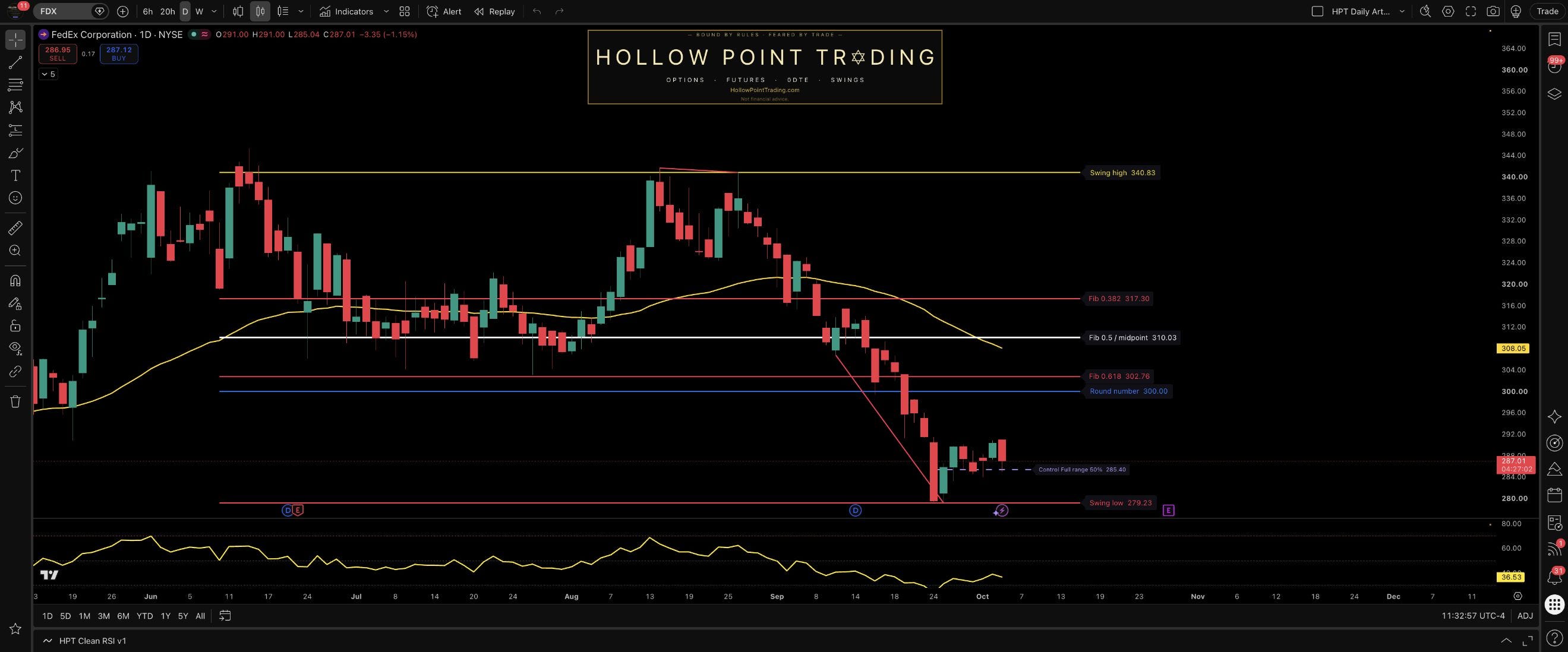
Source: TradingView HPT dedicated publisher tab, requested NYSE:FDX, observed NYSE display with BATS:FDX/Cboe One chart feed; 1-day timeframe; captured October 5, 2026 at 10:32 a.m. CT. October 5 candle is unfinished. 55 EMA near $308.05 and RSI near 36.53 are visual readings; RSI is the only lower panel. Static, feed-specific image; values can change and do not establish a future close, guaranteed fill or HPT position.
Sources: FedEx fiscal 2026 results and calendar-year outlook · FedEx supplemental recast financial history · FedEx investor calendar.
What October 28 combination of matched-period segment margin, package activity and cash conversion would convince you the post-spin business improved, and which completed daily close would invalidate your FDX chart case?