
Flex’s $2 Billion Axiom Funding Is a Preferred Claim, Not a Common-Share Windfall | October 5, 2026
The AI infrastructure story now has a financing price. Flex announced an agreement for investors led by General Catalyst, with Koch Equity Development and co-investors, to buy $2 billion of convertible preferred shares in Axiom, the cloud-and-power unit Flex intends to separate. The announced $37.5 billion initial enterprise value is an important outside valuation reference. It does not mean Flex received $37.5 billion in cash, and it does not make the preferred investors identical to future common shareholders. The security’s dividend and redemption terms are the useful bridge between the headline and the risk.
Macro: demand for data-center power still has a cost of capital
The U.S. regular equity session was open at this edition’s October 5, about 2:02 p.m. CT chart cutoff. Demand for power conversion, cooling and compute infrastructure can support a large addressable market, but financing terms matter even when the growth narrative is persuasive. A customer’s capital-spending plan, a supplier’s revenue, and an investor’s return are three different quantities. The October 5 announcement is evidence of an agreed financing transaction, not evidence that Axiom has already converted prospective AI infrastructure demand into realized sales or free cash flow.
Flex says the $2 billion preferred investment will help finance its pending EPC Power acquisition and prepare Axiom to operate independently. It also says committed term-loan financing covers the balance of that acquisition. These are planned sources of capital for a transaction that still has closing conditions. The investment has not been described as a simple $2 billion distribution to Flex common shareholders. At a time when large infrastructure projects require heavy upfront spending, the teaching point is to trace who receives the cash, which security gets paid first, and what conditions remain before assigning the headline valuation to the parent’s shares.
The calendar matters. Flex signed the preferred investment agreement on October 2 and announced it on October 5. Management intends to complete the separation in the first quarter of calendar 2027, subject to customary conditions. EPC Power’s acquisition is expected to close in the fourth quarter of 2026. These are guidance and transaction milestones, not completed outcomes. Regulatory review, acquisition closing, the proposed separation and operating execution can all change the eventual capitalization and timing.
Fundamental: the preferred coupon is the price of the outside capital
The announced $37.5 billion is an initial enterprise-value reference for Axiom. Enterprise value is not the same as the market value of Flex’s current ordinary shares, and it is not a cash receipt. The investors agreed to purchase 200,000 Axiom preferred shares at $10,000 each, totaling $2 billion. The preferred pays a 10% annual cash dividend before the separation. On an unchanged $2 billion stated amount, that is a simple annualized $200 million cash obligation, not a report of a full year’s actual expense. After the separation, the stated rate steps down to 6% if paid in cash or 7% if paid in kind, subject to later adjustments. Those simple annualized equivalents are $120 million cash or $140 million paid in kind before compounding or adjustments. Payment in kind preserves near-term cash but increases the preferred claim rather than making the cost disappear.
The Securities and Exchange Commission filing adds an unusually important downside branch. If the spin-off has not been completed by December 31, 2027, Axiom must redeem the then-outstanding preferred. Flex guarantees that obligation. Before cash dividends already paid and other specified adjustments, the stated redemption formula is 115% of purchase price if paid in cash or 125% if paid in Flex ordinary shares. On the original $2 billion stated amount, the simple starting equivalents are $2.3 billion and $2.5 billion, respectively; they are not a forecast of the eventual payment. The filing also includes a tax gross-up mechanism and 12% annual interest on an unpaid redemption balance. Share payment could dilute existing holders; a cash payment would consume liquidity. Investors should not collapse those branches into one guaranteed outcome.
This is why outside validation and common-equity upside must be separated. A strategic investor accepting a preferred instrument at a specified enterprise-value reference may validate interest in the business while also demanding priority, dividend economics, board nomination rights after separation, and protection if the separation stalls. The prospective benefit to Flex shareholders depends on what assets and liabilities each company retains, the allocation of acquisition financing, the preferred claim, and Axiom’s eventual operating performance. None of those can be read from the $37.5 billion headline alone.
The next fundamental checkpoints are concrete: closing of the preferred investment after required approvals; closing and integration of EPC Power; the separation documents’ capital structure and share distribution; and Axiom’s revenue, margins, working capital and cash generation once reported separately. Favorable execution would show real operating cash flow that can support the preferred obligation without crowding out reinvestment. An adverse path would involve delay, weaker demand conversion, higher integration cost, or a capital structure that transfers more of the future value to senior claims. These are scenarios, not reported results.
Technical: an intraday move above the 55-day average still needs a completed close
A newly captured TradingView daily chart for Flex’s Nasdaq-listed ordinary shares showed an unfinished October 5 bar around $117.41 at about 2:02 p.m. CT. The day’s displayed high was $121.48 and low $116.50. The established 55-day exponential moving average was near $115.85, with RSI around 56 as the chart’s only lower panel. The chart is a feed-specific visual observation, not an executable quote or a completed daily close. Today’s high-to-low range is wide enough to make an intraday break above the average less conclusive than a settled close and subsequent retest.
The constructive case requires a completed daily close above the roughly $115.85 trend average and a later hold of that area on pullback. A renewed move through today’s $121.48 high would add price confirmation if it is sustained on completed bars. The neutral case is a close near the average followed by further rotation between the current session’s roughly $116.50 low and $121.48 high while investors digest the security terms. A completed close back below the average, then failure on a reclaim, would invalidate the immediate trend-recovery case; a break of $116.50 would sharpen that warning for this session’s structure. Conversely, repeated closes above today’s high would weaken a near-term fade thesis. These lines are reference points, not predictions or guaranteed stop fills.
The chart cannot tell whether the preferred financing will close or whether the separation will create common-share value. It can show whether buyers keep accepting higher prices after the announcement. Price can gap through every level on financing, regulatory or acquisition news, so position size and exits must allow for slippage and overnight risk. No HPT trade, position or realized result is implied.
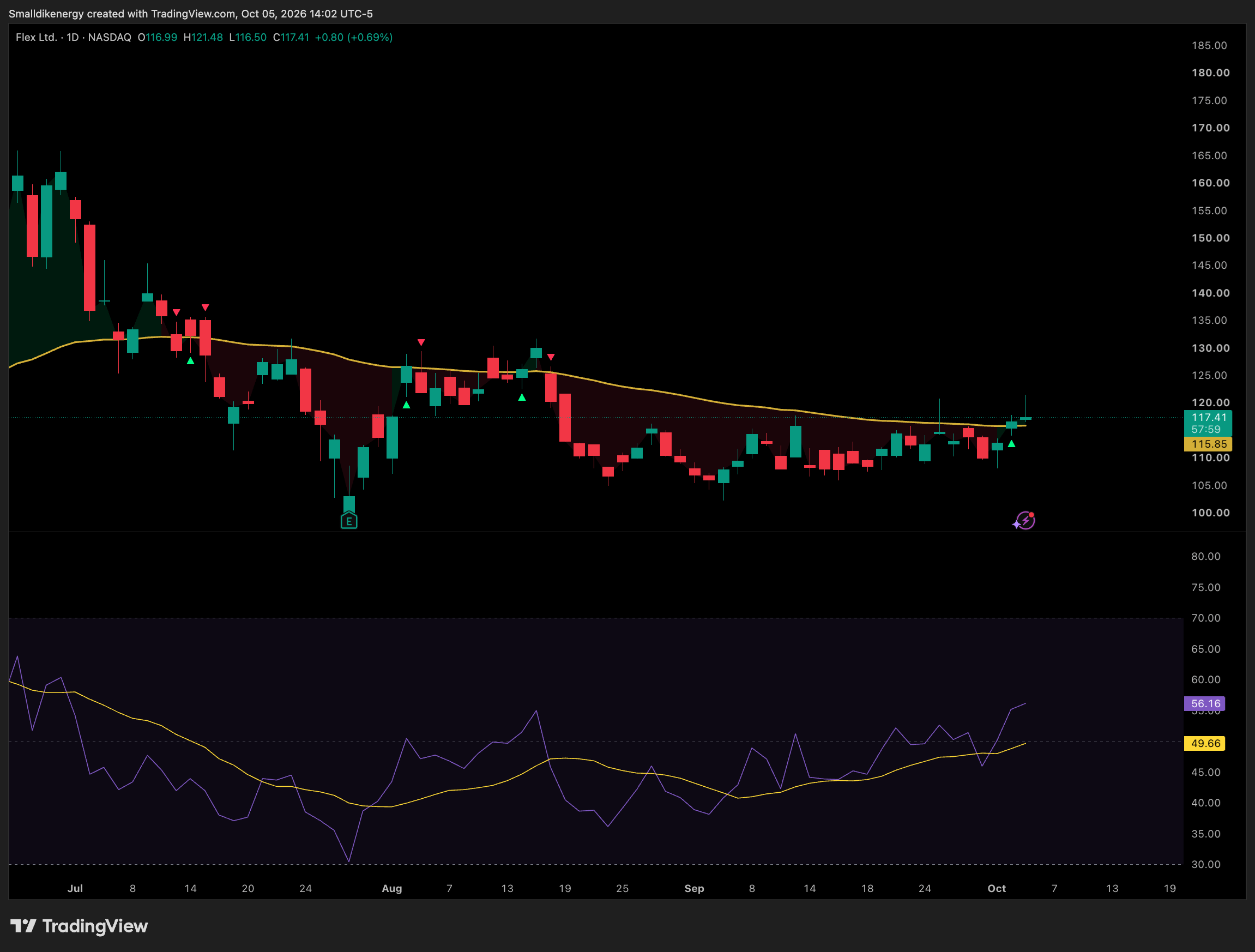
Source: TradingView, dedicated HPT publisher-owned NASDAQ:FLEX chart, daily timeframe, captured October 5, 2026 at about 2:02 p.m. CT during the U.S. regular session. October 5’s bar was unfinished. The roughly $117.41 displayed value, $115.85 established 55 EMA and RSI near 56 are visual, feed-specific readings. The session high/low and trend line are reference levels, not completed closes, forecasts, assured fills or an HPT position.
Sources: Flex October 5 announcement; Flex Form 8-K filed October 5, agreement dated October 2; TradingView chart. Educational research only. Corporate transactions can fail or change; equities, options and leveraged positions can incur substantial loss. This is not personalized investment advice.
Discussion: Which would change your view of the proposed separation more: the preferred redemption protection, verified Axiom cash generation after the EPC Power acquisition, or Flex holding above its daily trend average after this announcement?