
Macro — Enterprise AI has a location constraint
A bank can like an AI development tool and still decline to send sensitive source code outside its controlled environment. That is a different obstacle from a shortage of computing power. For enterprise software, the deployment location can decide whether a product even reaches a purchasing committee. IBM’s October 1 announcement gives that distinction a concrete catalyst: a self-hosted version of IBM Bob for customer-controlled infrastructure.
IBM says the option supports on-premises, private-cloud, sovereign-cloud and air-gapped environments. Bob is its agentic software development platform, aimed at software delivery and modernization. The release describes control over data residency and governance; it does not establish a new revenue contribution. That boundary matters when a product announcement arrives alongside an attractive industry narrative. A capability can widen the addressable customer set without immediately widening reported sales.
The macro interpretation here is conditional. Organizations that cannot move sensitive code to an external service may have a reason to evaluate a deployment that keeps that code inside their own perimeter. Whether they do so depends on procurement, implementation effort, supported models and the economics of the project. A vendor announcement does not tell us how those decisions will resolve. This article makes no claim that every regulated customer is ready to buy.
It is Saturday, October 3. U.S. equity markets are closed. The chart is a fresh capture of completed daily trading through Friday, October 2, rather than a live weekend quote. The next regular session can reassess this catalyst alongside broader market conditions. There is no reason to treat an enterprise software announcement as a guarantee that the stock must rise when equities reopen.
Fundamental — Removing a deployment barrier is one step in a commercial sequence
The useful teaching point is the difference between product eligibility and commercial conversion. Self-hosting may allow an organization to consider a tool it previously ruled out. Evaluation is still followed by technical testing, internal approval, contracting and implementation. Those stages can consume time and resources. None is interchangeable with recognized revenue, and the October 1 release supplies no measured Bob sales increment to bridge them.
Consider a hypothetical company that rejects externally hosted development tools. A self-hosted option moves IBM into its evaluation process. If the test fails, the new capability has produced no sale. If a contract is signed, the revenue effect still depends on contract structure and delivery. This is an illustration of procurement stages, not an account of an actual IBM customer. It helps explain why a product can be strategically relevant while its immediate financial contribution remains unquantified.
IBM’s July 22 second-quarter release gives the historical business context. Total revenue was $17.162 billion, up about 1% year over year. Software revenue was $7.761 billion, up 5%; Infrastructure revenue was $3.835 billion, down 7%. Within Hybrid Infrastructure, IBM Z fell 42% while Distributed Infrastructure grew 37%. These are reported second-quarter comparisons, not October operating results. The differing rates also show why an AI software catalyst should not be read as a universal statement about every IBM business.
IBM’s full-year outlook at that release called for 4%–5% constant-currency revenue growth. That was management guidance, not a completed result. Bob’s deployment expansion is a later product development, and this article does not revise that outlook or assign a forecast contribution to the announcement. The evidence to watch is subsequent company disclosure that connects adoption to financial performance, with enough detail to identify the product or related business activity.
A constructive fundamental scenario would show customer-controlled deployments progressing beyond trials and supporting durable software demand. A neutral scenario would show useful product interest with little measurable near-term revenue effect. An adverse scenario would involve expensive implementation, weak conversion or competitive alternatives that limit the commercial payoff. Those are analytical possibilities. We do not have reported customer counts or a Bob revenue series in the cited release that would justify ranking them numerically.
For a researcher, the next question is therefore specific: what evidence would connect this deployment option to spending? A general statement about AI enthusiasm is weaker than a measured change in paid usage, contract activity or disclosed product economics. Even broader Software growth would require care before attributing it to Bob alone, because IBM sells many products. Keep the attribution as narrow as the disclosure permits.
Technical — A product catalyst meets a daily chart still below trend
The fresh TradingView daily chart displays IBM on its NYSE listing, using the Cboe One feed identified internally as BATS:IBM. Friday’s completed candle shows an open of $225.51, high of $225.92, low of $221.63 and close of $222.64, down 1.32% for that session. The established 55-day EMA is $235.27. RSI(14), the only lower panel, reads 41.47. Feed-specific figures can differ from another provider; these numbers describe this chart.
The price sits beneath a declining EMA in this focused September-to-October view. That observation makes the announcement a business catalyst to evaluate rather than confirmation of a technical recovery. The nearest practical test is Friday’s $225.92 high. Regaining it would improve the immediate structure, but would still leave considerable distance to the $235.27 EMA. A single push through the prior-day high would not erase that larger hurdle.
For a bullish scenario, first look for price to reclaim $225.92 and retain it on a subsequent test. A broader repair would then require progress toward the EMA, with the actual EMA recalculated as new candles arrive. Failure to hold the reclaimed level would invalidate that specific breakout premise. This is a conditional next-session framework; no weekend entry or executed HPT position is asserted.
A base scenario is continued two-way movement between the $220 area and the prior-day high, without a sustained trend repair. The round $220 reference is a reading aid near recent candle lows, not an assurance of support. A bearish scenario would be a renewed loss of $221.63 followed by failure around $220. Holding back above the broken reference would challenge that continuation premise. Price behavior at those boundaries matters more than simply labeling RSI below 50.
Risk — The reopening price can cross the plan
A Monday gap can jump over a trigger or invalidation before a trader can act. A daily chart also cannot measure an options spread, implied-volatility change or time decay. Product enthusiasm, broad-market weakness and a later financial disclosure can move the stock in different directions. Size and execution choices require information beyond this static image.
Keep the two tests separate: IBM Bob needs evidence of commercial conversion, and IBM’s stock needs evidence of price repair. Neither proves the other. This is educational research, with no guaranteed outcome, personalized recommendation or claimed realized result.
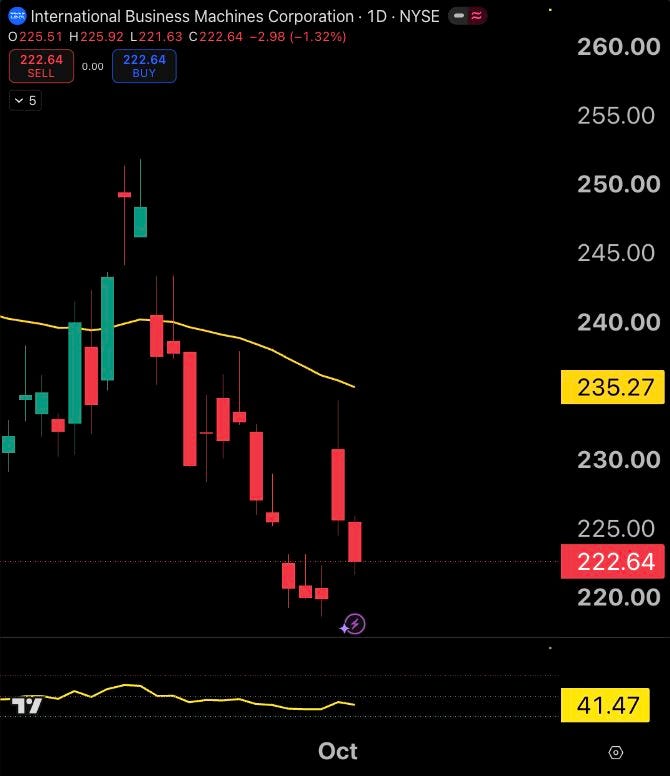
Source: genuine TradingView publisher-owned chart, requested NYSE:IBM; observed BATS:IBM / NYSE by Cboe One, 1D. Captured October 3, 2026 at approximately 1:40 p.m. America/Chicago. Equity market closed; latest completed candle October 2. Established 55 EMA $235.27; RSI(14) 41.47 is the only lower panel. Static feed-specific historical image, not a live weekend quote. Indicators and scenario references change with later bars; no forecast or guaranteed execution.
Sources and evidence limits
IBM Bob self-hosted deployment announcement — October 1, 2026
IBM second-quarter results and management outlook — July 22, 2026
Company figures are historical reported results; management outlook is guidance. Procurement examples are hypothetical teaching illustrations. Commercial and technical scenarios are inference. No third-quarter result or Bob revenue increment is assumed.
Discussion: What evidence would persuade you that IBM Bob’s self-hosted option is converting deployment eligibility into paid demand, and which price failure would invalidate your next-session IBM scenario?