November 18, 2026, post-session. Market comparisons below use November 18 versus November 17 regular-session ETF daily bars retrieved at 4:51 p.m. Central. They are not synchronized extended-hours prints, index breadth counts or a live options map. Bars can revise.
THE WHOLE-MARKET BOARD
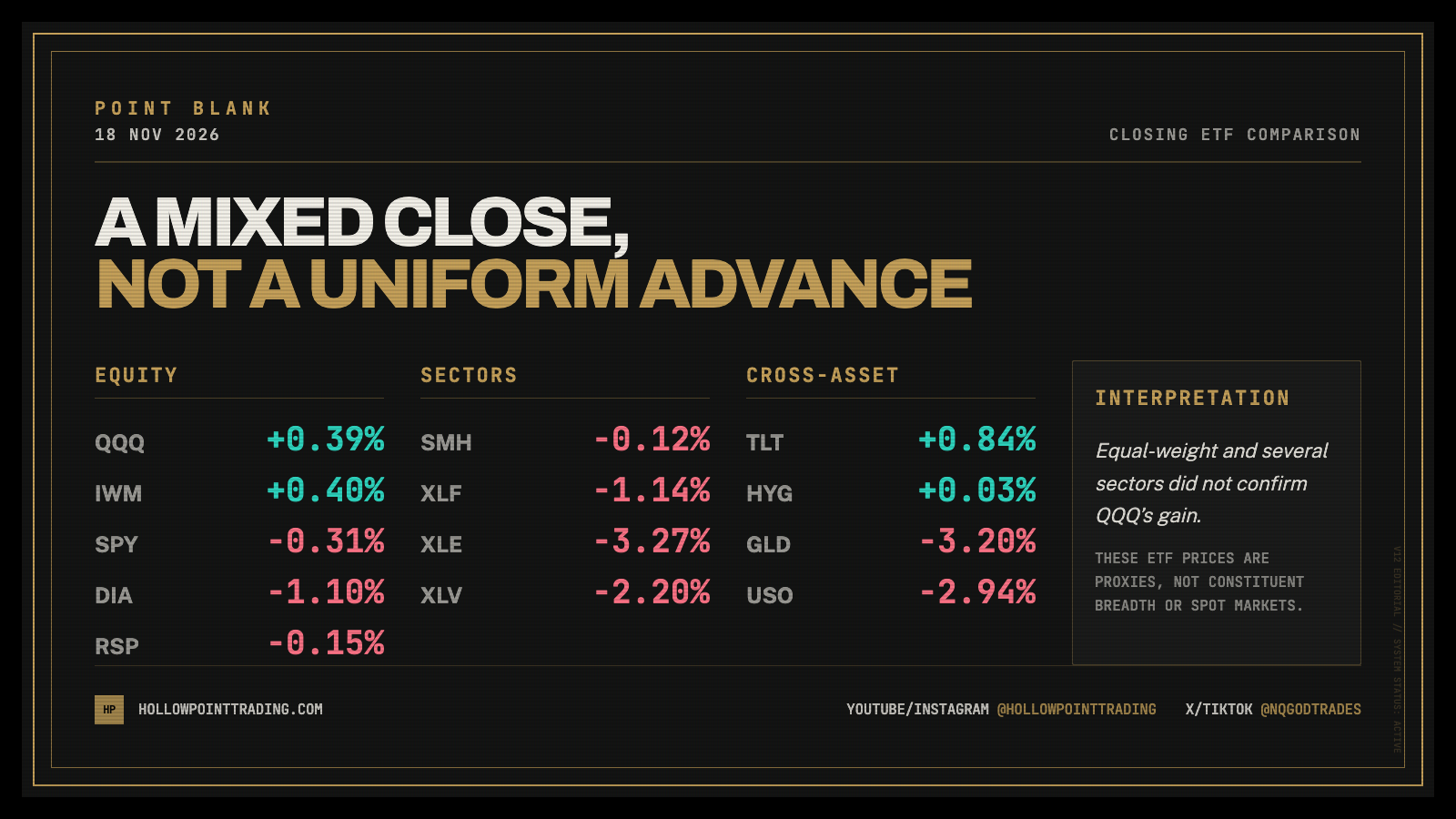
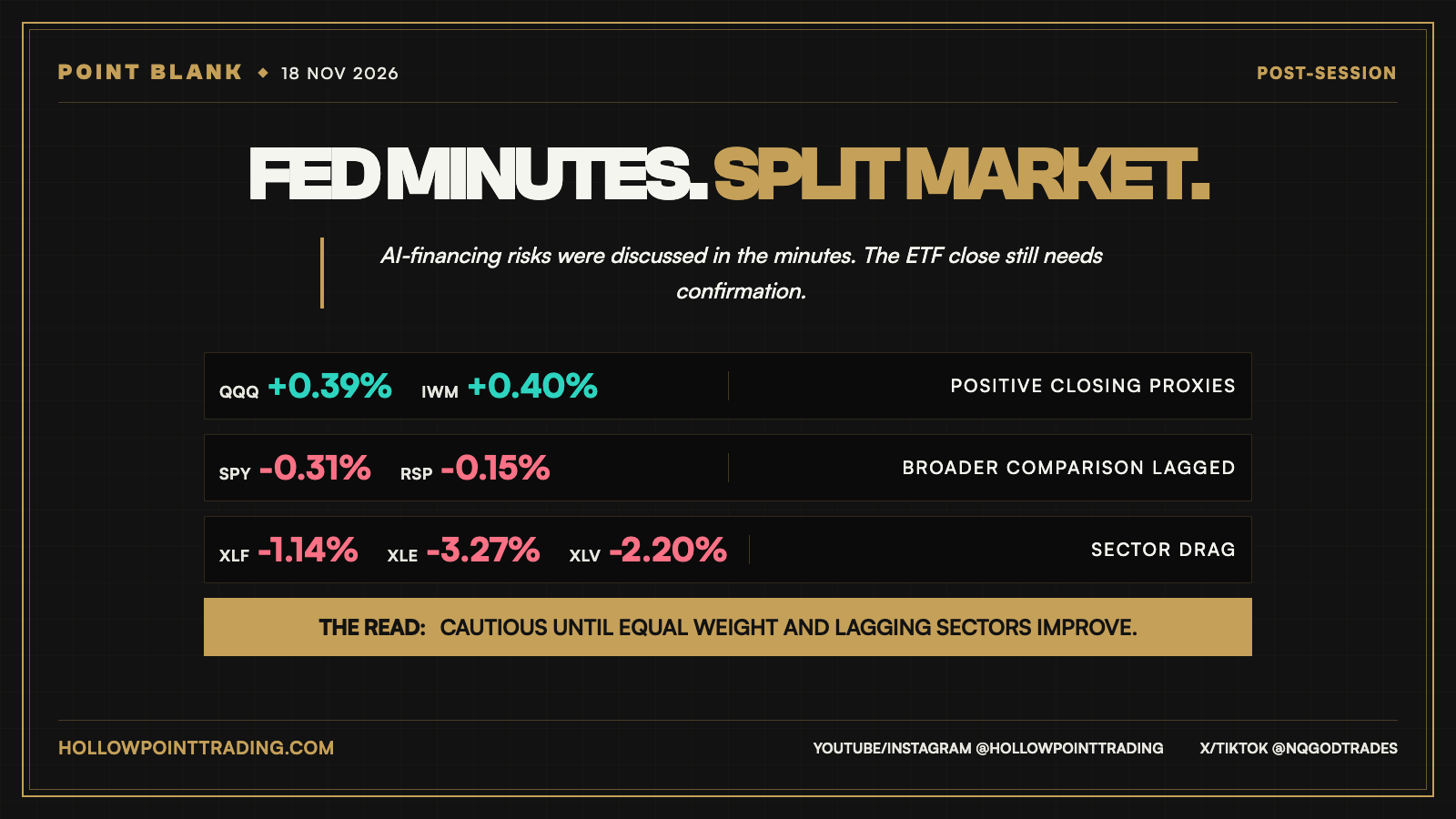
QQQ closed $659.51 (+0.39%) and IWM $270.12 (+0.40%). SPY fell to $730.20 (−0.31%), DIA to $501.73 (−1.10%) and equal-weight RSP to $215.43 (−0.15%). The two positive ETF proxies did not carry the broad cap-weighted, Dow-proxy or equal-weight funds with them. RSP measures an equal-weight portfolio, not the number of advancing stocks; no constituent breadth count is claimed here.
The sector comparison was similarly selective: SMH $459.54 (−0.12%), XLF $56.42 (−1.14%), XLE $61.29 (−3.27%) and XLV $181.17 (−2.20%). Semiconductor fund weakness alongside a higher QQQ is a useful warning against treating a tech-heavy index gain as uniform tech participation. The sharper declines in energy and health care matter for any broad-market confirmation test. This ETF list does not identify which individual issuers led or lagged.
Across other asset classes, TLT closed $80.22 (+0.84%), HYG $76.65 (+0.03%), GLD $341.19 (−3.20%) and USO $136.11 (−2.94%). These are fund prices, not direct Treasury yields, credit spreads, spot gold or spot crude. Their mix does not support a one-word risk-on or risk-off label.
DATED CATALYST | THE FED MINUTES’ AI FINANCING SECTION
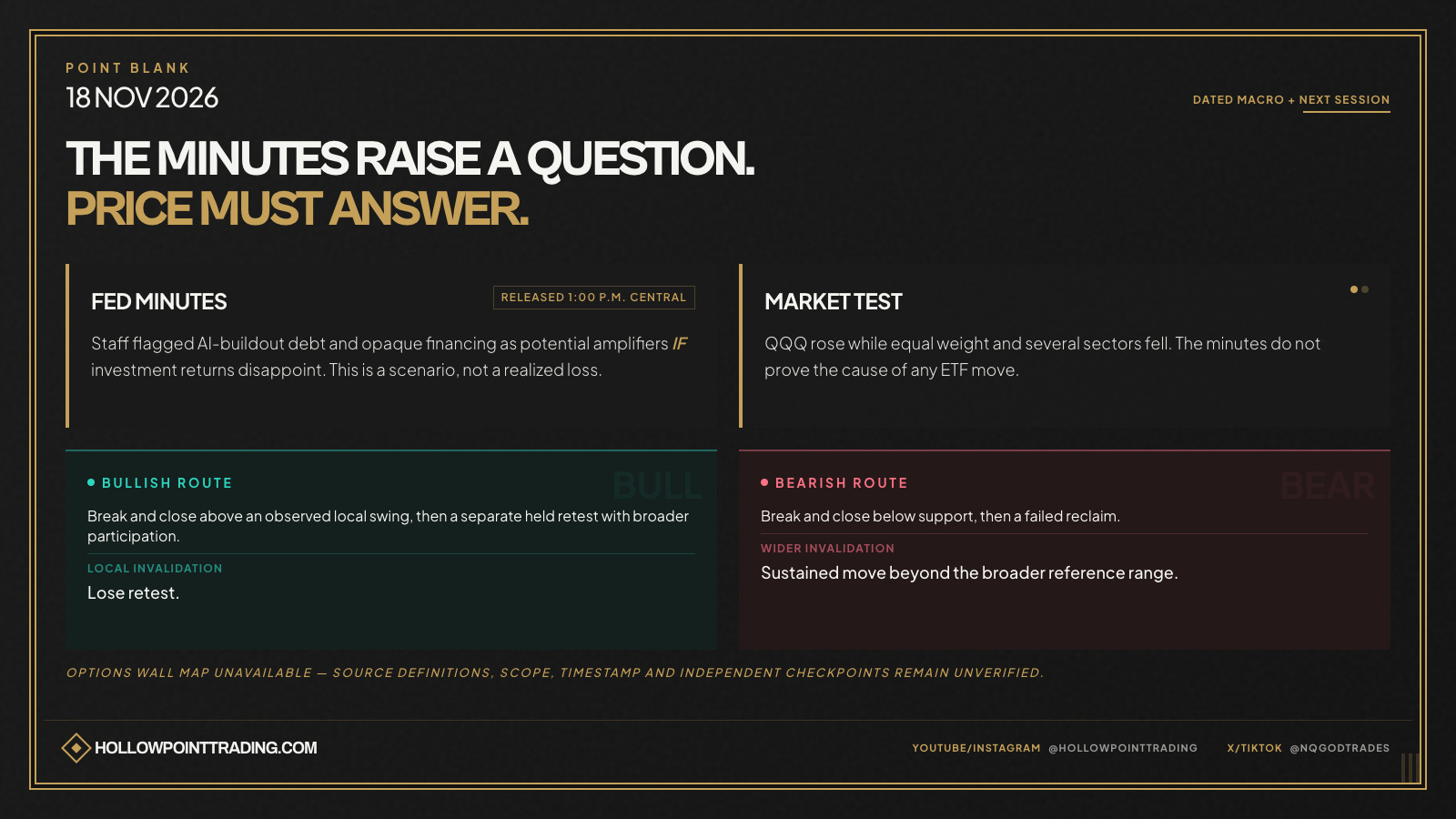
The Federal Reserve released minutes of its October 27–28 meeting at 1:00 p.m. Central on November 18. In its financial stability discussion, staff highlighted debt linked to the AI buildout, including off-balance-sheet leasing commitments and circular financing arrangements, as potential amplifiers if returns disappointed. Participants also discussed risks from a possible AI-related asset-price revaluation. The minutes describe concerns examined at the meeting, not a current finding that those losses have occurred. Their release is a dated catalyst to read beside the market board, not proof that it caused a given ETF close.
THE DECISION ROUTE
My lean remains cautious. A bullish next-session read requires a break and close above an observed local swing followed by a separate held retest, with improvement in equal weight and at least one lagging sector. Losing that retest would invalidate the local bullish route; sustained trade below the broader November 18 reference range would challenge the wider view. A bearish route needs a break and close below observed support followed by a failed reclaim. Today’s completed daily bars do not demonstrate either next-session sequence, and this conceptual comparison is not a genuine TradingView technical chart.
The six required options decision levels are unavailable: authenticated Tanuki put/call-wall definitions, exact symbol and expiry scope, underlying data timestamp and four independent checkpoints remain unverified. ETF prices are not substitutes for option walls or gamma levels.
Question: After these minutes, what would change your read first—RSP joining QQQ, SMH reclaiming, or a failed reclaim in the broad ETF proxy?
Sources and cutoff: Authenticated Alpaca delayed-SIP stock snapshots retrieved November 18 at 4:51 p.m. Central; November 18 and November 17 ETF daily bars, rounded to two decimals. Federal Reserve, Minutes of the Federal Open Market Committee, October 27–28, 2026, released November 18 at 1:00 p.m. Central, https://www.federalreserve.gov/monetarypolicy/fomcminutes20261028.htm. These source cutoffs are historical observations and not a live quote.
HollowPointTrading.com | YouTube/Instagram @HollowPointTrading | X/TikTok @NQGODTRADES | Reddit r/HollowPointTrading | Substack @HollowPointTrading