
Imagine you walk into a car dealership. You love a certain truck, but the sticker says $40,000 and you think that's too much. You'd happily buy it at $35,000. So you tell the dealer: "Here's the deal. I'll set aside $35,000 in cash right now. If the truck ever drops to $35,000, you sell it to me at that price — I'm committed. And for making that promise and locking up my cash, you pay me $500 today, no matter what happens."
The dealer takes the deal. Now two things can happen. Either the truck drops to $35,000 and you buy the truck you wanted anyway — at the price you wanted — and you keep the $500. Or the truck never drops, you never buy it, and you still keep the $500 just for making the offer.
That, in plain English, is a cash-secured put. You get paid to wait to buy a stock you already want, at a price you already like. This guide teaches it from zero. By the end, a complete beginner will understand exactly how it works, what can go wrong, and how to walk through a real example Monday morning.
What Is a Cash-Secured Put, in Plain English?
Let's slow down and define every word, because this is where beginners get lost.
A stock is a small piece of ownership in a company. When you buy one share of Apple, you own a tiny slice of Apple.
An option is a contract — a legal agreement — about buying or selling a stock at a set price within a set time. There are two flavors of options: calls and puts. We only care about puts in this guide.
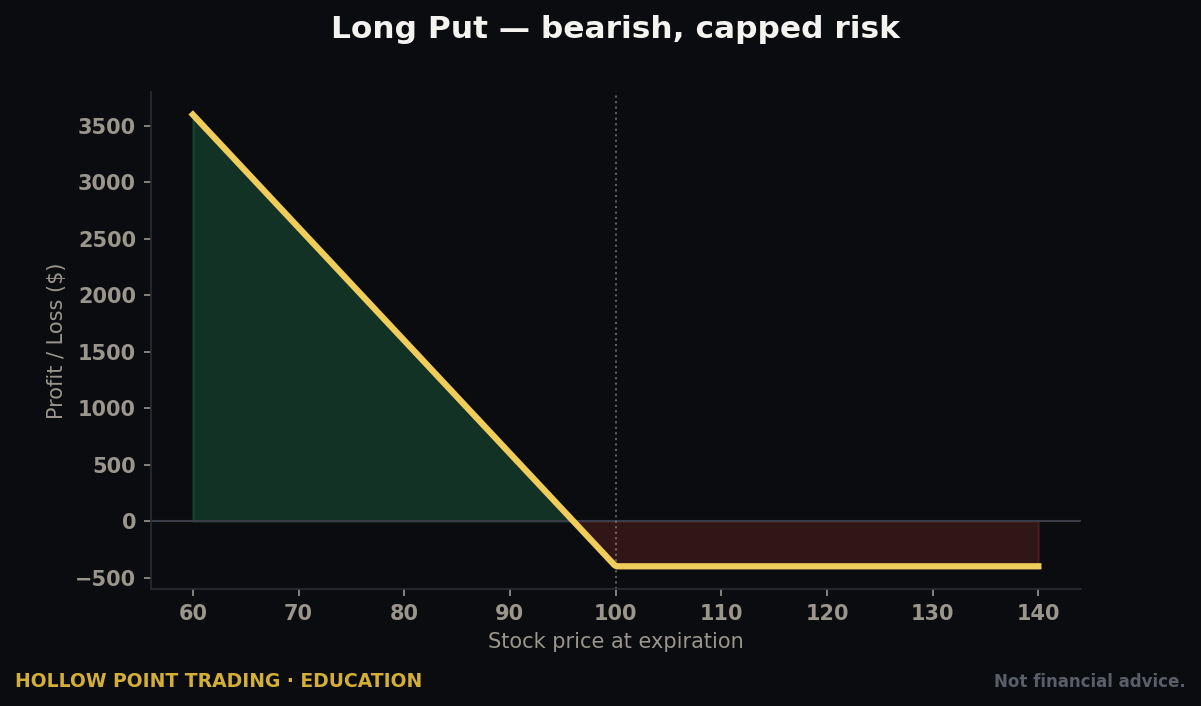
A put is a contract that gives its owner the right to sell 100 shares of a stock at a fixed price. Notice that word: right. The owner of a put can force someone to buy their shares at the agreed price. That "someone" — the person on the other side who is obligated to buy — is the put seller. In a cash-secured put, you are the seller. You are the one making the promise to buy.
Now let's unpack the two words in front of "put":
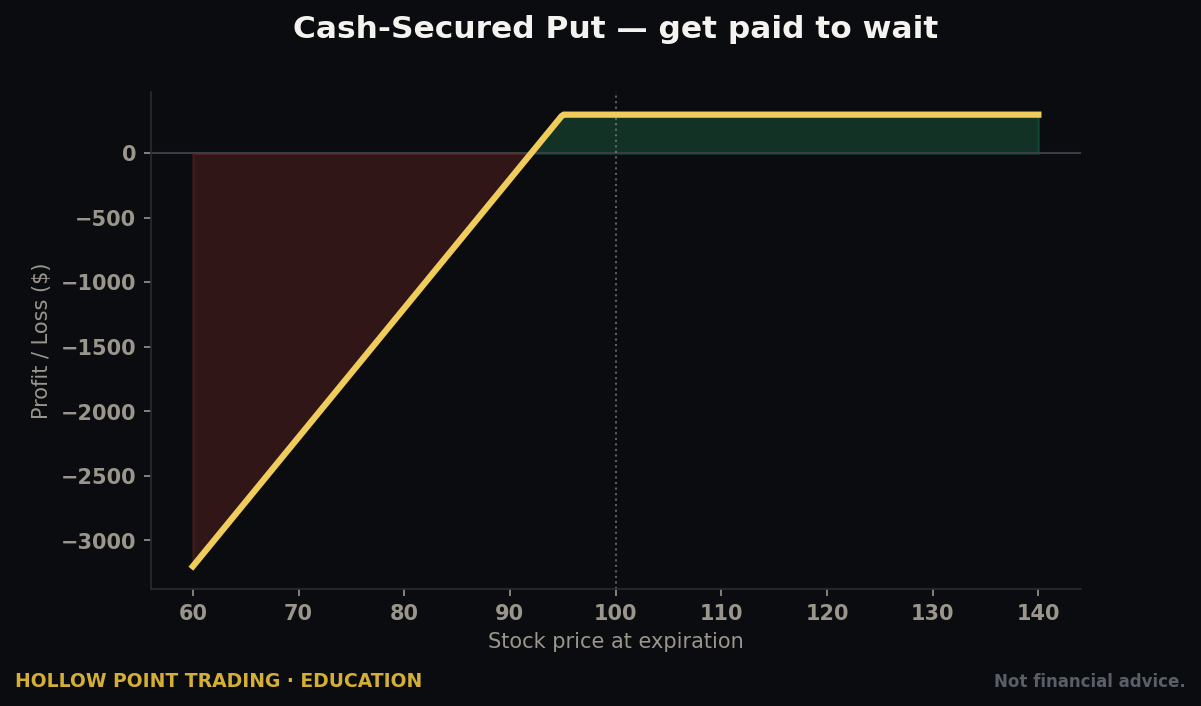
Cash-secured means you have set aside enough actual cash in your account to buy the shares if you're forced to. You're not borrowing. You're not betting money you don't have. The cash is parked, ready, guaranteeing your promise. This is the single most important word in the whole strategy, and it's why this is considered one of the safest options strategies a beginner can learn.
So a cash-secured put is this: You promise to buy 100 shares of a stock at a price you choose. You back that promise with real cash. In exchange for making the promise, you get paid money upfront — today — that is yours to keep no matter what.
That upfront payment has a name: the premium. Think of it as the fee someone pays you for your promise. It's the $500 the truck dealer paid you.
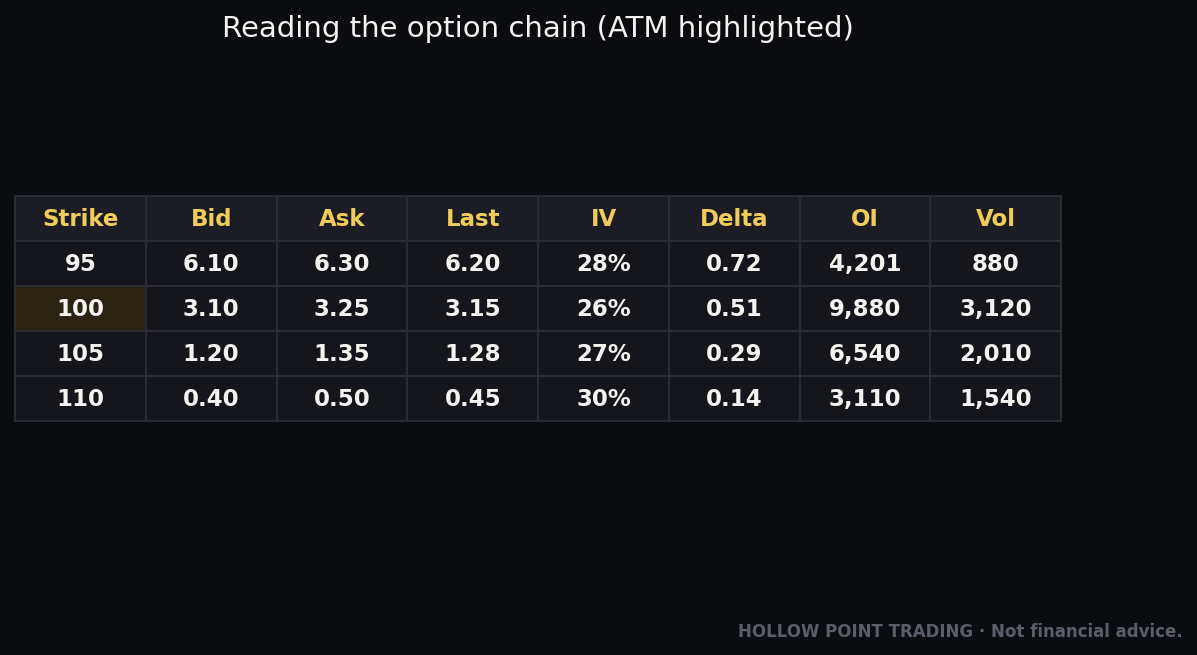
Every option contract controls 100 shares. This never changes and it trips up every beginner at least once. When you sell one put contract, you're promising to buy 100 shares. If the stock price is $50, that's a $5,000 commitment. Always multiply by 100.
The price you choose to buy at is called the strike price — the "strike" is just the trigger price where your promise kicks in. And every option has an expiration date, the day the contract dies. After expiration, the promise is over.
Why Should a Beginner Care About This?
Here's the honest truth: most beginners lose money in options because they buy lottery tickets. They buy calls and puts hoping a stock rockets or crashes, and they lose again and again as those tickets expire worthless. Cash-secured puts flip that entire game around. Instead of buying the lottery ticket, you sell it — you become the house, the one collecting the fee.
There are three reasons this strategy deserves a spot in a beginner's toolkit.
Reason one: it pays you to be patient. The hardest thing in investing is waiting for a good price. Cash-secured puts pay you while you wait. Every time you sell a put on a stock you want, you collect premium. Do it over and over on a stock that never quite reaches your price, and you build a steady stream of income for doing nothing but waiting.
Reason two: you only ever buy at a discount. You choose the strike price. You'd only ever pick a price you'd genuinely be happy to own the stock at. So the "worst case" — being forced to buy — is actually just buying a stock you wanted at a price you liked. That's a very different worst case from most trades.
Reason three: it teaches discipline. At Hollow Point Trading, we say discipline beats prediction every single time. Cash-secured puts force discipline on you. You can't sell one without deciding, in advance, exactly what price you'd pay and exactly how much cash you're committing. There's no guessing, no chasing, no hoping. The rules are set before you enter. That's the whole HPT ethos baked into a single trade.
The catch — and there's always a catch — is that your upside is capped. You collect the premium and that's the most you'll make on the option itself. If the stock triples, you don't get any of that; you only ever made your fee. This is not a get-rich strategy. It's a get-paid-to-wait strategy. For a beginner learning to protect capital first, that's exactly the right trade-off.
How It Works, Step by Step
Let's build the whole thing from the ground up. There are five decisions and one outcome. Take them slowly.
Step 1: Pick a stock you genuinely want to own. This is not optional and it's not a technicality. Because you might actually end up owning 100 shares, you must only ever do this on a company you'd be happy to hold for months or years. If you wouldn't want to own it, don't sell the put. At HPT we start top-down — the macro environment, then the sector, then the individual stock — so that when we pick a name, we already believe in it. A cash-secured put is only as safe as the stock underneath it.
Step 2: Pick your strike price — the price you'd love to buy at. This is the price where your promise activates. It's almost always below where the stock trades today. If a stock is at $52 and you'd be thrilled to buy it at $48, then $48 is your strike. You're saying, "I'll wait for the discount."
Step 3: Pick an expiration date. Options expire on specific dates. Beginners usually do well starting with expirations 30 to 45 days out. That window gives you a healthy premium while keeping the commitment short enough to stay flexible. Shorter dates pay less; longer dates lock your cash up longer.
Step 4: Set aside the cash. Multiply your strike by 100. That's the cash that must sit in your account, untouched, backing the promise. A $48 strike means $4,800 parked and ready. This is the "cash-secured" part, and it's non-negotiable. If you skip it, you're doing a different, far riskier trade called a naked put — beginners should never touch that.
Step 5: Sell the put and collect your premium. You place the order — in your brokerage it's called "sell to open" a put — and the premium lands in your account immediately. That cash is yours to keep from the very first moment, forever, no matter what happens next.
Now you wait. When expiration day arrives, exactly one of two things happens.
Outcome A — the stock stayed above your strike. Say it never dropped to $48. The put expires worthless to the buyer, which is a good thing for you. Your promise dissolves, your cash is freed up, and you keep the full premium. You made money and bought nothing. You can now turn around and sell another put, collecting premium again. Traders call this "rinse and repeat," and it's the bread and butter of the strategy.
Outcome B — the stock dropped below your strike. Now your promise kicks in. You get assigned — meaning you're required to make good on your word and buy 100 shares at your $48 strike, using the cash you set aside. You now own the stock you wanted, at the price you wanted, and you still keep the premium. We'll dig into assignment next, because it's the one part beginners fear and misunderstand the most.
That's the entire mechanism. Pick a stock you want, pick a price you'd pay, park the cash, get paid, and then either keep the fee or buy the stock at your discount. Two outcomes, both of which you chose in advance.
The Risk You Must Understand: Assignment
Every honest guide has to spell out the risk, and cash-secured puts have exactly one that matters. It's called assignment, and it means being forced to buy the 100 shares.
Let's be precise about what "risk" means here, because it's not the risk of losing your whole account. When you sell a cash-secured put, the true risk is that the stock falls well below your strike price, and you're forced to buy it at the strike anyway — paying more than it's now worth.
Go back to the truck. You promised to buy at $35,000. Suppose bad news hits the truck market and that model is suddenly worth only $30,000. Your promise still stands. You must buy at $35,000. You now own a truck worth $30,000, so you're down $5,000 on paper — softened by the $500 fee you kept, leaving you $4,500 underwater.
The stock version works the same way. You sold a put with a $48 strike and collected, say, $150 in premium. The stock crashes to $40 by expiration. You're assigned: you buy 100 shares at $48, spending $4,800, even though those shares are now worth only $4,000 on the open market. On paper you're down $800, minus the $150 you kept, for a net paper loss of $650.
Two things soften this, and one thing makes it manageable.
First, the premium is always yours. It lowers your real cost. In that example, you paid $48 per share but pocketed $1.50 per share in premium, so your true cost — your break-even — is $46.50 per share, not $48. You don't actually lose money until the stock falls below $46.50.
Second, you now own a stock you wanted. You're not stuck with garbage. You picked this company on purpose. If it's a quality business having a bad week, you own shares at a discount and can wait for a recovery — or sell covered calls against them to collect more premium (a strategy for another guide, but worth knowing exists).
Third — and this is the honest part — the worst case is not zero, but it is defined. The absolute maximum you can lose is if the stock goes all the way to $0. In that nightmare, you paid $4,800 for shares worth nothing, minus the $150 premium, for a maximum loss of $4,650. That's real. But notice two things: it's the same maximum loss you'd face if you'd simply bought the stock outright, and it's capped at the cash you already set aside. You can never lose more than the cash you committed. There's no borrowing, no margin call, no surprise. That's why "cash-secured" matters so much — it turns an open-ended fear into a known, fixed number you agreed to before you started.
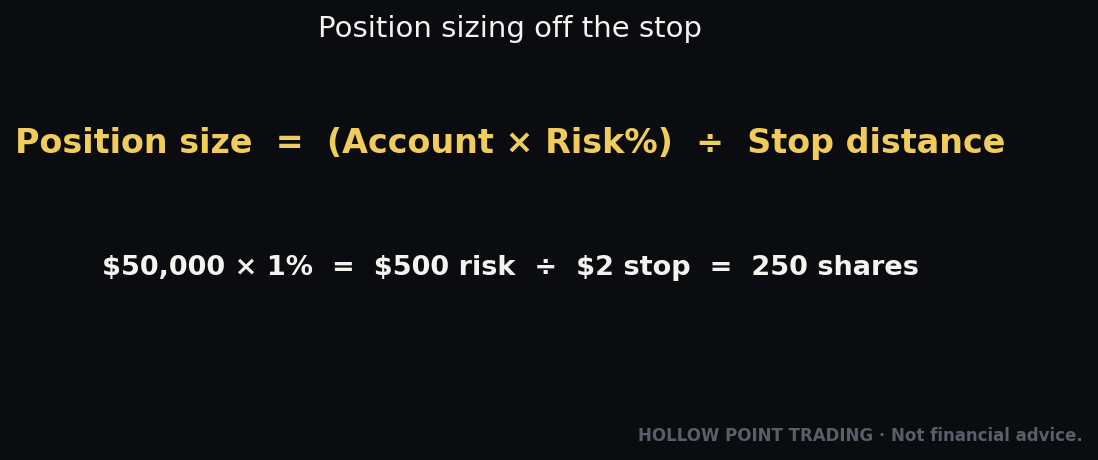
The takeaway: assignment is only a problem if you sold a put on a stock you didn't actually want, or at a strike you couldn't actually afford. Do it right — a stock you want, a price you'd pay, cash you have — and assignment stops being a risk and becomes just another good outcome.
A Fully Worked Beginner Example
Let's walk through a complete trade with real-ish numbers, slowly, from start to finish.
Meet a beginner named Sam. Sam has been watching a made-up company called Bright Coffee Co. (ticker: BRWU). Sam likes the business, thinks the long-term story is solid, but feels the current price of $52 per share is a touch expensive. Sam would be genuinely happy to own it at $48.
Sam has $5,000 in cash sitting in a brokerage account, doing nothing.
Here's Sam's thinking, out loud: "I want BRWU. I'd pay $48. I have the cash. Instead of just setting a price alert and waiting for free, let me get paid to wait."
Sam looks at the options. There's a put with a $48 strike expiring in 35 days. The premium being offered is $1.50 per share. Because every contract is 100 shares, that premium is worth $1.50 × 100 = $150 total.
Sam does the math before doing anything else:
- Cash required to secure the promise: $48 strike × 100 shares = $4,800. Sam has $5,000, so this fits.
- Premium collected immediately: $150, deposited today, Sam's to keep forever.
- Break-even price: $48 strike − $1.50 premium = $46.50 per share. Sam only loses money if BRWU falls below $46.50.
Sam places the order: sell to open one BRWU $48 put, expiring in 35 days. Instantly, $150 lands in the account. That $150 is a 6.4% return on the premium relative to the $2,325 Sam would need... no — let's keep it simple and honest: $150 collected against $4,800 of committed cash is about a 3.1% return in 35 days. Annualized, that pace is roughly 32% a year, which is why income traders love this. (We're not promising that return — it depends on getting to repeat it, which never happens perfectly. But it shows why the math is attractive.)
Now Sam waits 35 days. Let's look at the three ways this can end.
Ending 1 — BRWU rises to $55. The stock went up, so it's nowhere near the $48 strike. Nobody is going to force Sam to buy at $48 when they could sell at $55 in the open market. The put expires worthless. Sam's promise dissolves, the $4,800 is freed, and Sam keeps the full $150. Sam made $150 and bought nothing. Sam shrugs, and the next day sells another put to collect premium again.
Ending 2 — BRWU drifts to $49. Still above the $48 strike. Same result: the put expires worthless, Sam keeps the $150, cash is freed. Notice Sam profited even though the stock barely moved. This is the quiet magic of the strategy — you win when the stock rises, and you win when it goes sideways.
Ending 3 — BRWU falls to $45. Now the stock is below the $48 strike. Sam gets assigned: Sam must buy 100 shares at $48, spending the $4,800 that was set aside. Sam now owns 100 shares of BRWU — the company Sam wanted all along — at the price Sam chose. On paper, those shares are worth $45 × 100 = $4,500, so Sam is down $300 on the shares. But Sam kept the $150 premium, so the real paper loss is $150, and Sam's true cost per share is $46.50, not $48.
Here's the beginner's mindset that separates winners from panickers: Sam isn't upset. Sam wanted this stock. Sam now owns it below the price it was trading at when the trade started ($52) and can either hold it for the long-term recovery or start selling covered calls against those 100 shares to collect even more premium. The "bad" ending is just... owning a good stock at a discount.
That's a complete cash-secured put, cradle to grave. Every number came from three decisions Sam made up front: the stock, the strike, and the cash. Nothing was left to hope.
The Beginner Mistakes to Avoid
Every new options trader steps on the same rakes. Here are the ones that hurt, and how to sidestep them.
Mistake 1: Selling puts on stocks you don't actually want. Beginners get seduced by fat premiums on wild, volatile stocks. That premium is high because the market expects big drops. If you get assigned on a company you never wanted, you're now holding something you'll be tempted to panic-sell at the worst moment. Rule: only sell puts on stocks you'd be proud to own for a year.
Mistake 2: Chasing the biggest premium. The fear-and-greed trap. A $3.00 premium looks better than a $1.50 premium until you realize the $3.00 one comes with double the chance of a painful drop. Premium is payment for risk. More payment means more risk. Beginners should favor modest, reliable premiums on stable names.
Mistake 3: Forgetting to multiply by 100. This is the classic. A beginner sees "$1.50 premium" and thinks it's pocket change, or sees a "$48 strike" and forgets the real commitment is $4,800. Always, always multiply by 100. One contract is 100 shares.
Mistake 4: Not actually having the cash. If your broker lets you sell a put without the full cash set aside, you've wandered into naked put territory, where a crash can wipe out more than you have. Confirm the cash is there and dedicated. Never treat the same $4,800 as backing three different puts at once.
Mistake 5: Selling too many contracts at once. A beginner with $10,000 sees they can sell two contracts and doubles up. Then the market drops and they're assigned on both, tying up all their cash in a falling stock with nothing left to respond. Start with one contract. Learn the rhythm. Size up slowly.
Mistake 6: Picking expirations that are too far out. Selling a put a year out locks up your cash for a year for a premium that isn't proportionally bigger. The 30-to-45-day window is the beginner's sweet spot — enough premium, short enough to stay nimble.
Mistake 7: Panicking at assignment. If you did everything right — a stock you want, a price you'd pay, cash you have — then assignment is not an emergency. It's the plan working. The only people who panic at assignment are the ones who sold puts on stocks they never intended to own. Don't be that person.
Mistake 8: Ignoring earnings and events. Companies report earnings every three months, and stocks can lurch violently on those days. A beginner who unknowingly sells a put across an earnings date can get assigned on a nasty gap-down. Check whether earnings fall before your expiration, and when in doubt, avoid selling across them until you're experienced.
Your Simple Cash-Secured Put Cheat-Sheet
Tape this to your monitor. Run through it every single time before you sell a put.
Before you enter:
- [ ] Is this a stock I genuinely want to own for a year or more?
- [ ] Is my strike a price I'd be happy to buy at? (Usually below today's price.)
- [ ] Do I have the full cash set aside? (Strike × 100.)
- [ ] Is the expiration 30–45 days out?
- [ ] Have I checked for earnings or big events before expiration?
- [ ] Am I selling just ONE contract to start?
- [ ] Do I know my break-even? (Strike − premium per share.)
- [ ] Would I be genuinely okay with either outcome — keeping the premium OR owning the shares?
The core math, every time:
- Cash needed = Strike × 100
- Premium collected = Premium per share × 100
- Break-even = Strike − Premium per share
- Max loss = (Strike × 100) − Premium collected, if the stock goes to $0
The two outcomes, memorized:
- Stock stays above strike → put expires worthless → keep the premium → repeat.
- Stock falls below strike → assigned → buy 100 shares at your price → keep the premium anyway.
If every box is checked, you're not gambling — you're running a disciplined, cash-backed plan where you've pre-approved both possible endings. That's the whole point.
How This Fits the Bigger Hollow Point Trading Picture
A cash-secured put isn't a standalone trick. It's one clean expression of the way we think at Hollow Point Trading, and understanding where it fits will make you a better trader than just knowing the mechanics.
We build every decision top-down: macro, then sector, then stock. Before you sell a put on Bright Coffee Co., the HPT question isn't just "do I like this company?" It's "what's the broad market doing, is this a healthy part of the economy, and is this specific name strong within it?" A cash-secured put on a great stock in a collapsing market is still a rough trade. The strategy is the tool; the top-down read is the judgment that tells you when to reach for it. Sell puts into strength you believe in, not into falling knives you're hoping catch.
We also live by discipline over prediction. Nobody at HPT claims to know where a stock closes next month. What we can control is our rules: the price we're willing to pay, the cash we're willing to commit, and the size we're willing to carry. A cash-secured put is discipline made mechanical — you literally cannot place the trade without deciding your price and your commitment in advance. It removes the emotion that destroys beginner accounts.
And above everything, we protect capital first. The cash-secured put is one of the few options strategies that puts protection at its center. Your loss is capped at cash you already own. You can't be margin-called. Your worst case is buying a stock you wanted. In a world where most beginners blow up buying options that expire worthless, learning to sell premium with your capital fully secured is how you survive long enough to get good.
Where do you go from here? Once you're assigned and own 100 shares, the natural next step is selling covered calls against them — getting paid again to potentially sell those shares at a higher price. Chain the two together and you've got what traders call the wheel: sell puts until assigned, sell calls until called away, collecting premium at every turn. That's your next guide. But it all starts here, with the humble, disciplined, cash-backed put — getting paid to wait for the stock you already wanted.
Start with one contract. One stock you love. One price you'd pay. Cash in hand. Collect your premium, and let the rules do the work.
Bound by rules, feared by trade.