
Most people think about the stock market in exactly one way: buy a stock, hope it goes up, sell it later for more than you paid. Up equals good. Down equals bad. Sideways equals boring. That's the whole mental model most beginners start with.
The Wheel Strategy quietly breaks that model. It's a way to get paid while you wait to buy a stock, then get paid again while you hold it, and get paid a third time when you eventually sell it. It turns "boring and sideways" into an income stream. And here's the part that matters for a beginner: it's built around owning good companies at prices you already like — not gambling on lottery tickets.
This guide assumes you have never traded an option in your life. You may not even know what an option is. That's fine. We're going to build the whole thing from the ground floor, one plain-English brick at a time, with real-ish numbers you can follow on a napkin. By the end you'll understand the full loop well enough to explain it to a friend — and to decide, with clear eyes, whether it belongs anywhere near your money.
First, the one word you must understand: an "option"
Everything about the Wheel rests on one financial tool called an option. So let's kill the mystery right now.
An option is a contract — an agreement between two people. It gives one person the right to buy or sell a stock at a specific price, on or before a specific date. The other person is obligated to do their side of the deal if asked.
Think of it like a coupon, or like putting a deposit down on a house.
Imagine a house is listed at $300,000. You're not sure you're ready, so you pay the seller $3,000 for a signed agreement that says: "For the next 30 days, I have the right to buy this house for $300,000." That $3,000 is non-refundable. The seller keeps it no matter what. If house prices jump and the place is suddenly worth $350,000, you happily use your agreement and buy at $300,000 — a great deal. If prices crash and it's now worth $250,000, you walk away and just lose your $3,000 deposit.
That deposit is called the premium. It's the price of the option itself. And this is the single most important idea in the entire Wheel Strategy: in the Wheel, you are usually the person collecting the premium, not paying it. You're the house seller pocketing the $3,000 deposits, over and over.
There are two flavors of option, and the Wheel uses both.
A call option is the right to buy a stock at a set price. A put option is the right to sell a stock at a set price. We'll define each one properly when the Wheel actually uses it, so don't try to memorize them yet. Just hold onto the big picture: an option is a paid agreement about a future price, and premium is the money that changes hands for it.
Two more quick vocabulary words and then we start building.
The strike price is the specific price named in the contract — the $300,000 in our house example. The expiration date (or "expiry") is the deadline — the 30 days. Every option has a strike and an expiration. Always.
One last practical fact: in the U.S. stock market, one option contract almost always controls 100 shares of stock. This number will come up constantly, so tattoo it on your brain. One contract = 100 shares.
What the Wheel Strategy actually is, in plain English
The Wheel Strategy is a repeating three-step loop that turns owning a stock into an income routine. Here is the entire thing in one breath:
- You get paid to promise to buy a stock at a price you like.
- If you end up buying it, you then get paid to promise to sell it at a higher price.
- When it sells, you pocket the gain — and start the loop over again.
That's it. That's the wheel. It spins: promise to buy, buy, promise to sell, sell, repeat. Around and around. Each turn of the wheel drops a little income into your account through those premiums we just talked about.
The technical name for step 1 is selling a cash-secured put (CSP). The technical name for step 2 is selling a covered call. Those two phrases sound intimidating, so we're going to take them apart slowly and you'll see they're both simpler than they sound.
The reason it's called a "wheel" is that you never really stop. A stock trader is always either waiting to buy or waiting to sell. The Wheel just makes sure you're getting paid during both waits. Instead of standing around hoping, you're collecting rent on your patience.
Why a beginner should actually care about this
Let me be honest about something up front: most "beginner-friendly" options strategies are a trap. They're marketed as easy money and they quietly hand new traders enough rope to blow up their account in a week. The Wheel is genuinely different, and here's why it's one of the few options strategies I'd point a beginner toward at all.
It forces you to only trade stocks you'd be happy to own. This is the whole safety mechanism. Because step 1 might actually result in you buying the stock, you can only run the Wheel on companies you'd be comfortable holding for months. That single rule quietly filters out 90% of the garbage that wrecks beginners. No meme lottery tickets. No companies you can't explain. If you wouldn't want it sitting in your account through a rough month, it's not a Wheel candidate.
It pays you for patience instead of punishing you for it. In normal buy-and-hope trading, waiting earns you nothing. In the Wheel, every week or month of waiting drops premium into your account. Time is on your side for once.
Its risks are ones you can actually understand and see coming. We'll cover the risks in full, but none of them are the account-vaporizing surprises that come with fancier options plays. The worst realistic outcome of the Wheel is that you end up owning a good stock that dropped — which, if you picked well, is a temporary problem, not a permanent one.
It teaches you the mechanics of options with training wheels on. Selling cash-secured puts and covered calls are the two safest option positions that exist. If you're ever going to learn options at all, this is the on-ramp.
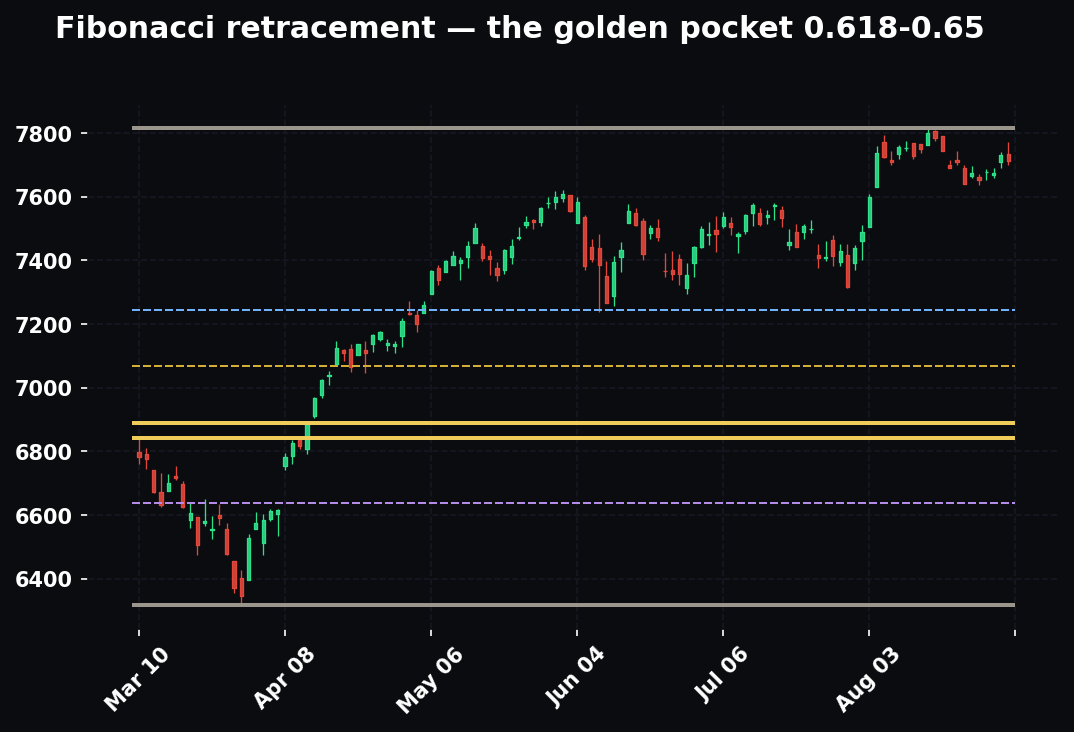
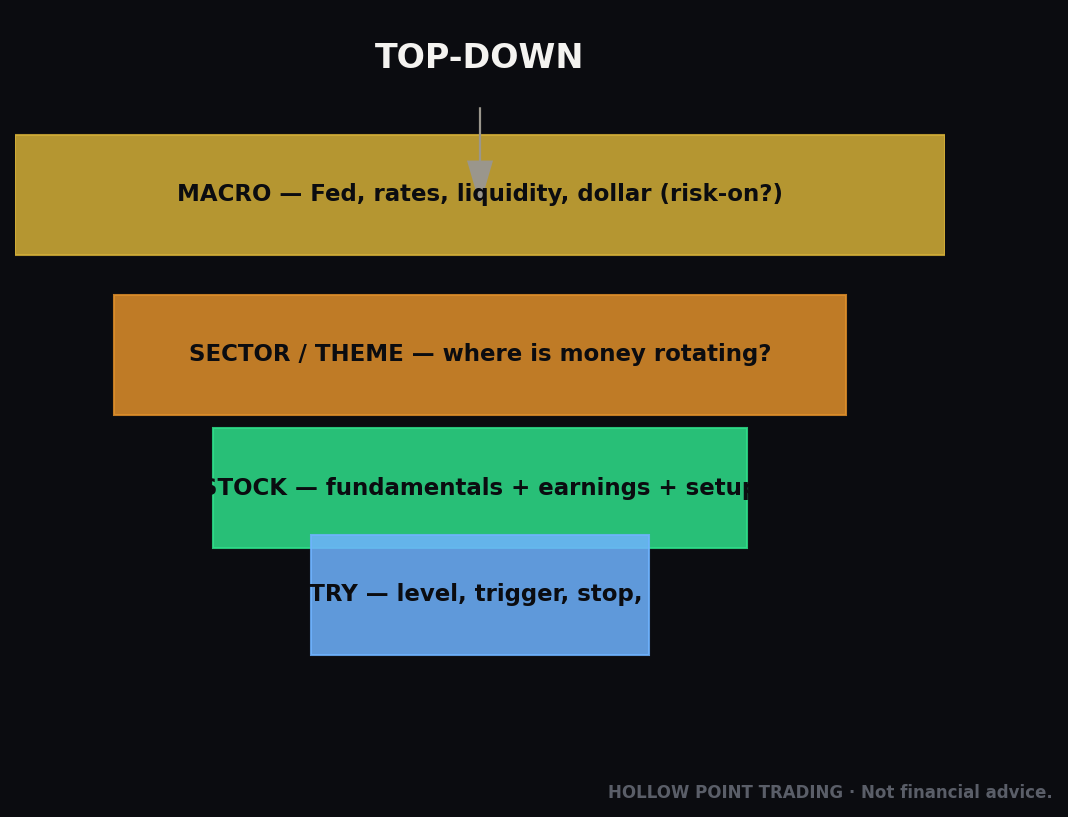
At Hollow Point Trading, the whole philosophy runs macro to sector to stock, then discipline over prediction. The Wheel fits that skeleton perfectly. You're not predicting a pop tomorrow. You're picking a strong company inside a strong sector, deciding what price is a genuinely good deal, and then getting paid to wait for that price with the discipline baked right into the mechanics. Prediction is optional. Rules do the work.
Step 1, in detail: the cash-secured put (getting paid to promise to buy)
Here's where we slow way down, because this is the step beginners fumble.
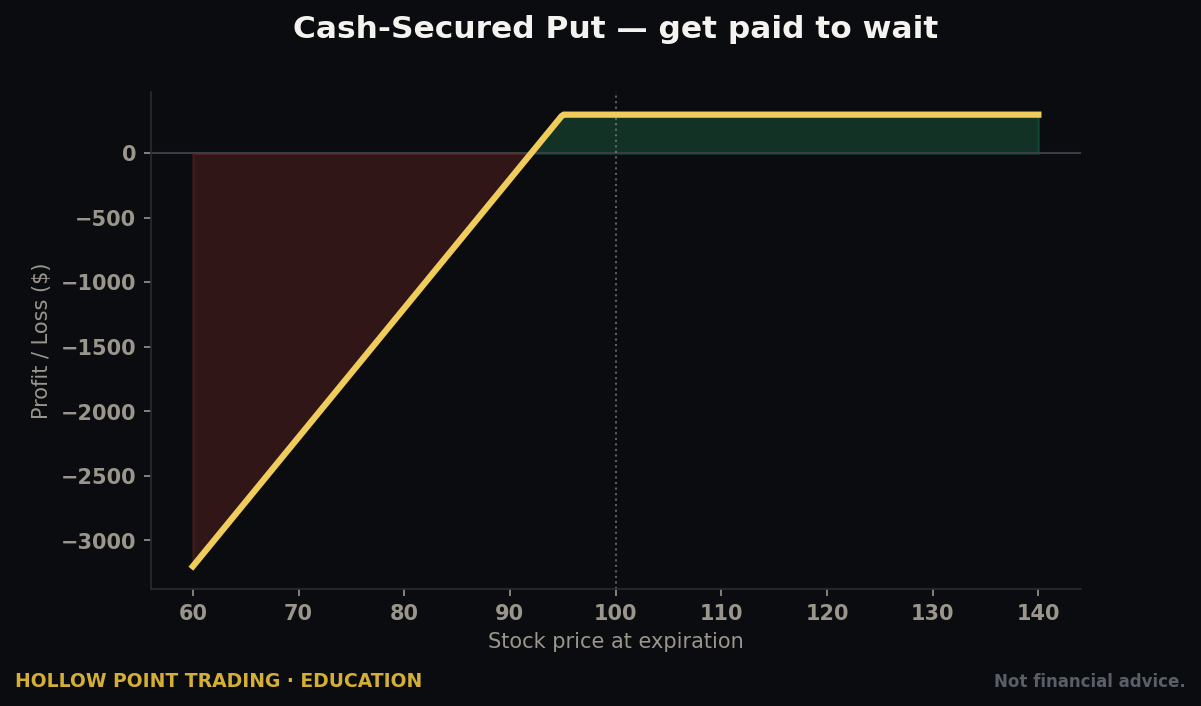
Remember, a put option is the right to sell a stock at a set strike price. When you sell a put to someone, you're taking the other side — you are promising: "If the stock falls to your strike price and you want to sell me your shares at that price, I'll buy them from you." You're volunteering to be the buyer. In exchange for making that promise, you collect premium right now, today, into your account.
The "cash-secured" part means you set aside enough cash to actually buy those 100 shares if you get called on your promise. You're not borrowing. You're not on margin. The money is parked and ready. This is what makes it a beginner-safe position: you have already decided you're okay buying, and you have the cash sitting there to do it.
Let's make it concrete.
Say there's a solid company — we'll call it Acme Corp, ticker ACME — currently trading at $52 a share. You've done your homework. You like the business. You'd genuinely be happy to own 100 shares, but not at $52; you think $50 is a fair, comfortable entry.
So you sell one cash-secured put with:
- Strike price: $50 (the price you're happy to buy at)
- Expiration: about 30 days out
- Premium collected: $1.50 per share
Because one contract is 100 shares, that $1.50 per share means you collect $150 in cash, immediately. It hits your account today and it's yours to keep no matter what happens next.
You also set aside the cash to buy 100 shares at $50 — that's $5,000 parked and secured.
Now one of two things happens over the next 30 days.
Outcome A: ACME stays above $50. The stock drifts sideways or up. At expiration it's sitting at, say, $53. Nobody is going to force you to buy shares at $50 when they could just sell them on the open market for $53 — your promise is worthless to them. The option expires worthless, your promise dissolves, and you simply keep the $150. Your $5,000 is freed back up. You made $150 for 30 days of waiting on cash you never even spent. Then you do it again next month.
Outcome B: ACME falls below $50. Say it drops to $48. Now your promise gets called on — the term is assignment, or you get "assigned." You buy 100 shares at $50, using your parked $5,000. You now own ACME.
Here's the thing beginners miss: you didn't get a bad deal. You wanted to own ACME at $50, and you got it at $50 — and you kept the $150 premium. So your real cost is effectively $50 minus the $1.50 you already collected = $48.50 per share. That's called your cost basis — the true price you paid after premium. You bought a stock you like, at a price you chose, at an effective discount. That's not a loss. That's the plan working.
Read that again, because it's the emotional core of the Wheel. There is no bad outcome here as long as you only sold the put on a stock you actually wanted at a price you actually liked. Either you get paid to wait, or you get paid to buy. That's the whole magic, and it's also the whole discipline: the strategy is only safe if that "stock you actually wanted" part is true.
Step 2, in detail: the covered call (getting paid to promise to sell)
Now let's say Outcome B happened. You own 100 shares of ACME at a $48.50 cost basis. The wheel keeps turning — now you rotate to the second position.
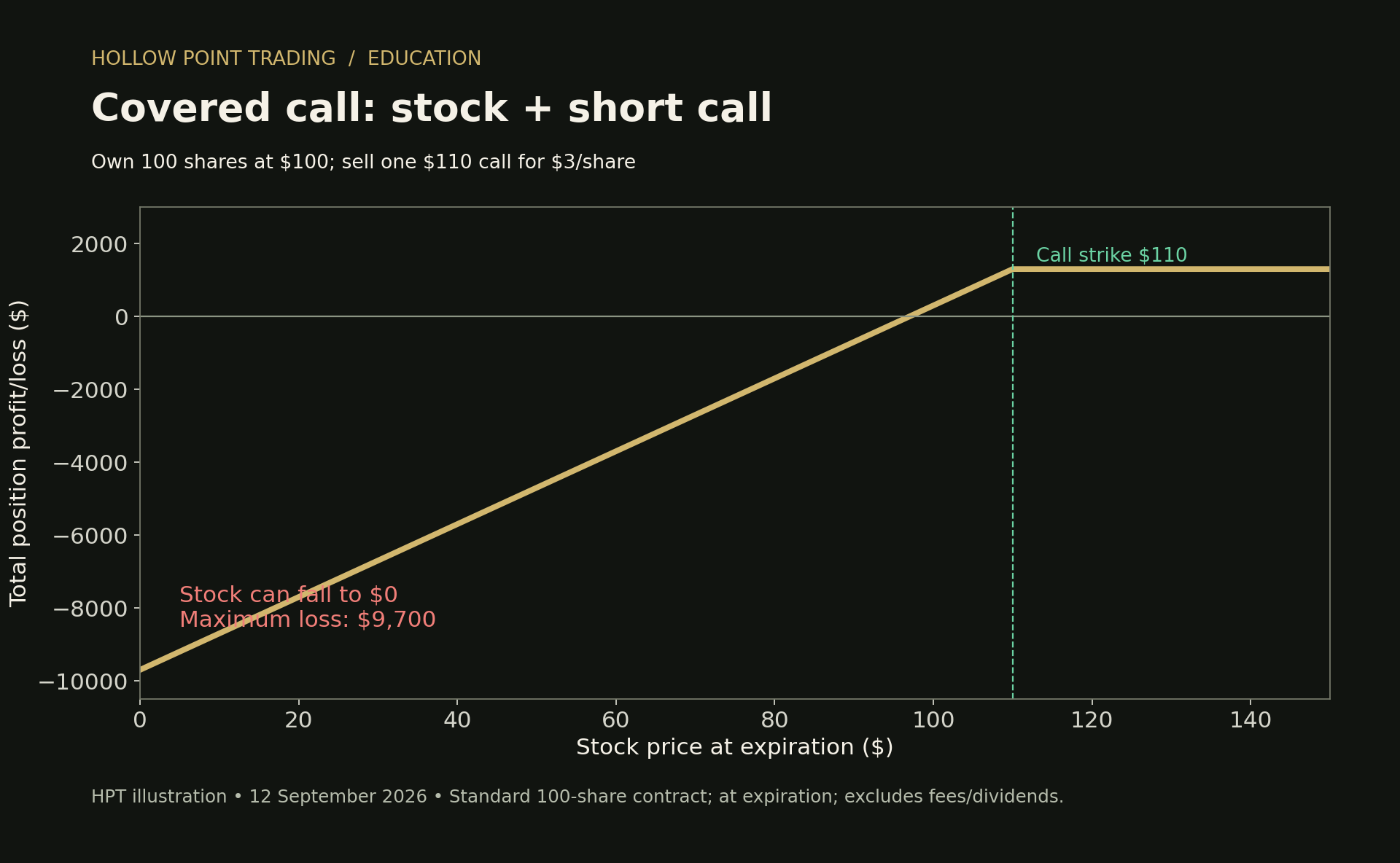
A call option is the right to buy a stock at a set strike. When you sell a call, you take the other side of that: you promise, "If the stock rises to this strike and the buyer wants to buy my 100 shares at that price, I'll sell them." Again, you collect premium right now for making the promise.
The "covered" part means you already own the 100 shares you're promising to sell. You're covered — you can deliver if called on. (Selling a call without owning the shares is called a "naked" call and it's genuinely dangerous — beginners should never touch it. The Wheel never uses it. You always own the shares first.)
Back to ACME. You own 100 shares, cost basis $48.50, and the stock has recovered to $50. You sell one covered call with:
- Strike price: $53 (a price you'd be glad to sell at for a profit)
- Expiration: about 30 days out
- Premium collected: $1.20 per share = $120 immediately
Two outcomes again.
Outcome A: ACME stays below $53. At expiration it's at $51. Nobody wants to buy your shares at $53 when the market price is $51, so the call expires worthless. You keep the $120 premium and you keep your 100 shares. You made $120 for 30 days of owning a stock you already wanted to own. Now you sell another covered call next month and collect again. This is you getting paid to hold.
Outcome B: ACME rises above $53. Say it climbs to $55. Your shares get "called away" — you're assigned, and you sell your 100 shares at $53. Let's total up that turn of the wheel:
- You bought effectively at $48.50 (cost basis)
- You sold at $53.00
- That's a $4.50-per-share gain = $450 on the shares
- Plus the $120 call premium you just collected
- Plus the original $150 put premium from step 1
You pocketed roughly $720 across the full loop, and now you're back to holding cash — right where you started, ready to sell a new cash-secured put and spin the wheel again.
Notice what happened: the stock only had to move from around $48 to $53 — a modest, unglamorous move — and you got paid three separate times along the way. No home run required. The Wheel is a singles-and-doubles game, and that's exactly why it suits a beginner temperament.
The full loop, start to finish
Let's zoom out and watch one complete rotation as a single story, so the pieces connect.
You start with cash. Say $5,000 earmarked for one Wheel position on ACME.
Turn 1 — Sell a cash-secured put. Strike $50, collect $150. You're now getting paid to wait for a good entry.
The stock dips and you're assigned. You buy 100 shares at $50. Cost basis $48.50 after premium. You now own the stock.
Turn 2 — Sell a covered call. Strike $53, collect $120. You're now getting paid to hold.
The stock rises and shares are called away. You sell at $53. You bank the share gain plus all the premium, and you're holding cash again.
Back to the top. Sell another cash-secured put. Repeat.
That's the wheel spinning through one full turn. In real life the loop isn't always this clean — sometimes you sell puts for months without ever getting assigned, just collecting premium the whole time and never buying a share. Sometimes you get assigned and then sell covered calls for months before the stock finally gets called away. The rhythm varies. But the shape never changes: paid to wait, buy, paid to hold, sell, repeat.
The engine that powers all of it is a quiet fact about options: they lose value as their expiration date approaches, all else equal. This is called time decay. When you're the one selling options and collecting premium, time decay works for you every single day. Each day that passes, the promise you sold is worth a little less to buy back — which is good, because you're on the collecting side. You are, in a real sense, selling time. And time only moves one direction.
A fully worked beginner example, from a cold start
Let's run one clean example end to end with a beginner-sized account, so you can see the actual dollars and the actual decisions.
Meet Jordan. Jordan has $3,000 to try the Wheel and has never sold an option. Jordan wants a stock priced low enough that 100 shares fit inside $3,000. After research, Jordan settles on a steady, well-known company trading at $28 a share — call it Bedrock Inc. 100 shares would cost $2,800, which fits. Good. Jordan would genuinely be happy owning Bedrock at $27.
Month 1 — the cash-secured put. Jordan sells one put, strike $27, expiring in ~30 days, and collects $0.70 per share = $70. Jordan sets aside $2,700 in cash. The $70 lands in the account today. Bedrock spends the month bouncing between $28 and $30 and closes at $29. The put expires worthless. Jordan keeps the $70 and never bought a share. That's a ~2.6% return on the parked cash in one month, and Jordan still owns zero stock.
Month 2 — sell another put. Same trade. Strike $27, collect another $65. This month Bedrock stumbles and drops to $25 by expiration. Jordan gets assigned: buys 100 shares at $27, spending the parked $2,700. Cost basis is $27 minus all collected premium. So far Jordan has collected $70 + $65 = $135, or $1.35 per share, making the effective cost basis $25.65 — actually below where the stock is now trading at $25... nearly break-even despite the stock falling. Jordan now owns 100 shares of a good company.
Months 3–4 — sell covered calls. Jordan now owns the shares and starts selling covered calls. Month 3: strike $28, collect $55. The stock stays at $26; the call expires worthless; Jordan keeps the $55 and the shares. Running premium total: $190. Month 4: sell another covered call, strike $28, collect $50. This time Bedrock rallies to $29 and the shares get called away at $28.
The tally. Jordan bought at $27, sold at $28 → $100 share gain. Plus total premium collected across four months: $70 + $65 + $55 + $50 = $240. Total profit: roughly $340 on about $2,700 of committed cash over four months. That's around 12–13% in four months, on a stock that mostly went sideways and even dipped along the way — and Jordan never took a wild risk, never bought a lottery ticket, and always either had cash secured or owned shares outright.
That's a realistic, unspectacular, good Wheel outcome. Notice it never needed a moonshot. It needed a decent company, chosen prices, and patience.
The risks — told to you straight
I would be doing you a disservice if I made this sound risk-free. It isn't. Here are the real risks, in plain language, with no sugar-coating.
Risk 1: The stock keeps falling hard after you're assigned. This is the big one. You sold a put at $27, got assigned, and now the company reports terrible news and the stock craters to $15. You own 100 shares that are deep underwater. The premium you collected softens the blow a little, but it doesn't save you. You're now sitting on a real, painful paper loss. This is exactly why the Wheel only works on companies you'd be genuinely comfortable owning through a bad stretch — because you might have to. Never run the Wheel on a stock you're not prepared to actually own and hold.
Risk 2: Your upside is capped. When you sell a covered call at $53, you've agreed to sell at $53 — period. If the stock rockets to $70 on great news, you still only get $53. You had to hand over the shares and you missed the huge move. You keep your premium and your modest gain, but you watched the home run sail over your head from the dugout. The Wheel trades away explosive upside in exchange for steady, reliable income. For a disciplined beginner that's usually a good trade — but you have to make peace with it.
Risk 3: Your cash is tied up. While a cash-secured put is open, that $2,700 is locked and can't do anything else. If a better opportunity shows up, you can't reach that money without closing the position. The Wheel is a commitment, not a quick flip.
Risk 4: Boredom and its evil twin, over-trading. The Wheel is slow. It's supposed to be. The danger is that a bored beginner starts reaching for higher premiums by selling puts on shakier companies or at reckless strikes — chasing yield right off a cliff. The premium is bigger on garbage stocks because they're more likely to blow up. That bigger number is the market pricing in bigger danger, not handing you free money.
Risk 5: You can still lose more than the premium. New traders sometimes think "I collected premium, so I can't really lose." Wrong. Your loss on an assigned stock that keeps dropping can dwarf the premium you collected many times over. Premium is a cushion, not a shield.
None of these are hidden landmines — they're all visible from the start and manageable with rules. But they're real, and pretending otherwise is how beginners get hurt.
The beginner mistakes to avoid
Here are the specific, common ways new Wheel traders shoot themselves in the foot.
Selling puts on stocks you don't actually want to own. The single most common mistake, and the most dangerous. If you're only in it for the premium and you'd never willingly hold the shares, you're not running the Wheel — you're gambling with an obligation attached.
Chasing fat premiums on junk. A put paying 8% for one month looks amazing until the stock drops 40%. Rich premium is a warning label, not a gift.
Picking strikes at prices you don't believe in. If you don't genuinely think $50 is a fair price for ACME, don't sell the $50 put. The strike is your buy order. Treat it like one.
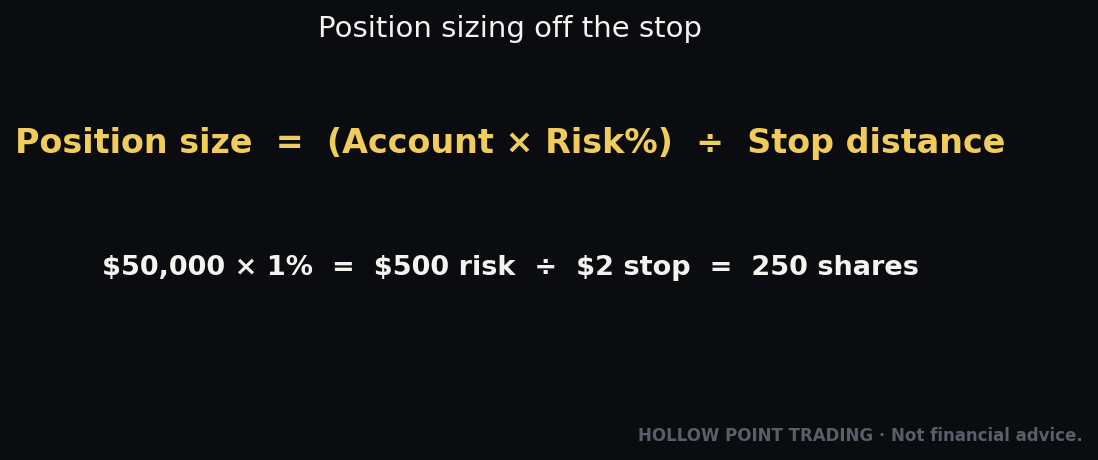
Committing too much of your account to one name. A beginner with $5,000 should not put all $5,000 into one Wheel on one stock. If that company gaps down, your whole account takes the hit. Spread across names, sectors, and time.
Forgetting the loop can strand you. If you sell a covered call at $53 and the stock jumps to $60, your shares get called away at $53 and you miss the run. Fine — but if you'd sold the call too cheaply, in a hurry, you'll kick yourself. Don't rush the strikes.
Panic-buying-back positions at a loss. When a stock dips and your put goes against you temporarily, beginners panic and "close" the position at a loss out of fear — often right before the stock recovers. If you picked a stock you're happy to own, assignment is fine. Let the plan work.
Ignoring earnings and events. A company's earnings report can move the stock 20% overnight. Selling a put right before earnings on a stock you're lukewarm about is asking for a bad assignment. Know what's on the calendar.
Your simple Wheel cheat-sheet
Tape this next to your screen. If you can't check every box, don't place the trade.
Before selling a cash-secured put:
- [ ] Would I be genuinely happy to own 100 shares of this company for months?
- [ ] Is this a stock in a sector I actually believe in? (macro → sector → stock)
- [ ] Is the strike a price I truly consider a good entry?
- [ ] Do I have the full cash to buy 100 shares, set aside, no margin?
- [ ] Is this position a small enough slice of my account that a big drop won't wreck me?
- [ ] Have I checked for earnings or big events before expiration?
After you're assigned (you now own shares):
- [ ] Sell a covered call at a strike I'd be glad to sell at for a profit.
- [ ] Is that strike above my cost basis, so I lock in a gain if called away?
- [ ] Am I okay keeping the shares if the call expires worthless?
Always:
- [ ] Am I collecting premium, never paying it, as the seller?
- [ ] Am I letting time decay work for me?
- [ ] Am I sticking to my strikes instead of chasing bigger, riskier premium?
- [ ] Is every position sized so no single stock can seriously hurt me?
The one-sentence version: Get paid to promise to buy a great stock at a great price; if you buy it, get paid to promise to sell it higher; repeat, and never break the "stock I'd love to own" rule.
How the Wheel fits the bigger Hollow Point picture
The Wheel isn't a magic money machine, and anyone selling it that way is selling you something. What it is is a beautifully disciplined framework — and discipline is the whole game at Hollow Point Trading.
Look at how naturally it maps onto the HPT way of thinking. We work macro to sector to stock: read the broad market, find the strong sectors, then pick the strong names inside them. The Wheel demands exactly that top-down homework, because you can only sell puts on companies you'd want to own — which forces you to actually understand what you're trading instead of chasing tickers.
We prize discipline over prediction. The Wheel doesn't ask you to guess where a stock goes tomorrow. It asks you to decide what price is fair and let the mechanics — assignment, time decay, premium — do the work. The rules carry the load, not your crystal ball.
We insist on protecting capital first. The cash-secured put's whole design is capital protection: cash set aside, no borrowing, no naked risk, and a strategy that only touches companies you'd hold through a storm. The covered call is the safest way to hold a stock while getting paid. These are the two most conservative option positions that exist, and that's not an accident — it's why they're the beginner's on-ramp.
And we live by reward-to-risk discipline — the 1:3 mindset, where you protect the downside first and let the math tilt in your favor over many repetitions. The Wheel is a repetition game. No single turn makes you rich. But a disciplined trader, spinning a good wheel on good companies, collecting premium turn after turn, sizing every position so no one stock can hurt them — that's the kind of slow, boring, rules-first edge that actually survives.
Start tiny. One stock. One contract. Cash fully secured. Watch a full loop play out with real money you can afford to commit, and let the mechanics teach you what no article can. The Wheel rewards the patient and punishes the greedy — which, if you've read this far, tells you exactly which kind of trader to become.
Get the boring parts right, and the boring parts pay you.
Bound by rules, feared by trade.