
Imagine two people show up to trade on the same Monday morning. They have the same starting money. They take the same trades all year. They get the exact same calls right and the exact same calls wrong. One of them ends December richer. The other blows up in March and never trades again.
The difference isn't skill. It isn't a secret indicator. It isn't luck. It's risk management — the boring, unglamorous, life-saving discipline of controlling how much you can lose before you ever think about how much you can win.
This is the single most important thing a new trader can learn. Not chart patterns. Not moving averages. Not some magic setup. Those things help you win. Risk management is what keeps you in the game long enough for winning to matter. And here's the hard truth most beginners learn the expensive way: you can be right most of the time and still go broke, or wrong most of the time and still grow your account — depending entirely on how you manage risk.
Let's build this from zero. By the end, you'll have rules you can actually use Monday.
What Risk Management Actually Is (In Plain English)
Let's define the term, because we'll use it constantly.
Capital is simply the money in your trading account — the money you're using to trade. If you funded your account with $2,000, that $2,000 is your capital.
Risk is the amount of that capital you could lose on a trade if the trade goes against you. Not the amount you put into the trade — the amount you could actually lose.
Risk management is the set of rules you use to decide, before you click buy, exactly how much you're willing to lose — and to make sure no single trade, or bad day, or bad week, can take you out of the game.
Here's an analogy. Picture a poker player who sits down at a table with $1,000. A disciplined player decides ahead of time: "I will risk at most $20 on any single hand." A reckless player shoves all $1,000 in on the first exciting hand. The disciplined player can lose 20 hands in a row and still be sitting there, still playing, still able to win it back. The reckless player is one bad hand from walking out with empty pockets.
Trading is the same. Risk management is deciding your "at most $20 per hand" — and then honoring it no matter how good a trade looks.
There's a phrase you'll hear serious traders repeat like a prayer: protect capital first. It means your number one job — ahead of making money, ahead of being right, ahead of everything — is to not lose your money. Because if you keep your capital, you get to keep trading. And if you keep trading with good rules, the profits come. But if you lose your capital, the game is over. There are no more trades. You can't catch the perfect setup next Tuesday if you have no money to trade it with.
Making money is the goal. Protecting capital is the job. The goal follows from doing the job well.
Why a Complete Beginner Should Care More Than Anyone
You might be thinking: "I'll get good at reading charts, and then I won't lose much anyway." Here's why that thinking is dangerous.
Every trader — the best in the world included — is wrong a lot. Losing trades aren't a sign you're bad at this. They are a normal, permanent, unavoidable part of trading. Nobody wins every time. The professionals aren't professionals because they stopped losing. They're professionals because they made sure their losses stay small and survivable.
As a beginner, you will lose more often than you'd like while you're learning. That's not a warning to scare you off — it's the reality of the learning curve. And that's exactly why risk management matters more to you than to anyone. A skilled trader with sloppy risk management is a slow-motion disaster. A beginner with sloppy risk management is a fast one.
The good news is genuinely encouraging: risk management is the one part of trading you can master immediately. Reading charts takes months of screen time. But sizing your risk correctly? You can learn that today and do it perfectly on your very first trade. It's math and discipline, not talent and experience. It's the fastest, highest-value skill available to you — and almost no beginner focuses on it, which is exactly why so many beginners don't last.
The Math That Should Scare You: How Drawdowns Really Work
Now we get to the piece that changes how you think forever. It's a bit of arithmetic, and it's the most important arithmetic in all of trading.
A drawdown is a drop in your account from a high point. If your account grows to $1,000 and then falls to $800, you've had a $200 drawdown, which is 20% of your account. Simple enough.
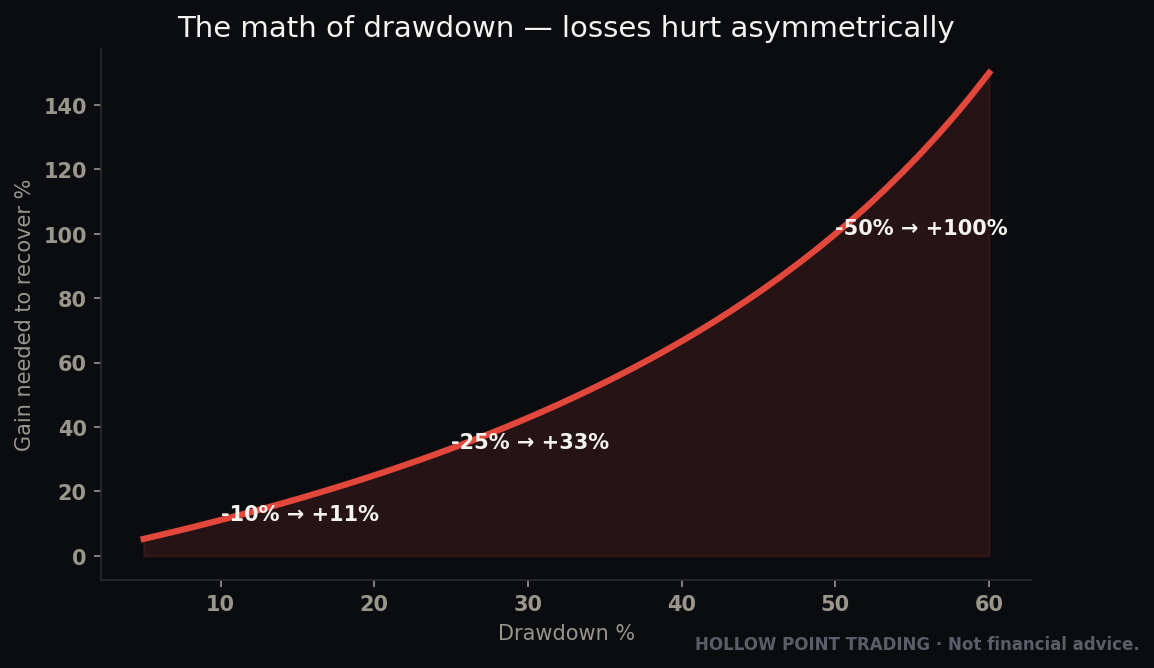
Here's the part that catches everyone off guard: losses and the gains needed to recover them are not equal. They are not symmetrical. A loss of a certain percentage requires a bigger percentage gain to get back to even. And the deeper the hole, the more brutally lopsided it gets.
Let's watch it happen with real numbers. Say you start with $1,000.
You lose 10%. You're down to $900. To get back to $1,000, how much do you need to gain? You might guess 10%. But 10% of $900 is only $90, which brings you to $990 — still short. To get from $900 back to $1,000, you actually need to gain about 11.1%. A little worse than the loss, but not terrible.
Now watch it get ugly as the hole gets deeper.
- Lose 10% → you need +11% to recover
- Lose 20% → you need +25% to recover
- Lose 25% → you need +33% to recover
- Lose 33% → you need +50% to recover
- Lose 50% → you need +100% to recover (you have to double your money just to get back to even)
- Lose 75% → you need +300% to recover
- Lose 90% → you need +900% to recover
Read that 50% line again, because it's the one that ends careers. If you lose half your account, making it back isn't a 50% gain. It's a 100% gain. You have to double what's left. If your $1,000 becomes $500, you don't need to make $500 the "easy" way — you need to turn $500 into $1,000, which is a doubling, and doubling your money is hard. It can take a very long time, if it happens at all.
And the 90% line is where you see why big losses are basically fatal. Lose 90%, and you need to make nine times your remaining money — a 900% return — just to get back to where you started. Almost nobody does that. That account is, for all practical purposes, dead.
Here's the plain-English lesson underneath the math: small losses are recoverable, big losses are not. The whole art of risk management is keeping every loss in that top, gentle, recoverable zone — the 5%, 10% region where a normal winning stretch pulls you right back out — and never, ever letting a single trade or a single bad decision drag you into the 50%-and-deeper zone where the math turns against you and the mountain becomes unclimbable.
You don't manage risk because losses feel bad. You manage risk because deep losses are mathematically almost impossible to come back from. The numbers, not your emotions, are why the rules exist.
Why One Big Loss Undoes Ten Wins
Let's make that math personal with a story you'll recognize before your first month is over.
Meet a beginner we'll call Sam. Sam starts with $1,000 and is doing everything right — being patient, taking small wins. Over two weeks, Sam wins ten trades in a row, each one adding $30. Ten wins, $30 each, is $300 in profit. Sam's account is now $1,300. Sam feels great. Sam feels smart.
Then a trade looks like a sure thing. Sam gets excited, forgets the rules, and puts way more on the line than usual. The trade goes wrong. And because Sam didn't limit the loss, it keeps going wrong, and Sam holds on hoping it turns around. By the time Sam gives up, that one trade lost $400.
Ten wins built $300. One loss took $400. Sam is now at $900 — below where they started, after being up $300. Ten good decisions, erased and then some, by one bad one.
This is the thing beginners cannot feel until they've lived it: your worst loss matters more than your best win. Wins add up slowly, one careful step at a time. But one oversized, unmanaged loss doesn't just cancel a win — it can wipe out weeks of them in a single afternoon. Progress is built brick by brick and demolished by wrecking ball.
The lesson isn't "never lose." Losing is unavoidable. The lesson is: make sure every loss is small enough that ten wins can absorb it, not the other way around. If your typical win and your typical loss are about the same size, ten wins and one loss leaves you far ahead. It's only when you let a loss run huge — many times the size of a normal win — that one trade can undo everything.
Sam's real mistake wasn't the losing trade. Losing trades happen. Sam's mistake was letting that one trade be big. Risk management is the wall that stops any single loss from ever getting big enough to matter that much.
How Risk Management Works, Step by Step
Enough theory. Here is the actual, do-it-Monday process. This is the core mechanic every disciplined trader uses, and you can start using it on your first trade.
Step 1: Decide your risk-per-trade percentage
Before anything, decide the most you'll risk on a single trade, as a percentage of your whole account. For beginners, the widely-taught rule is 1% to 2% per trade. Meaning: on any single trade, you allow yourself to lose no more than 1–2% of your total capital.
Why so small? Go back to the drawdown math. If you risk 1% per trade, you could lose ten trades in a row and only be down about 10% — squarely in the easily-recoverable zone. Small risk-per-trade is what makes a losing streak survivable instead of fatal. We'll use 1% for our examples.
Step 2: Know your entry and your stop-loss
Your entry is the price you buy at. Your stop-loss (or just "stop") is a price you decide in advance at which you'll admit the trade is wrong and get out — automatically, no arguing with yourself. The stop-loss is the single most important tool in risk management, because it's the thing that guarantees a loss stays small.
A stop-loss order is an instruction you place with your broker: "If the price falls to this level, sell me out automatically." You set it, and it protects you even if you're not watching, even if you're panicking, even if you've talked yourself into "just giving it a little more room." The stop doesn't have feelings. That's the point.
The distance between your entry and your stop is your risk per share — how much you lose, per share, if the stop is hit. If you buy at $50 and put your stop at $48, your risk per share is $2.
Step 3: Calculate your position size
This is the step almost every beginner skips, and it's the one that ties everything together. Position size is how many shares you buy. Beginners usually pick this number at random ("I'll buy 100 shares") or by how much they can afford ("I'll put in $500"). Both are wrong. The correct way is to let your risk decide your size.
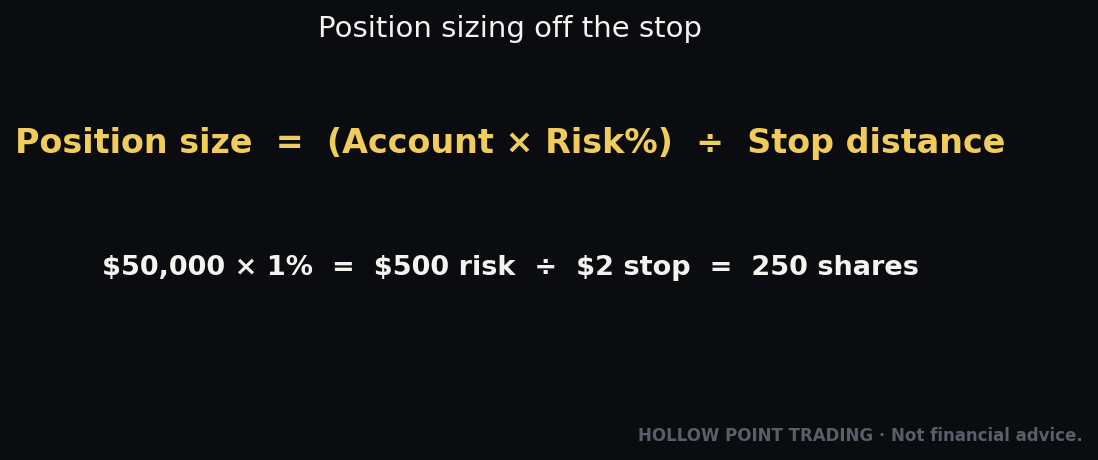
The formula is simple:
Position size = (Account × Risk %) ÷ Risk per share
Let it choose the number of shares for you. Whatever amount keeps your total loss at exactly your 1% limit — that's how many shares you buy. Not more, no matter how good the trade looks.
Step 4: Set a reward target worth the risk
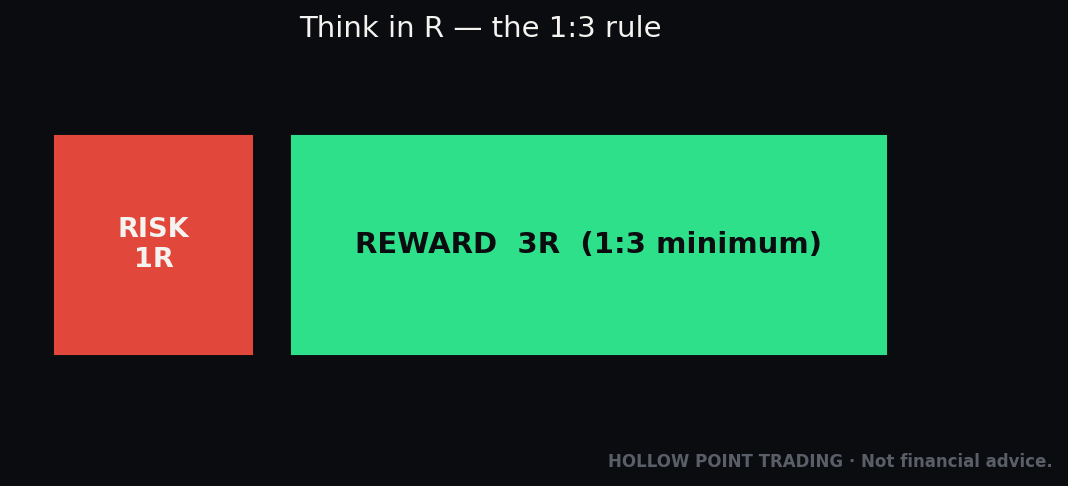
Now that you know what you're risking, ask: what's the reward if you're right? HPT's core rule here is 1:3 reward-to-risk — for every $1 you're willing to lose, you're aiming to make at least $3. If your stop is $2 below your entry, your target should be at least $6 above it. We'll see exactly why this rule is so powerful in a moment.
Step 5: Only take the trade if the math works
If the reward isn't at least three times the risk, you don't take the trade. You wait for one where it is. This is the discipline that separates traders who last from traders who don't — being willing to say "no, not this one" over and over until the numbers are on your side.
A Fully Worked Beginner Example
Let's run a real trade from start to finish with actual numbers, so you see every step click together.
Your account: $2,000. Your risk-per-trade rule: 1%. So the most you'll lose on this trade is 1% of $2,000 = $20. That $20 is your line in the sand. It cannot be crossed.
The trade: You've found a stock trading at $50 that you think is going up. Your entry is $50.
Your stop-loss: You look at the chart and decide that if the price falls to $48, your idea was wrong and you're out. So your stop is $48. Your risk per share is $50 − $48 = $2 per share.
Position size: Now let the math choose how many shares. You can risk $20 total, and each share risks $2 if the stop hits. So:
$20 ÷ $2 = 10 shares.
You buy 10 shares at $50. That's $500 of stock. Notice something important: you're buying $500 worth, but you're only risking $20 — because your stop caps the loss. Beginners constantly confuse "money invested" with "money at risk." They are not the same thing. Your stop is what makes them different.
Now let's play out both endings.
The trade goes wrong. The price drops to $48. Your stop triggers, you're sold out automatically. You lose 10 shares × $2 = $20. Exactly your limit. Your account is now $1,980 — down just 1%. It stings a little, but you're completely fine. You could do this nine more times in a row and still have most of your account intact. This is what a survivable loss looks like.
The trade goes right. Remember the 1:3 rule — your target was three times your $2 risk, so $6 above entry, at $56. The price climbs to $56, you sell. You make 10 shares × $6 = $60. Your account is now $2,060 — up 3%.
Look at those two numbers side by side: risk $20 to make $60. That's the 1:3 ratio in action, and here's why it's so powerful for a beginner. With a 1:3 reward-to-risk ratio, you can be wrong most of the time and still make money.
Watch. Suppose you take four of these trades and you're right only once. Three losses of $20 each = −$60. One win of $60 = +$60. You net exactly zero — you broke even, while being wrong 75% of the time. Now win two out of four: two losses (−$40) and two wins (+$120) = +$80 profit, being wrong half the time. You didn't need to be a genius. You didn't need to predict the market. You needed your wins to be bigger than your losses, and the ratio did the heavy lifting.
That is the magic no beginner believes until they see it: with good risk-to-reward, you don't have to be right often. You just have to keep your losses small and let your wins be worth more than your losses. Risk management isn't the boring part of trading you tolerate so you can get to the fun part. It is the part that makes money.
The Beginner Mistakes That Blow Up Accounts
Almost every account-ending disaster comes from the same short list of mistakes. Learn them now so you recognize them when the temptation hits — because it will.
Mistake 1: Trading with no stop-loss. "I'll just watch it and sell if it drops." No, you won't. When the price is falling and you're losing money, your brain will invent a hundred reasons to hold on and hope. Hope is not a plan. The stop-loss removes the decision from your emotional, panicking, in-the-moment self and hands it to your calm, rules-following self who set it in advance. Always set the stop before you enter, never after.
Mistake 2: Position sizes that are way too big. The beginner sees a "sure thing" and puts half the account into one trade. Now a normal, ordinary price wiggle can do catastrophic damage. There are no sure things. Ever. The size of your position should be decided by your stop and your 1% rule — by math — not by how confident or excited you feel. Excitement is not information.
Mistake 3: Moving your stop to avoid the loss. The price approaches your stop, and instead of accepting the small loss, you slide the stop lower to "give it room." You've just turned your small, planned, survivable loss into a potentially large, unplanned, unsurvivable one. This one habit has destroyed more beginner accounts than any other. Your stop is a promise. Keep it. The one direction you may move a stop is in your favor — up, to lock in profit on a winner — never wider to postpone a loss.
Mistake 4: Revenge trading. You take a loss, it makes you angry, and you immediately jump into another trade — bigger this time — to "win it back fast." This is how one $20 loss becomes a $200 loss becomes a blown account, all in an afternoon of raging emotion. When you feel the urge to get even with the market, that is the exact moment to walk away from the screen. The market doesn't know you're angry and doesn't care.
Mistake 5: Risking money you can't afford to lose. Never trade with rent money, grocery money, or borrowed money. Beyond the obvious danger, money you can't afford to lose makes you trade terribly — you hold losers too long because you can't accept the loss, and you panic-sell winners too early. Trade only with money that, if it vanished entirely, would not change your life. Fear is a bad co-pilot.
Mistake 6: No maximum daily loss. Some days nothing works. Without a stopping rule, a bad day becomes a bloodbath as you keep trying to force it. Set a daily loss limit — for example, "if I'm down 3% on the day, I stop trading and close the platform." Live to fight tomorrow. The market opens again in the morning; make sure your account is still there to trade it.
Your Risk Management Cheat-Sheet
Print this. Tape it next to your screen. Read it before every single trade until it's carved into your bones.
Before every trade:
- [ ] Am I risking 1–2% or less of my account on this trade?
- [ ] Have I set my stop-loss before entering?
- [ ] Did I calculate position size with the formula, not by feel? (Account × Risk %) ÷ Risk per share
- [ ] Is my reward at least 3× my risk (1:3)? If not, I skip it.
- [ ] Is this money I can genuinely afford to lose?
Iron rules that never bend:
- [ ] I never move my stop wider to avoid a loss.
- [ ] I never add to a losing trade to "average down."
- [ ] I stop for the day when I hit my daily loss limit (e.g. −3%).
- [ ] I never revenge trade. Angry = away from the screen.
- [ ] I protect capital first. Surviving beats being right.
The math to never forget:
- [ ] A 50% loss needs a 100% gain to recover. Keep losses small.
- [ ] One big loss can erase ten good wins. Never let a loss get big.
- [ ] With 1:3, I can be wrong most of the time and still profit.
How This Fits the Bigger Hollow Point Picture
At Hollow Point Trading, everything is built on a single foundation: protect capital first, everything else second. Risk management isn't one lesson in the curriculum — it's the ground the whole curriculum stands on. Every chart pattern, every indicator, every setup you'll ever learn is only useful if you're still in the game to use it. Risk management is what keeps you in the game.
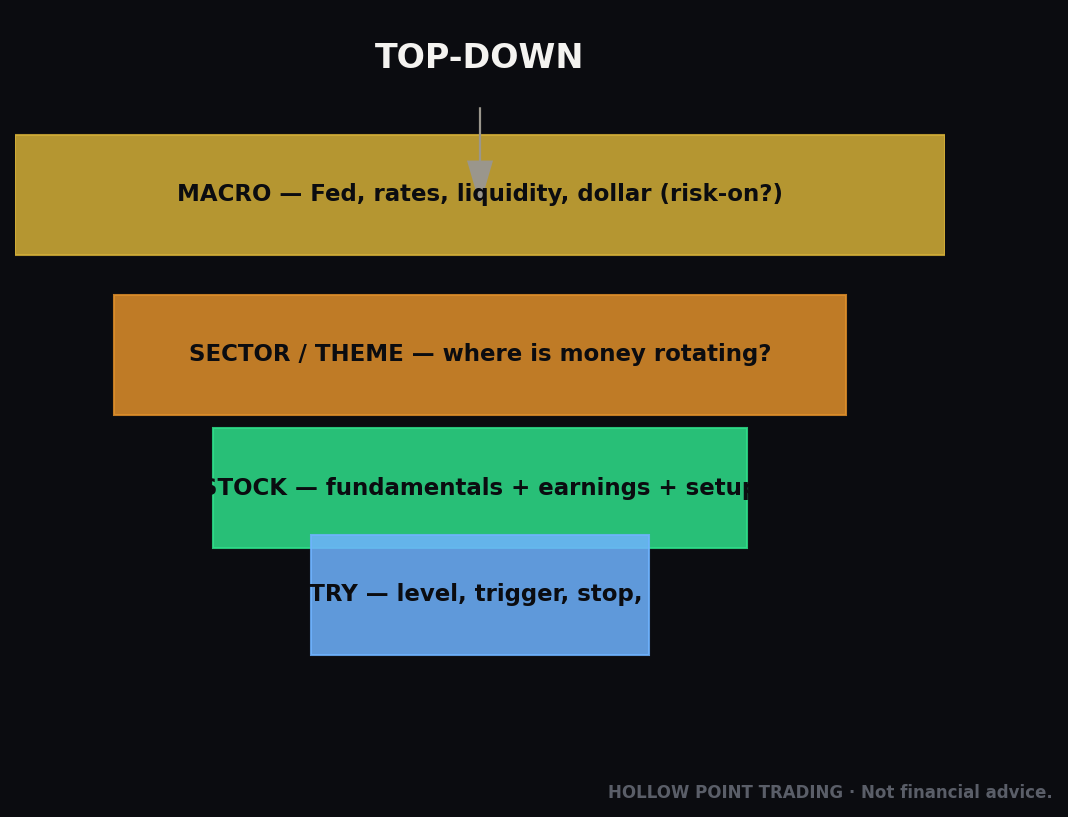
Here's how the pieces connect. HPT teaches a top-down way of finding trades: macro → sector → stock. That means you start big-picture — the overall market and economy (macro), then narrow to which sector (group of similar companies, like technology or energy) is strong, then finally to the individual stock. That process finds you good trades. But even the best trade, found through the most careful macro-to-stock work, can still go wrong — the market humbles everyone. So on top of the good trade, you layer risk management: the stop, the 1% sizing, the 1:3 target. The analysis finds the opportunity; the risk rules make sure being wrong about it can never hurt you badly.
This is also why HPT preaches discipline over prediction. Beginners think trading is about predicting the future — being the person who knew the stock would go up. But nobody can reliably predict the market, and chasing that fantasy is what makes people over-bet on "sure things." The professional doesn't predict; the professional manages. They accept they'll be wrong plenty, they keep every loss small, they let the 1:3 math work over many trades, and they stay disciplined when their emotions scream to do otherwise. You don't need a crystal ball. You need rules, and the spine to follow them.
And that's the whole HPT ethos in one line: you can't control whether any single trade wins. You can control how much you lose when it doesn't. Control what you can control. Protect your capital, honor your stops, size with math, demand your 1:3, and survive — because the trader who survives long enough to keep learning is the trader who eventually wins.
Master this one skill and you're already ahead of most people who've been trading for years. Everything else we teach builds on top of it.
Bound by rules, feared by trade.