
Imagine you're learning to drive. Before the instructor lets you press the gas pedal, they make you do one thing: put on your seatbelt. Not because they expect you to crash — but because if you do crash, the seatbelt is the difference between a bad day and a life-changing one. You put it on when everything is calm, when you're not scared, when your hands aren't shaking. You never think, "I'll grab the seatbelt in the half-second before impact." That's insane. The whole point is that it's already on.
A stop loss is the seatbelt of trading. And just like the seatbelt, the entire secret is that you buckle it before anything goes wrong — before the emotion, before the fear, before your account is on fire. This guide is going to teach you exactly what a stop loss is, where to put it (hint: not a random number you made up), the two kinds you'll hear about, and why — if you're a beginner — one of those two kinds could quietly destroy your account while the other one saves it.
Let's slow all the way down and build this from zero.
What a Stop Loss Actually Is (In Plain English)
Let's define our terms carefully, because this whole guide depends on them.
When you buy a stock (or any tradable thing — a stock, a futures contract, a currency, whatever), you are hoping the price goes up so you can sell it later for more than you paid. That's the dream. But sometimes the price goes down instead. When it goes down, you're losing money on paper. Every dollar it drops is a dollar of your money evaporating.
A stop loss — often just called a "stop" — is an instruction you give ahead of time that says: "If the price falls to this exact level, get me out. Sell it. I'm done. I don't want to lose any more than this."
That's it. That's the whole idea. It's a pre-decided exit for when you're wrong.
Here's a simple example with round numbers. Say you buy a stock at $100 per share. You decide, before you do anything else, that you are not willing to lose more than a few dollars per share if you're wrong. So you set a stop loss at $97. Now one of two things happens:
- The price goes up to $110. Great. Your stop just sits there, unused, doing nothing. It's a fire extinguisher on the wall during a day with no fire.
- The price drops to $97. Your stop triggers — it automatically sells your shares — and you're out of the trade with a small, known loss of $3 per share. The stock might keep falling to $80, $70, $50. You don't care anymore. You're already out. You escaped the burning building at the first alarm.
The key word in that whole description is pre-decided. A stop loss is a decision you make when you are calm — before you're in the trade, before you have money on the line, before your emotions have hijacked your brain. You're writing a rule for your future, panicked self to follow, because you know your future self won't be thinking clearly.
That last sentence is the entire philosophy of this piece. Underline it.
Why a Beginner Should Care More Than Anyone
You might be thinking, "Okay, but I'll just watch the trade and sell if it goes bad. I don't need some automatic thing." Let me tell you exactly why that thought is the most expensive mistake in all of beginner trading.
Reason one: your brain betrays you when money is on the line. There's a well-documented quirk of human psychology — losing $100 hurts roughly twice as much as gaining $100 feels good. (Psychologists call this "loss aversion"; you don't need the term, just the truth of it.) Because losses hurt so much, your brain will do anything to avoid admitting one. When your trade is down and you're staring at red numbers, your brain whispers, "Just wait. It'll come back. Don't sell now, that would make the loss real." So you wait. And it drops more. And now the loss is bigger, so it's even harder to admit, so you wait more. This is a doom loop, and it has vaporized more beginner accounts than any bad stock pick ever has.
A stop loss is the cure. It makes the decision for you, at a moment when you were thinking clearly.
Reason two: protecting your capital is the whole game. Here's a piece of math that terrifies every beginner the first time they see it, so let's get it out of the way now.
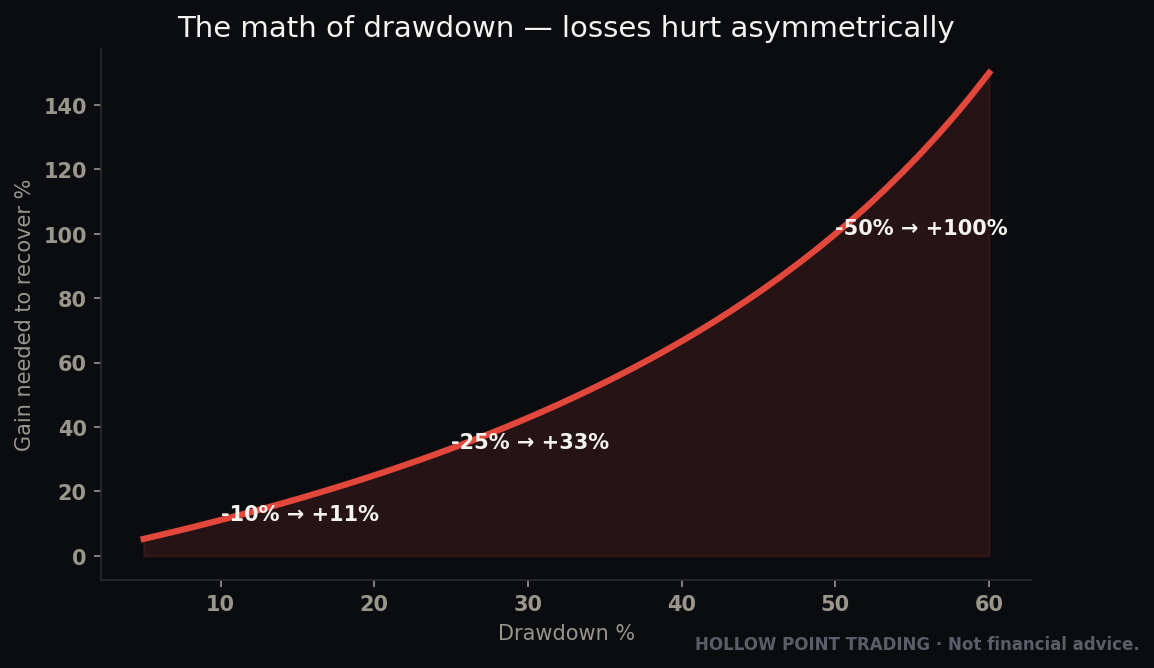
If you lose 50% of your money, how much do you have to make to get back to even? Most people say 50%. Wrong. You have to make 100% — you have to double your remaining money — just to get back to where you started.
Watch: you have $10,000. You lose 50%, so you're down to $5,000. To get back to $10,000, you need to grow that $5,000 by... $5,000. And $5,000 is 100% of $5,000. So a 50% loss requires a 100% gain to undo. The deeper the hole, the more impossibly steep the climb out.
| If you lose... | You must gain this much just to break even |
|---|---|
| 10% | 11% |
| 25% | 33% |
| 50% | 100% |
| 75% | 300% |
| 90% | 900% |
Look at that table. Small losses are easy to recover from. Big losses are nearly impossible. This is the single most important reason stop losses exist: they keep your losses small, so you never fall into a hole you can't climb out of. A trader who survives is a trader who can keep playing. Protecting your capital isn't the boring part of trading — it is trading. Everything else is secondary.
At Hollow Point Trading we put it plainly: protect capital first. You cannot win the game if you get knocked out of it. A beginner's job in the first year is not to get rich — it's to not go broke while you learn. The stop loss is the tool that keeps you in the game long enough to actually get good.
Where a Stop Goes: Structure, Not a Random Number
Now we arrive at the part almost every beginner gets wrong, and the part that separates people who understand trading from people who are just gambling.
Here's the wrong way, the way a beginner's gut tells them to do it: "I'll set my stop $2 below where I bought, because... $2 feels like a reasonable amount to risk."
That number came from nowhere. It's based on your feelings about your wallet, not on anything the actual market is doing. The market has never heard of your $2. It doesn't know or care where you bought or how much you're comfortable losing. And here's the cruel part: a random stop like that will get you knocked out of good trades constantly, because you placed your exit in a spot that means nothing.
The right way is to place your stop based on structure. Let's define that.
Structure means the meaningful levels on a price chart — the places where the price has historically reacted, paused, bounced, or reversed. These aren't random. They're spots where lots of buyers and sellers have made decisions before, so they tend to matter again. The two most important structural ideas for a beginner are support and resistance.
Support is a price level where, in the past, the price stopped falling and bounced back up — like a floor. Buyers showed up there before, and they may show up again. Think of it as a shelf the price keeps landing on.
Resistance is the opposite: a level where the price stopped rising and turned back down — like a ceiling. Sellers showed up there before.
Here's the core principle, and it's beautifully simple:
A stop loss goes just beyond the level that, if the price reaches it, proves your reason for the trade was wrong.
Let's unpack that with the floor idea. Suppose a stock has bounced up off the $50 level three separate times over the past few weeks. That $50 shelf is clearly support — a floor buyers keep defending. You decide to buy at $52 because you believe that floor will hold again and the price will bounce up.
So where's your stop? Ask the magic question: "What price would prove I was wrong?" You were betting the $50 floor holds. So if the price breaks through $50 and keeps going — say it hits $49 — your entire reason for being in the trade is gone. The floor cracked. You were wrong. Time to leave.
So you place your stop just below the floor, at around $49.50 or $49. Not at $50 exactly (we'll see why in a moment), but just beyond it — beyond the level that defines whether you're right or wrong.
Notice what just happened. Your stop isn't based on your feelings or a random dollar amount. It's based on a real, observable level on the chart that means something. If price is above $50, your idea is alive. If price is below $50, your idea is dead. The stop is placed at the exact spot where "alive" becomes "dead."
This is the whole art. The chart tells you where the stop goes. You don't invent it. A structural stop asks a real question — "is my reason still valid?" — and a random-number stop asks a meaningless one — "have I lost my arbitrary comfort amount yet?"
Why "just beyond" and not "right at" the level
Real markets are messy. Price doesn't stop on a perfectly clean number. It'll often poke slightly past a level — dipping to $49.90 for a moment before snapping back up to $53. This quick poke-and-reverse is so common it has a name among traders: a stop hunt or a wick — a brief spike that grabs the stops of people who placed them too tightly, then reverses.
If you'd put your stop exactly at $50.00, that little poke to $49.90 would've kicked you out right before the trade worked. Gut-wrenching. So you give the level a small cushion — you put your stop a little beyond the noise, at $49 or $49.50, so a meaningless wiggle doesn't eject you from a good trade, but a genuine break of the floor still gets you out. You want to be knocked out only when you're actually wrong, not when the market twitches.
The same idea in reverse (for when you bet on a fall)
Quick note for completeness: you can also make money betting a price will fall — this is called shorting, and it's more advanced, so as a beginner you'll likely start by buying things you expect to rise. But the logic mirrors perfectly. If you bet a price will fall away from a ceiling (resistance) at $70, your stop goes just above that ceiling, maybe $71. If price climbs back above $70, the ceiling failed, you were wrong, you leave. Same question, same answer: the stop sits just beyond the level that proves you wrong.
Position Size: The Piece Nobody Tells the Beginner
Before we go further, we have to connect two ideas that beginners usually think are separate but are actually joined at the hip: where your stop goes and how many shares you buy. This is the piece that makes the whole system work, and skipping it is why beginners blow up even with stops.
Here's the mistake: a beginner decides they want to buy "$5,000 worth of the stock" first, and then thinks about a stop. That's backwards. Do it the other way around.
Step one: decide the most you're willing to lose on this one trade. A common, sensible rule for beginners is to risk no more than 1% of your account on any single trade. If your account is $10,000, that's $100 of risk. That $100 is the absolute most you'll lose if this trade goes wrong. This number protects you: even if you're wrong ten times in a row (which happens), you've only lost about 10% of your account — survivable, recoverable, still in the game.
Step two: figure out your risk per share* — that's just the distance from your buy price to your stop. Using our earlier example: you buy at $52, stop at $49. The distance is $52 − $49 = $3 per share**. Every share can lose you $3 before the stop kicks in.
Step three: divide. How many shares can you buy so your total risk stays at $100?
$100 ÷ $3 per share = 33 shares (round down to be safe).
So you buy 33 shares. If you're wrong and the stop triggers, you lose 33 × $3 = $99 — right at your $100 limit. Perfect. Now your position size is determined by your stop, not the other way around.
This is the elegant part beginners rarely grasp: the stop distance decides how many shares you buy. A trade where the sensible stop is far away means you buy fewer shares (each one risks more, so you need fewer of them). A trade where the sensible stop is close means you can buy more shares. Either way, the total amount you can lose stays fixed at your comfortable $100. Your risk is constant even though your share count changes. That's control.
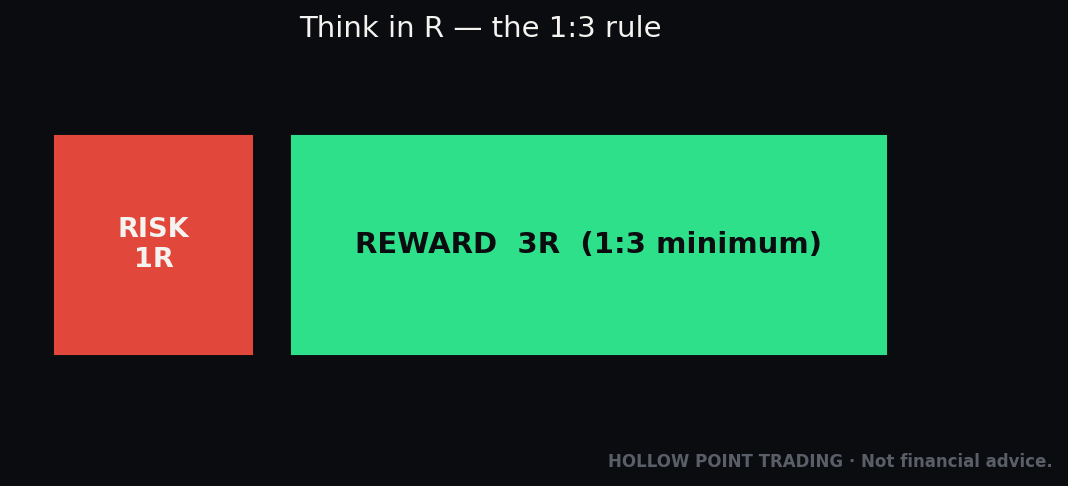
And this is where it connects to something you'll hear constantly at HPT: 1:3 reward-to-risk. It simply means you only take trades where the reward you're aiming for is at least three times the amount you're risking. If you're risking $3 per share to your stop, you want a realistic target that's at least $9 per share of profit (a move from $52 up to $61). Why three-to-one? Because it means you can be wrong more often than you're right and still make money. Win one, lose three, and if that one winner pays 3x while each loss costs 1x — you break even. Do a little better than that, and you profit. The stop loss defines the "1" in that ratio. Without a stop, there's no "1," and the whole risk-reward framework collapses. The stop is the foundation the entire system is built on.
Hard Stops vs. Mental Stops: The Choice That Defines You
Now, the heart of this guide. There are two ways to "have" a stop loss, and choosing between them is one of the most important decisions a beginner will make.
The hard stop
A hard stop (also called a "stop order" or "resting order") is a real order you place with your broker in advance. You literally enter it into the system: "Sell my 33 shares if the price hits $49." It just sits there in the broker's computers, waiting. You don't have to be watching. You don't have to do anything. If the price touches $49 — whether you're asleep, at work, in the shower, or panicking — the order fires automatically and gets you out. It's a machine that never gets emotional, never hesitates, never "hopes it comes back."
The mental stop
A mental stop is a stop that exists only in your head. You say to yourself, "If it hits $49, I'll sell." But you don't place any actual order. You're planning to watch the price and manually click "sell" when it gets there. The plan lives in your mind, and your mind is the thing that has to execute it in the moment.
Sounds fine, right? You're a disciplined person. You'll just sell when it hits your level.
No. Absolutely not. Not as a beginner. Let me tell you exactly why.
Why beginners MUST use hard stops
Here's what actually happens with a mental stop. The price drifts down toward $49. Now remember everything we said about your brain — loss aversion, the pain of admitting you're wrong. The price hits $49.10, then $49.00. Your rule says sell now. But in that exact instant, your brain floods with excuses:
"It's only barely below. Let me give it a little room." "Look, it's already bouncing — see, $49.05! I'll wait for confirmation." "If I just wait for it to come back to $50, I'll get out even instead of taking a loss."
Every one of these thoughts feels reasonable in the moment. That's the trap — they're not obviously stupid, they're seductively logical. And so you don't sell. And the price goes to $48, then $46, then $44. Your planned $99 loss is now a $264 loss, then a $528 loss. The mental stop didn't fail because you're a bad person. It failed because a mental stop asks you to make the single hardest decision in trading — voluntarily accepting a loss — at the exact worst moment, when your emotions are screaming the loudest. It's like planning to buckle your seatbelt during the crash.
A hard stop removes your panicked in-the-moment self from the equation entirely. You made the decision when you were calm and rational — before you entered the trade — and you committed it to the broker's machine. Now no amount of hoping, freezing, or rationalizing can stop the exit from happening. You've taken the weakest, most emotional version of yourself out of the driver's seat. That is exactly what a beginner needs, because as a beginner, your emotional discipline is the least developed part of your trading — it's a muscle you haven't built yet. Don't rely on a muscle you don't have. Rely on the machine.
Experienced professional traders sometimes use mental stops, and they'll tell you so. Don't copy them. They've spent years — sometimes decades — building emotional control, and even many of them still use hard stops because they know their own psychology. A beginner using a mental stop is like a brand-new driver deciding to skip the seatbelt because they saw a race car driver do a stunt without one. The pro survived because of thousands of hours you don't have yet. Use the hard stop. Every single time. No exceptions while you're learning. This isn't a suggestion; at HPT it's a rule, and rules are the whole point.
One honest caveat, so you're not surprised
A hard stop guarantees you an exit, but on rare, fast-moving days it may not guarantee the exact price. If truly dramatic news hits and a stock gaps — jumps straight from $50 to $44 without trading at the levels in between — your $49 stop will sell you out, but at the next available price (around $44), not at $49. This is called slippage, and it's uncommon but real. Here's the thing though: this is an argument for hard stops, not against them. Without any stop at all, you'd have ridden that same crash all the way down with no exit at all. A hard stop that gets you out at $44 on a brutal day is still infinitely better than a mental stop where you froze and rode it to $30. Don't let the rare imperfect exit talk you out of the tool that saves you the other 99% of the time.
A Fully Worked Beginner Example, Start to Finish
Let's put every single piece together in one clean walkthrough, so you can see the whole thing move as one machine. We'll invent a stock called "Meridian Corp," ticker MRC. (Made up — for teaching only.)
The setup. You've been watching MRC. You notice on the chart that every time it drops to around $40, it bounces back up. It's done this four times in two months. That $40 level is clearly support — a floor buyers keep defending. Right now MRC is sitting at $42, just above that floor, and it looks like it's steadying itself for another bounce. Your reasoning: "The $40 floor is strong. I'll buy near it and ride the bounce back up toward the $50 ceiling where it's stalled before."
Your account. You have $8,000. Your rule: risk a maximum of 1% per trade. That's $80 of risk. This $80 is the most you'll allow yourself to lose on MRC, no matter what.
Step 1 — Entry. You decide to buy at the current price, $42.
Step 2 — Where's the stop? Ask the magic question: what price proves I'm wrong? Your whole reason is "the $40 floor holds." So if MRC breaks below $40 and keeps falling, you're wrong — the floor cracked. You place your stop just beyond the floor to allow for a harmless wick, at $39.50.
Step 3 — Risk per share. From your $42 entry to your $39.50 stop is $42 − $39.50 = $2.50 per share.
Step 4 — Position size. Your total allowed risk is $80. Divide: $80 ÷ $2.50 = 32 shares. So you buy 32 shares of MRC, costing 32 × $42 = $1,344 of your capital. (Note: you only risk $80, even though you spent $1,344 to buy the shares. The $80 is what you lose if stopped out — the rest of that $1,344 comes back to you when you sell, at whatever price.)
Step 5 — Set the target (the reward). HPT wants at least 1:3 reward-to-risk. You're risking $2.50 per share, so your target needs to be at least 3 × $2.50 = $7.50 of profit per share — a move from $42 up to $49.50. Conveniently, that's right near the $50 ceiling you already spotted. The trade makes sense: the reward you're reaching for is three times the risk you're taking.
Step 6 — Place the hard stop. Immediately. The moment you buy your 32 shares, you enter a hard stop order at $39.50 with your broker. It's now resting in the system. You could close your laptop and go to the beach. Your seatbelt is buckled.
Now let's see both endings:
Ending A — You were wrong. MRC weakens, drifts down, and breaks the $40 floor. At $39.50, your hard stop fires automatically and sells all 32 shares. You lose 32 × $2.50 = $80 — exactly your planned maximum. It's 1% of your account. You barely feel it. You didn't have to make an agonizing decision in the moment; the machine did it for you while you were calm and prepared. MRC keeps falling to $34, but you're long gone and don't care. You live to trade another day. This is a successful trade — not because you profited, but because you protected your capital and followed your rules. A small loss taken correctly is a win for a beginner.
Ending B — You were right. The $40 floor holds, MRC bounces exactly as you expected, and it climbs to your $49.50 target. You sell and pocket 32 × $7.50 = $240 of profit. You risked $80 to make $240 — a clean 1:3. Buckled seatbelt, smooth drive, arrived exactly where you planned.
Study Ending A especially. The beginner who doesn't use a hard stop lives a different Ending A: they freeze at $40, hope, ride it to $34, and turn an $80 lesson into a $256 wound. Same trade, same chart, wildly different account — and the only difference is the seatbelt.
The Beginner Mistakes to Avoid
Let's name the traps directly, so you recognize them when your own brain offers them to you.
Mistake 1: Trading with no stop at all. The cardinal sin. "I'll just watch it." No. This is driving with no seatbelt because you plan to be careful. One bad day ends your account. Never enter a trade without knowing your exit first.
Mistake 2: Using a mental stop as a beginner. Covered at length above. Your discipline muscle isn't built yet. The machine is stronger than your willpower in the moment. Always hard, always in advance.
Mistake 3: Setting the stop at a random dollar amount. "I'll risk $2 because $2 feels okay." The market doesn't know your comfort level. Place the stop at structure — just beyond the level that proves you wrong — and let that distance tell you your share count.
Mistake 4: Moving your stop down to avoid getting hit. This is the deadliest habit disguised as the most reasonable. Price approaches your $39.50 stop, and you think, "I'll just move it to $38 to give it more room." Now you've done something insane: you've increased your loss and broken your own rule in the same click. If you'd move a stop down, you never really had a stop — you had a suggestion. A stop only ever moves in one direction: up, to lock in profit once a trade is working (this is called a "trailing stop," a more advanced tool). It never, ever moves down to accommodate hope.* Set it once, correctly, and leave it alone.
Mistake 5: Setting stops too tight, exactly on the level. If you put your stop right at $40.00 instead of just beyond it, a harmless wick to $39.95 kicks you out right before the bounce. Give structure a small, sensible cushion so noise doesn't eject you — but not so much cushion that you blow past your 1% risk. It's a balance, and it comes from the chart, not from your wallet.
Mistake 6: Setting stops too wide to "avoid getting stopped out." The opposite error. Some beginners hate being stopped out so much they put the stop miles away. But a stop that's too far means either a huge loss when hit, or (if you keep your risk fixed) so few shares that the trade isn't worth taking. The stop belongs at the structural level — no closer, no farther.
Mistake 7: Risking too much per trade. Even with a perfect stop, if you risk 20% of your account on one trade, three losses in a row cripples you. Keep it small — 1% to 2% max as a beginner. Small risk plus hard stops equals survival.
Your Simple Stop-Loss Cheat Sheet
Print this. Tape it near your screen. Run every trade through it before you click buy.
Before every trade, in order:
- Find the structure. Where's the floor (support) or ceiling (resistance) my trade idea depends on?
- Ask the magic question. "What exact price would prove my idea is wrong?" That's where the stop belongs.
- Place the stop just beyond that level* — a small cushion for noise, not right on it.
- Measure risk per share = entry price − stop price.
- Set your max risk = 1% of your account (2% absolute ceiling as a beginner).
- Calculate share count = max risk ÷ risk per share. Round down.
- Check the reward. Is my realistic target at least 3× my risk (1:3)? If not, skip the trade.
- Enter the trade AND the hard stop together. The stop is a real resting order, placed immediately. Never a thought in your head.
- Walk away. The machine is watching now. You don't need to.
- Never move the stop down. Ever. Up to protect profit, fine. Down to dodge a loss, never.
The one-sentence version: Put your stop just beyond the price that proves you wrong, make it a real order with your broker before you look away, and never move it down.
How This Fits the Bigger Hollow Point Picture
Everything you just learned is one gear in a larger machine, and it's worth seeing where it sits.
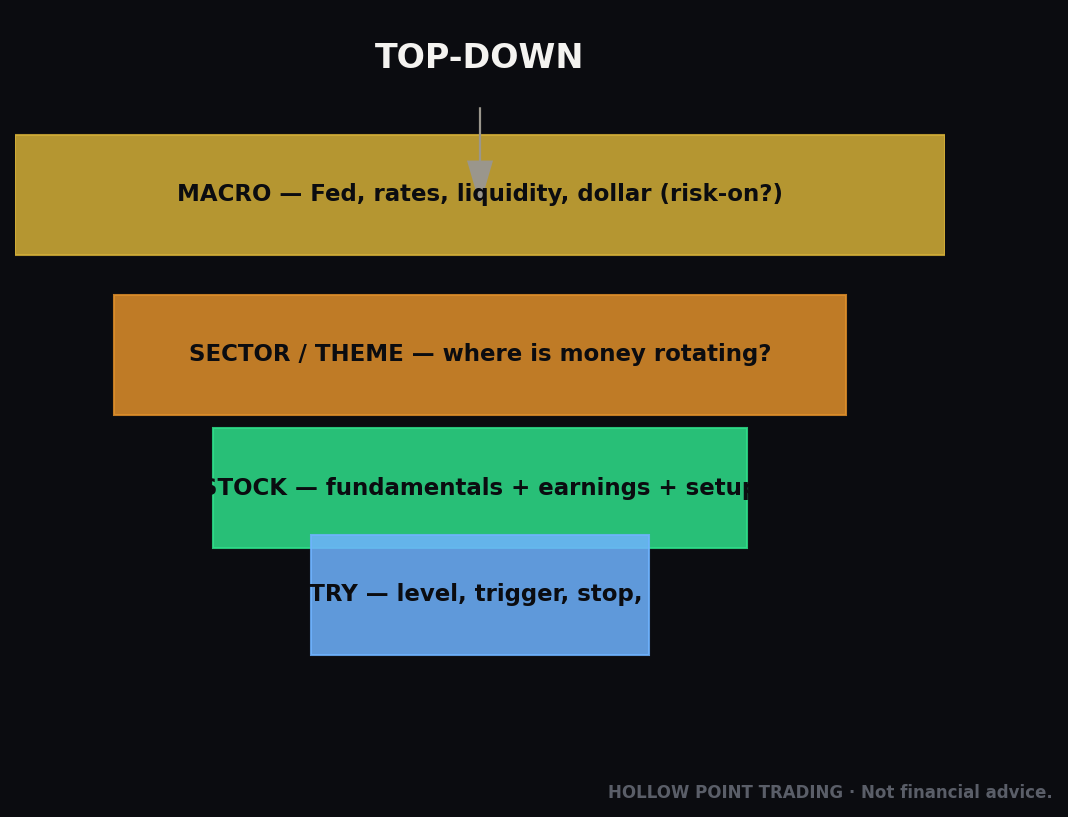
At Hollow Point Trading, the way we look at any trade flows macro → sector → stock: first the big picture (is the overall market environment healthy or ugly?), then the sector (is this group of stocks in favor?), then the individual stock (does this specific chart offer a clean setup?). That whole funnel is about choosing good trades. But choosing a good trade is only half the job. The other half — the half that decides whether you're still trading a year from now — is managing risk once you're in. And risk management starts and ends with the stop loss.
There's a phrase we live by: discipline over prediction. Beginners obsess over predicting — "will it go up?" — as if trading were about being a fortune-teller. It isn't. Nobody knows the future. The best traders in the world are wrong constantly. What makes them profitable isn't a crystal ball; it's that when they're right, they win big (that's the 1:3), and when they're wrong, they lose small (that's the stop loss). Prediction is a coin flip. Discipline is a choice. The stop loss is discipline made concrete — it's you, on your calm day, protecting you, on your worst day.
And it all rests on the first principle, the one we opened with: protect capital first. You are not trying to win big this week. You're trying to survive long enough to get good, because getting good is what eventually pays. Every hard stop you place is a small act of survival. String enough of them together — enough small, controlled losses and occasional 3:1 wins — and the math quietly bends in your favor over time. Skip them, freeze on a mental stop, ride one loss into the ground, and none of the rest matters, because you're out of the game.
The stop loss isn't the exciting part of trading. It's the seatbelt, the fire extinguisher, the unglamorous discipline. But it is, without exaggeration, the single most important skill a beginner can build. Master this one thing — placing a real, structural, hard stop before every trade and never moving it down — and you're already ahead of the overwhelming majority of people who ever open a trading account. Not because you'll predict the market better than them. Because you'll survive it, and they won't.
Buckle up before you touch the gas. Every trade. Every time.
Bound by rules, feared by trade.