
If you have ever bought an option — or even just watched one on a screen — you have probably had this exact confusing moment. The stock moves up a dollar. Your option gains a little. The stock moves up another dollar. Suddenly your option is gaining way more than it did on the first dollar. Same stock, same size move, wildly different reaction from your option.
That is not a glitch. That is gamma doing its job.
Gamma is one of those words that sounds like it belongs in a physics lecture, and most explanations you will find online make it worse, not better. They throw formulas at you before you understand what the thing even is. We are going to do the opposite. By the end of this guide, you will understand gamma well enough to actually use it on Monday — to know which options will behave calmly and which ones are little sticks of dynamite, and why that difference matters more than almost anything else when you are protecting your money.
Let's build it from the ground up. Zero prior knowledge assumed. We define every term the first time we use it.
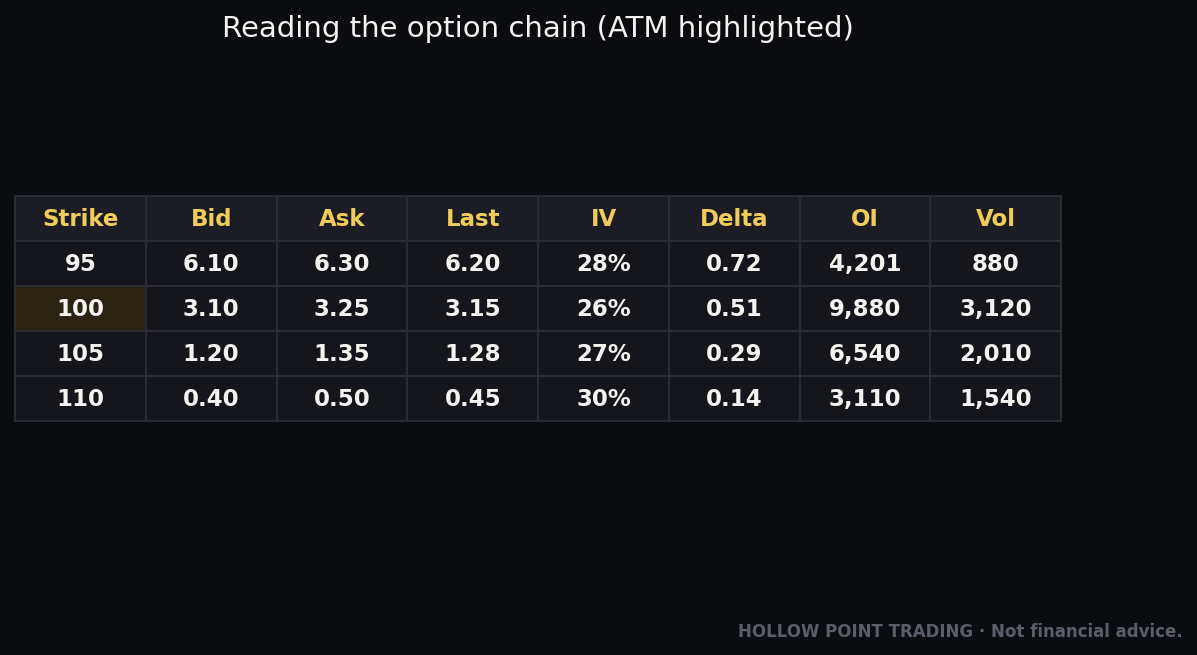
First, The Two Words You Cannot Skip: Option and Delta
Before gamma makes any sense, two ideas have to be rock-solid.
An option is a contract that gives you the right — but not the obligation — to buy or sell a stock at a set price, before a set date. A call option is the right to buy. A put option is the right to sell. The set price is called the strike price. The set date is the expiration date, often just called "expiration" or "expiry."
Here is the only mental picture you need: a call option is a bet that the stock goes up, and a put option is a bet that the stock goes down. That is 90% of what a beginner needs to hold in their head.
Now the second word, and this is the important one: delta.
Delta tells you how much your option's price moves when the stock moves one dollar.
That's it. If a call option has a delta of 0.50, it means: when the stock goes up $1, the option gains roughly $0.50. When the stock drops $1, the option loses roughly $0.50. Delta is measured between 0 and 1 for calls (and 0 to -1 for puts, because puts go the opposite way of the stock).
Think of delta as your option's current speed — how fast it reacts to the stock right now.
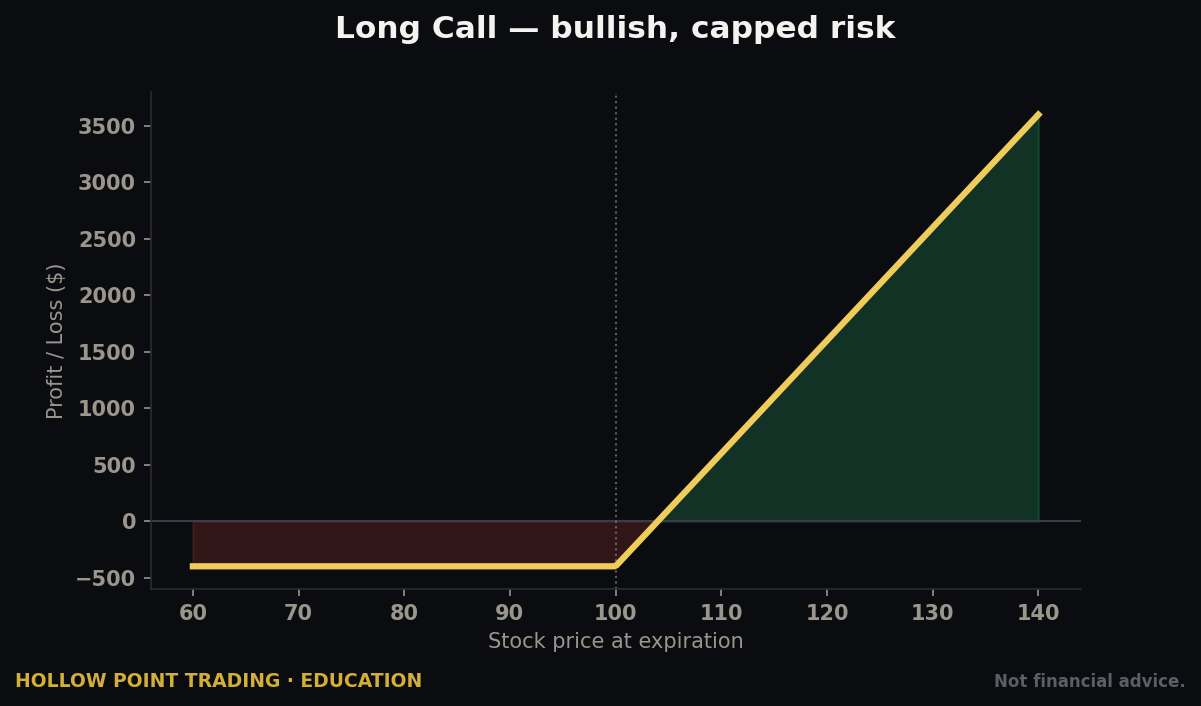
A delta of 0.50 means the option moves at "half speed" compared to the stock. A delta of 0.90 means it moves at nearly "full speed" — almost dollar-for-dollar with the stock. A delta of 0.10 means it barely reacts at all — it's crawling.
Hold onto that "speed" idea, because we are about to add the second dial.
So What Is Gamma? (Plain English, No Math)
Here is the whole thing in one sentence:
Gamma tells you how fast delta itself changes.
If delta is your option's speed, then gamma is your option's acceleration — how quickly that speed is picking up or slowing down.
Let me say it a different way, because this is the single most important idea in the whole guide. Delta is not a fixed number. It does not sit still. As the stock moves around, delta changes. Gamma is the number that tells you how much delta changes for every $1 the stock moves.
Let's make it concrete. Say your call option has:
- Delta of 0.50 (moves 50 cents per $1 stock move)
- Gamma of 0.05
That gamma of 0.05 means: for every $1 the stock rises, your delta increases by 0.05.
So watch what happens as the stock climbs:
- Stock at $100 → delta is 0.50
- Stock rises to $101 → delta becomes 0.55 (0.50 + 0.05)
- Stock rises to $102 → delta becomes 0.60
- Stock rises to $103 → delta becomes 0.65
Your option is speeding up. It moved 50 cents on the first dollar, but by the time the stock hits $103, it's moving 65 cents per dollar. The option is gaining value faster and faster as the stock goes your way. That acceleration — that pickup in speed — is gamma at work.
And it cuts both ways. If the stock falls, gamma pulls delta down, so the option loses speed as it goes against you. On the way down, gamma is quietly protecting you a little; on the way up, it's turbo-charging you. (For a put, the direction flips, but the acceleration idea is identical.)
The Everyday Analogy That Makes Gamma Click
Forget stocks for a second. Imagine you're pushing a shopping cart.
Delta is how fast the cart is currently rolling. Gamma is how hard you're pressing on it — how quickly it's speeding up.
A cart with high gamma is one you're shoving hard: it goes from a standstill to zooming down the aisle in no time. A cart with low gamma is one you're barely nudging: its speed changes slowly and predictably. You have plenty of time to react.
A high-gamma option is the cart you shoved hard. Its behavior changes fast. One moment it's sluggish, the next it's flying — and if the stock reverses, it can go from flying back to sluggish just as quickly. It is unpredictable and hard to steer.
A low-gamma option is the gentle nudge. Its speed changes slowly. It's calm, boring, and easy to manage.
When traders say an option is "twitchy," this is exactly what they mean: high gamma. The delta jumps around so fast that the option's whole personality changes with small moves in the stock. Twitchy options can make you a lot of money quickly — and lose it just as quickly. Calm options are slow and steady.
Why Should A Beginner Care About Any Of This?
Fair question. You might be thinking, "I just want to buy a call and make money. Why do I need to know about the acceleration of the speed of the price?"
Here's why it matters, and it comes straight from the Hollow Point Trading ethos: protect your capital first.
Gamma is the number that tells you how surprised you're going to be. High-gamma options are the ones where you fall asleep with a small gain and wake up with a big loss — or the reverse. They move so fast, and their behavior changes so suddenly, that beginners consistently get whipsawed by them. You size a position thinking it'll behave one way, and gamma makes it behave a completely different way an hour later.
If you understand gamma, you can choose your battles. You can say: "I'm a beginner, I want predictable behavior, so I'll pick lower-gamma options while I'm learning." Or: "I understand this option is twitchy, so I'm going to trade it smaller and watch it closely." Either way, you're making a decision on purpose instead of getting blindsided.
That is the entire difference between gambling and trading. Gambling is not knowing why your option just did what it did. Trading is knowing the machinery underneath it. Gamma is a big piece of that machinery.
The Three Zones: In-the-Money, At-the-Money, Out-of-the-Money
To understand where gamma is highest, you need three quick definitions. These describe where the stock price is sitting relative to your strike price.
At-the-money (ATM): The stock price is right at (or very close to) your strike price. If your call strike is $100 and the stock is trading at $100, you're at-the-money. This is the "on the fence" zone — the option genuinely doesn't know yet whether it'll finish as a winner or a loser.
In-the-money (ITM): The option already has real value baked in. For a call, that means the stock is above your strike — a $100 call with the stock at $115 is in-the-money by $15. It's already a "winner" (for now).
Out-of-the-money (OTM): The option has no baked-in value yet. For a call, the stock is below your strike — a $100 call with the stock at $85 is out-of-the-money. It's a "not yet" bet. It only pays off if the stock climbs above the strike before expiration.
Now here's the punchline you must remember:
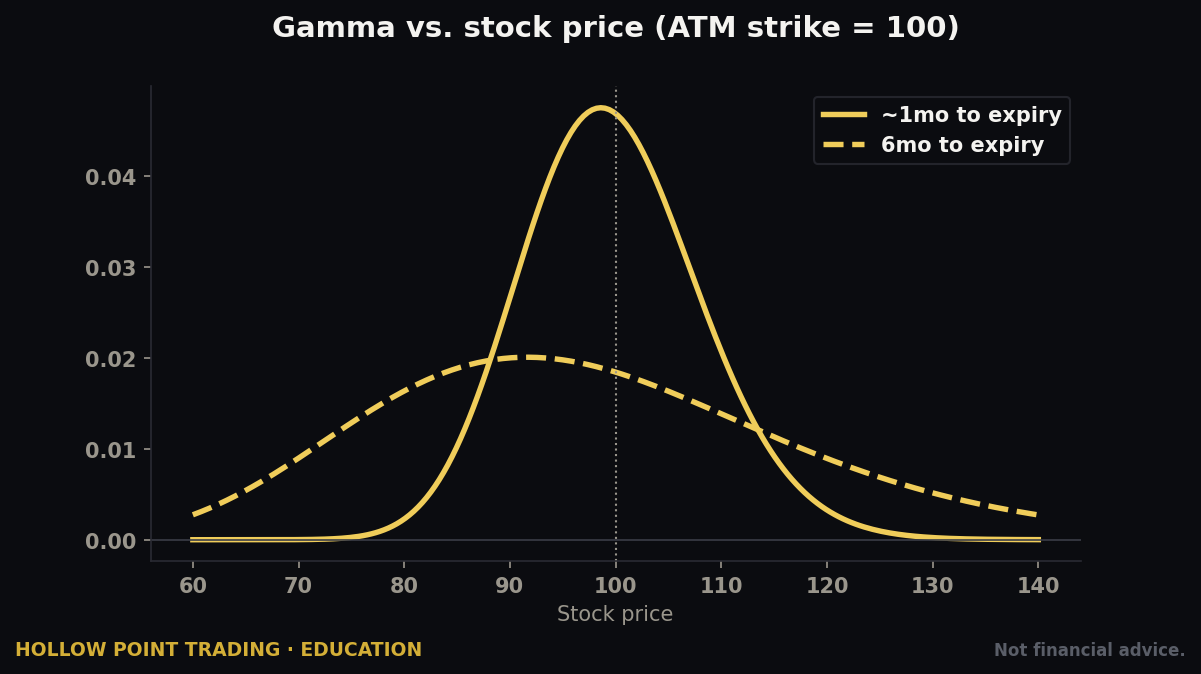
Gamma is highest when the option is at-the-money.
Deep in-the-money and far out-of-the-money options have low gamma. The at-the-money option — the one sitting right on the fence — has the highest gamma of all.
Why? Think back to "on the fence." When the stock is right at your strike, every little wiggle genuinely changes the option's fate. A tiny move up makes it look like a winner; a tiny move down makes it look like a loser. So its delta — its sensitivity — has to change dramatically with each small move. That dramatic change is high gamma.
Compare that to a deep in-the-money call (stock at $115, strike at $100). That option is already basically acting like the stock itself. Its delta is close to 1.0 and there's almost nowhere for it to go — it can't get much more "certain" than it already is. So its delta barely changes. Low gamma.
And a far out-of-the-money call (stock at $85, strike at $100)? That one is basically a lottery ticket that's probably going to expire worthless. Its delta is near 0, and a $1 move in the stock doesn't change much about its hopeless outlook. Also low gamma.
The fence-sitters are twitchy. The ones with their fate already mostly decided are calm.
A Fully Worked Beginner Example
Let's walk through a real-ish trade slowly, watching gamma the whole way.
Meet a stock we'll call Riverside Tech, trading at exactly $100. You buy one at-the-money call option with a $100 strike, expiring in a few weeks. Let's say this option currently costs $3.00 (remember: one option contract normally controls 100 shares, so this actually costs you $300, but we'll track the per-share price to keep it simple).
Here are your two key numbers at the start:
- Delta: 0.50 — for every $1 Riverside moves, your option moves about 50 cents
- Gamma: 0.06 — for every $1 Riverside moves, your delta changes by 0.06
Now let's push the stock up, one dollar at a time, and track everything.
Riverside goes from $100 to $101. Your option gains about 50 cents (that's the delta). New option price: roughly $3.50. But now gamma kicks in — your delta rises from 0.50 to 0.56.
Riverside goes from $101 to $102. This time your option gains about 56 cents (the new, higher delta). New price: roughly $4.06. Delta climbs again, from 0.56 to 0.62.
Riverside goes from $102 to $103. Now your option gains about 62 cents. New price: roughly $4.68. Delta climbs to 0.68.
Look at what happened. The stock rose a total of $3.00 — the same $1 each step. But your option's gains got bigger with each step: 50 cents, then 56, then 62. That escalation is gamma. The option accelerated as it went your way. This is the magic that makes at-the-money options so exciting when a stock trends in your favor.
Now the sobering half. Let's rewind to the start — Riverside at $100, delta 0.50, gamma 0.06 — but this time the stock goes down.
Riverside falls from $100 to $99. Your option loses about 50 cents. New price: roughly $2.50. Delta drops from 0.50 to 0.44.
Riverside falls from $99 to $98. Your option loses about 44 cents now — the losses are getting smaller per dollar. New price: roughly $2.06. Delta drops to 0.38.
Riverside falls from $98 to $97. Your option loses about 38 cents. New price: roughly $1.68. Delta drops to 0.32.
Notice the losses shrink per dollar as the stock keeps falling. Gamma is bleeding away your delta, so each additional dollar down hurts a little less than the last. On the downside, gamma is quietly cushioning you.
This is the beautiful, dangerous asymmetry of a long option (an option you bought): gains accelerate when you're right, and losses decelerate when you're wrong. That sounds like a free lunch — and it's not, because you paid for that privilege in the option's price, and there's a silent thief eating that price every single day. That thief is called theta (time decay), and it's the flip side of owning all this juicy gamma. We'll touch on that in the mistakes section, because it's where beginners get wrecked.
Gamma Near Expiration: When Twitchy Becomes Explosive
Everything we've said so far gets dialed up to eleven as expiration approaches. This is the part every beginner needs tattooed on their brain.
The closer an option gets to its expiration date, the higher the gamma of at-the-money options becomes.
Why? Go back to the "on the fence" idea. Three weeks before expiration, an at-the-money option has time — the stock could wander anywhere, and the option's fate is genuinely uncertain, but that uncertainty is spread out over many days. The delta changes, but gently.
Now it's the afternoon of expiration day, and the stock is sitting right at your strike. Every single tick matters enormously, because there's no time left for anything to average out. A tiny move up and the option is a winner that will pay off in hours. A tiny move down and it expires completely worthless. The delta has to swing violently — from near 0 to near 1 — over a tiny range of stock prices. That violent swing is enormous gamma.
On expiration day, an at-the-money option's delta can rocket from 0.30 to 0.80 on a move of less than a dollar. The option becomes a coin-flip lottery ticket that swings hundreds of dollars in value on the smallest wiggle of the stock. This is where you hear war stories of options going from $0.10 to $2.00 and back to zero in the span of an hour.
This is exactly why those cheap, same-day-expiration options — you may have heard the scary nickname "zero-days-to-expiration" or "0DTE" — are the most twitchy, gamma-loaded, beginner-destroying instruments on the whole market. They are pure gamma. Professional traders can handle them; a beginner poking at them is standing on a landmine.
The beginner rule that flows straight out of this: the closer to expiration, the more explosive and unpredictable at-the-money options become. If you are learning, give yourself more time, not less. More days until expiration means lower gamma, calmer behavior, and fewer heart attacks.
The One Other Place You'll Hear "Gamma": Market-Maker Gamma
You may run into gamma in a bigger, market-wide context — people talking about "gamma walls," "gamma flip," or "dealer gamma" (this is the world of GEX, or gamma exposure). Here's the beginner-level version so the words don't intimidate you.
When you buy an option, someone sells it to you. That someone is usually a market maker — a big firm whose job is to provide options to buyers and sellers. They don't want to bet on direction; they just want to earn the spread. So after selling you a call, they hedge by buying some of the underlying stock to stay neutral.
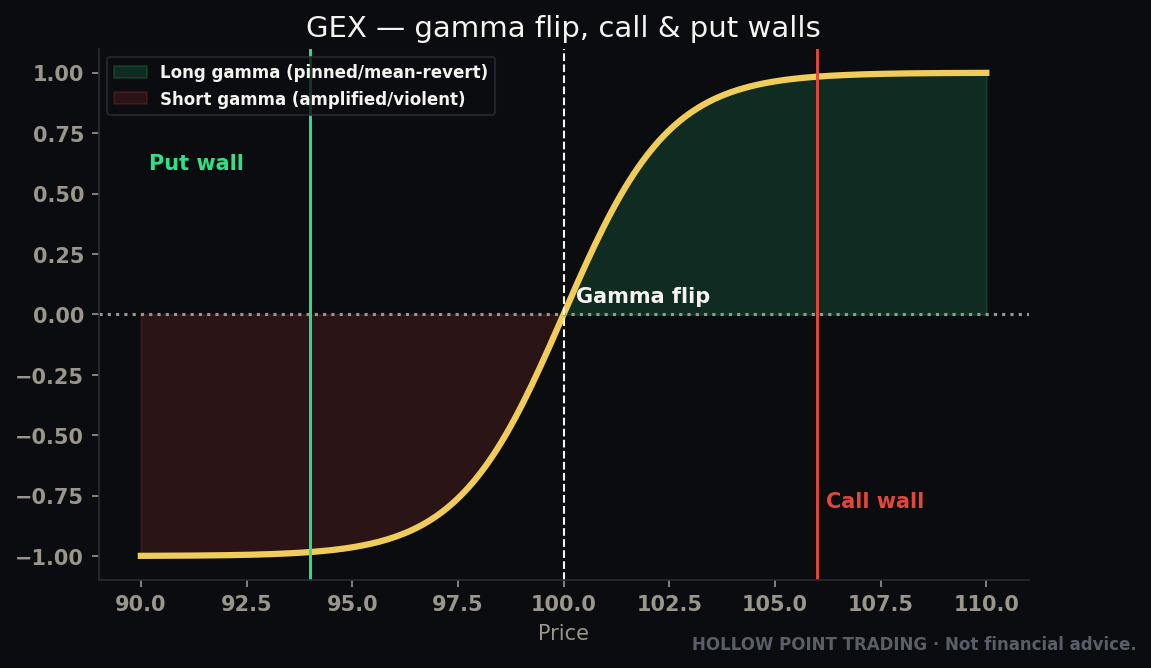
Here's the thing: because their position also has gamma, they have to constantly re-hedge — buying and selling the stock as it moves to stay neutral. When a lot of options are stacked at a certain strike price, all that forced re-hedging can actually push the stock toward or away from that price. Big clusters of options can act like magnets (pinning the stock to a price) or like walls (levels the stock struggles to break through).
You do not need to trade off this as a beginner. But you should know it's real, because it's part of why prices sometimes "stick" to round numbers near big expiration dates. In the Hollow Point Trading world, these gamma levels are one input among many — never the whole story, and never something to invent when the data isn't in front of you.
The Beginner Mistakes To Avoid
These are the specific ways gamma quietly hurts new traders. Learn them now, cheaply, instead of learning them later with your money.
Mistake 1: Buying same-day or near-expiration options because they're "cheap." That $0.15 option looks like a lottery ticket you can't lose much on. But its gamma is so extreme that its behavior is basically random, and its theta (that daily time-decay thief) is eating it alive by the hour. Cheap does not mean safe. It usually means "about to be worthless." Beginners should give themselves weeks of time, not hours.
Mistake 2: Forgetting that gamma cuts both ways. New traders fall in love with the "gains accelerate" story and forget that a high-gamma option can reverse just as fast. You're up nicely, you get greedy, the stock ticks back down, and gamma yanks your gains away faster than you can react. If you buy twitchy options, take profits with discipline — don't wait for the "perfect" top.
Mistake 3: Sizing a twitchy position like a calm one. A high-gamma, near-expiration option can swing 100% in value in minutes. If you put the same dollar amount into it as you would a calm, far-dated option, you've secretly taken on many times the risk. The twitchier the option, the smaller your position should be. Match your size to the volatility, not the other way around.
Mistake 4: Ignoring theta, gamma's evil twin. Every day you hold a long option, you pay rent in the form of time decay. Near expiration, when gamma is highest, theta is also highest. You're renting explosive potential at a brutal daily price. If the stock doesn't move your way fast, the clock kills you even when you were "right" about direction eventually. Gamma and theta always travel together — you can't have one without the other.
Mistake 5: Confusing "high gamma" with "good." High gamma isn't good or bad — it's a tool with a personality. It's right for a fast, well-timed, closely-watched trade with small size. It's wrong for a beginner who wants to buy and hold for a week and sleep at night. Know which situation you're in.
How Gamma Fits The Bigger Hollow Point Picture
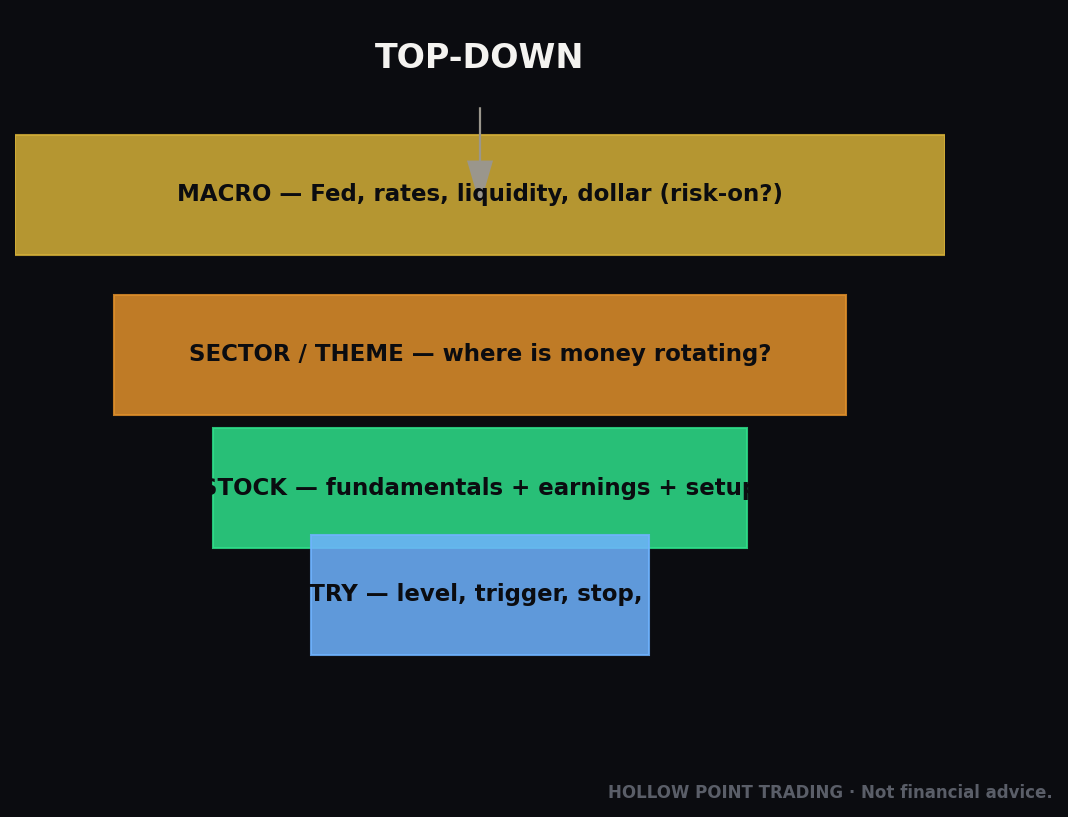
At Hollow Point Trading, the process runs top-down: macro → sector → stock. You start with the big-picture market environment, narrow to the sector that's leading or lagging, then choose the individual stock. Only after all that do you pick the actual instrument — the specific option, strike, and expiration.
Gamma lives at that last step, and it's where a lot of good analysis gets thrown away by a careless choice. You can nail the macro, nail the sector, nail the stock, and still lose money because you bought a twitchy, near-expiration, high-gamma option that got whipsawed out of the trade before your thesis had time to play out.
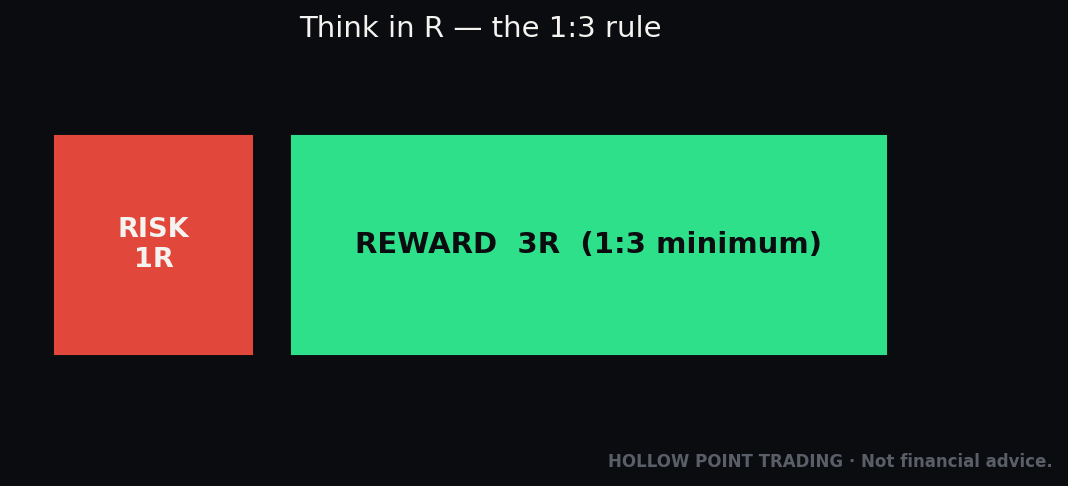
Gamma is also woven into the core HPT rule of 1:3 reward-to-risk — risking one dollar to make three. You can't honestly measure your risk if you don't understand how your option behaves. A high-gamma option's "risk" isn't a fixed number; it changes as the stock moves and as expiration approaches. Understanding gamma is part of understanding what you're actually risking, which is the foundation of every position size you'll ever take.
And it ties into the deepest HPT principle of all: discipline over prediction. You will never perfectly predict where a stock goes. What you can control is choosing instruments whose behavior you understand, sizing them correctly, and protecting your capital first. Gamma is a discipline tool. It tells you which options demand respect, which ones demand small size, and which ones a beginner has no business touching yet. Knowing the difference is the job.
Your Simple Gamma Cheat-Sheet
Keep this next to you. It's the whole guide compressed into things you can act on Monday.
What the two numbers mean:
- Delta = how much your option moves per $1 stock move (its speed).
- Gamma = how much delta changes per $1 stock move (its acceleration).
Where gamma is HIGH (twitchy — handle with care):
- At-the-money options (stock sitting right at the strike).
- Options close to expiration (days or hours out).
- Combine those two and you get the most explosive options on the market.
Where gamma is LOW (calm — beginner-friendly):
- Deep in-the-money options (already acting like the stock).
- Far out-of-the-money options (long-shot lottery tickets).
- Options with lots of time left until expiration.
The beginner defaults:
- Give yourself time — weeks until expiration, not hours. Lower gamma, calmer trade.
- The twitchier the option, the smaller the position.
- Take profits on high-gamma trades with discipline — don't hunt the perfect top.
- Never buy "cheap" near-expiration options thinking you can't lose much. Gamma and theta will prove you wrong.
- Remember gamma cuts both ways: it accelerates gains and reversals.
The one-sentence summary: Gamma is your option's acceleration — highest when the stock sits at your strike and when expiration is near, which is exactly when a beginner should slow down, size small, and respect the machine.
Master this, and you've got something most people who "trade options" never actually learn: you know why your option does what it does. That knowledge is the difference between being surprised by the market and being prepared for it. And being prepared — sizing right, choosing right, protecting capital first — is the entire game.
Bound by rules, feared by trade.