
You did your homework. You were sure the company would beat. Earnings came out, the stock jumped exactly like you predicted — and your option lost money anyway. If that has happened to you, or you're afraid it will, this guide is for you. There's a name for the thing that robbed you, and once you understand it, you'll never get blindsided by it again. It's called IV crush, and it's one of the most expensive lessons a beginner can learn the hard way. Let's learn it the easy way instead.
First, What Even Is an Option?
Before we can talk about IV crush, we need to make sure you're solid on the basics. If you already know this, skim it — but I'd rather over-explain than lose you.
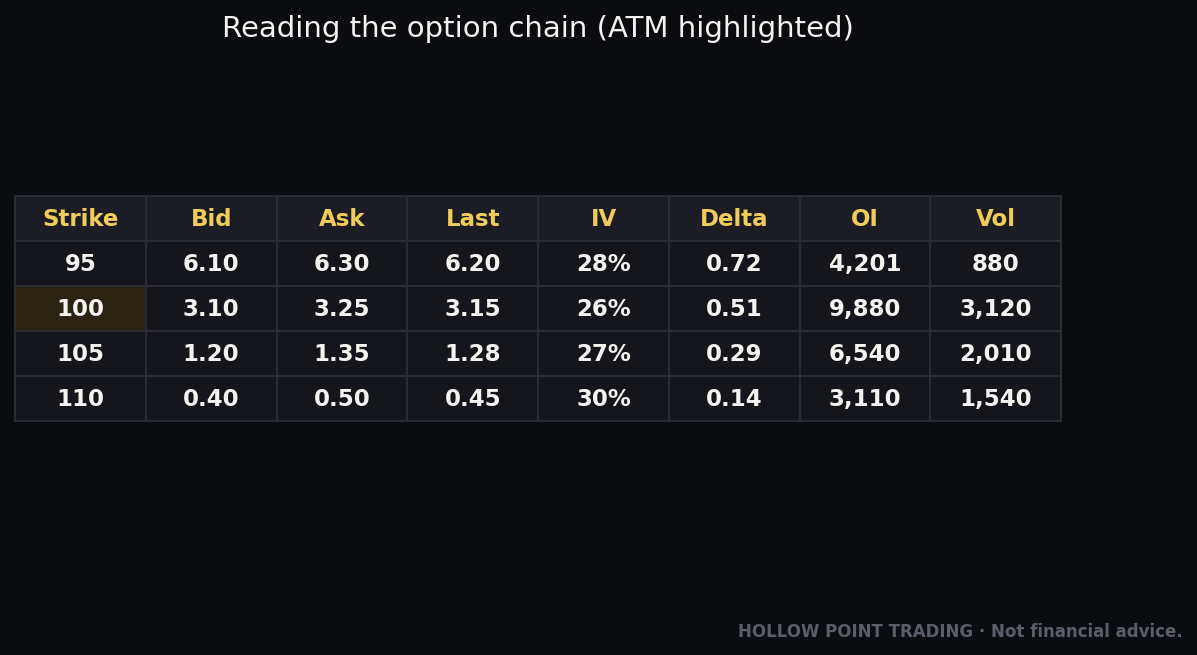
An option is a contract. It gives you the right, but not the obligation, to buy or sell a stock at a set price before a set date. You pay a small fee up front for that right. That fee is called the premium — it's the price of the option itself.
There are two flavors:
- A call is a bet that the stock goes up. You're buying the right to buy the stock at a fixed price. If the stock climbs above that price, your call becomes valuable.
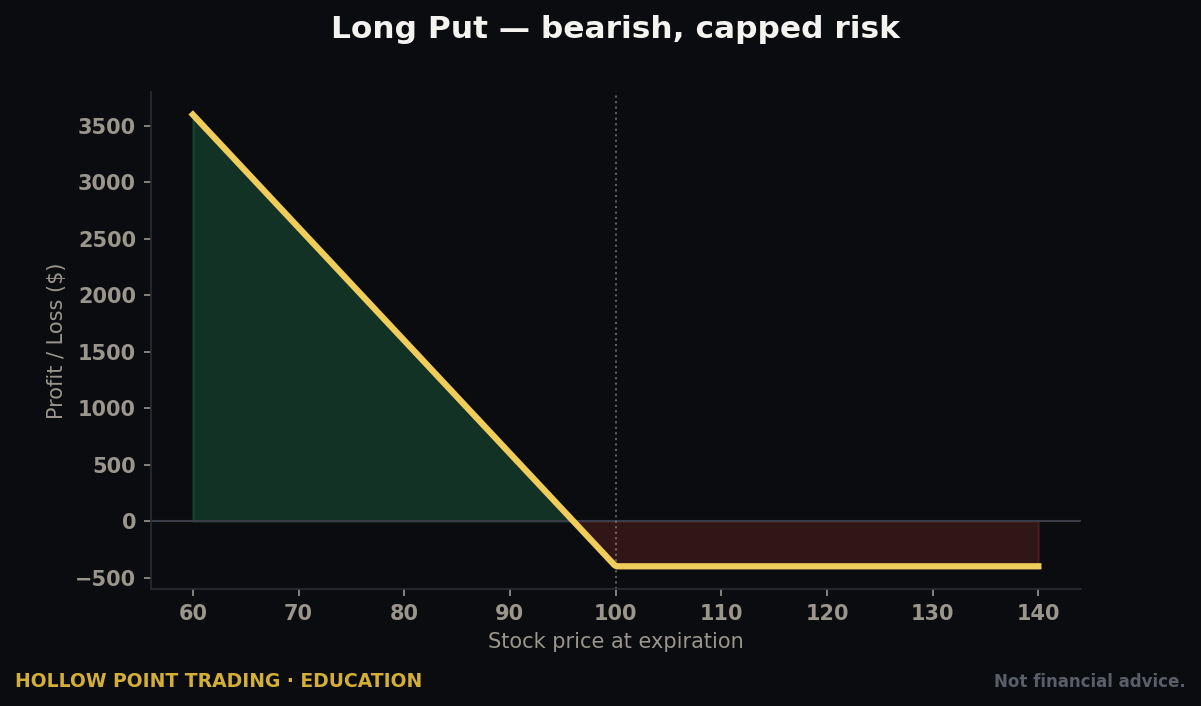
- A put is a bet that the stock goes down. You're buying the right to sell the stock at a fixed price. If the stock falls below that price, your put becomes valuable.
The fixed price in the contract is the strike price (or just "strike"). The deadline is the expiration date (or "expiry"). And here's the magic that makes options attractive to beginners: they're cheap relative to the stock. Instead of paying $500 to buy one share of a $500 stock, you might pay $10 for a call that controls 100 shares. That's called leverage — a small amount of money controlling a large position.
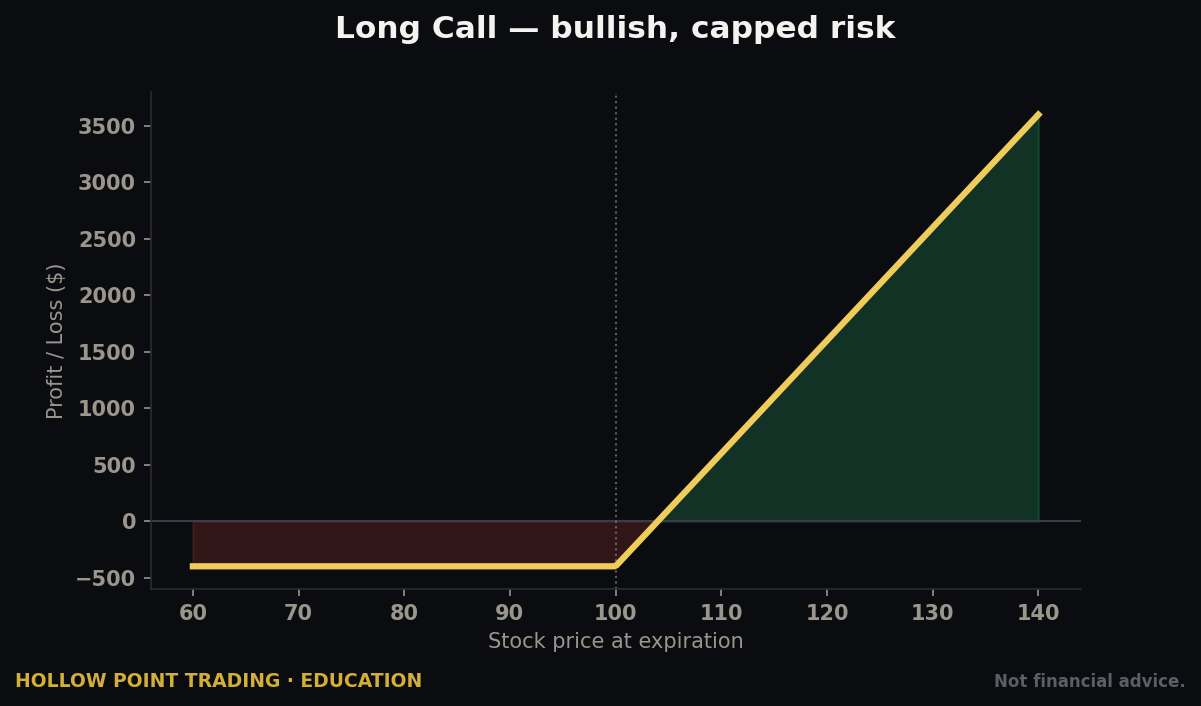
Leverage is exciting. It's also exactly why beginners get hurt. Leverage magnifies gains and losses, and it introduces a moving part that most new traders never see coming — the one this whole guide is about.
The Hidden Ingredient in an Option's Price
Here's the thing nobody tells you at the start: an option's price is made of two separate ingredients, not one.
Ingredient one: intrinsic value. This is the "real" part. It's how much the option would be worth if it expired right now. If you own a call with a $100 strike and the stock is trading at $105, that call has $5 of intrinsic value — you could buy at $100 and instantly the position is $5 in the money. Intrinsic value is simple. It only depends on where the stock is versus your strike.
Ingredient two: extrinsic value (also called "time value"). This is the "potential" part. It's the extra amount you pay for the chance that the option becomes more valuable before it expires. Even an option with zero intrinsic value can cost real money, because there's still time on the clock and anything could happen.
Think of it like buying a concert ticket from a reseller. Part of the price is the ticket's face value — that's the intrinsic part, the guaranteed thing you're getting. But part of the price is the hype: how badly people want in, how uncertain it is whether tickets will still be available later. If the show is rumored to be legendary and might sell out, the resale price balloons far above face value. That extra is pure emotion and expectation. When the hype cools, the resale price collapses back toward face value — even though the ticket itself never changed.
That "hype" portion of an option's price has a name, and it's the single most important word in this entire guide: implied volatility.
Implied Volatility: The Price of Uncertainty
Volatility just means how much a stock moves around. A calm, boring stock that drifts a few cents a day has low volatility. A wild stock that swings 5% in an afternoon has high volatility.
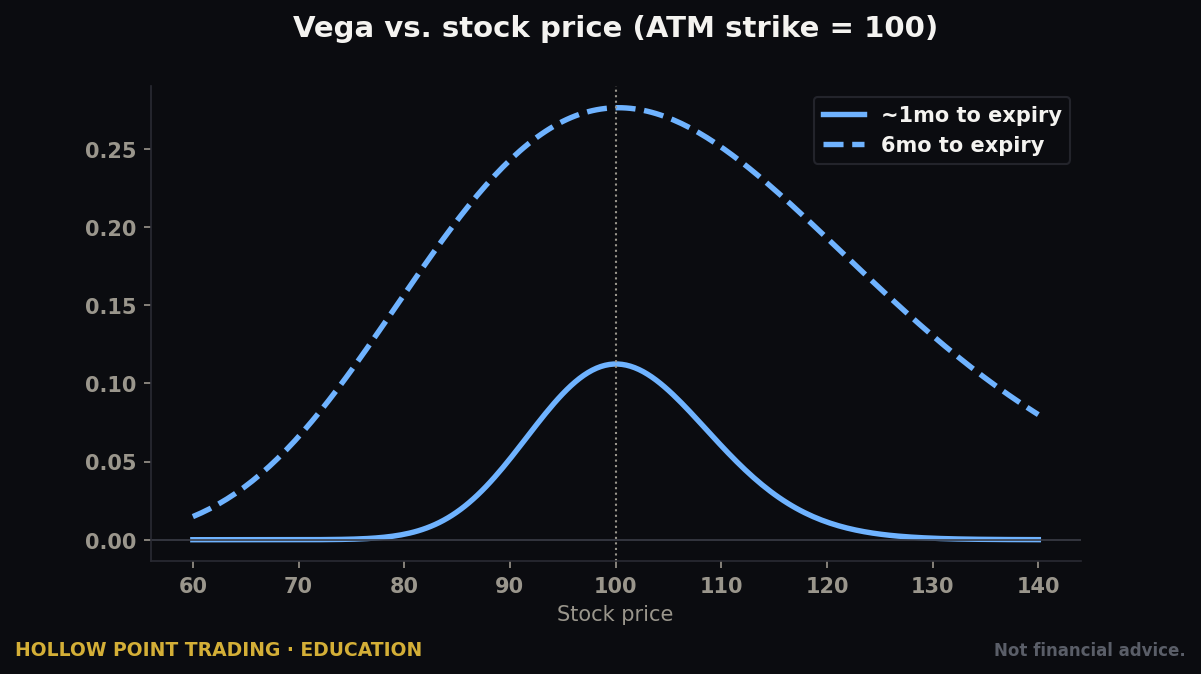
Implied volatility — we'll call it IV from here on — is the market's guess about how much a stock is going to move in the future. It's baked right into the option's price. When the market expects big moves ahead, IV is high, and options get expensive. When the market expects calm, IV is low, and options get cheap.
Notice the key word: expects. IV is about anticipation. It doesn't measure what happened; it measures fear and excitement about what might happen. That's why it behaves so strangely around one specific event on every company's calendar.
That event is earnings.
Why Earnings Turns Options Into a Casino
Every public company reports its financial results four times a year. This is the earnings report — a scheduled announcement of how much money the company made, whether it beat or missed expectations, and what management thinks comes next. It usually drops right after the market closes or right before it opens.
Here's why this matters for our story: earnings is the single most uncertain moment in a stock's quarter. Nobody outside the company knows the numbers until they're released. The stock could gap up 10%, gap down 10%, or barely move. "Gap" means the price jumps to a new level between the market closing and reopening, leaving a literal gap on the chart.
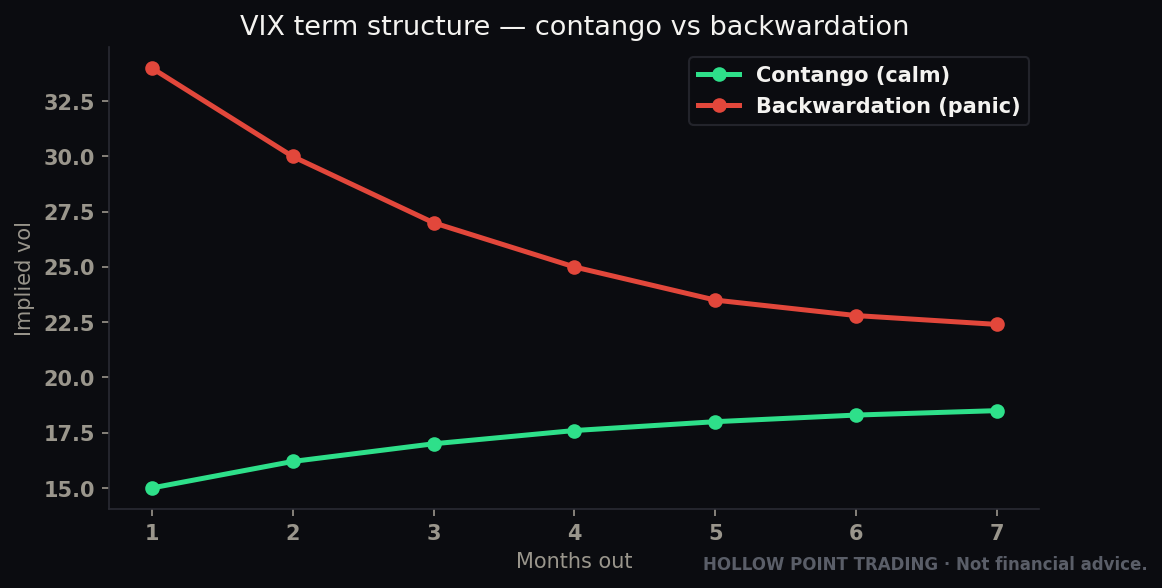
Because that uncertainty is so enormous, IV does something dramatic in the days leading up to earnings. It climbs. And climbs. Traders pile into options — some betting on direction, some protecting existing positions — and all that demand plus all that uncertainty pushes IV higher and higher. This run-up is called the volatility ramp, or vol ramp for short.
Then earnings comes out. The numbers are known. The uncertainty that IV was pricing in? Gone. The mystery is solved. And IV collapses — sometimes losing half its value or more in a single instant.
That collapse is IV crush.
IV Crush, in Plain English
Let me say it as simply as I can:
Before earnings, options are expensive because nobody knows what's coming. After earnings, everybody knows — so the "uncertainty premium" vanishes, and the extra value that uncertainty added to your option evaporates almost instantly.
That evaporation is IV crush. It happens to every option on the stock, calls and puts alike, the moment the results hit the wire. It's not a glitch. It's not bad luck. It's the mechanical, predictable, 100%-guaranteed release of air from a balloon that got pumped up before the announcement.
And here's the cruel part for beginners: the crush can wipe out your gains even when the stock moves in your direction. You can be right about the company and still lose on the option, because the amount you lose to the vanishing uncertainty premium is bigger than the amount you gain from the stock's move.
This is the trap. You were promised leverage. You were right about the direction. And the house still took your money. Let's see exactly how, with real-ish numbers.
A Fully Worked Beginner Example
Meet a made-up but realistic stock: we'll call it Brightline Foods, trading at $100 a share. Earnings come out tomorrow after the close. You're convinced Brightline is going to beat expectations and the stock will pop. So you decide to buy a call.
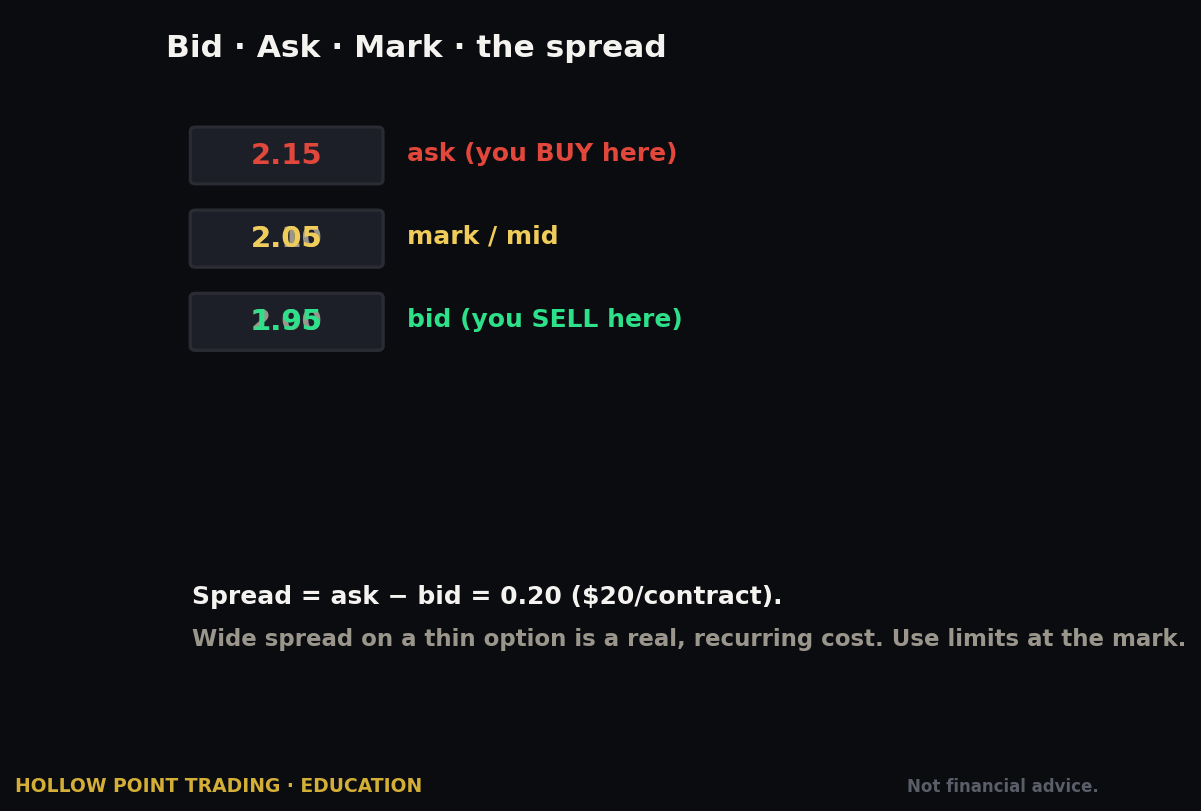
You look at the $100 strike call expiring at the end of the week. Right now, the day before earnings, it costs $5.00. Because one option contract controls 100 shares, that $5.00 quote means you pay $500 for the contract.
Now let's break that $5.00 into our two ingredients:
- Intrinsic value: The stock is at $100 and your strike is $100. The option is exactly "at the money" — zero intrinsic value. If it expired this second, it'd be worth nothing.
- Extrinsic value: All $5.00 of the price is extrinsic. It's entirely the uncertainty premium. You're paying $500 purely for the chance that Brightline moves in your favor.
That's a red flag already, but let's keep going and watch what happens.
The IV on this option is sky-high — let's say 80% — because of the vol ramp into earnings. Normally, when there's no big event, Brightline's options trade around 35% IV. So more than half of the option's value is temporary hot air that will escape the moment earnings drops.
Scenario A: You're right, and the stock jumps.
Earnings come out. Brightline beats! The stock gaps up from $100 to $104 — a solid 4% move. You were right. You nailed it. Time to check your account.
Your $100 call now has $4.00 of intrinsic value — the stock is at $104, your strike is $100, that's $4 in the money. Good so far.
But the uncertainty is gone. IV crashes from 80% back down to its normal 35%. All that extrinsic hot air escapes. The leftover extrinsic value on the option is now maybe $0.50 instead of the $5.00 of pure air you paid.
So your option is now worth about $4.00 + $0.50 = $4.50.
You paid $5.00. You're worth $4.50. You lost $50 — on a trade where you correctly predicted a 4% pop.
Read that again, because it's the whole point of this guide. You were right about the direction, the stock moved your way, and you still lost money. IV crush ate a bigger chunk than your correct call could pay you back.
Scenario B: You're right, but the stock only moves a little.
Same setup. Earnings beat, but the market had already expected a beat, so the stock only nudges up to $101. Now your call has just $1.00 of intrinsic value, plus that shrunken $0.50 of extrinsic, for a total of $1.50. You paid $5.00. You lost $350 — 70% of your money — on a stock that went up.
Scenario C: You're wrong.
Brightline misses. Stock drops to $96. Your $100 call is now out of the money with zero intrinsic value, and after the crush the extrinsic is nearly nothing. The option is worth maybe $0.10. You've lost almost the entire $500.
Do you see the setup for what it is? To make money buying that call, Brightline didn't just need to go up. It needed to go up more than about 5% — enough for the intrinsic value gained to outrun the extrinsic value lost. That threshold, the move the stock has to exceed just for you to break even, is what the market was pricing in the whole time. It's called the expected move, and the option's price already includes it. You weren't getting a bargain on Brightline's future. You were paying full retail for it.
The "Expected Move" — The Number That Explains Everything
Here's a concept that makes IV crush click for good. The market isn't stupid. When it pumps IV up before earnings, it's pricing in a specific amount of expected movement. This is the expected move — roughly how far the stock is likely to travel, up or down, on the earnings reaction.
You can eyeball it: the expected move is approximately the combined price of the at-the-money call plus the at-the-money put. In our Brightline example, if the $100 call costs $5.00 and the $100 put also costs about $5.00, the market is telling you it expects a move of around $10, or roughly ±5% (a $5-ish swing in either direction is the rough one-standard-deviation read, but the point for a beginner is simply: the market has already priced in a big move).
Why does this matter so much? Because it means the deck is stacked. For your long option to win, the stock has to move more than the expected move — and it has to do it in your direction. If it moves exactly the expected amount, IV crush cancels out your gains. If it moves less, you get crushed. You're not betting on whether the stock goes up or down. You're betting on whether it moves more violently than an entire market of professionals already expects. That is a much, much harder bet than "I think they'll beat."
This is the deepest lesson in the whole piece: buying options into earnings is not a bet on direction. It's a bet on magnitude versus expectations. Most beginners think they're doing the first. They're actually doing the second, and losing.
Why Beginners Fall For It Every Single Time
Let's name the psychology, because knowing the mechanics isn't enough — you have to see the trap emotionally, too.
It feels like the smart-money move. You have a strong opinion. Options give you leverage. Combining a strong opinion with leverage feels like the sophisticated play. The pieces fit together so nicely that the flaw is invisible.
The reward looks enormous. Option chains around earnings dangle life-changing returns. "If it just moves 8%, this call triples!" That framing hides the truth: the reason the payoff looks so big is that the odds are so bad. The market priced it that way on purpose.
Being right feels like it should pay. This is the cruelest hook. Nowhere else in life does being correct lose you money. Your brain refuses to accept that a correct prediction can be a losing trade. So you do it again, sure that this time your rightness will finally get rewarded.
The losses hide in plain sight. New traders blame the wrong thing. "The stock only went up 3%, that's why I lost." No — you lost to the crush. Because you misdiagnose it, you never fix it, and you repeat the mistake next quarter with a different ticker.
The Beginner Mistakes to Avoid
Let's turn all of this into hard rules. These are the specific errors that separate the beginner who bleeds out on earnings from the one who survives to trade another day.
Mistake #1: Buying cheap out-of-the-money options into earnings because they're "only $50." Cheap options are cheap for a reason — they need a huge move to pay off, and the crush guts them first. "Only $50" times ten tickets is $500 of near-certain donation.
Mistake #2: Confusing being right about the company with being right about the trade. These are two completely different skills. The company can beat and your option can still lose. Always ask: "Does the stock need to move more than the expected move for me to win?" If yes, be very, very careful.
Mistake #3: Ignoring IV entirely. If you never look at the IV number, you're flying blind into the exact thing that will hurt you. Before any earnings trade, check whether IV is elevated versus its normal level. If it's way up, the crush is coming.
Mistake #4: Holding a long option through the announcement and hoping.* Hope is not a strategy. The single most reliable way to eat a full IV crush is to hold a bought option across the earnings release. If you don't have a specific, tested reason to be in that position at that exact moment, you probably shouldn't be.
Mistake #5: Betting money you can't afford to lose on a coin flip with bad odds. Earnings option buys are, for beginners, closer to lottery tickets than investments. Never risk rent money on one. Never risk an amount that would hurt to lose. Protecting your capital comes before every clever idea you'll ever have.
Mistake #6: Doubling down after a crush loss. "I'll make it back next earnings." No. That's how a $500 lesson becomes a $5,000 one. One clean lesson is enough.
So How Do You Actually Use This on Monday?
This is a beginner guide, and the HPT way is protect capital first, get fancy never. So the most useful thing I can teach you is not a slick strategy — it's what not to do, plus the small handful of safe things you can do.
The safest move of all: don't buy options into earnings. Full stop. There is no rule that says you have to have a position on every event. Sitting out is a real, powerful, professional choice. The traders who last are the ones comfortable doing nothing. Watching an earnings move from the sidelines with your capital intact is a win, not a missed opportunity.
If you want to be involved in the stock, consider the stock itself. Buying shares doesn't suffer IV crush — shares have no extrinsic value to lose. You'll take the full risk of the gap, so size small, but at least you won't be fighting an invisible headwind. (More advanced traders sometimes sell options into the vol ramp to profit from the crush, but that carries its own serious risks and is not a beginner move. File it away for later; don't touch it yet.)
If you're determined to learn by doing, paper-trade it first. "Paper trading" means placing fake trades with no real money to see what would have happened. Pick three stocks reporting earnings this week. Write down the option price the day before. Write down what you think will happen. Then check the price the day after and watch the crush happen to your imaginary money. Do this for a full earnings season — about three months — before risking a single real dollar. You'll learn more from watching ten fake crushes than from one painful real one.
Your IV Crush Cheat-Sheet
Print this. Tape it to your monitor. Read it before any earnings trade.
Before you place any option trade near earnings, ask:
- When does this company report earnings? If it's within a week or two, IV is probably ramping. Know the date. Never get surprised by an earnings report you didn't know was coming.
- Is IV unusually high right now? Compare today's IV to the stock's normal, calm-period IV. If it's dramatically elevated, the crush is loaded and waiting.
- What's the expected move? Roughly add the price of the at-the-money call and at-the-money put. That's the move already priced in. For your bought option to win, the stock must move more than that, in your direction.
- Am I holding this through the announcement? If yes, assume IV crush will hit you. Ask whether your expected profit can survive it. Usually the honest answer is no.
- Am I betting on direction, or on magnitude? If you're buying an option into earnings, you're really betting on magnitude beating expectations — a hard bet. Make sure you know which game you're actually playing.
- Can I afford to lose 100% of this? Earnings option buys can go to near-zero overnight. If losing it all would hurt, the position is too big — or shouldn't exist.
- Is doing nothing an option? It almost always is. And it's almost always underrated.
If you can't answer all seven cleanly and still feel good, that's your signal to step aside. The trade will still be there next quarter. So will your capital, if you protect it.
How This Fits the Bigger Hollow Point Picture
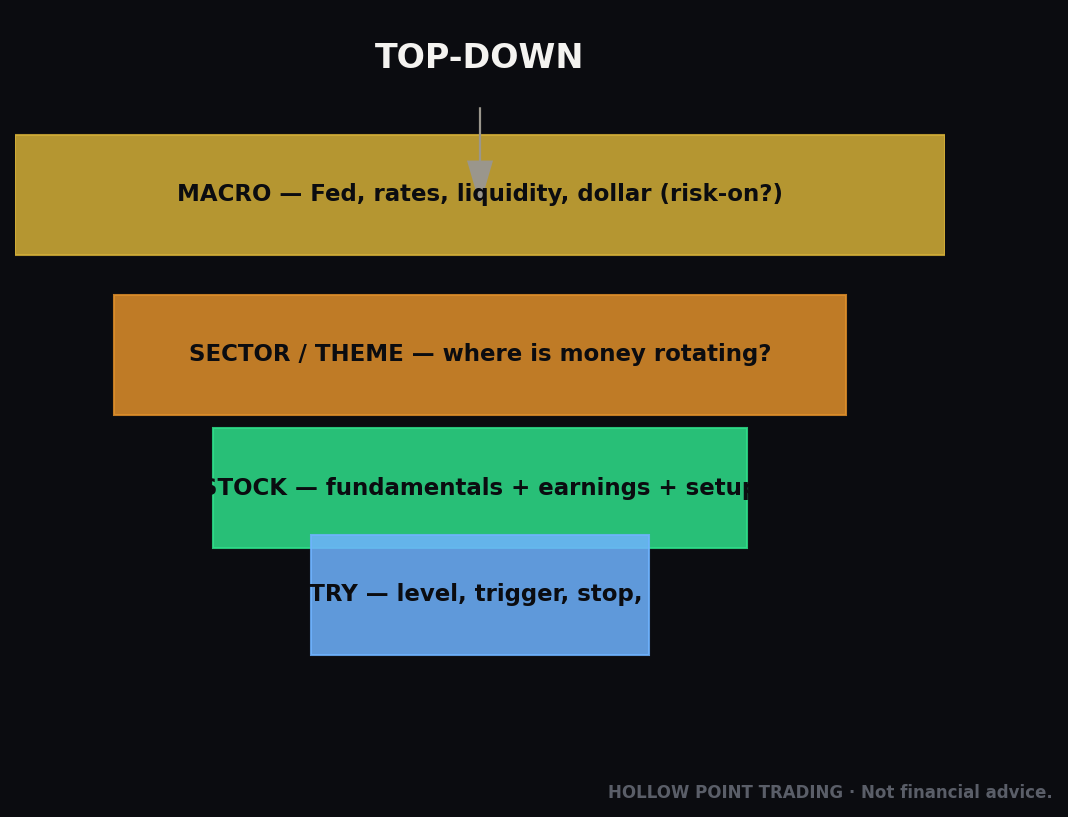
At Hollow Point Trading, we teach a specific order of operations for understanding any market: macro, then sector, then stock. Start with the big economic picture — rates, the overall market mood. Then narrow to the sector — is this industry in favor or out? Only then do you zoom into the individual stock. IV crush lives at that final, narrowest layer, but it teaches a lesson that echoes all the way up the chain: the market has already priced in what everybody knows. The obvious beat, the obvious miss, the obvious move — it's all baked in before you get there. Your edge, if you have one, comes from discipline and risk control, not from predicting the obvious.
That's why our core rule is discipline over prediction. IV crush is the perfect classroom for it, because it proves that even a correct prediction can lose. If being right isn't enough, then chasing "being right" was never the real game. The real game is managing risk so that your wins are bigger than your losses over many trades.
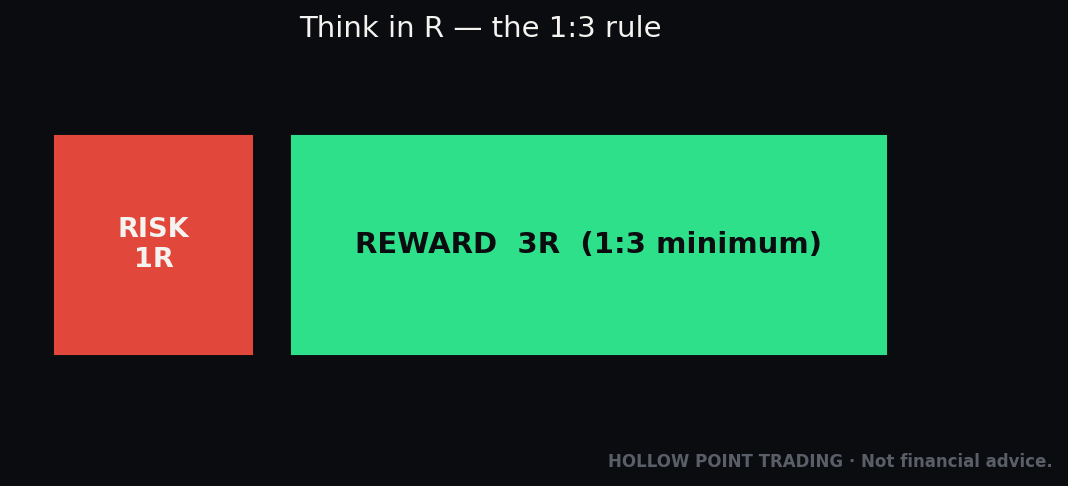
Which brings us to the number we build everything around: 1:3 reward-to-risk. That means we only take trades where, if we're right, we stand to make at least three times what we'd lose if we're wrong. Now look back at buying a call into earnings. You risk 100% of the premium, and even when you're right, IV crush might hand you a loss. That's not 1:3. That's not even 1:1. It's a negative-edge bet dressed up as a smart one. Seen through the HPT lens, the whole earnings-option-buying game fails our very first filter — and that's exactly why we teach beginners to recognize it and walk away.
Protect capital first. That's the foundation under all of it. You cannot trade tomorrow if you blow up today. Every rule in this guide — know the earnings date, respect the crush, size small, sit out when unsure — flows from that one commandment. IV crush isn't your enemy. It's a teacher. It's the market showing you, in the clearest possible terms, that the obvious trade is rarely the profitable one, and that survival beats brilliance every single time.
Learn this lesson once, on paper or on a small position, and you'll have learned something most traders take years and thousands of dollars to figure out: being right is not the same as making money — and knowing the difference is where real trading begins.
Bound by rules, feared by trade.