
You've probably had this experience already, even if you didn't have a name for it. The market opens, and a stock just sits there. It ticks up two cents, back down two cents, up three, back down three. All day. Like it's glued to a number. The news is exciting, the volume is decent, and yet price acts like it's stuck in wet cement.
Then, a few days later, the opposite happens. One piece of news hits and price doesn't just move — it leaps, then leaps again, like each move is feeding on itself, snowballing bigger and bigger until it feels like the floor dropped out.
Most beginners assume both of those days are random. They're not. A huge amount of that behavior is caused by something called gamma — specifically, the hedging that big trading firms are forced to do behind the scenes. Once you can see it, you stop being surprised by "sticky" days and "runaway" days. You start expecting them.
This guide will teach you gamma from absolute zero. No prior options knowledge needed. By the end, you'll understand why price pins, why it accelerates, what "GEX" means when you hear traders throw the term around, and — most importantly — how a brand-new trader can actually use this on Monday without getting hurt.
Let's build it one brick at a time.
First, The Words We Need (Read This — Don't Skip)
Gamma lives inside the world of options, so we need a few plain-English definitions before anything else makes sense. I'll define each term once, clearly, and then we'll use them.
An option is a contract that gives someone the right — but not the obligation — to buy or sell a stock at a set price, before a set date. Think of it like a coupon. A coupon says "you may buy this TV for $500 until Saturday." You don't have to. But you can if you want.
A call option is a coupon to buy a stock at a set price. People buy calls when they think price will go up.
A put option is a coupon to sell a stock at a set price. People buy puts when they think price will go down.
The strike price is the set price on the coupon — the "$500" in our TV example. For a stock option it might be "the right to buy Apple at $200."
Expiration is the date the coupon expires. After that, it's worthless if unused.
Now the two big characters in our story:
The buyer is usually a regular trader — maybe you, maybe a fund. They want something to happen. They bought the coupon on purpose.
The dealer (also called a market maker) is the giant firm on the other side of that trade. When you buy a call, someone has to sell it to you. That someone is usually a dealer. Here's the crucial part: the dealer usually doesn't have an opinion on the stock. They're not betting it goes up or down. They're a shop. They sell you the coupon, collect a small fee, and then they immediately try to protect themselves so that no matter which way the stock moves, they don't get wiped out.
That act of protecting themselves is called hedging — and that hedging is what moves the market. Hold onto that sentence. It's the whole game.
What Gamma Actually Is, In Plain English
Before gamma, you need one more term: delta.
Delta answers a simple question: if the stock moves $1, how much does this option move? A call with a delta of 0.50 gains about 50 cents when the stock gains a dollar. You can also think of delta as "how many shares of stock does this option behave like right now." A delta of 0.50 behaves like 50 shares.
Here's why the dealer cares. When a dealer sells you a call, they're now exposed — if the stock rips higher, that call you own becomes very valuable, and they owe you that value. To protect themselves, the dealer buys some actual shares of the stock to offset the risk. How many shares? Exactly enough to match the delta. If the option behaves like 50 shares, the dealer buys 50 shares. Now they're balanced — if the stock moves, their shares gain what the option costs them, and vice versa. This is called being delta-hedged or delta-neutral. Neutral just means "I don't care which way it moves, I'm protected."
Simple enough. But here's the twist that creates all the drama:
Delta doesn't stay still. As the stock price moves, the option's delta changes. A call that behaved like 50 shares might behave like 70 shares after the stock rallies, or like 30 shares after it drops.
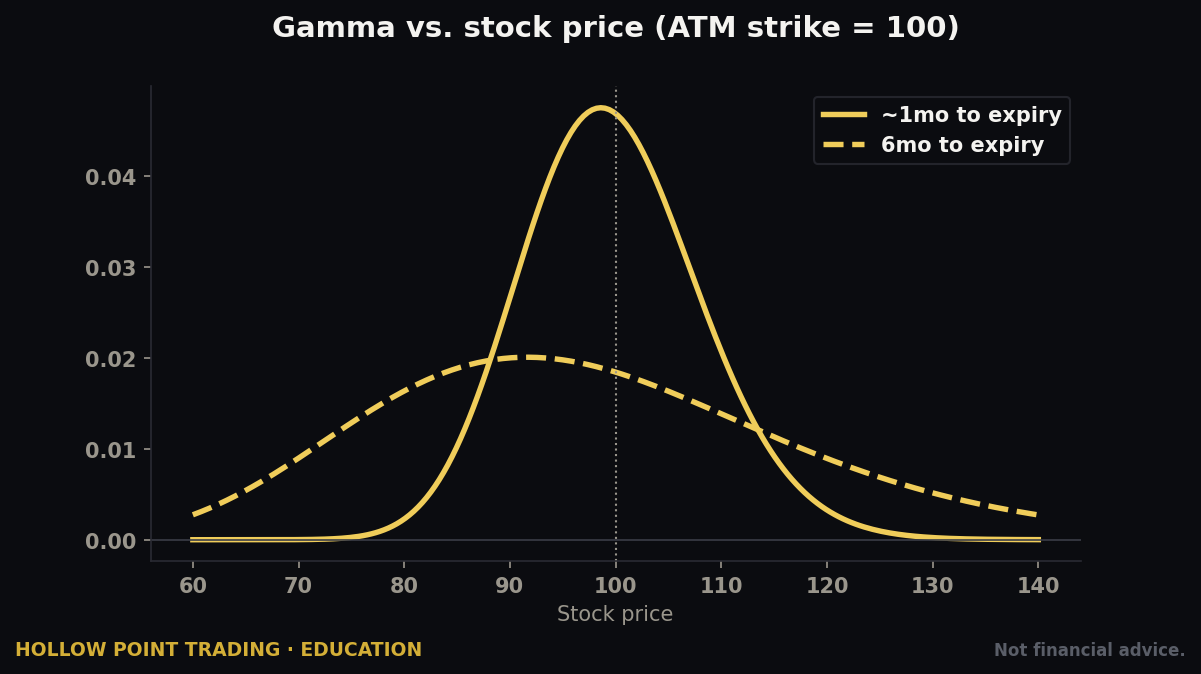
Gamma is the speed at which delta changes. That's the entire definition. Gamma measures how fast the dealer's hedge goes out of balance as price moves.
- High gamma = delta changes fast = the dealer has to re-adjust their hedge constantly, buying and selling shares over and over.
- Low gamma = delta barely changes = the dealer can mostly sit still.
And every time the dealer re-adjusts their hedge, they are buying or selling real shares in the real market. That buying and selling is the fingerprint gamma leaves on price. When there are enough options concentrated in one place, the dealer's forced hedging becomes big enough to steer the stock.
The Two Worlds: Long Gamma and Short Gamma
This is the single most important concept in the entire guide, so we'll go slow. There are two situations a dealer can be in, and they produce opposite market behavior.
World 1: Dealers Are "Long Gamma" — The Market Gets Sticky
When dealers are long gamma, their required hedging works against whatever price is doing. It's a calming force. Here's the mechanic:
- Stock goes up → the dealer's hedge tells them they now need fewer shares → so they sell shares → selling pushes price back down.
- Stock goes down → the dealer's hedge tells them they need more shares → so they buy shares → buying pushes price back up.
Read that again and notice the pattern: they sell into strength and buy into weakness. They're constantly fading the move. It's like the stock is on a bungee cord. Every time it tries to run away, the dealer's hedging yanks it back toward the middle.
This is why some days feel glued. Long-gamma environments create low volatility, tight ranges, and "pinning" — price magnetized toward a level and unwilling to leave.
World 2: Dealers Are "Short Gamma" — The Market Gets Wild
When dealers are short gamma, everything flips. Now their hedging works with the move — it pours gasoline on it:
- Stock goes up → the dealer's hedge tells them they need more shares → so they buy shares → buying pushes price higher still.
- Stock goes down → the dealer's hedge tells them they need fewer shares → so they sell shares → selling pushes price lower still.
Now the pattern is: they buy into strength and sell into weakness. They're chasing the move, amplifying it. A small drop makes them sell, which makes a bigger drop, which makes them sell more. It snowballs.
This is why some days explode. Short-gamma environments create high volatility, big trending moves, and "acceleration." The scary, fast, one-directional days — especially sharp sell-offs — very often happen in short-gamma conditions. The dealers aren't causing the crash out of malice; they're mechanically forced to sell as it falls, and that selling makes the fall worse.
Here's the one-sentence version to tattoo on your brain:
Long gamma = brakes. Short gamma = gas pedal.
Everything else in this guide is just detail hanging off that idea.
Why Should A Total Beginner Even Care?
Fair question. You're new. You're not trading options yet. Why does the hedging behavior of billion-dollar firms matter to your first trades?
Three reasons.
Reason one: it explains days that would otherwise confuse and frustrate you. New traders lose money and confidence on sticky days because they keep expecting a breakout that the gamma environment is actively preventing. You'll take a small long, price pins, you get bored, you get chopped up entering and exiting. If you knew it was a pinning day, you'd either stand aside or trade the range instead of fighting it.
Reason two: it warns you when moves can get violent. Short-gamma days are where beginners get hurt — because a stop-loss you thought was safe gets blown through in seconds when the acceleration kicks in. Knowing you're in a "gas pedal" environment tells you to size smaller and give moves more room, or simply to stay out.
Reason three — and this is the HPT reason — it fits the discipline-first way we trade. At Hollow Point Trading we don't try to predict the market like fortune tellers. We read the conditions and then follow rules that protect our capital. Gamma is a condition. It's one more input that tells you whether today favors patient range-trading or careful trend-riding — or no trading at all. You will not build a strategy purely on gamma. But ignoring it is like sailing without checking whether the water is calm or stormy.
How It Works, Step By Step
Let's walk the full chain of cause and effect one time, slowly, so nothing is a mystery.
Step 1 — Regular traders buy options. Lots of people buy calls at, say, the $200 strike on some stock because they think it'll rise. Big volume piles up at that strike.
Step 2 — Dealers take the other side. They sold those calls. Now they're exposed and must hedge.
Step 3 — Dealers buy shares to hedge. They buy enough stock to match delta and become neutral.
Step 4 — Price moves, so delta moves, so the hedge must be adjusted. This is gamma in action. The dealer is now forced to trade shares again.
Step 5 — The direction of that forced trading depends on whether dealers are net long or short gamma. Long gamma → they fade the move (calming). Short gamma → they chase it (amplifying).
Step 6 — Repeat all day, on every tick. Multiply this across thousands of options and dozens of dealers, and their combined hedging becomes a real, measurable force pressing on price.
The bigger the pile of options at a given price, the stronger the effect. This is why traders watch specific strike prices so closely — because a strike with a mountain of open contracts is a place where dealer hedging is concentrated, and concentrated hedging bends price.
Meet The Walls And The Flip
Now we can name the three landmarks that gamma creates on a chart. These are the practical, look-at-them-on-Monday features.
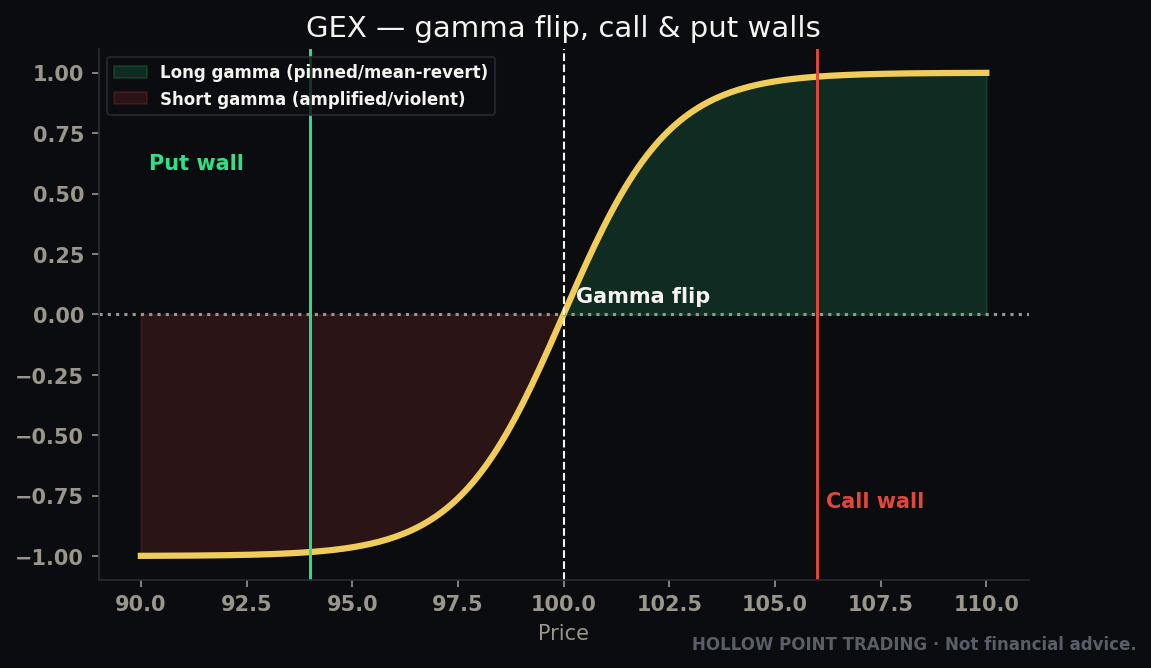
The Call Wall. This is the strike price with the largest pile of call options above the current price. Because of how dealer hedging works around a big call pile, the call wall often acts like a ceiling — a level price struggles to punch above, at least while that pile is intact. Think of it as the top of the room.
The Put Wall. The mirror image: the strike with the largest pile of put options below current price. It often acts like a floor — a level price struggles to fall below. The bottom of the room.
The Gamma Flip. This is the price level where dealers switch from long gamma to short gamma. Above the flip, you're usually in the "brakes" world — calm, pinning, range-bound. Below the flip, you're usually in the "gas pedal" world — fast, trending, dangerous. The gamma flip is like the waterline of a ship. Above it, you're floating in calm conditions. Drop below it, and suddenly you're underwater where everything is turbulent and moves fast.
This is why experienced traders get nervous when the market breaks below its gamma flip level. It's a signal that the character of the market may have just changed from "sticky and safe" to "fast and violent."
Now, GEX — In Plain English
You'll hear traders and services throw around GEX. It sounds technical. It isn't, really.
GEX stands for Gamma Exposure. It's a single number that tries to answer one question: overall, are dealers in the "brakes" world or the "gas pedal" world right now, and how strongly?
- Positive GEX = dealers are net long gamma = brakes = expect calmer, range-bound, pinning behavior.
- Negative GEX = dealers are net short gamma = gas pedal = expect wilder, trending, accelerating behavior.
- The bigger the number (positive or negative), the stronger the effect.
That's it. GEX is a thermometer. Positive reading = calm weather likely. Negative reading = storm weather likely. You don't need to calculate it yourself — data services compute it. Your job as a beginner is simply to read whether it's positive or negative and how extreme, and let that shape your expectations for the day.
A quick honesty note, because HPT does not sell fairy tales: GEX is an estimate. It's built on assumptions about who's holding what, and different services calculate it slightly differently. It is a weather forecast, not a crystal ball. Treat it as a lean, not a law.
A Fully Worked Beginner Example
Let's make this concrete with round, fake-but-realistic numbers. Meet a stock we'll call Zeta, trading at $100.
Suppose the options data shows:
- A huge call wall at $105.
- A huge put wall at $95.
- The gamma flip sits at $98.
- Current GEX is positive — dealers are long gamma, in "brakes" mode.
What should a beginner expect? Because GEX is positive and price ($100) is above the gamma flip ($98), we're in the calming world. So the base case is: Zeta chops around inside the $95–$105 room, and probably gravitates toward a big round pile in the middle. The walls act like a floor at $95 and a ceiling at $105.
Monday morning: Zeta opens at $100 and drifts up to $103. A beginner without gamma knowledge thinks "breakout! it's going to $110!" and buys, chasing. But you know the call wall is at $105. As price pushes toward $105, dealers who are long gamma sell shares to rebalance, capping the move. Zeta stalls at $104.60, can't clear the wall, and slides back to $101. The chaser gets stopped out. You, meanwhile, either stood aside near the wall or you faded it — you expected the ceiling and weren't fooled.
Tuesday: Zeta dips to $96, approaching the put wall at $95. The same mechanic in reverse: dealers buy shares to rebalance, and $95 holds like a floor. Zeta bounces back to $99. A beginner who panic-sold the dip at $96 got shaken out right at support. You expected the floor.
Wednesday — the character change: Bad news hits. Zeta slices straight through $95, the put wall, and keeps falling to $97... then $94... then punches below the gamma flip at $98 — wait, we're already below it. Once price is under the flip, dealers flip to short gamma. Now every tick down forces them to sell more, which drives price lower, which forces more selling. Zeta free-falls from $94 to $89 in twenty minutes. The move is fast and ugly.
Here's the lesson stacked inside that story: the same stock behaved calmly for two days and violently on the third — and the difference was entirely which gamma world it was in. Above the flip, walls held and ranges ruled. Below the flip, the floor gave way and acceleration took over. If you were watching the gamma flip, Wednesday didn't blindside you. The break below $98 was your early warning to tighten up, size down, or get flat.
That's the whole point of learning gamma: it turns "the market did something scary and random" into "the market did exactly what the conditions said it might."
The Beginner Mistakes To Avoid
New traders reliably hurt themselves in the same handful of ways with this topic. Here they are, so you can skip the tuition.
Mistake 1: Treating gamma levels as guarantees. The call wall is a magnet and a lean, not a brick wall welded in place. Price can and does blow through walls, especially on strong news or as expiration passes and the options roll off. Never bet your account on a wall holding. Use it to set expectations, not to remove your stop-loss.
Mistake 2: Trading gamma with no other confirmation. Gamma is one input. At HPT we stack confluence — macro conditions, the sector, the individual stock's structure, trend, and behavior all pointing the same way — before we act. A pinning lean plus a clean chart level plus a trend that agrees is a setup. A pinning lean alone is just a guess wearing a lab coat.
Mistake 3: Ignoring expiration. Gamma effects are strongest close to expiration — the day the options die, often called OPEX. Pinning is frequently most intense on those days because so much gamma is concentrated in near-dated contracts. And right after a big expiration, the "walls" you were watching can vanish because the options that created them expired. Always know when expiration is.
Mistake 4: Underestimating short gamma. Beginners love the calm long-gamma days and forget the gas-pedal days will eventually come. The short-gamma acceleration is exactly where oversized positions and too-tight stops get destroyed. When GEX flips negative or price breaks the gamma flip, that is your cue to respect the danger — smaller size, wider stops, or no trade.
Mistake 5: Confusing gamma with a prediction. Gamma tells you the conditions and tendencies — brakes or gas, likely floor, likely ceiling. It does not tell you the future. HPT's entire philosophy is discipline over prediction. Gamma fits that beautifully because it's about conditions, not fortune-telling. The moment you treat it as prophecy, you've misunderstood it.
Mistake 6: Forgetting to protect capital first. Every single one of these ties back to the first rule of the house: your first job is not to make money, it's to not lose money. Gamma awareness is a shield before it's a sword. Its highest value to a beginner is keeping you out of the bad spots.
Your Simple Gamma Cheat-Sheet
Print this. Tape it near your screen. This is the beginner version you can actually use Monday.
Before the day starts, ask:
- Is GEX positive or negative today? Positive = expect brakes (calm, range). Negative = expect gas (fast, trend).
- Where is the gamma flip level? Above it = calmer world. Below it = faster world. Watch for a break through it.
- Where is the call wall (likely ceiling) and the put wall (likely floor)? These frame today's "room."
- When is expiration? Effects are strongest near it; walls can vanish right after.
During the day, remember:
- Long gamma (positive GEX) → dealers fade moves → don't chase breakouts into a wall; expect pinning.
- Short gamma (negative GEX) → dealers chase moves → respect trends, size down, widen stops or stand aside.
- A break below the gamma flip = character may be shifting from calm to violent. Get defensive.
- Walls are leans, not laws. Always keep your stop-loss.
The one-line summary: Positive GEX = bungee cord (snaps back). Negative GEX = snowball (runs away).
How Gamma Fits The Bigger HPT Picture
Let's zoom all the way out, because gamma is a single tool and you are building a whole toolbox.
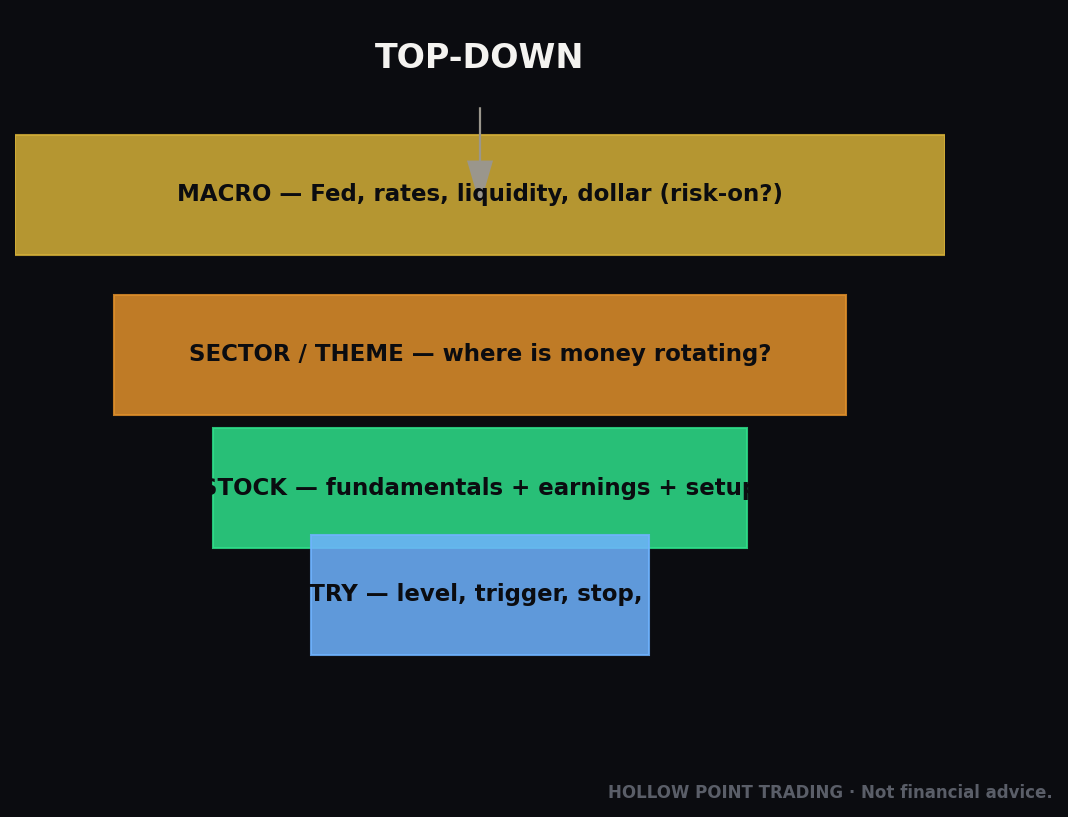
At Hollow Point Trading, decisions flow in a specific order: macro → sector → stock → behavior. We start with the big economic weather. We narrow to which sectors are strong or weak. We pick the individual stock. Then we read behavior — how price is actually acting right now. Gamma lives mostly in that last layer, the behavior layer. It's a lens for reading how today is likely to move — sticky or wild, capped or accelerating.
It never replaces the layers above it. A gorgeous pinning setup on a stock in a collapsing sector during an ugly macro backdrop is still a trade you probably skip. Gamma refines your read; it doesn't override the hierarchy.
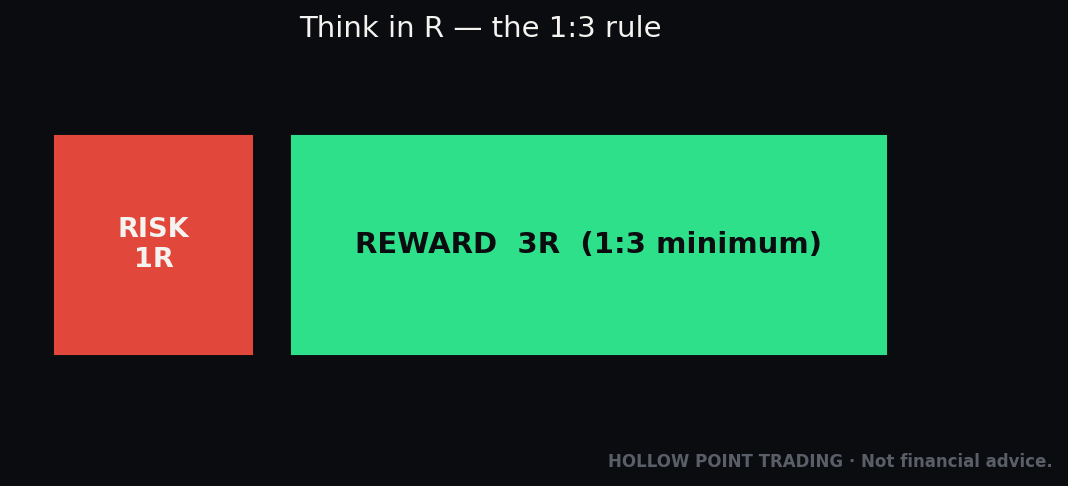
And it plugs directly into the two rules that define how we trade. First, discipline over prediction: gamma gives you conditions, not prophecies, which is exactly the mindset that keeps a trader alive. Second, protect capital first with a 1:3 reward-to-risk floor — meaning we only take trades where we stand to make at least three dollars for every one we risk. Gamma helps here in a very direct way: knowing where the walls are helps you find spots where your risk is small (a stop just past a strong floor) and your reward is large (room to run toward the ceiling). That's the kind of asymmetric setup that makes a 1:3 possible instead of a fantasy.
Here's the honest truth for a beginner: you do not need to master gamma to start trading responsibly. You need position sizing, stop-losses, a plan, and the patience to follow rules. But once those basics are solid, gamma is one of the highest-value context tools you can add. It's the difference between staring at a sticky market baffled — and nodding, because you already knew today was a bungee-cord day.
Start small. For your first month of watching gamma, don't even trade on it. Just observe. Note the call wall, the put wall, and the flip each morning, then watch how price behaves around them. Was it a brakes day or a gas day? Did the walls hold? You'll be astonished how often the market respects these invisible lines — and you'll start to see the dealers' hidden hand in the tape. Only after you can reliably read it should you let it shape a trade, and even then only as one voice in a stack of confluence.
That's gamma. Not a secret weapon, not a crystal ball — just the mechanical footprint of forced hedging, pressing quietly on price all day long. Now you can see it. And a trader who can see the current is a great deal harder to drown than one who can't.
Bound by rules, feared by trade.