
If you have ever watched a futures price flicker up and down and wondered, "Wait — how much money is that actually?", this guide is for you. By the end, you will be able to look at any futures quote and know, to the penny, what one tick, one point, and one full move is worth. That single skill is the difference between trading with your eyes open and trading blind.
We are going to go slow. We will define every word the first time we use it. And we will use the two most popular futures contracts in the world — the ES (E-mini S&P 500) and the NQ (E-mini Nasdaq-100) — as our running examples, with lots of small, worked-out numbers you can follow on your fingers.
Let's build it from the ground up.
First, What Even Is a Futures Contract?
Before we talk about ticks and points, we need to know what we are measuring.
A futures contract is a standardized agreement to buy or sell something at a set price on a future date. That "something" can be oil, gold, wheat, or — in our case — a stock market index.
Here is the plain-English version. Imagine you and a friend make a bet on where the S&P 500 stock index will be. The S&P 500 is just a number that tracks 500 large U.S. companies bundled together. Today that number might be, say, 5,400. You think it goes up; your friend thinks it goes down. A futures contract is a formal, exchange-backed version of that bet — except instead of a handshake, it is a regulated contract traded on the CME (the Chicago Mercantile Exchange, the big marketplace where these trade).
You do not actually receive 500 physical stocks. With index futures, the contract is cash-settled — meaning it is all settled in dollars based on where the index number goes. You are trading the movement of the number.
Two key terms before we go further:
- Going long means you buy first, betting the price goes up. You profit if it rises.
- Going short means you sell first, betting the price goes down. You profit if it falls. (Yes, in futures you can sell something before you own it — that is normal and built into how the market works.)
Now — the big question. If the index moves, how much money did you just make or lose? To answer that, we need three little building blocks: tick size, tick value, and the contract multiplier (also called the point value). These three numbers are the "specs" — the specifications — of the contract. Every futures contract has them, and they are published and fixed by the exchange. They never change on you mid-trade.
Let's take them one at a time.
Building Block #1: What Is a "Point"?
A point is simply one full unit of the index's price.
If the S&P 500 index is at 5,400.00 and it moves to 5,401.00, that is a one-point move. If it goes from 5,400 to 5,410, that is a ten-point move. Easy. A point is just the whole number moving by one.
Think of it like the odometer in your car. Each full number that rolls over is one "point" of distance. The index has an odometer too, and each full number it climbs or drops is one point.
But here is the crucial part that trips up every beginner: a point of the index is not a dollar. When people who have never traded futures see the S&P go up "one point," they assume that means one dollar. It does not. One point of movement is worth a specific, fixed dollar amount — and that amount is decided by the contract multiplier. We will get to that in Building Block #3, and it is where the real money lives.
First, though, we need to zoom in even smaller than a point — because the market does not move in whole points. It moves in ticks.
Building Block #2: What Is a "Tick" and What Is "Tick Size"?
The price does not jump straight from 5,400 to 5,401. It shuffles along in tiny approved steps. Each smallest step is called a tick.
The tick size is the smallest amount a contract's price is allowed to move. You cannot place an order at just any random price — the exchange only allows prices at these fixed increments.
For both the ES and the NQ, the tick size is 0.25 — a quarter of a point.
That means the price can be 5,400.00, then 5,400.25, then 5,400.50, then 5,400.75, then 5,401.00. It cannot be 5,400.10 or 5,400.33. Those prices simply do not exist for this contract. The market moves in quarters.
So how many ticks are in one point? Since each tick is 0.25 and a point is 1.00:
1 point ÷ 0.25 = 4 ticks per point.
Write that down, because it is one of the most useful little facts in all of futures trading: for the ES and the NQ, one point equals four ticks. Always. Every time.
Why does tick size exist at all? Two reasons, in beginner terms. First, it keeps the market orderly — everyone is quoting prices on the same neat grid instead of a chaotic mess of fractions. Second, it creates a clear, countable unit for measuring your profit and loss. Instead of saying "I made 0.75 of a point," a trader says "I made three ticks." It is a cleaner way to count.
A quick analogy: think of a ruler. A point is one inch. A tick is a quarter-inch mark on that ruler. The price can stop on any quarter-inch line, but never in between them.
Now we know how far the price steps. But we still do not know how much money each step is worth. For that, we finally reach the number that matters most.
Building Block #3: The Contract Multiplier (a.k.a. What One Point Is Worth)
Here is the heart of the whole thing.
Every index futures contract has a contract multiplier — a fixed dollar amount that translates index movement into real money. It answers the question: "When the index moves one full point, how many dollars does one contract gain or lose?"
- The ES (E-mini S&P 500) has a multiplier of $50 per point.
- The NQ (E-mini Nasdaq-100) has a multiplier of $20 per point.
That is it. That is the magic number. When the S&P index moves one point and you are holding one ES contract, you make or lose $50. When the Nasdaq index moves one point and you hold one NQ contract, you make or lose $20.
Let that sink in, because it reframes everything. When a beginner sees "the S&P is up 20 points today" on the news, that sounds like a small number. But to someone holding one ES contract, twenty points is 20 × $50 = $1,000. Twenty little points is a thousand dollars per contract. The multiplier is what makes futures so powerful — and so dangerous if you do not respect it.
This is also why the contract multiplier is sometimes just called the point value — because it literally tells you what one point is worth in dollars.
Now we can connect all three building blocks into one clean picture.
Putting It Together: Tick Value
We have:
- Tick size = 0.25 (the smallest price step)
- Point value / multiplier = $50 for ES, $20 for NQ (what a full point is worth)
From these two, we can calculate the single most practical number in day trading: the tick value — the dollar amount you make or lose on one single tick, per contract.
The formula is simple:
Tick value = tick size × multiplier
Let's do both.
ES: tick value = 0.25 × $50 = $12.50 per tick.
NQ: tick value = 0.25 × $20 = $5.00 per tick.
So every time the ES price ticks up or down one step (0.25), one contract gains or loses $12.50. Every time the NQ ticks one step, one contract gains or loses $5.00.
And because there are four ticks in a point, you can double-check the whole thing:
- ES: 4 ticks × $12.50 = $50 per point. ✓
- NQ: 4 ticks × $5.00 = $20 per point. ✓
Everything ties out. These four numbers — tick size, tick value, point value, and ticks-per-point — are the entire spec sheet for each contract, and now you understand where every one of them comes from.
Let me put them in a little table you can memorize.
| ES (E-mini S&P 500) | NQ (E-mini Nasdaq-100) | |
|---|---|---|
| Tick size | 0.25 | 0.25 |
| Ticks per point | 4 | 4 |
| Tick value | $12.50 | $5.00 |
| Point value (multiplier) | $50 | $20 |
Why a Beginner Should Care About This More Than Anything Else
You might be thinking: "Okay, but can't I just watch my account balance and see if it goes up?" You can — but by then it is too late. Understanding specs before you click is what protects your money. Here is why this matters so much for a brand-new trader.
1. You cannot size a trade without it. Your position size is how many contracts you hold. If you do not know what one contract does per point, you have no idea how much you are risking. Trading without knowing your tick value is like driving without a speedometer — you have no sense of how fast you are going until you crash.
2. Risk is measured in points, but felt in dollars. A trader decides "I'll risk 10 points on this trade." That sentence means nothing until you translate it. On one ES contract, 10 points is $500 of risk. On one NQ contract, 10 points is $200 of risk. Same 10 points, very different dollars — because the multipliers differ. The specs are the translator between the chart and your bank account.
3. The NQ moves faster than the ES. The Nasdaq-100 is more volatile — it swings more points in a day than the S&P does. So even though the NQ's point value ($20) is smaller than the ES's ($50), the NQ often produces bigger dollar swings because it travels more points. A beginner who assumes "smaller multiplier = safer" gets a nasty surprise. Specs plus behavior together tell the real story.
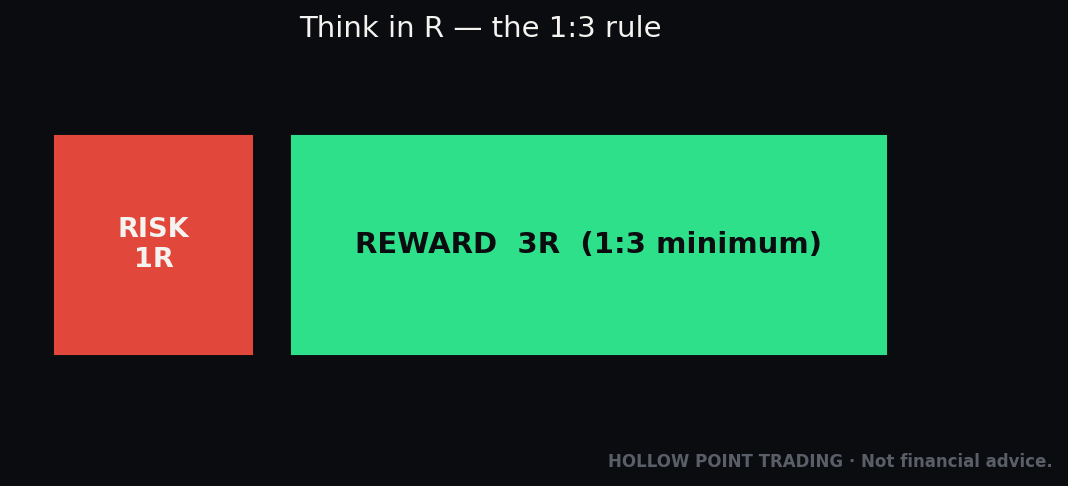
4. It is the foundation of the 1:3 reward-to-risk rule. At Hollow Point Trading, we live by risking one to make three — every dollar of risk should be paired with three dollars of potential reward. You literally cannot calculate a 1:3 setup without knowing what a point is worth. The specs are step one of every disciplined trade.
So this is not dry trivia. This is the ground floor of the entire building. Let's now walk through full examples so it becomes second nature.
A Fully Worked Beginner Example — The ES Trade
Let's trade one ES contract together, step by step, with pretend money. We will keep the numbers simple so you can follow every move.
The setup. You are watching the E-mini S&P 500. The price is 5,400.00. You believe it is going up, so you go long (buy) one ES contract at 5,400.00.
Step 1 — Know your specs before you click. One ES contract: each point = $50, each tick (0.25) = $12.50. You write this down. Good trader.
Step 2 — The price moves in your favor. The market ticks up: 5,400.25 → 5,400.50 → 5,400.75 → 5,401.00. That is four ticks, or one full point. Your gain so far: 1 point × $50 = $50. (Or check it the other way: 4 ticks × $12.50 = $50. Same answer.)
Step 3 — It keeps going. The price reaches 5,410.00. From your entry of 5,400.00, that is a 10-point move. Your open profit: 10 × $50 = $500 on one contract.
Step 4 — You take the trade off. You sell your one contract at 5,410.00 to close the position. That locks in $500 in profit (before broker fees and commissions, which are small but real — usually just a few dollars per contract round-trip).
Now let's run the same trade the other way, because losses are just as important to understand.
The losing version. You went long at 5,400.00. Instead of rising, the price falls to 5,396.00. That is a 4-point move against you. Your loss: 4 × $50 = $200. If you had set a rule to exit if the trade went 4 points against you — a stop loss, which is a pre-set exit that caps your loss — you would be out at exactly minus $200. No guessing, no hoping. That is discipline in action.
Notice how clean this is. Because you knew the specs cold, every price level on the chart instantly translated into dollars. You never had to wonder what was happening to your account — you knew before it happened.
A Second Worked Example — The NQ Trade (and Why It Feels Different)
Now let's do the exact same exercise on the NQ, so you feel the difference between contracts.
The setup. The Nasdaq-100 futures are trading at 19,000.00. You go long one NQ contract at 19,000.00.
Your specs. One NQ contract: each point = $20, each tick (0.25) = $5.00.
The price moves. The NQ ticks up one full point to 19,001.00 — that is four ticks. Your gain: 1 × $20 = $20 (or 4 ticks × $5 = $20).
Now here is the eye-opener. The Nasdaq is a jumpy, fast-moving index. In an active hour it might travel 50 points without much trouble. Say the price runs from 19,000 to 19,050. That is 50 points × $20 = $1,000 on a single contract.
Compare that to the ES. For the ES to make you $1,000 on one contract, it needs to move 20 points ($1,000 ÷ $50). The S&P is slower and steadier; it might take much longer to cover those 20 points than it takes the Nasdaq to cover 50.
The lesson: the NQ has a smaller point value but usually bigger daily dollar swings, because it moves more points. This is why many beginners are told to start on the ES, or even smaller (we will get to "smaller" in a moment) — the NQ can hand you a $500 swing in the time it takes to refill your coffee. Neither contract is "better." They are just different tools with different personalities, and the specs are how you measure that personality in dollars.
The Micros: A Beginner's Best Friend
Here is something that did not exist for early futures traders but is a gift to beginners today: Micro contracts.
For each of these big contracts, the CME offers a "Micro" version that is exactly one-tenth the size. Same index, same tick size, same behavior — just one-tenth the money at stake. They are perfect for learning because you get the real experience with a fraction of the risk.
- MES (Micro E-mini S&P 500): point value $5, tick value $1.25. (That is the ES divided by 10.)
- MNQ (Micro E-mini Nasdaq-100): point value $2, tick value $0.50. (That is the NQ divided by 10.)
So if that scary $1,000 NQ example felt like a lot for your first trade — good instinct. On the MNQ, that same 50-point move is 50 × $2 = $100, not $1,000. Same chart, same skill, one-tenth the heat. The tick size and point-counting are identical, so everything you learned above applies perfectly; you just swap in the smaller multiplier.
Full protect-capital ethos: start on Micros. Learn the mechanics, build your discipline, and prove your process works when the dollars are small. The market will still be there when you are ready to size up.
Here is the expanded cheat table including the Micros:
| Contract | Tick size | Tick value | Point value |
|---|---|---|---|
| ES (E-mini S&P 500) | 0.25 | $12.50 | $50 |
| MES (Micro S&P 500) | 0.25 | $1.25 | $5 |
| NQ (E-mini Nasdaq-100) | 0.25 | $5.00 | $20 |
| MNQ (Micro Nasdaq-100) | 0.25 | $0.50 | $2 |
The Beginner Mistakes to Avoid
Every new futures trader stumbles on the same handful of spec-related traps. Here they are, so you can step over them instead of into them.
Mistake #1: Confusing points with dollars. "The S&P moved 5 points, no big deal." On one ES contract, 5 points is $250. Always translate points into dollars before you feel relaxed about a number. The multiplier is not optional math — it is the whole game.
Mistake #2: Confusing ticks with points. A beginner sets a stop "10 away" but is fuzzy on whether that is 10 ticks or 10 points. On the ES, 10 ticks is $125, while 10 points is $500 — a four-times difference. Mixing these up will wreck your risk plan. Remember: four ticks make one point. Say out loud which one you mean.
Mistake #3: Assuming the smaller multiplier is safer. As we saw, the NQ's $20 multiplier looks tamer than the ES's $50, but the Nasdaq's speed can make the NQ the bigger dollar risk. Judge risk by dollars moved in a real day, not by the multiplier alone.
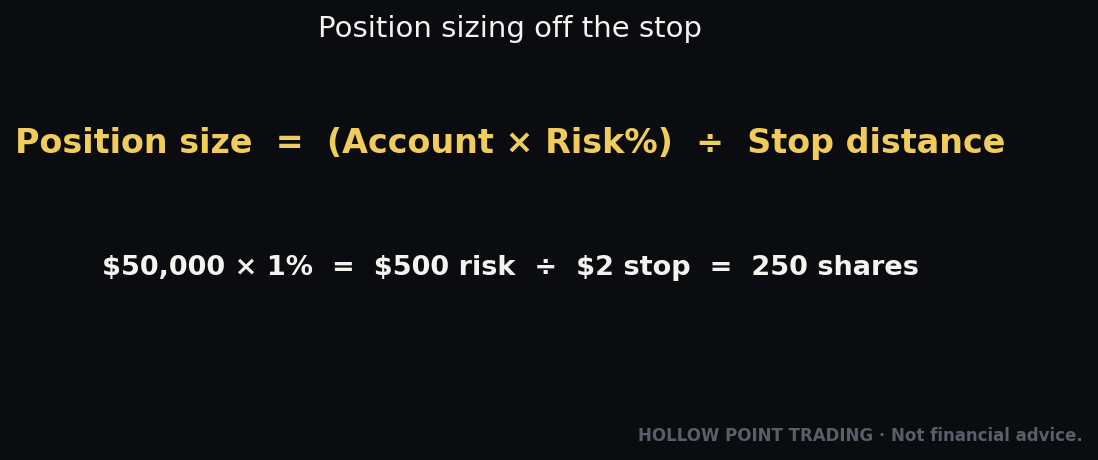
Mistake #4: Ignoring how many contracts you hold. Every number in this guide is per contract. Hold three ES contracts and every point is 3 × $50 = $150, every tick is 3 × $12.50 = $37.50. Beginners forget to multiply by their position size and are shocked by how fast the account moves. More contracts is not more courage — it is more of everything, gains and losses alike.
Mistake #5: Starting too big. The single most common way beginners blow up an account is trading full-size ES or NQ before they are ready. The Micros exist precisely so you never have to. There is no prize for risking $50 a point on day one.
Mistake #6: Trading before you can recite the specs from memory. If you cannot instantly say what a point and a tick are worth on the contract in front of you, you are not ready to click buy. This is not gatekeeping — it is the seatbelt. Put it on first.
Your Simple Spec Cheat-Sheet
Print this. Tape it to your monitor. Read it before every session until it lives in your head.
The four numbers that never change:
- ES: 1 tick = 0.25 = $12.50 · 1 point = $50
- NQ: 1 tick = 0.25 = $5.00 · 1 point = $20
- MES: 1 tick = $1.25 · 1 point = $5
- MNQ: 1 tick = $0.50 · 1 point = $2
The rules of thumb that always apply:
- 4 ticks = 1 point. Always.
- Tick value = tick size × multiplier.
- Every number is per contract — multiply by how many you hold.
- Points are the chart; dollars are your account. Always translate.
- Bigger multiplier ≠ bigger risk. Real daily movement decides risk.
The pre-trade three-question check:
- What is one point worth on this contract, in dollars?
- How many points am I risking, and how many dollars is that?
- Is my potential reward at least three times that risk? (1:3 or better.)
If you can answer those three questions before you click, you are already ahead of most people who have been "trading" for a year.
A Worked Risk Example That Ties It All Together
Let's finish the mechanics with one complete, disciplined trade that uses the specs to build a real risk plan — the Hollow Point way.
You want to trade one MES contract (smart, small, beginner-appropriate). Price is 5,400.00. Your plan:
- Entry: long at 5,400.00.
- Stop loss: 5,396.00 — that is 4 points of risk. In dollars: 4 × $5 = $20 of risk.
- Target: for a 1:3 reward-to-risk, you need three times your risk. 3 × 4 points = 12 points of reward. So your target is 5,400 + 12 = 5,412.00. In dollars: 12 × $5 = $60 of potential reward.
Now the whole trade is defined in advance: risk $20 to make $60. You know your worst case before you enter. You are not predicting where the market goes — you are defining what you will accept either way. That is the entire mindset shift that separates traders from gamblers, and it is built entirely on the specs you just learned. Without knowing that a point equals $5 on the MES, none of that plan could exist.
Even if this trade loses, you lose a known, small $20. Even if you are wrong more often than right, a stack of 1:3 trades can still grow your account, because your winners are three times the size of your losers. The specs are what let you engineer that math on purpose.
How This Fits the Bigger Hollow Point Picture
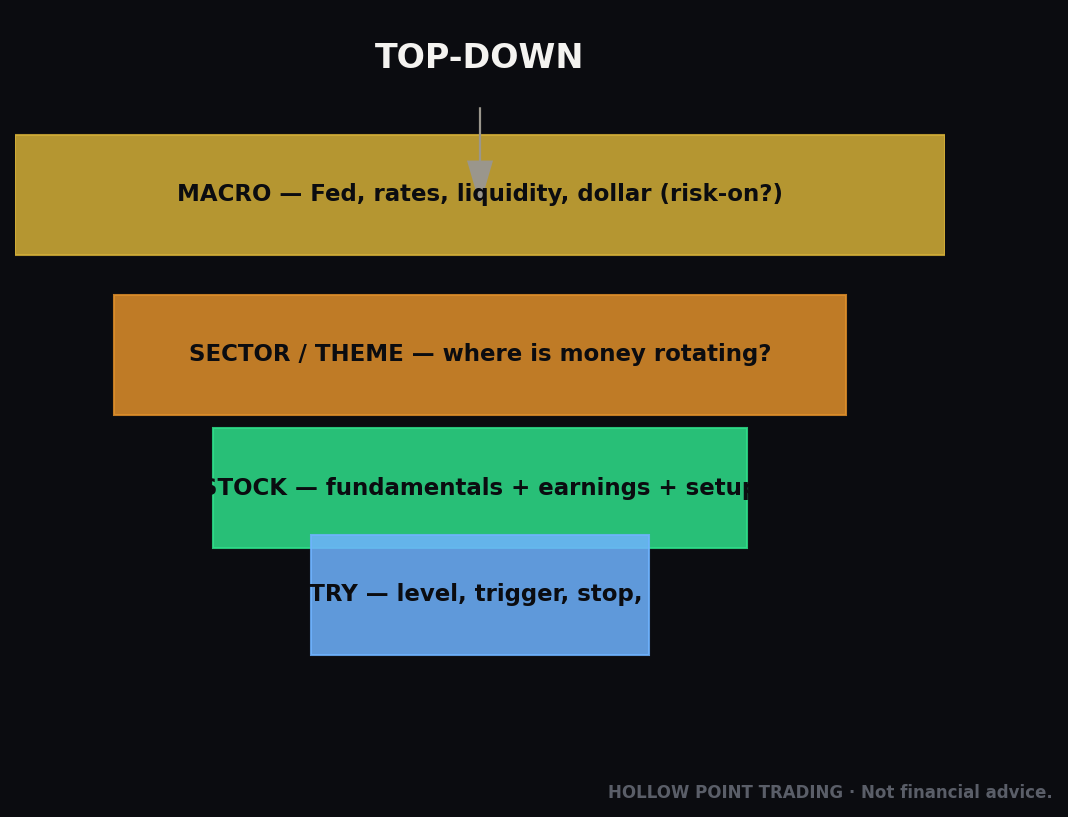
At Hollow Point Trading, we teach top-down: macro → sector → stock. We start by reading the whole market's weather (the macro — interest rates, the broad trend, the overall mood), then narrow to which sectors are leading, then down to the specific instrument we will actually trade. The ES and NQ sit near the very top of that funnel — they are the broad market. The S&P is the wide U.S. economy; the Nasdaq is the technology-heavy, faster-moving cousin. When you trade them, you are trading the macro tide itself.
But reading the market right is only half the job. The other half — the half that keeps you in the game long enough for your reads to pay off — is knowing exactly what you are risking on every click. That is what contract specs give you. A brilliant market read with sloppy sizing still ends in a blown account. A modest read with airtight sizing and 1:3 discipline survives, compounds, and grows.
That is the whole Hollow Point ethos in one sentence: we protect capital first, and we let discipline — not prediction — carry the results. Specs are the foundation of that discipline. You cannot risk one to make three if you do not know what one is. You cannot protect capital you cannot measure. Everything else we teach — the levels, the confluence, the patterns, the timing — sits on top of this floor you have just poured.
So here is your homework, and it is the best first move a beginner can make. Open your platform on the MES or MNQ, not the full-size contract. Watch the price tick. Every time it moves one tick, say the dollar amount out loud: "$1.25… $2.50…" Every time it moves a point, say it: "$5… $10…" Do that until the translation is automatic — until points are dollars in your mind without any effort. When you reach that point, you will have earned the single most important instinct in futures trading, and you will be ready for everything that comes next.
Welcome to the seat. Now you know what the numbers cost.
Bound by rules, feared by trade.