
You've probably heard someone say they "trade futures" and make it sound thrilling — fast money, up all night, green numbers flashing. What they usually leave out is the other side of the story: futures is also the market that can take a beginner from confident to broke in a single morning, sometimes in a single bad ten minutes. Not because the person was stupid. Because they didn't understand the one thing that makes futures different from almost everything else — speed multiplied by borrowed size.
This guide exists to fix that. By the end, you'll understand what a futures contract actually is, why it moves so violently, why "leverage" is both the appeal and the trap, and — most importantly — exactly how to size a position and set a stop so that no single trade can hurt you. We're going to go slow, define every term, and use a lot of small examples with real-ish numbers. If you've never placed a trade in your life, you're in the right seat.
What A Futures Contract Actually Is (In Plain English)
Let's start with zero assumptions.
A futures contract is an agreement to buy or sell something at a set price on a future date. That's where the name comes from — you're trading the future price of a thing. The "thing" can be oil, gold, wheat, or — the ones most beginners end up looking at — a stock market index like the S&P 500 or the Nasdaq 100.
Originally, futures were built for farmers and companies. A corn farmer in spring doesn't know what corn will sell for in the fall, so he locks in a price now using a futures contract. That way, if prices crash by harvest, he's protected. This is called hedging — using futures to reduce risk on something you actually own or produce.
But most people trading futures today aren't farmers. They're speculators — people trying to profit from price movement itself, without ever wanting to take delivery of 5,000 bushels of corn. When you hear a beginner say "I trade futures," they almost always mean they're speculating on the direction of an index like the S&P 500.
Here's the key mental shift: you are not buying the thing. You are making a bet on which way its price moves, and putting up a small deposit to hold that bet. That small deposit is where all the danger — and all the opportunity — lives.
The Terms You Need Before We Go Further
Let's define the vocabulary now, once, so nothing later trips you up.
- Going long: betting the price goes up. You buy first, hoping to sell higher.
- Going short: betting the price goes down. In futures, you can sell first and buy back later. This is normal and easy in futures — that's one reason people love them.
- Point: the basic unit a contract's price moves in. If the S&P 500 index goes from 5000 to 5001, that's one point.
- Tick: the smallest amount a price can move — a fraction of a point. On many index contracts, one tick is 0.25 of a point.
- Tick value / point value: the dollar amount you gain or lose per tick or per point. This is the number that turns price movement into money in your account. Memorize that it exists; we'll use it constantly.
- Margin: the deposit you must put up to open a position. Not the cost of the contract — just a good-faith deposit to hold it.
- Contract (or "lot"): one unit of the trade. "Trading two contracts" means twice the size, twice the money per point, twice the risk.
Got those? Good. Now let's see why futures move fast — and why that matters more than anything else in this guide.
Why Futures Move So Fast
Two reasons. Understand both and you understand 80% of the danger.
Reason one: the market is huge, liquid, and open almost around the clock. Index futures trade nearly 24 hours a day, five days a week. Enormous amounts of money flow through them. When news hits — an economic report, a war headline, a surprise from the Federal Reserve — the reaction shows up in futures first, and it shows up instantly. Prices can lurch dozens of points in seconds. There's no "wait for the market to open" cushion. It's always live.
Reason two — and this is the big one: leverage. In futures, a tiny move in price is multiplied into a large move in your account, because each point is worth a fixed chunk of dollars and you're controlling a big position with a small deposit. We're going to spend real time on this, because leverage is the single most misunderstood — and most account-destroying — concept for beginners.
Put those together and you get a market where a beginner can be up $300 and then down $500 inside of one coffee. That's not a horror story. That's a Tuesday.
Leverage: The Appeal And The Trap
Leverage means controlling a large amount of value with a small amount of money.
Think about buying a house. You want a $400,000 house but you only put down $40,000. The bank covers the rest. You control a $400,000 asset with $40,000. That's leverage — roughly 10-to-1 here. Now, if the house goes up 10%, it's worth $440,000. You made $40,000 — a 100% return on your $40,000 down payment. Leverage magnified your gain enormously.
But flip it. If the house drops 10%, it's worth $360,000. You just lost your entire $40,000 down payment on a mere 10% move. Leverage magnifies losses exactly as hard as it magnifies gains. That symmetry is the whole story.
Futures work the same way, but faster and with far more leverage. Let's put real numbers on it.
Take a common beginner contract: the Micro E-mini S&P 500, ticker MES. (A "micro" is a smaller version of a full contract, built specifically so smaller accounts can participate. More on that soon.) With MES, each one-point move in the S&P 500 index is worth $5 to you, per contract.
Now, the S&P 500 index might be sitting around 5000. One full contract's worth of exposure is 5000 × $5 = $25,000 of market value you're controlling. But the deposit — the margin — to hold one MES overnight might be only around $1,000 to $1,500, and some brokers let you hold it intraday for as little as a few hundred dollars.
So with roughly $1,200, you're controlling $25,000 of market. That's about 20-to-1 leverage. A 1% move in the S&P — completely normal in a single day — is 50 points. Fifty points × $5 = $250. On your ~$1,200 deposit, that's a 20% swing in your account from an utterly ordinary daily move.
Now imagine the beginner who thinks "micro is small, let me trade ten of them to make it interesting." Now every point is worth $50, and that same ordinary 50-point day is a $2,500 swing. That's the trap. The size feels small. The dollar consequences are not.
Meet The Contracts A Beginner Might Actually Touch
You don't need to know all futures products. You need to know the handful a beginner encounters, and their point values, because the point value is your risk-per-move.
- MES (Micro E-mini S&P 500): tracks the S&P 500. $5 per point. One tick (0.25) = $1.25.
- ES (E-mini S&P 500): the big brother. $50 per point. One tick = $12.50. Ten times the size of MES.
- MNQ (Micro E-mini Nasdaq 100): tracks the tech-heavy Nasdaq 100. $2 per point. The Nasdaq moves many more points than the S&P, so don't let the small per-point number fool you.
- NQ (E-mini Nasdaq 100): the big brother. $20 per point. This is the fast, wild one. A "quiet" NQ day can still be 200+ points of range — that's $4,000 of movement per contract.
Notice the pattern: the "micro" versions exist so beginners can trade with one-tenth the dollar risk of the full-size contract. A beginner should never start on a full-size ES or NQ. Start on the micros. The math still teaches you everything, but a mistake costs you tens of dollars instead of hundreds.
Here's why NQ deserves special fear. Say the Nasdaq moves 100 points against you — a small move for that index. On one MNQ that's 100 × $2 = $200. On one full NQ it's 100 × $20 = $2,000. Same chart, same move, ten times the pain. Beginners blow up on NQ specifically because they underestimate how many points it travels.
The Concept That Saves Beginners: Risk Per Trade
Everything we've covered — speed, leverage, big point values — sounds scary because it is scary if you have no defense. Here's the defense, and it's beautifully simple.
You decide, before you enter, the exact number of dollars you're willing to lose on this one trade. Then you build the trade around that number.
That's it. That's the whole secret that separates traders who survive from traders who don't. Amateurs think about how much they could make. Professionals decide first how much they could lose, cap it, and let the profit take care of itself. At Hollow Point Trading we put it bluntly: protect capital first. You cannot trade tomorrow if you're broke today.
The industry rule of thumb is to risk no more than 1% of your account on any single trade — and for beginners, going even smaller, half a percent, is wiser while you learn. Let's define what "risk 1%" means with a real account.
Say your account is $5,000. One percent of that is $50. That $50 is your maximum loss on the next trade — your "risk per trade." Not a suggestion. A hard ceiling. If a trade would require risking more than $50, you either make the trade smaller or you don't take it. Full stop.
Now the beautiful part: once you know your dollar risk and you know where the trade proves you wrong, the correct position size calculates itself. You never have to guess. Let's learn the two tools that make that automatic — the hard stop and the sizing formula.
Hard Stops: Your Automatic Emergency Brake
A stop-loss — usually just called a stop — is an order you place that automatically closes your trade if the price hits a level you chose in advance. It's the emergency brake. You set it, and if the market goes against you to that point, the position is exited for you, no decision required in the heat of the moment.
A hard stop means a real, live order sitting in the market — not a level you're "watching" and promising yourself you'll honor. This distinction matters enormously.
Here's why. Beginners love the idea of a mental stop — "I'll get out if it drops to 4990, I've got it in my head." In a slow, calm market maybe that works. In fast-moving, leveraged futures, mental stops are where accounts die. The moment price hits your level, your brain does not say "sell." Your brain says "let me give it a second, it might bounce." It doesn't bounce. Now you're down double, and your brain says "well now I can't sell here, that's too much of a loss." That's the exact psychology that turns a small planned loss into an account-ending one.
A hard stop removes your panicking brain from the equation. The order is already there. It executes. You're out. You live to trade again.
One honest caveat, because we don't sell fantasies: in very fast markets, price can gap or "slip" past your stop, so you might exit a little worse than your exact number. This is called slippage. It's real, and it's another reason to trade the smaller micro contracts and avoid trading right into major news — but a stop that fills a couple ticks worse is still infinitely better than no stop at all.
Rule you never break: no position without a hard stop already working. Ever. You place the entry and the stop as a pair. If you can't identify where you'd be wrong, you don't have a trade — you have a hope.
Position Sizing: The One Formula That Ties It All Together
This is the most important paragraph in the guide, so read it twice.
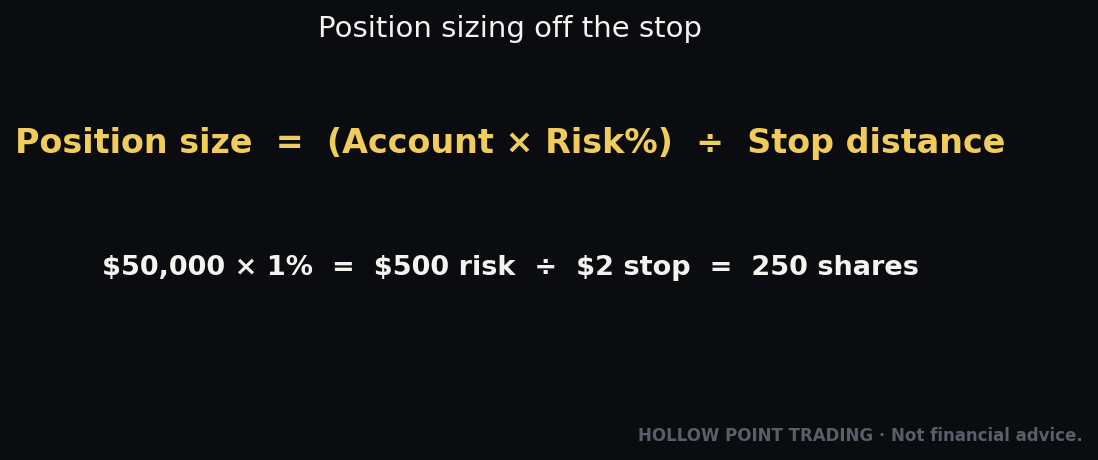
Position size = (dollars you're willing to risk) ÷ (dollars you'd lose per contract if your stop is hit).
That's the whole engine. Let's break down where each piece comes from and then work a full example slowly.
- Dollars you're willing to risk: your 1% (or less). From a $5,000 account, that's $50.
- Dollars lost per contract if stopped: this is (distance from your entry to your stop, in points) × (the contract's point value).
So the full recipe is:
- Decide your dollar risk (1% of account).
- Decide your entry price and your stop price. The gap between them, in points, is your stop distance.
- Multiply stop distance × point value = dollars at risk per contract.
- Divide your dollar risk by that number = how many contracts you can trade.
If the answer is less than one contract, the trade is too big for your account at that stop distance, and the honest answer is you don't take it (or you use a smaller contract). That "no" is discipline, and discipline is the job.
A Fully Worked Beginner Example, Step By Step
Let's do a complete, realistic trade from scratch. Go slow with me.
Your setup:
- Account: $5,000
- You'll risk 1% = $50 on this trade.
- You're trading MES (Micro E-mini S&P 500), point value $5 per point.
The trade you're looking at: The S&P 500 is at 5000. You think it's going up (going long). You look at the chart and decide that if it falls to 4990, your idea is wrong and you want out. So:
- Entry: 5000
- Stop: 4990
- Stop distance: 5000 − 4990 = 10 points
Step 1 — dollars lost per contract if stopped: 10 points × $5 per point = $50 per contract.
Step 2 — position size: $50 risk ÷ $50 per contract = 1 contract.
So the correct size for this trade is exactly one MES contract. If price hits your stop, you lose $50 — precisely your planned 1%. Not a penny more. You knew your worst case before you clicked buy. That is trading like a professional.
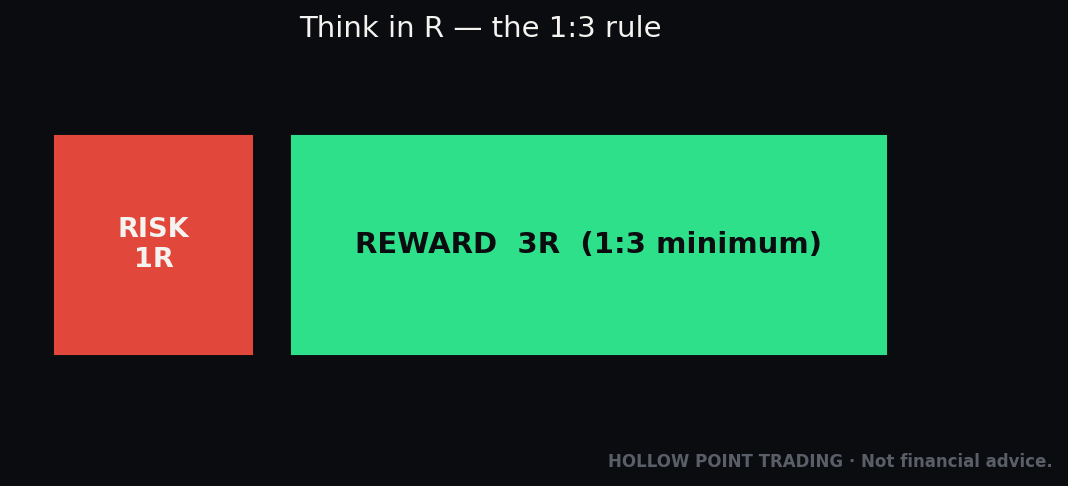
Now watch what happens when we add Hollow Point's 1:3 reward-to-risk rule. That rule says: only take trades where your potential reward is at least three times your risk. You risked 10 points ($50). So your profit target should be at least 30 points away — up at 5030 — worth 30 × $5 = $150.
Think about what that does over time. You can be wrong more often than you're right and still make money. If you win only 4 out of 10 trades at 1:3:
- 6 losses × $50 = −$300
- 4 wins × $150 = +$600
- Net: +$300, despite being wrong 60% of the time.
That's the quiet magic of reward-to-risk. You don't need to predict the market. You need your winners to be bigger than your losers and your risk capped every time. Prediction is a coin flip; risk control is a choice.
A Second Example — Watch Position Size Change With The Stop
Let's prove the formula flexes correctly. Same $5,000 account, same $50 risk, same MES ($5/point). But this time your chart tells you the sensible stop is only 5 points away (entry 5000, stop 4995).
- Dollars per contract if stopped: 5 × $5 = $25 per contract.
- Position size: $50 ÷ $25 = 2 contracts.
Interesting — a tighter stop let you trade more contracts while keeping the exact same $50 total risk. And a wider stop would force fewer contracts. This is the relationship beginners never grasp: your stop distance and your position size move in opposite directions, and together they hold your dollar risk constant. The formula does this for you automatically every time. You never eyeball size again.
Now the danger example, so you feel it. Same account, but the beginner ignores all this and trades on the wild NQ ($20/point) with a 50-point stop "because Nasdaq moves a lot":
- Dollars per contract if stopped: 50 × $20 = $1,000 per contract.
One contract risks $1,000 — that's 20% of a $5,000 account on a single trade. Four bad trades in a row and half the account is gone. And 50 points on NQ can happen in minutes. This is precisely how beginners blow up — not from being wrong once, but from being wrong once while enormously oversized. The formula would have screamed the truth: $50 ÷ $1,000 = 0.05 contracts. You can't trade one-twentieth of a contract, so the honest reading is: this trade is far too big for this account. Trade a micro, or don't trade it.
The Prop-Firm Drawdown Mindset
Here's a path many beginners take today, and it teaches a mindset worth adopting even if you never use it.
A prop firm (proprietary trading firm) is a company that lets you trade their money instead of your own. You pay a fee and pass an evaluation — basically a test where you have to hit a profit goal without breaking their risk rules. Pass, and they fund you an account; you keep a large share of the profits. It's popular because you can control a bigger account without risking thousands of your own dollars.
But here's the part that matters for every trader: prop firms are obsessed with one number — the drawdown limit.
Drawdown means how far your account is allowed to fall. Prop firms set a hard floor. Say you're given a $50,000 account with a $2,000 trailing drawdown. That means if your account ever drops $2,000 from its high-water mark, you're done — the account is closed, evaluation failed, no second chances. Trailing means the floor rises as your account grows: get up to $52,000 and your kill-line trails up to $50,000. Touch it, and it's over.
Why should a beginner trading their own money care? Because the drawdown mindset is exactly the mindset that keeps you alive. It forces you to think like this:
- There is a number I cannot fall below, or I'm out of the game entirely.
- Therefore every trade's risk must be tiny relative to that number.
- Therefore I take small, high-quality trades and I never try to make it all back at once.
That last point is the killer. The single most destructive instinct in trading is revenge trading — losing money and immediately jumping into a bigger, sloppier trade to win it back fast. It's the emotional opposite of everything in this guide. The drawdown mindset murders that instinct, because you know one oversized revenge trade can hit your floor and end everything. So you don't.
Adopt this even with a personal account: give yourself a daily loss limit. Decide, before the day starts, "if I'm down $150 today, I stop, close the laptop, and I'm done." Three losing trades at $50 each and you walk. No fourth trade, no "just one more," no revenge. That single rule will save more beginner accounts than any indicator ever will. Hollow Point's whole identity is built on it: discipline over prediction. The market rewards the trader who protects the floor, not the one who swings hardest.
Putting The Whole Picture Together — The HPT Way
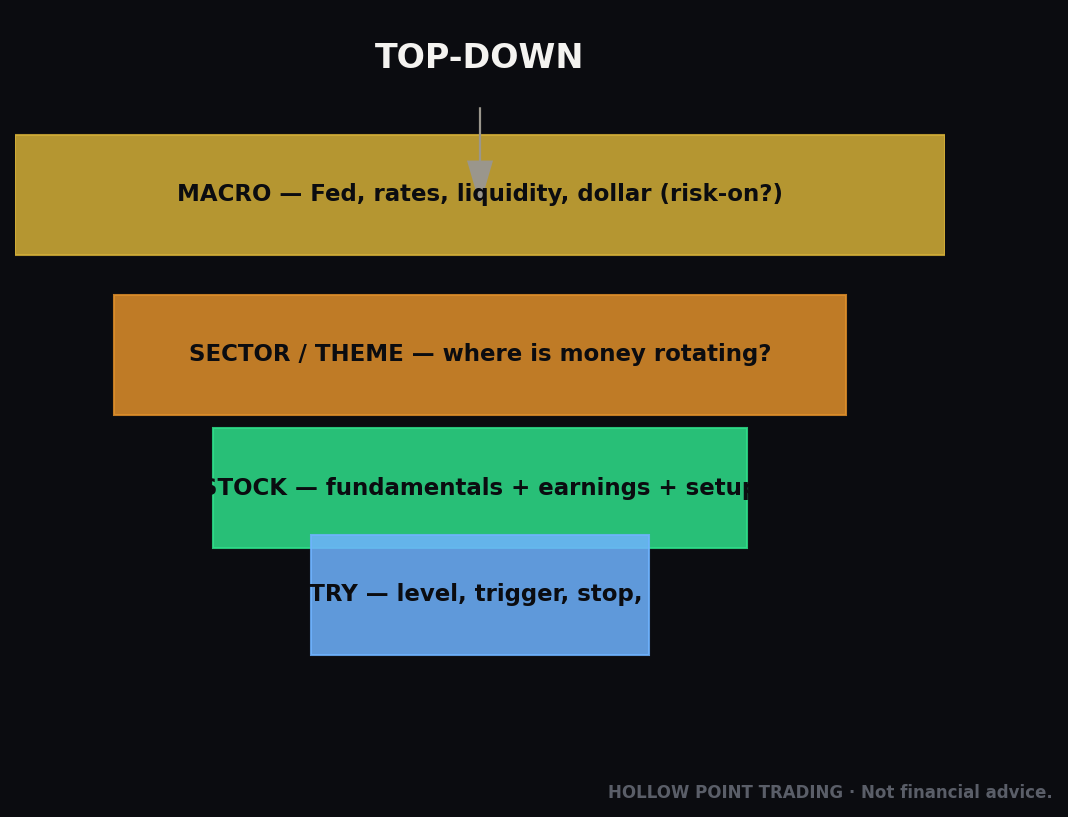
Everything above is the risk layer. But risk sizing is only half a trade. The other half is deciding what to trade in the first place, and Hollow Point Trading builds that decision top-down. It's worth seeing where risk fits into the bigger machine.
The HPT approach flows macro → sector → stock (or index):
- Macro first: what's the overall environment? Is the broad market trending up or down? What big economic events are on today's calendar — a Fed decision, a jobs report, an inflation print? These are the moments futures move violently, and a beginner's best macro skill is often knowing when not to trade.
- Sector next: which parts of the market are strong and which are weak? Money flows between areas, and you want to be aligned with strength, not fighting it.
- Stock/index last: only after the big picture agrees do you drill down to the specific thing you'll trade and the exact level.
Risk management is the discipline that wraps around all of it. You can have a brilliant macro read and still blow up if you size wrong. You can have a mediocre read and survive indefinitely if your risk is airtight. That's why, in the HPT world, the risk rules aren't the boring part you get to after the "real" analysis — they are the real analysis. The setup tells you where; the risk math tells you how much and where you're wrong. A trade isn't complete until both are locked.
And this is why futures, specifically, demand the most discipline of any market a beginner might touch. The speed and leverage that make it exciting are the same forces that punish carelessness instantly. In slower markets, a sloppy beginner bleeds out over weeks and has time to learn. In futures, the lesson can arrive in an afternoon. So we front-load the discipline. We make the risk rules automatic before we ever need them, so that when the market moves fast — and it will — our decisions are already made.
The Beginner Mistakes To Avoid
Let's name the traps directly, because knowing them by name helps you catch yourself in the moment.
- Trading full-size contracts to start. Begin on micros (MES, MNQ). The dollar risk of a mistake is one-tenth. There is zero shame and enormous wisdom in trading small while you learn.
- No stop, or a "mental" stop. Every position gets a real, working hard stop, placed at entry. No exceptions, ever.
- Sizing by feeling instead of by formula. "One contract feels fine" is not risk management. Run the formula every time: risk ÷ (stop distance × point value).
- Moving your stop wider when the trade goes against you. This is just choosing to lose more. If you catch yourself dragging a stop away from price to "give it room," stop trading for the day. That instinct is the account-killer.
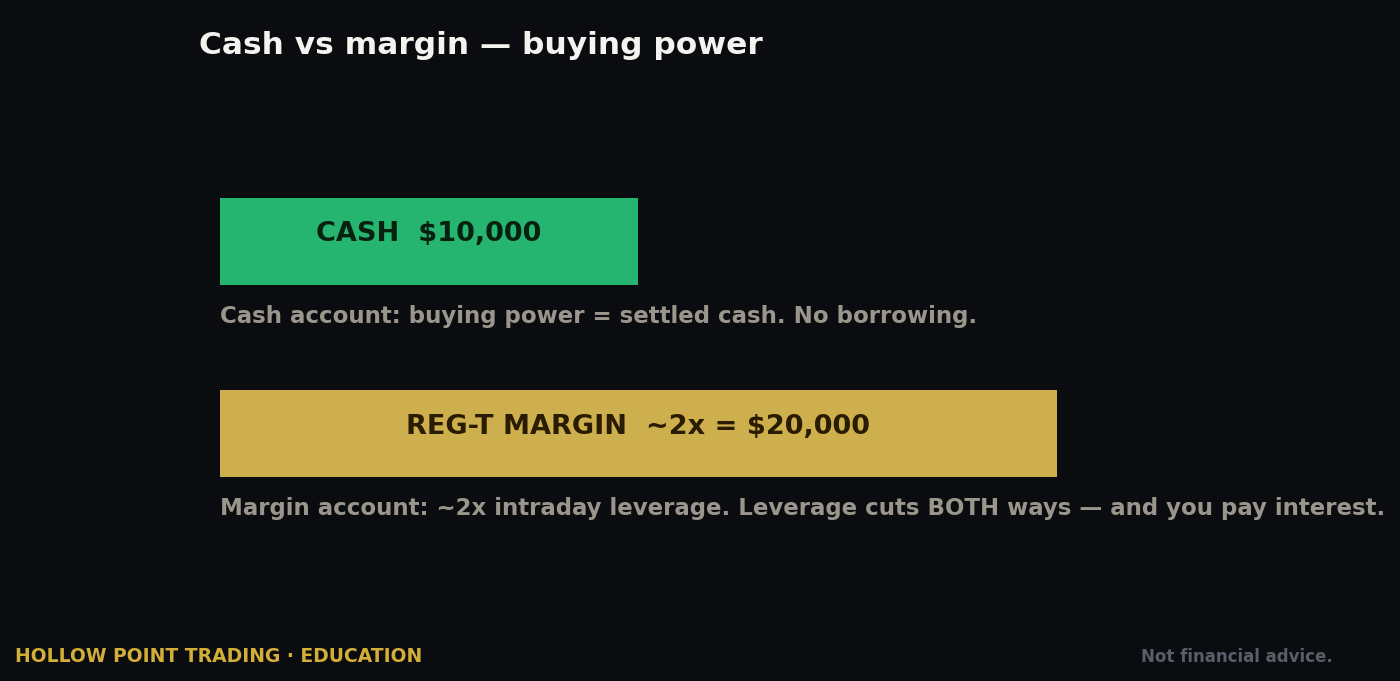
- Confusing margin with risk. The small margin deposit is not your maximum loss. Your loss is driven by point value and how far price moves — which can dwarf the deposit. Never size a trade based on "I can afford the margin."
- Ignoring how many points the index actually travels. NQ's small-sounding per-point value hides enormous point ranges. Always translate points into dollars for that specific contract before trading.
- Revenge trading after a loss. The fastest road to zero. Honor your daily loss limit and walk away. The market is open tomorrow.
- Trading straight into major news with size on. Fed announcements and big economic reports cause violent, gap-prone moves and slippage. Beginners are usually better off flat (holding no position) into those moments.
- Thinking about profit before thinking about loss. Reverse it. Decide your risk first, always. Profit is what's left over when risk is handled well.
Your Simple Pre-Trade Cheat-Sheet
Tape this next to your screen. Do not click "buy" or "sell" until every line has an answer.
- What's my account size, and what's 1% of it? (That's my max risk for this trade.)
- Am I trading a micro contract? (MES/MNQ to start — yes.)
- What's the point value of this contract? (MES $5, MNQ $2, ES $50, NQ $20.)
- What's my entry price?
- What's my stop price — where am I proven wrong? (If I can't answer this, I don't have a trade.)
- Stop distance in points × point value = dollars per contract at risk.
- My risk ÷ dollars per contract = position size. (If it's under 1 contract, the trade's too big — pass or go smaller.)
- Is my target at least 3× my risk away? (HPT's 1:3 minimum.)
- Is my hard stop actually placed and working? (Not mental. Live in the market.)
- Have I hit my daily loss limit? (If yes — I'm done for the day. Close the laptop.)
Ten lines. Under a minute. This checklist is the difference between a trader who's still here in a year and one who isn't.
A Final Word Before You Trade Anything Real
Do not put real money into futures the day you finish reading this. The smartest move a beginner can make is to open a paper trading account — a free simulator that uses fake money but real, live prices — and run this entire process a few hundred times until the formula is muscle memory and the daily loss limit is a reflex, not a debate. Paper trading won't teach you the emotions of real risk, but it will make the mechanics automatic, and automatic mechanics are what free your mind to handle the emotions later.
When you do go live, go live tiny. One micro contract. Risk a few dollars. Prove to yourself that you can follow your own rules when actual money is on the line — because that, not prediction, is the entire game. The trader who survives isn't the one who's right most often. It's the one who is never, ever hurt badly by being wrong. Futures will happily hand you both outcomes. Your rules decide which one you get.
Speed and leverage are neutral. In a disciplined hand, they're a tool. In an undisciplined one, they're a countdown. Everything in this guide exists to keep you firmly, permanently in the first camp.
Bound by rules, feared by trade.