
You bought something. It was doing exactly what you wanted. And then, on a random Thursday, the whole market seemed to shrug, prices got weird and jumpy, and you found out your contract was about to "expire." Nobody warned you. Welcome to the single most confusing thing about futures trading that nobody explains up front: rollover.
Here is the good news. Rollover sounds technical, but it is actually one of the simplest, most mechanical, most learnable things in all of trading. Once you understand it, you will never be surprised by it again. It becomes a calendar event you plan around, like knowing the trash gets picked up on Tuesday. This guide will take you from "I have no idea what any of this means" to "I know exactly what to do and when" — with plain English, real-ish numbers, and analogies you can actually picture.
Let's build it from the ground up.
First, What Even Is a Futures Contract?
Before we can talk about rollover, we need to be crystal clear on what a futures contract is. If you already sort of know, read this anyway — it takes ninety seconds and it makes everything after it click.
A futures contract is a legal agreement to buy or sell something at a set price on a set future date. That "something" is called the underlying — it could be crude oil, gold, corn, the S&P 500 stock index, and so on. That is where the name comes from: you are agreeing today about a transaction that happens in the future.
Here is the everyday analogy. Imagine you run a bakery, and you know you will need 1,000 pounds of flour in three months. You are worried the price of flour might jump. So you find a flour supplier and you both sign a piece of paper: "In three months, I will buy 1,000 pounds of flour from you at today's price of 50 cents a pound." You both signed. You are now locked in. That piece of paper is, in spirit, a futures contract. It has a price (50 cents), a quantity (1,000 pounds), and a delivery date (three months from now).
Now, the original purpose of futures was exactly this — letting farmers, miners, airlines, and food companies lock in prices ahead of time so a bad price swing wouldn't wreck their business. That is called hedging (protecting yourself against price moves). But somewhere along the way, traders realized you don't have to actually want the flour. You can buy and sell these contracts purely to profit from the price moving up or down, and sell the contract before the delivery date ever arrives. That is speculating, and it is what most retail futures traders — probably including you — are doing.
The key thing to burn into your memory: every futures contract has a built-in expiration date. It is not optional. It is baked into the contract from the moment it is created. A stock like Apple can theoretically live forever. A futures contract cannot. It is born with a death date. And that single fact is the entire reason rollover exists.
So What Is "Rollover" in Plain English?
Rollover is the act of closing your position in a futures contract that is about to expire and re-opening the same position in a later-dated contract of the same market. You are "rolling" your trade forward from the dying contract into a fresh one.
Think of it like a magazine subscription. Your subscription runs out at the end of the month. If you still want to keep reading, you renew — you move your subscription forward to the next period. You didn't change what you're reading; you just moved it into a fresh term so it keeps going. Rollover is the trader's version of renewing.
Or picture a relay race. The runner carrying the baton (your position) is running out of track (the contract is expiring). Before they hit the wall, they pass the baton to a fresh runner (the next contract) who has a full lap of track ahead. The baton — your market exposure — never stops moving. Only the runner carrying it changes.
In practical terms, if you are holding a position and the contract is nearing expiration, rolling over means two actions done close together:
- Close the position in the expiring contract (sell it if you were long, buy it back if you were short).
- Open the same position in the next contract further out in time.
That's it. That is the whole concept. Everything else in this guide is about the details: which contract, when, why, and how to not get burned.
Why Should a Beginner Care? (The Real-World Stakes)
You might be thinking, "Okay, contracts expire, I'll just deal with it when it happens." Please don't. Here is why rollover matters before it becomes a problem, told through the four things that go wrong when beginners ignore it.
1. You could get forced into "delivery." Remember the bakery example — the whole point was that on the delivery date, real flour changes hands. Some futures contracts are physically settled, meaning if you're still holding them at expiration, you are legally on the hook to actually deliver or receive the physical goods. This is the famous nightmare scenario: a beginner falls asleep holding a crude oil contract and technically owes someone 1,000 barrels of oil delivered to a tank farm in Oklahoma. In reality your broker will usually force-close you before it gets that far, but the point stands — holding into expiration is a landmine.
2. Your contract can simply stop existing while you sleep. Other contracts are cash-settled, meaning no physical goods change hands — the contract just converts to a final cash value and vanishes. That sounds safer, and it is, but it means your position gets closed for you at a price and time you didn't choose. If you wanted to keep the trade going, too bad — it's gone, and you have to re-establish it fresh, possibly at a worse price.
3. The dying contract becomes a ghost town. As a contract approaches expiration, traders abandon it and move to the next one. Fewer and fewer people are trading it. This is called falling liquidity — liquidity just means "how easily you can buy or sell without moving the price." Low liquidity is dangerous for beginners in ways we'll cover in detail below. This is the single biggest reason to care.
4. You'll misread your own charts. When a contract rolls, the price can appear to "gap" — jump up or down — not because the market moved, but because you're now looking at a different contract with a slightly different price. If you don't understand rollover, you'll think something dramatic happened when it didn't, and you might make a bad decision off a fake signal.
Protecting your capital first is the whole HPT ethos, and rollover is capital protection 101. It is not advanced. It is foundational. Getting it wrong can cost you money for reasons that have nothing to do with whether your trade idea was right.
The "Front Month": The Contract Everyone Is Actually Trading
Here is a term you'll hear constantly: the front month.
Because every market has many futures contracts existing at the same time — one expiring this month, one next month, one three months out, and so on — traders needed a word for "the one everybody is actually trading right now." That's the front month.
The front month is the nearest-to-expiration contract that is still the most actively traded. It usually has the most volume (the most buying and selling happening), the tightest prices, and the easiest entries and exits. This is almost always the contract a beginner should be trading. It's where the crowd is, and where the crowd is, there is liquidity.
The contracts further out in time — next month, the month after — are called back months or deferred months. They exist, and you can trade them, but they're usually thinner (less volume, wider prices). Beginners generally stay in the front month.
Now here is the subtle part, and it's the whole crux of rollover. There's a difference between:
- The front month — the most-traded contract (where you want to be), and
- The expiring contract — the one whose death date is coming up next.
For most of the contract's life, these are the same thing. But near expiration, the crowd starts leaving the expiring contract and piling into the next one. There's a window — usually about a week before expiration — where the "most traded" title passes from the expiring contract to the next contract out. When that title changes hands, the front month has effectively "rolled."
Your job as a trader is simple: be where the crowd is. When the crowd moves to the next contract, you move with them. You roll.
How Contracts Are Named (So You Can Actually Find the Right One)
You cannot roll if you can't identify which contract is which, so let's decode the codes. Every futures contract has a symbol made of three parts:
- The root symbol — the market. For example,
ESis the E-mini S&P 500,CLis crude oil,GCis gold,NQis the E-mini Nasdaq-100. - A month code — a single letter for the expiration month.
- A year — the last digit or two of the year.
The month codes are a fixed, universal set. They're not intuitive (there's no "J for January" logic), so here they are:
- January = F
- February = G
- March = H
- April = J
- May = K
- June = M
- July = N
- August = Q
- September = U
- October = V
- November = X
- December = Z
So ESZ25 means: E-mini S&P 500 (ES), December (Z), 2025 (25). And CLH26 means crude oil, March, 2026. When you roll from ESU25 (September) to ESZ25 (December), you're moving one contract forward in the cycle.
You don't need to memorize all twelve codes today. Most trading platforms show you a friendly dropdown of available contracts with plain dates. But recognizing the pattern means you'll never accidentally trade the wrong month, and you'll understand what your platform is showing you.
One more thing: not every market uses every month. The stock index futures (like ES and NQ) use a quarterly cycle — only March (H), June (M), September (U), and December (Z). So those roll four times a year. Crude oil, by contrast, has a contract every single month. Always check which months your specific market actually lists.
Why Contracts Expire in the First Place
Let's answer the "why" directly, because it makes the whole system make sense.
Futures exist to let real businesses lock in prices for a specific future date. A corn farmer harvesting in the fall needs a December contract. An airline budgeting fuel for spring needs a contract that settles in spring. Each contract is tied to a specific delivery window because the underlying real-world need is tied to a specific time.
If contracts never expired, they couldn't do their core job — connecting a price today to a real transaction on a real date. Expiration is the mechanism that "settles up." On the expiration date, all the open agreements resolve: either goods are delivered (physical settlement) or everyone's account is squared to a final cash number (cash settlement). Then that contract is retired forever, and life goes on in the next one.
So expiration isn't a bug or an inconvenience the exchange invented to annoy you. It's the entire point of what a futures contract is. Understanding that turns rollover from a chore into something that makes obvious sense.
The Danger Zone: Low Liquidity at Expiration
This is the part I most want you to internalize, so let's slow down.
Liquidity is how easily you can get in and out of a trade at a fair price. A liquid market is like a busy farmers market with hundreds of buyers and sellers — you can sell your apples in seconds at the going rate. An illiquid market is like trying to sell those same apples in an empty parking lot at midnight — maybe one person shows up, and they'll lowball you because they know you have no other options.
As a contract nears expiration, traders leave it for the next contract. The busy farmers market slowly empties out. By the final days, the expiring contract can become that midnight parking lot. Here's what that does to you:
The spread widens. The spread is the gap between the highest price a buyer will pay (the bid) and the lowest price a seller will accept (the ask). In a liquid market these are almost touching — maybe one tick apart. In a dying contract, the spread can blow out. Now every time you enter or exit, you're paying that wider gap. It's a hidden tax that grows as liquidity shrinks.
Slippage gets worse. Slippage is when you get filled at a worse price than you expected because the market moved (or was too thin) in the split second your order hit. In a thin contract, a normal-sized order can push the price around, and your fills get ugly.
Prices get erratic. With few participants, a single large order can jolt the price in a way that has nothing to do with real market direction. Your stop-loss (an order that auto-closes you at a set price to limit losses) can get triggered by a random illiquid spasm rather than a genuine move.
You can get pinned near settlement. In the final hours, weird technical stuff happens around the official settlement price. It is not a place for a beginner to be improvising.
The lesson writes itself: do not trade the expiring contract into its final days. Get out of the danger zone before it becomes one. Roll early, roll into the busy contract, and let someone else deal with the ghost town.
How Rollover Works, Step by Step
Let's make this concrete and mechanical. Here is the beginner's rollover procedure, start to finish.
Step 1 — Know your expiration and your roll date. Every contract has a published expiration date. But you do not wait until then. The practical roll date is when volume shifts to the next contract — typically about one week before expiration for the big index futures. For the ES and NQ index contracts, a well-known rhythm is the second Thursday-ish before the third-Friday expiration. You don't need to compute this by hand; your platform and countless free "futures roll date" calendars publish it. Just know it's coming.
Step 2 — Identify the current front month and the next contract. Confirm which contract you're currently holding (say, ESU25, September) and which one you're rolling into (ESZ25, December). Look at the volume on each — you're watching for the moment the next contract's volume overtakes the expiring one.
Step 3 — Close your position in the expiring contract. If you're long (you bought, betting on up), you sell to close. If you're short (you sold, betting on down), you buy to close. This flattens you in the old contract.
Step 4 — Re-open the same position in the new contract. Immediately establish the identical position — same direction, same size — in the next contract. Long stays long, short stays short.
Step 5 — Adjust your reference levels. The new contract will be trading at a slightly different price than the old one (more on this in a second). So your stop-loss, your target, and any levels you drew need to be re-checked against the new contract's prices. Don't blindly copy your old numbers.
That's the manual version. Some brokers offer a calendar spread order that does the close-and-open as a single combined trade at a known price difference, which is cleaner — but the two-step version above is perfectly fine and easier to understand as a beginner.
And an important beginner escape hatch: if you don't need to keep the trade on, you don't have to roll at all. You can simply close the expiring position and walk away. Rollover is only for when you want to continue the exposure. Not every trade needs to be immortal.
Contango, Backwardation, and Why the Price "Jumps"
When you roll from one contract to the next, the two contracts almost never trade at exactly the same price. This price difference is normal and has a name.
If the further-out contract is more expensive than the near one, the market is in contango. Think of it as "it costs more to get it later" — often because of storage costs, insurance, and interest for holding something over time. Picture stacking contracts up a staircase, each further month a step higher.
If the further-out contract is cheaper than the near one, the market is in backwardation — the staircase goes down as you look further out. This often happens when there's urgent demand for something right now.
Why does a beginner care? Because when you roll, the price you see on your chart will shift by roughly that difference. Say ESU25 is trading at 5,600 and ESZ25 is trading at 5,660. When the front month rolls from September to December, the chart price appears to jump up 60 points overnight — but the market didn't rally 60 points. You're just now looking at the more expensive December contract. This is the "fake gap" we mentioned earlier.
Serious charting platforms handle this with a continuous contract (often shown with a symbol like ES1!), which stitches the contracts together and smooths out those roll gaps so your long-term chart looks clean. When you're analyzing history, use the continuous chart. When you're placing an actual trade, make sure you're in the specific real contract that's the current front month. Knowing which one you're looking at prevents a lot of confused decisions.
A Fully Worked Beginner Example
Let's walk through a complete, realistic rollover from start to finish with numbers, so you can see every piece move.
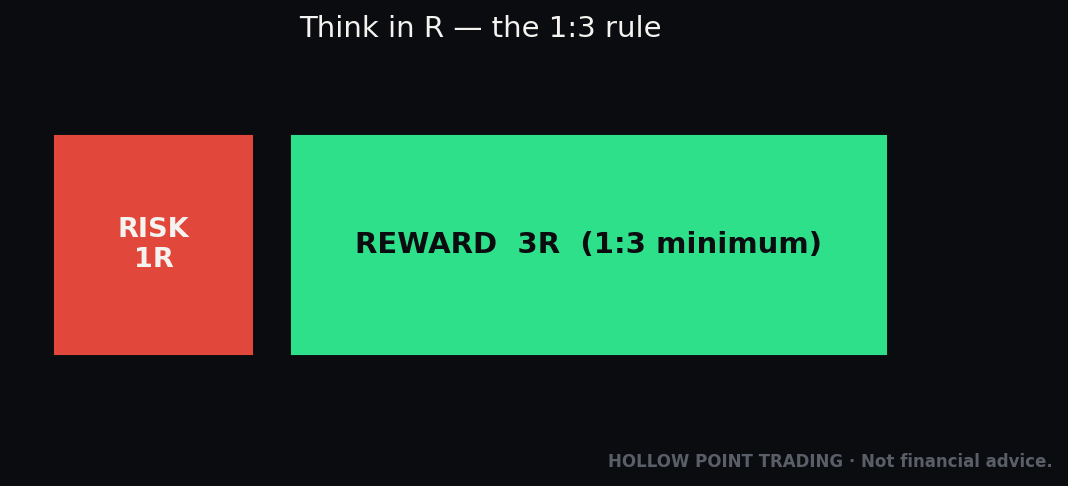
The setup. It's early September 2025. You're trading the Micro E-mini S&P 500 (MES — a smaller, cheaper version of ES, great for beginners because each point is worth less money). You went long (bought) one MESU25 contract — the September contract — at a price of 6,450, because you think the market is heading higher over the next few weeks. Your stop-loss is at 6,410 (40 points of risk), and your target is at 6,570 (120 points of reward). That's a 40-point risk for 120 points of potential reward — a clean 1:3 reward-to-risk ratio, exactly the HPT standard.
The problem appears. The September MES contract expires on the third Friday of September. You check a roll-date calendar and see the roll happens the Thursday before — call it September 18. It's now September 16. Volume in MESU25 is already thinning; you can see the December contract, MESZ25, starting to attract more traders. Your trade is working — price is at 6,530, up nicely — but you are not going to ride the September contract into its low-liquidity death spiral. You're going to roll.
The roll. You check both prices:
MESU25(September, expiring): trading at 6,530MESZ25(December, next): trading at 6,590
The December contract is 60 points higher — the market is in mild contango (later contract costs more). This is normal; don't panic.
You execute:
- Sell to close your one
MESU25at 6,530. You entered at 6,450, so you locked in +80 points of profit on the September contract. - Buy to open one
MESZ25at 6,590. You're now long the December contract, same direction, same size. Your market exposure never skipped a beat.
Adjusting your levels — the step beginners skip. Your original stop (6,410) and target (6,570) were set in September-contract prices. But you're now in the December contract, which trades ~60 points higher. If you left your target at 6,570, the December contract is already past it at 6,590 — you'd get instantly stopped or closed for nonsense reasons. So you shift your levels up by the ~60-point roll difference to keep the same real-world trade idea intact:
- New stop: 6,410 + 60 = 6,470
- New target: 6,570 + 60 = 6,630
Now your risk and reward are the same shape as before — 40 points of risk, 120 of reward, still 1:3 — just expressed in the new contract's prices.
The outcome. Over the next two weeks the market grinds higher, and MESZ25 hits 6,630. You close for +40 points on the December contract (6,630 − 6,590). Add that to the +80 points you banked on the September contract before rolling, and your total on the idea is +120 points — exactly the move you were playing for. The rollover let you capture the entire run without ever holding a dying, illiquid contract. That's the whole point.
The Beginner Mistakes to Avoid
These are the specific ways new futures traders get burned by rollover. Read them twice.
Mistake 1 — Not knowing your contract expires at all. The classic. You treat a futures contract like a stock and assume it just... continues. Then it settles out from under you, or your broker force-liquidates you. Fix: the moment you open a futures position, write down its expiration date and its roll date.
Mistake 2 — Rolling too late, into no liquidity. Waiting until the final day or two, when the expiring contract is a midnight parking lot. Wide spreads, ugly fills, erratic prices. Fix: roll around the standard roll date, roughly a week before expiration, while both contracts still have healthy volume.
Mistake 3 — Trading the wrong (dying) contract. A beginner opens a brand-new trade in a contract that's about to expire, because it was at the top of the list or looked familiar. Now they're in the illiquid one from the start. Fix: always confirm you're entering the current front month — the one with the highest volume — not the expiring one.
Mistake 4 — Panicking at the roll "gap." Seeing the chart jump 60 points at rollover and thinking the market crashed or exploded, then trading off that fake move. Fix: understand contango/backwardation, use a continuous chart for analysis, and know that a roll gap is a bookkeeping shift, not a real move.
Mistake 5 — Forgetting to move your stops and targets. Rolling into the new contract but leaving your old-contract price levels in place, so your stop or target is instantly in the wrong spot. Fix: after every roll, recalculate your levels by the roll difference. Same trade idea, new contract's prices.
Mistake 6 — Rolling a trade you should just close. Renewing exposure out of habit when the reason for the trade is gone. Rollover is for continuing a valid idea, not for avoiding the discomfort of closing. Fix: before you roll, ask "would I open this trade fresh in the new contract right now?" If no, don't roll — just close.
Mistake 7 — Ignoring the extra transaction costs. Every roll is a close plus an open — that's commissions and spread paid twice. Roll only when you mean to, size appropriately, and don't over-trade the roll. Fix: treat each roll as a real, costed transaction, not a free reset.
Your Rollover Cheat-Sheet
Pin this up. It's the whole guide compressed into a checklist you can run in two minutes.
Before you enter any futures trade:
- ☐ Confirm you're in the front month (highest volume), not the expiring contract.
- ☐ Write down the contract's expiration date.
- ☐ Write down its roll date (roughly one week before expiration — check a roll calendar).
As the roll date approaches (about a week out):
- ☐ Check the volume: has the next contract overtaken the expiring one yet?
- ☐ Decide: do I still want this exposure? If no → just close. If yes → roll.
To execute the roll:
- ☐ Note the price of the expiring contract and the next contract; find the difference (the roll gap).
- ☐ Close the position in the expiring contract (sell if long, buy if short).
- ☐ Open the same position — same direction, same size — in the next contract.
- ☐ Shift your stop and target by the roll difference so the trade idea stays intact.
- ☐ Confirm your reward-to-risk is still at least 1:3.
Never:
- ☐ Never hold a physically-settled contract into expiration.
- ☐ Never trade the expiring contract in its final low-liquidity days.
- ☐ Never trade a roll gap as if it were a real market move.
How Rollover Fits the Bigger HPT Picture
Zoom out. Why does a disciplined trading approach care so much about a mechanical calendar event?
Because rollover is capital protection, and protecting capital comes first — before profits, before being right, before everything. Most of what blows up beginner accounts isn't bad market calls; it's avoidable operational mistakes. Getting force-liquidated, eating a terrible fill in a dead contract, trading off a fake gap — none of those are about market analysis. They're about not knowing the rules of the instrument you're trading. Master the boring mechanics and you remove an entire category of losses that have nothing to do with skill.
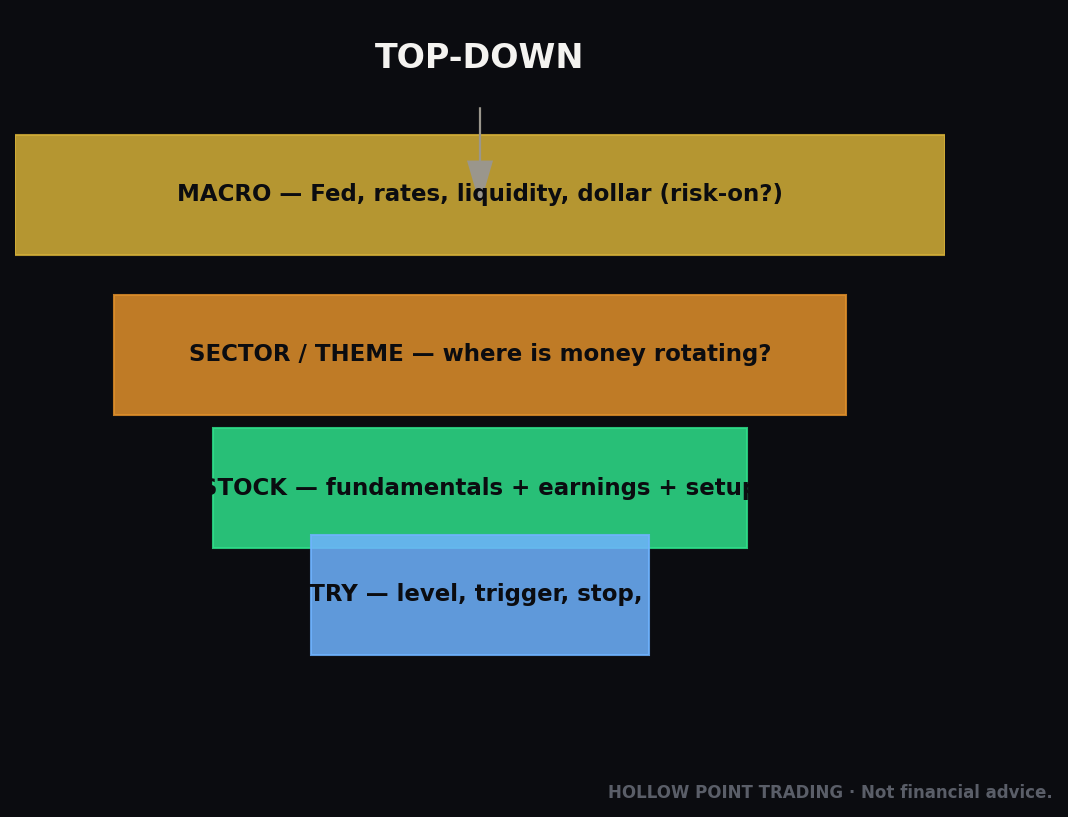
Rollover also fits the HPT read on markets: macro → sector → stock (or instrument). You form a view on the big picture, narrow to what's strong, then express it in a specific vehicle. Futures are one of those vehicles — but unlike a stock, a futures position has a clock on it. Rollover is simply the discipline of keeping a valid idea alive in a clean contract as that clock runs down, without ever letting the instrument's mechanics corrupt the trade.
And it reinforces the deepest principle: discipline over prediction. You cannot predict when a thin contract will spasm, or exactly where settlement will pin. But you don't have to. You can follow a rule — roll on the roll date, into the liquid contract, adjust your levels, keep your 1:3 — and sidestep the whole problem. That's the entire game. You don't out-guess the market; you out-prepare it. Rollover is a small, repeatable, rule-based habit that quietly saves you money for the rest of your trading life.
Learn it once. Run the checklist every time. Never get surprised by an expiring contract again.
Bound by rules, feared by trade.