
You have probably heard that trading is dangerous, that people lose their savings, that it is basically gambling in a nicer shirt. A lot of that is true — for people who start too big, with no rules, betting money they cannot afford to lose. This guide is about the opposite of that. It is about starting so small that a mistake costs you a cup of coffee instead of a car payment, and using that small size to actually learn the craft before real money is ever on the line in a serious way.
The tool that makes this possible is called the micro futures contract. If you have never traded anything in your life, this is one of the best on-ramps that exists. By the end of this guide you will understand what a micro future is, why it is the right size to start with, the exact math of how money moves, and how to place a real practice trade Monday morning without risking anything you would miss.
Let us build it from the ground up. No assumed knowledge. Every term defined the first time you meet it.
First, what is a "future" at all?
Before we get to the micro part, we need the plain-English version of a futures contract.
A futures contract is an agreement to buy or sell something at a set price on a future date. That is the whole idea. The word "futures" just means the settlement happens later, not right now.
Here is an everyday analogy. Imagine you run a small bakery and you know flour prices bounce around. You call your supplier and say, "I want to lock in the price of 100 bags of flour for delivery in three months, at today's price." You both sign. You have just created a futures contract. If flour gets more expensive later, you win — you locked in the cheaper price. If flour gets cheaper, the supplier wins. Either way, the price was agreed now for something that settles later.
That is where futures came from — farmers and buyers locking in prices so a bad season would not ruin them. Today, most people trading futures are not bakers and are not taking delivery of anything. They are trading the price movement itself. They buy a contract, the price goes up, they sell it back a few minutes or hours later, and they keep the difference. Or the price goes down and they lose the difference. Nobody shows up with a truck full of flour.
The important thing for you: futures let you bet on whether a price will go up or down, and you can do it in both directions. You can buy first and sell later (called going long, betting the price rises). Or you can sell first and buy back later (called going short, betting the price falls). Do not worry about shorting yet — just know it exists.
What are you actually trading? Stock market indexes
The micros we care about track stock market indexes. An index is just a number that measures how a big basket of stocks is doing overall. Instead of watching 500 different companies, you watch one number that summarizes all of them.
The four big American indexes, and the micro contract tied to each, are:
- The S&P 500 — the 500 largest U.S. companies. The broadest "how is the market doing" number. Its micro is MES.
- The Nasdaq-100 — 100 of the biggest non-financial companies, very heavy on technology (think the big tech names). Its micro is MNQ.
- The Dow Jones Industrial Average — 30 large, well-known American companies. The oldest headline number. Its micro is MYM.
- The Russell 2000 — 2,000 small U.S. companies. A read on smaller businesses. Its micro is M2K.
When you trade one of these micros, you are not buying the actual stocks. You are trading a contract whose price rises and falls with that index. If the S&P 500 goes up, MES goes up. Simple as that. You get exposure to the whole market's direction through one small, clean instrument.
So what makes it "micro"?
Here is the heart of it.
The professionals and institutions trade what are called E-mini contracts — "mini" because they are already a smaller version of an even older, larger contract. But even the E-mini is big for a beginner. One E-mini S&P 500 contract can move hundreds of dollars in a single minute. Get the direction wrong on a fast day and you can lose more than a week's grocery budget before lunch.
In 2019, the exchange that runs these markets (the CME Group) launched the micro versions. A micro contract is exactly one-tenth the size of its E-mini big brother. Everything is the same — same index, same hours, same behavior — just scaled down to 10% of the money at stake.
That one-tenth is the entire reason micros exist and the entire reason this guide exists. It means a beginner can trade the exact same S&P 500 that the pros trade, on the exact same screen, learning the exact same skills — but with the money-at-risk turned way, way down. You are not trading a fake, watered-down product. You are trading the real market in a size that will not hurt you while you are still learning to walk.
Think of it like a flight simulator that is also a real plane, flying at ten feet off the ground. Real controls, real feel, real lessons — but if you crash, you step off with a bruise, not a disaster.
The four micros, side by side
Let me give you the four contracts with their nicknames and what makes each one tick. Do not memorize this yet — just get familiar.
- MES — Micro E-mini S&P 500. The gentlest, most beginner-friendly of the four. Moves smoothly, huge amount of trading activity, forgiving. If you trade nothing else your first year, trade this.
- MNQ — Micro E-mini Nasdaq-100. Faster and jumpier because it is tech-heavy. Bigger swings, more excitement, more danger. A great second market once MES feels comfortable.
- MYM — Micro E-mini Dow. Priced in "points" that are easy to eyeball. Calmer personality. A fine alternative to MES.
- M2K — Micro E-mini Russell 2000. Small-company index, can be choppy. Least popular of the four for beginners; fine to ignore at the start.
For your first steps, the honest recommendation is: start with MES and only MES. One market. Learn its rhythm. We will do all our math with MES so the numbers stick.
The math, built up slowly
This is the part that scares beginners, and it should not, because it is just multiplication. Let us go one brick at a time.
Brick 1: Points and the multiplier
An index is quoted as a number. The S&P 500 might be sitting at, say, 5,000 "points." When it moves from 5,000 to 5,001, that is a one-point move.
Every contract has a multiplier — a fixed dollar amount that says how much money one point is worth. For MES, the multiplier is $5. That means:
Every 1 point the S&P 500 moves = $5 of profit or loss per MES contract.
So if you are long one MES (betting up) and the index rises 4 points, you made 4 × $5 = $20. If it fell 4 points instead, you lost $20. That is the whole engine. Points times $5.
Compare that to the big E-mini (ES), where the multiplier is $50 — ten times more. That same 4-point move is $200 on the E-mini versus $20 on the micro. Same market, same move, one-tenth the dollars. That is why you start with the micro.
Brick 2: Ticks — the smallest step
Index prices do not move in whole points only. They move in smaller steps called ticks. A tick is the smallest amount the price is allowed to change.
For MES, the tick is 0.25 points (a quarter of a point). Because each full point is $5, a quarter-point tick is worth:
$5 × 0.25 = $1.25 per tick.
So the smallest possible move on MES is $1.25. The price ticks up one step, you are up $1.25. It ticks down one step, you are down $1.25. Everything is built out of these little $1.25 stairs. Four ticks make one point ($5). This "smallest unit is barely more than a dollar" quality is exactly what makes micros so safe to learn on.
Brick 3: The other three, for reference
You do not need these to start, but here they are so the guide is complete. Each is the multiplier and the tick value:
- MES — $5 per point · tick 0.25 = $1.25 per tick
- MNQ — $2 per point · tick 0.25 = $0.50 per tick
- MYM — $0.50 per point · tick 1.0 = $0.50 per tick
- M2K — $5 per point · tick 0.10 = $0.50 per tick
Notice they are all tiny. On every single one of these, the smallest move is fifty cents to a dollar and a quarter. You would have to move dozens of ticks to lose the price of a lunch. That is the point.
A fully worked beginner example
Let us walk through one complete, realistic MES trade, dollar by dollar, so you can see exactly how money is made and lost. We will keep the numbers round and clear.
The setup. It is a Monday morning. The S&P 500 (and therefore MES) is trading at 5,000. You have done your homework and you believe the market is going to drift up over the next hour. You decide to buy 1 MES contract — going long.
The entry. You click buy. You are now long 1 MES at 5,000. Remember: each point is worth $5 to you now. If the price rises, you gain $5 a point. If it falls, you lose $5 a point.
Setting your safety net first — the stop-loss. Before you even think about profit, you decide the most you are willing to lose on this trade. This is a stop-loss: an order that automatically closes your trade if the price moves against you to a set level, so a small loss can never quietly become a huge one. You decide that if MES drops to 4,996 — 4 points against you — you are wrong and you are out.
- Risk in points: 5,000 − 4,996 = 4 points
- Risk in dollars: 4 points × $5 = $20
So the very worst this trade should cost you is about $20. You have defined your pain before entering. This is the single most important habit in this entire guide.
Setting your target — and the 1:3 rule. Now the reward side. A core Hollow Point Trading rule is 1:3 reward-to-risk: you only take trades where the potential reward is at least three times the money you are risking. You risked $20, so your target should aim for at least $60 of profit — which is 12 points ($60 ÷ $5).
So you set a take-profit (an order that automatically closes the trade in profit at a set level) at 5,012 — 12 points above your entry.
- Reward in points: 5,012 − 5,000 = 12 points
- Reward in dollars: 12 × $5 = $60
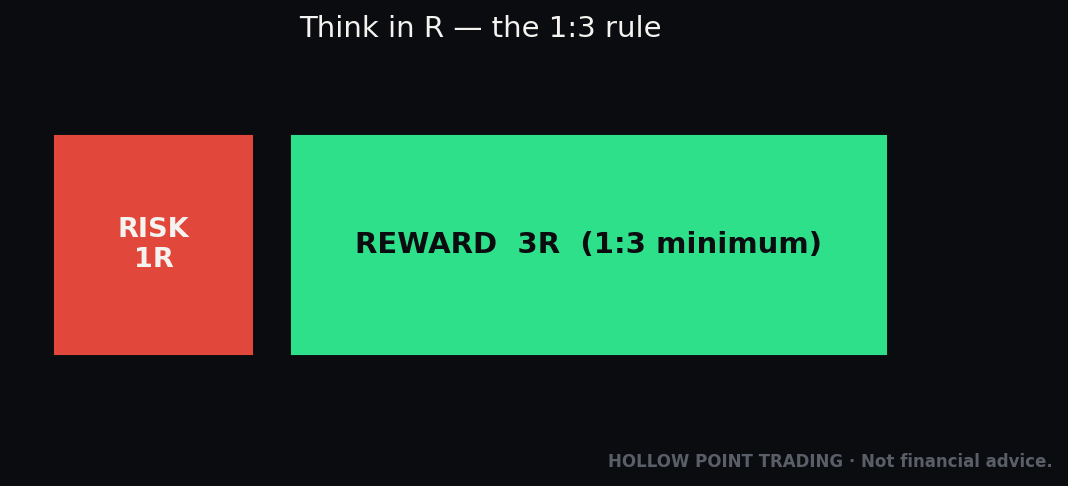
Your trade now has a built-in floor and ceiling: lose about $20, or make about $60. You are risking one to make three. Even if you are wrong more often than right, this math can keep you profitable — that is the quiet power of the 1:3 rule.
How it plays out. The market drifts up like you thought. MES climbs through 5,004, 5,008, and touches 5,012. Your take-profit fires. You are out with +$60 (minus a small fee, more on that below). Congratulations — that is a textbook trade.
The other outcome. Suppose instead the market rolled over. MES slid to 4,996, your stop-loss fired, and you were out for −$20. That is not a failure. That is the system working exactly as designed — a small, controlled, survivable loss. You live, you learn, you take the next trade. Protecting capital first means you are still in the game tomorrow.
Now sit with the size of these numbers. Twenty dollars of risk. Sixty dollars of reward. You just traded the entire S&P 500 — the same market a hedge fund trades — and your worst case was a pizza. That is what micros unlock.
What it costs to play: margin and fees
Two more plain-English money terms before you are dangerous.
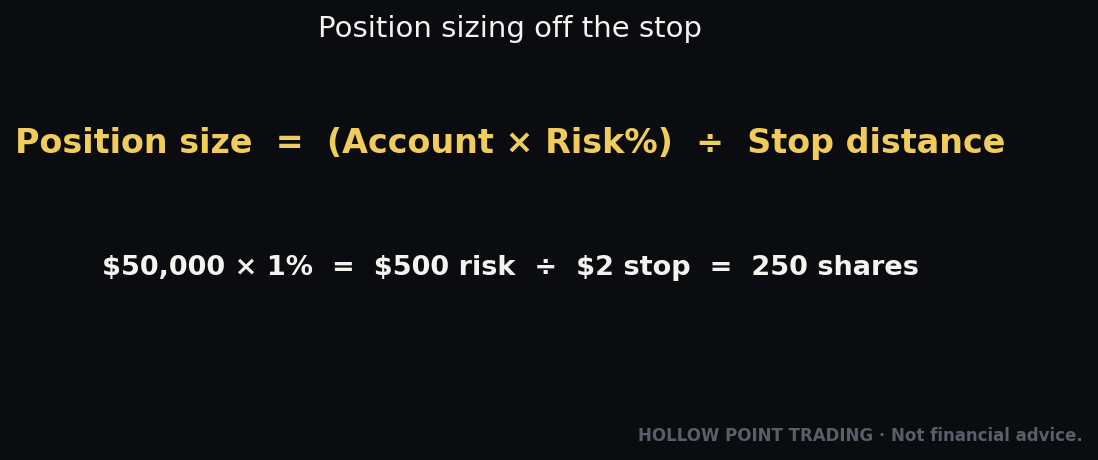
Margin is the amount of money your broker requires you to have in your account to hold one contract. It is not the cost of the trade — think of it more like a refundable deposit that proves you can cover a move against you. For a single micro, brokers often ask for something in the ballpark of $50 to $100 to hold it during the trading day (this varies by broker and market conditions, so always check yours). That is remarkably low. It means you can realistically open a futures account and start trading micros with a few hundred dollars, though having more cushion is wiser.
Commissions and fees are the small charge your broker and the exchange take each time you trade. On a micro, this is typically a dollar or two per contract, per side (once to get in, once to get out). It is small, but it is real — on tiny trades those couple of dollars matter, so factor them in. In our example, a $60 win might really be about $56 or $57 after fees. Still a great trade; just do not pretend fees are zero.
The takeaway: micros have low margin and low fees, which is the whole reason a beginner can afford to practice on them repeatedly. You get lots of at-bats without the cost of each swing eating you alive.
Why a beginner should care — the real argument
Let us make the case directly. Here is why micros are the right first size, not just a smaller version of something scary.
1. Small size keeps your emotions in the driver's seat. The number one killer of new traders is not bad analysis — it is feelings. When too much money is on the line, fear and greed take over. You panic-sell winners, you freeze on losers, you break your own rules. When your worst case is $20, your brain stays calm enough to actually practice the correct behavior. You are training your discipline, and micros let you train it cheaply.
2. You learn on the real market, not a toy. Micros move exactly like the full-size contracts because they track the same index and trade in the same pool of activity. Every lesson you learn — how the market behaves at the open, how it respects certain price levels, how news jolts it — is a real lesson that transfers directly when you eventually size up.
3. You can scale up one micro at a time. This is beautiful and underrated. When you get good with 1 contract, you do not have to jump to a giant E-mini. You go to 2 micros. Then 3. Then 5. Your risk grows in gentle, $5-per-point steps instead of terrifying $50 leaps. Ten micros equals one E-mini — so you can approach "pro size" by inches, entirely on your own timeline, backing off the moment it feels like too much.
4. The math is small enough to feel. When a point is $5, you can watch your profit-and-loss tick up and down and it makes intuitive sense. You develop a feel for risk. That feel is the thing you are really building in your first year, and cheap contracts let you build it without trauma.
The beginner mistakes to avoid
Everyone makes these. Reading them now means you might dodge a few.
Mistake 1 — Trading without a stop-loss. The deadliest one. Without a stop, a $20 "small loss" can turn into a $200 disaster while you sit there hoping it comes back. Set your stop before you enter. Every single time. No exceptions. If you cannot decide where your stop goes, you do not have a trade yet.
Mistake 2 — Too many contracts too soon. The low margin is a trap if you abuse it. Just because your account allows you to trade 10 micros does not mean you should. Ten micros is a full-size E-mini — the very thing you were trying to avoid. Start with 1. Earn the right to trade 2.
Mistake 3 — Skipping the 1:3 math. Taking trades where you risk $50 to make $20 is a slow way to go broke, even if you are right often. Always know your risk and your reward in dollars before you click. If the reward is not at least three times the risk, pass. There is always another trade.
Mistake 4 — Ignoring fees on tiny trades. If you are scalping for two or three ticks and paying two dollars round-trip in fees, the fees can eat most of your profit. Micros are cheap, not free. Aim for moves big enough that the fee is a rounding error, not the main event.
Mistake 5 — Confusing the four micros. MNQ moves much faster than MES. A beginner who wanders onto MNQ expecting MES-sized calm can get shaken up fast. Master one market first. Do not tab around chasing whichever one is moving.
Mistake 6 — Revenge trading. You take a $20 loss, get annoyed, and immediately jump back in bigger to "win it back." This is how a $20 loss becomes a $200 hole. The stop did its job. Take a breath. The market will still be there in five minutes.
Mistake 7 — Trading real money before you are ready. Nearly every broker offers a paper trading (fake-money practice) mode that uses live prices. Spend real weeks there first. Micros are cheap, but "free while you learn the buttons" is cheaper.
Your simple starting checklist
Tape this next to your screen. Before every micro trade, top to bottom:
- Which market? MES to start. One market only.
- Which direction, and why? Long (up) or short (down) — and a one-sentence reason. If you cannot say why, do not trade.
- Where is my stop-loss? Pick the price. Know the dollar risk (points × $5 for MES). Is it a loss I can shrug off? If not, smaller size or no trade.
- Where is my target? At least 3× the risk in dollars (the 1:3 rule). Know it before you enter.
- How many contracts? Start with 1. Only 1, until you have a real track record.
- Did I set both orders? Stop-loss AND take-profit placed the moment you enter — not "I'll watch it."
- Am I calm? Not angry, not revenge-trading, not chasing. If your heart is pounding, step away.
- After the trade — did I follow my own rules? Win or lose, that is the only score that matters while you learn.
If you cannot answer all eight cleanly, you are not ready to click. That is not weakness — that is the discipline that keeps your account alive.
How micros fit the bigger Hollow Point picture
Everything above is the how. Here is the why it matters in the larger way we think about markets.
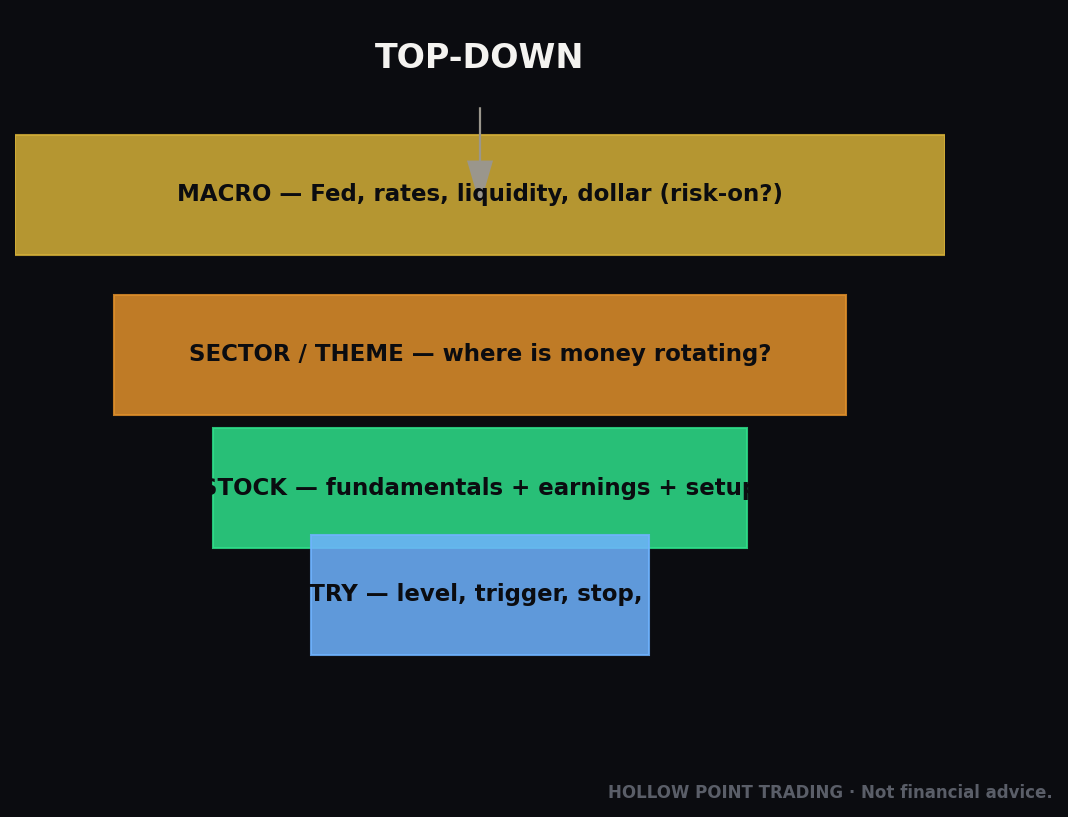
At Hollow Point Trading, we teach a top-down way of seeing: macro → sector → stock. You start with the big picture — the whole economy and the overall market mood (the macro). Then you narrow to which parts of the market are strong (the sectors). Then you get specific.
Micro index futures live right at the top of that funnel, and that is what makes them such a clean teaching tool. When you trade MES, you are trading the entire S&P 500 — the purest expression of "how is the whole market doing right now." You are not tangled up in one company's surprise news or one CEO's tweet. You are reading the big picture directly, which is exactly the muscle a top-down trader most needs to build. Micros let you practice reading the macro with real money on the line but the risk turned down to a whisper.
They also embody our deepest belief: protect capital first. We are not in the business of predicting the future — nobody can. We are in the business of managing risk so well that we survive being wrong, over and over, until the times we are right add up. The 1:3 reward-to-risk rule, the stop-loss before every entry, the "start with one contract" discipline — these are not restrictions on your trading. They are the trading. The setups and the charts are just how you find the entries; the rules are how you stay alive long enough to profit from them.
Micros are the perfect classroom for this philosophy precisely because they make the cost of a lesson so low. You will be wrong. Everyone is wrong a lot. The whole game is being wrong small and right big — and a $5-per-point contract lets you be wrong small enough to keep showing up, day after day, until the skill is real and the size can finally grow.
Start with one MES. Set your stop. Aim for three times your risk. Follow the checklist. Do that a hundred times before you touch anything larger, and you will have done something almost no beginner does: you will have learned to trade without letting the learning bankrupt you.
That is the whole gift of the micro. The smallest door — into the biggest markets.
Sources:
- Micro E-mini Futures Products Overview — CME Group
- Micro Index Futures | MES, MNQ, MYM, M2K — Discount Trading
- MES Futures Tick Value — QuantVPS
Bound by rules, feared by trade.