
There's a trade that can go up 300% and back to zero before you finish your coffee. It's the fastest-growing product in the U.S. equity options market, it now accounts for a huge share of all S&P 500 options volume on any given day, and most of the people trading it have no idea what's actually happening inside the price. They see a cheap ticket. They don't see the physics.
This is a piece about the physics. By the end you'll understand what a zero-days-to-expiration option really is, why it moves the way it moves, who's on the other side of your trade, why the market so often gets "pinned" into the close, how the same instrument behaves like a totally different animal in a trend versus a chop versus a high-vol day, how it stacks with the rest of your toolkit, and — most importantly — how to trade these things like a professional instead of feeding the machine. We do this the HPT way: top-down, rules first, defined risk, discipline over prediction.
Most 0DTE education is either a hype reel of screenshots showing somebody's 900% winner, or a dry textbook definition of theta that never tells you how to actually place a trade. This is neither. This is the whole machine — the concept, the mechanism, the dealer plumbing, the regime map, and a stack of worked examples with real numbers — built from the ground up so that when you sit down in front of a live chart, you know exactly what you're looking at and exactly where you're wrong.
Let's build it.
The Concept: What "Zero Days to Expiration" Actually Means
An option is a contract. A call gives you the right to buy 100 shares of something at a fixed strike price before the option expires. A put gives you the right to sell 100 shares at a fixed strike before expiration. You pay a premium for that right. That premium is the price of the option, quoted per share, so a $1.50 option costs $150 for one contract (100 shares).
The word that matters here is expires. Every option has an expiration date. On that date, the contract settles: if it's worth something, it pays out; if it's worthless, it evaporates. 0DTE means "zero days to expiration" — an option that expires today. You are buying or selling a contract that has a few hours, sometimes a few minutes, of life left before it turns into either cash or dust.
A short history of how we got here
For years, most index options expired only on the third Friday of each month. That was the whole calendar — one big expiration a month, and everything else was a longer-dated bet. Then the exchanges added weeklies, so a Friday expiration existed every week. Then they added Monday and Wednesday expirations. Then Tuesday and Thursday. By 2022, on the biggest index products, something expires every single trading day. On the S&P 500 index (SPX), there is now an expiration Monday, Tuesday, Wednesday, Thursday, and Friday. That means on any given day, there exists a batch of options with hours to live. Those are the 0DTEs, and traders swarm them.
Why did this explode? Three reasons stacked on top of each other. First, structure — daily expirations mean a same-day bet is always available, so you never have to hold overnight risk to trade options. Second, cost — a same-day option strips out almost all the time value, so the ticket is cheap, which pulls in retail size. Third, leverage — the exact thing that makes them cheap also makes them explosive, and explosive is what a certain kind of trader is shopping for. The result is that 0DTE options went from a niche to, on many days, the single largest slice of S&P options volume.
The three products that dominate — know the differences cold
Three products own this world, and the differences between them are not trivia. They change your tax bill, your assignment risk, and your position sizing.
SPX — options on the S&P 500 index itself. These are cash-settled (no shares change hands; you settle in dollars), European-style (can only be exercised at expiration, so no surprise early assignment), and they carry a favorable U.S. tax treatment known as Section 1256 (60% long-term / 40% short-term regardless of holding period). SPX is where the serious 0DTE volume lives. One SPX contract is large — it tracks the full index, so it's roughly 10x the notional of one SPY contract. If SPX is at 5000, one at-the-money contract controls roughly $500,000 of notional index exposure.
SPY — options on the S&P 500 ETF. These are American-style (can be exercised any time) and settle into actual ETF shares. Smaller, more accessible, penny-wide strikes, great for smaller accounts — but assignment risk is real if you're short. If you sell a SPY put that goes in-the-money, you can be assigned 100 shares of SPY per contract, and that's real capital you suddenly owe.
QQQ — options on the Nasdaq-100 ETF. Same American-style, share-settled structure as SPY, but tracks tech-heavy Nasdaq, so it moves faster and wider. The Nasdaq-100 futures (NQ) and QQQ are the high-beta cousins — more range, more gamma, more danger. A day that's a sleepy pin in SPX can be a wild trend in QQQ because the index itself is moving twice as much in percentage terms.
There's also XSP — a mini-SPX that's one-tenth the size of SPX but keeps the cash-settled, European, 1256 treatment. It's the bridge for accounts that want SPX's clean mechanics without SPX's notional. And for the futures crowd, /ES and /NQ options give you the same 0DTE exposure with 23-hour access and futures margin.
Cash settlement and the pin-risk trap
One concept that trips up beginners: pin risk and how settlement works. With SPX, cash settlement at expiration means you never wake up owning shares — you're paid or debited the difference in dollars. With SPY and QQQ, an option that finishes even a penny in-the-money is auto-exercised into shares. If you're short a SPY spread and the underlying settles between your two strikes, one leg exercises and the other doesn't, and you can be left holding a directional stock position over the weekend you never intended. Pros trading same-day ETF spreads either close before the bell or accept that they must manage assignment. This is one of the quiet reasons serious 0DTE size lives in cash-settled SPX: the settlement is clean and there is no Monday-morning surprise.
So that's the concept. A 0DTE is an option living its last few hours. Cheap, because there's almost no time left. Explosive, because of why it's cheap. To understand the explosion, we have to talk about the two Greek letters that run the entire show: theta and gamma.
The Mechanism: Theta Decay and Gamma Explosion
Every option's price is made of two ingredients. Intrinsic value is how far in-the-money it already is — a call struck at 5000 when the index is at 5020 has $20 of intrinsic value. Extrinsic value (also called time value) is everything else you're paying — the price of possibility, the chance the option finishes further in the money before it dies.
Here's the thing about extrinsic value on expiration day: it's almost all melting away, all day, every second. That melt has a name.
Theta — the clock that never stops
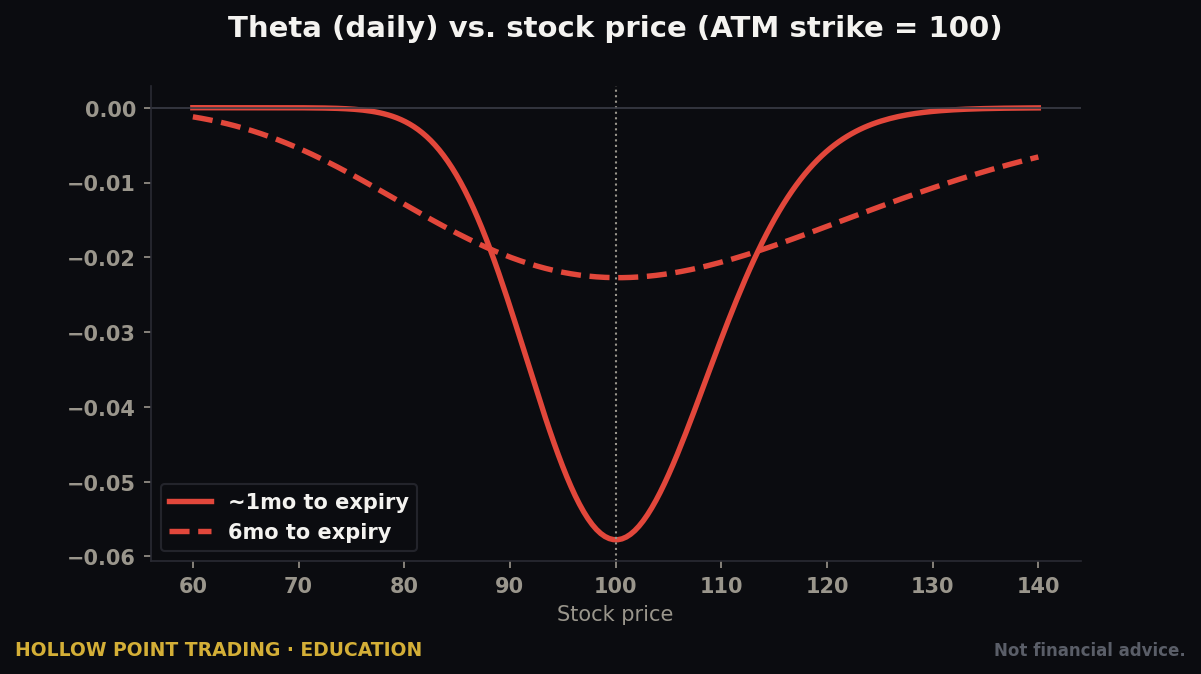
Theta measures how much an option loses in value from the simple passage of time, all else equal. It's the daily bleed. On a normal option with 30 days left, theta is a slow drip. On a 0DTE, theta is a waterfall. There's only a handful of hours of time value left, and it has to reach zero by the close. That decay isn't linear — it accelerates into the final hours, and the closer an option sits to the money, the more brutal the drop.
Put a number on it. Imagine an at-the-money 0DTE that opens the day worth $8.00 of pure extrinsic value. By 11 a.m. it might be $5.50. By 1 p.m., $3.50. By 2:30, $2.00. By 3:30, $0.80. Same strike, price hasn't moved, and two-thirds of the value is gone — not because you were wrong, but because time passed. That's theta. And notice the shape: it doesn't lose value evenly by the hour. It loses slowly early and then falls off a cliff into the final ninety minutes, because the remaining uncertainty is collapsing fastest right at the end.
This is why 0DTE options that finish just barely out-of-the-money go to zero. Not "down 40%." Zero. The entire premium was extrinsic value, and extrinsic value is worth nothing the moment the contract expires without being in the money. If you buy a 0DTE call and the index doesn't get to your strike, you don't lose "some" — you lose all of it.
The flip side: if you're the one selling that option (collecting the premium), theta is your paycheck. Every hour that passes without the underlying reaching the strike, the option you sold gets cheaper, and you keep the difference. This is the core reason so many professional 0DTE strategies are net sellers of premium — they're renting out the melting ice cube and letting the clock do the work. But selling naked premium has its own way of killing you, which brings us to the second Greek.
Gamma — why it moves 100%+ in minutes
Delta is how much an option's price moves for a $1 move in the underlying. A delta of 0.50 means the option gains about 50 cents for every dollar the index rises. Simple enough. Delta also doubles as a rough probability of finishing in-the-money — a 0.20-delta option is loosely a "20% chance" bet.
Gamma is the rate of change of delta. It's the acceleration. It tells you how fast your delta itself is changing as the underlying moves.
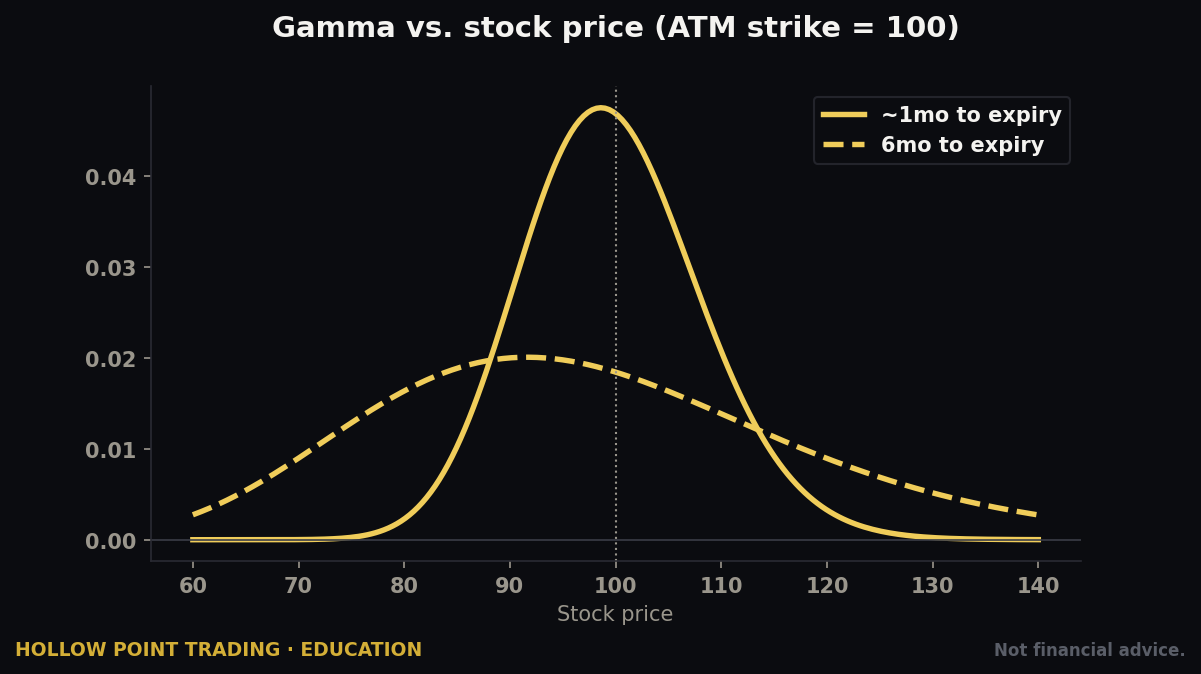
Here's the key fact that makes 0DTE its own animal: gamma explodes as expiration approaches, and it's highest for options near the money. On a 0DTE at-the-money option, a tiny move in the index can flip the option from "probably worthless" to "probably worth a lot" — because there's no time left for the situation to reverse. Delta can rocket from 0.20 to 0.80 in a single fast move. The option isn't just responding to price; it's responding to a collapsing probability distribution. On a 30-day option, a 10-point move barely nudges delta because there's a month for things to change. On a 0DTE with two hours left, that same 10-point move is nearly the whole ballgame, so delta reprices violently.
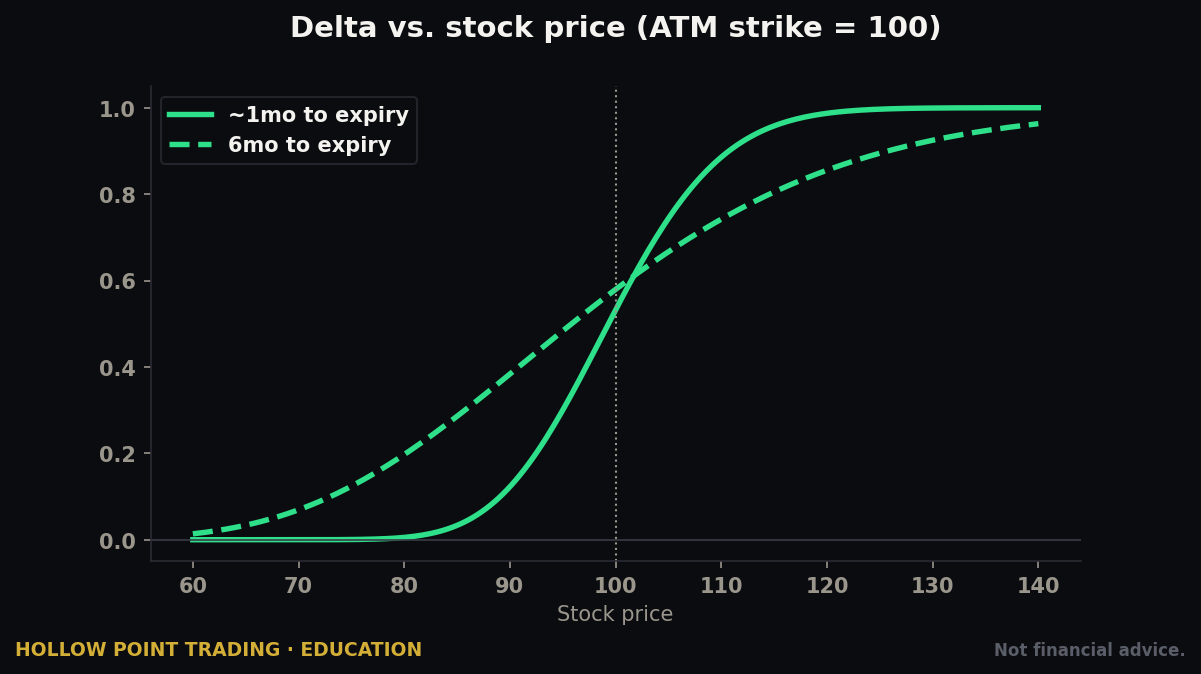
That's the mechanical reason a 0DTE can print +100%, +300%, +500% in minutes. You bought a slightly-out-of-the-money call for $0.80. The index rips 15 points in your direction in ten minutes. Suddenly your call is in-the-money, its delta went vertical thanks to gamma, and it's worth $3.20. That's a 4-bagger before lunch. The same forces run in reverse with equal violence: the same $3.20 can be $0.40 twenty minutes later if price rolls over, because gamma cuts both ways and theta is draining the tank the entire time.
Vega quietly leaves the room
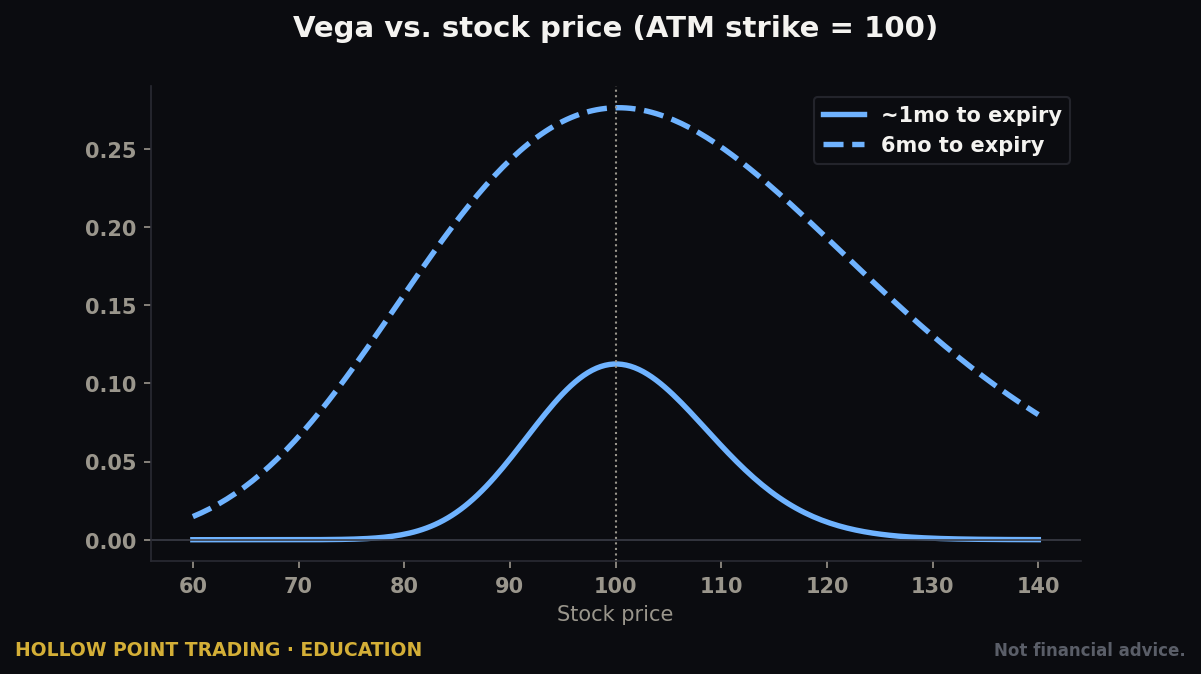
There's a third Greek worth naming so you know why it doesn't matter much here. Vega is sensitivity to implied volatility — how much the option reprices when the market's fear gauge moves. On longer-dated options, vega is huge; a spike in IV can make you money even if price doesn't move. On a 0DTE, vega is tiny and shrinking toward zero, because there's no future time for volatility to express itself in. This has a practical consequence: 0DTE options are almost pure delta/gamma/theta plays. You don't get bailed out by an IV pop the way you might on a monthly. What you see in price movement and time decay is essentially the whole story. That's cleaner in one sense, and more unforgiving in another — there's no volatility cushion to hide a bad directional read.
This is the entire seduction and the entire danger of 0DTE in one sentence: the combination of high gamma (violent directional sensitivity) and high theta (relentless decay) means you're being paid enormous leverage for being right right now — and punished at the same leverage for being early, being wrong, or being slow.
The moneyness map — where your ticket actually lives
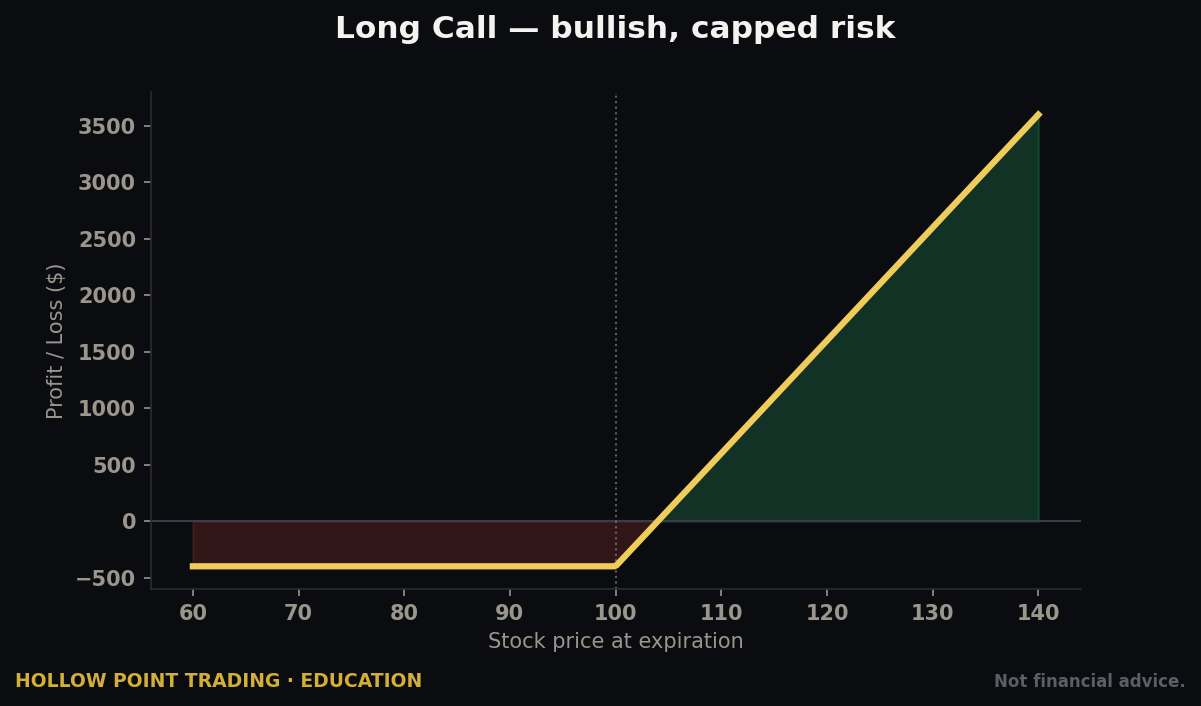
Not all 0DTEs behave alike, and the single biggest driver is moneyness — how far your strike sits from spot.
- Deep in-the-money (ITM): mostly intrinsic value, high delta near 1.0, low gamma. It moves nearly point-for-point with the index. Expensive, but it behaves like a stock proxy, not a lottery ticket.
- At-the-money (ATM): maximum gamma, maximum theta. This is the whip zone — the most explosive and the most decaying strike on the board. This is where scalpers live and where the biggest percentage moves happen in both directions.
- Out-of-the-money (OTM): all extrinsic value, low delta, and the further out you go the closer the whole thing is to a coin-flip with bad odds. Cheap for a reason.
- Deep OTM: effectively a raffle ticket. Priced at pennies because the market's honest assessment is "this almost certainly expires worthless." The rare 20-bagger is funded by the fifty tickets that went to zero.
When you buy near-the-money, your thesis has real delta and the trade tracks the chart. When you buy deep OTM "because it's cheap," you've stopped trading and started gambling on a tail. The map matters.
Dealer Gamma, Pinning, and the Invisible Hand on the Close
Now the part almost no retail trader understands, and the part that separates people who read the tape from people who get run over by it.
When you buy an option, someone sells it to you. Overwhelmingly, that someone is a market maker — a dealer whose job is to provide liquidity, not to bet on direction. When a dealer sells you a call, the dealer is now short that call and exposed to the market rising. To neutralize that, the dealer hedges by buying the underlying (or futures) to offset the delta. This is called delta hedging, and dealers do it continuously, mechanically, all day. They are not trying to predict anything. They are trying to stay flat and earn the bid/ask spread. But the mechanics of how they stay flat are what move your chart around.
Here's where it gets interesting. The way dealers have to hedge depends on whether they are, in aggregate, long gamma or short gamma.
Long-gamma dealers = a shock absorber (pinning)
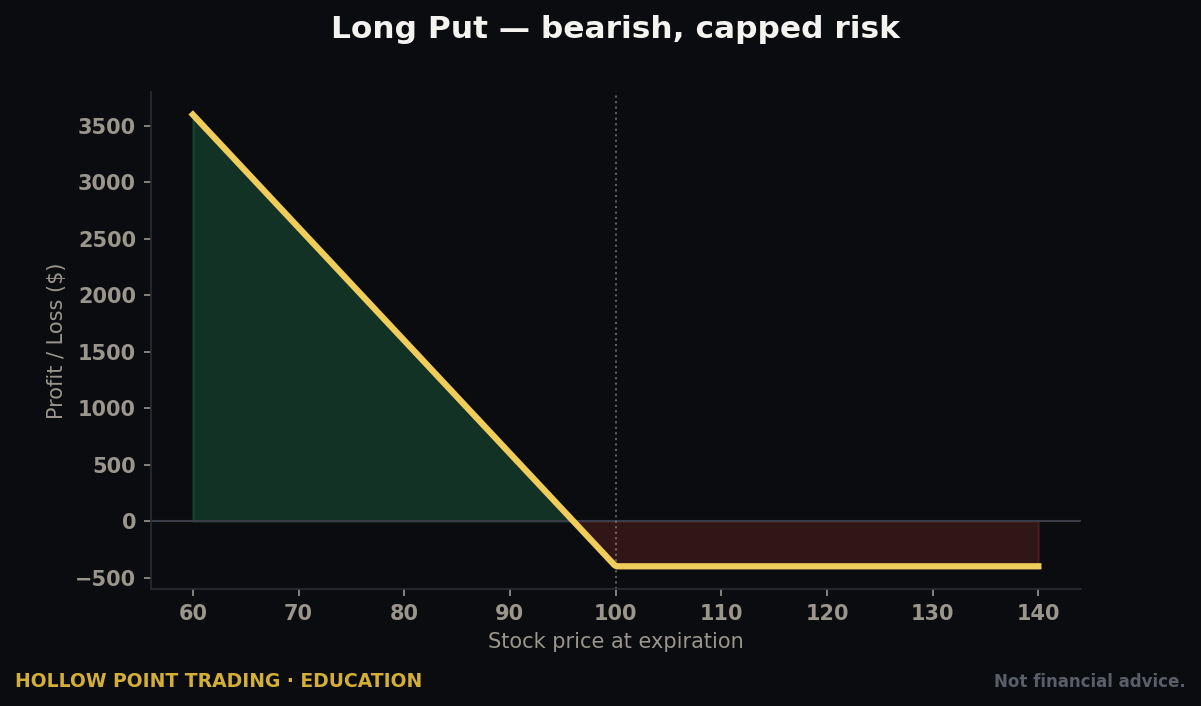
When dealers are net long gamma, their hedging is stabilizing. As price rises, their delta grows and they must sell the underlying to stay hedged. As price falls, their delta shrinks and they must buy. Sell into strength, buy into weakness — that's mean-reverting, dampening behavior. It sucks volatility out of the market and glues price to a level.
This is the mechanism behind pinning — the tendency of the underlying to gravitate toward, and get stuck at, a strike where a massive amount of open interest sits, especially into the afternoon and the close. As 0DTE options approach expiration, the gamma at the big strikes becomes enormous, and the hedging flows around them become powerful enough to magnetize price. The market seems to grind sideways into a number and refuse to leave. That's not coincidence. That's thousands of contracts' worth of hedging holding it in place.
Think about why the pull gets stronger into the close. As expiration nears, gamma at the nearest big strike goes near-vertical, which means dealers must hedge harder for every point of movement away from that strike. The further price drifts from the magnet, the bigger the offsetting flow that drags it back. It's a restoring force that tightens as the clock runs down — which is exactly why the tightest, most reliable pins show up in the last two hours, not the first.
Short-gamma dealers = an accelerant (the squeeze)
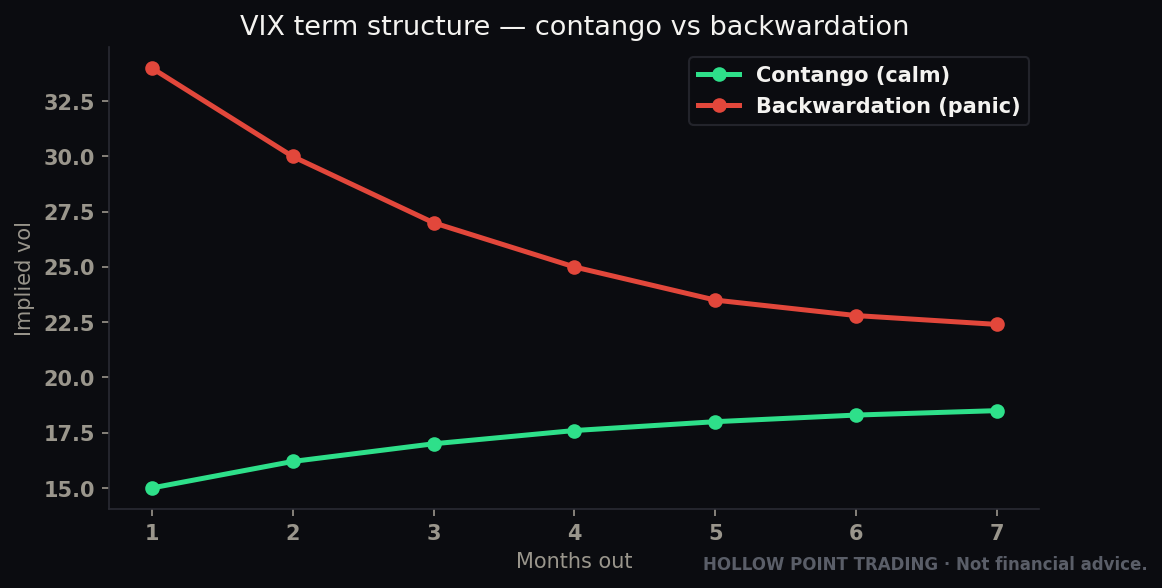
When dealers are net short gamma, everything inverts and gets dangerous. Now, as price rises, they have to buy the underlying to stay hedged, which pushes price higher, which forces them to buy more. As price falls, they must sell, pushing it lower, forcing more selling. Their hedging becomes pro-cyclical — it feeds the move instead of fighting it. This is the machinery behind those vicious, one-directional afternoon trends and air-pocket selloffs where price just goes and goes with no pullback. The dealers aren't choosing to chase; they're forced to, by the math of their hedge.
This is also why the worst down-days feel unnaturally smooth and relentless — no bounces, no relief, just a staircase lower. When the market is deep in short-gamma territory, every tick down mechanically generates more selling. The move stops feeling like a market and starts feeling like an avalanche, because in a sense it is one: each slide triggers the next.
The gamma flip level — the most useful number on your screen
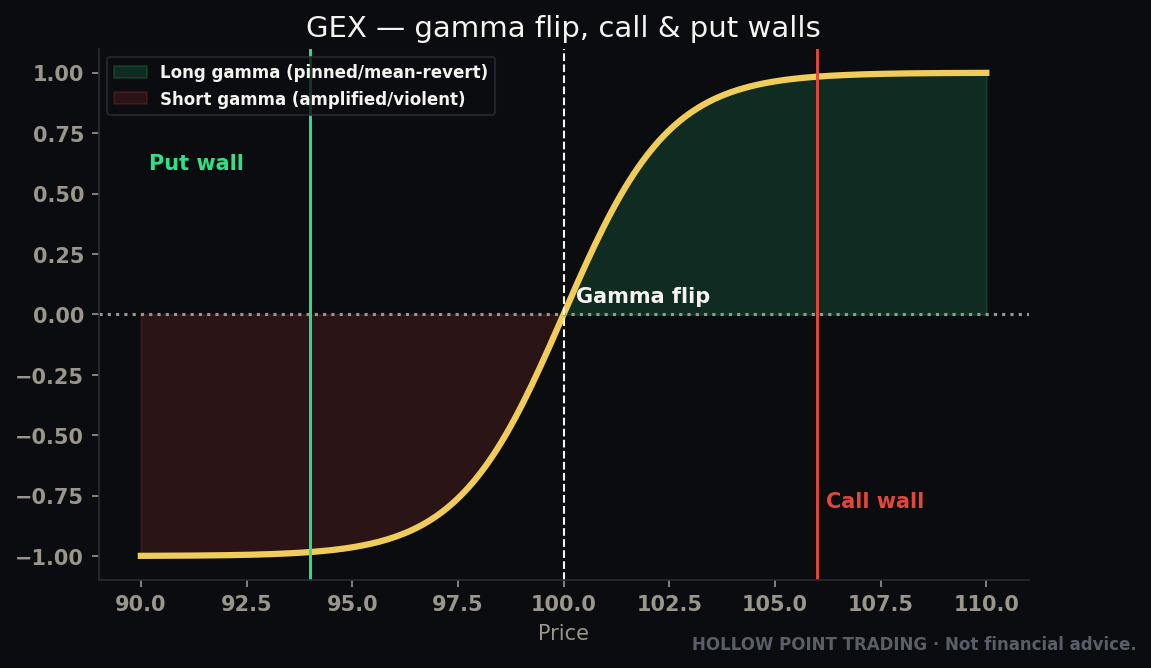
The single most useful concept that falls out of this is the gamma flip level (sometimes called the zero-gamma level): the price at which aggregate dealer gamma flips from positive to negative. Above it, the market tends to be calm and mean-reverting. Below it, the market tends to be violent and trending. Knowing roughly where that level sits on a given day tells you what kind of day to expect — a chop-and-pin day where fades work, or a trend day where you get run over fading.
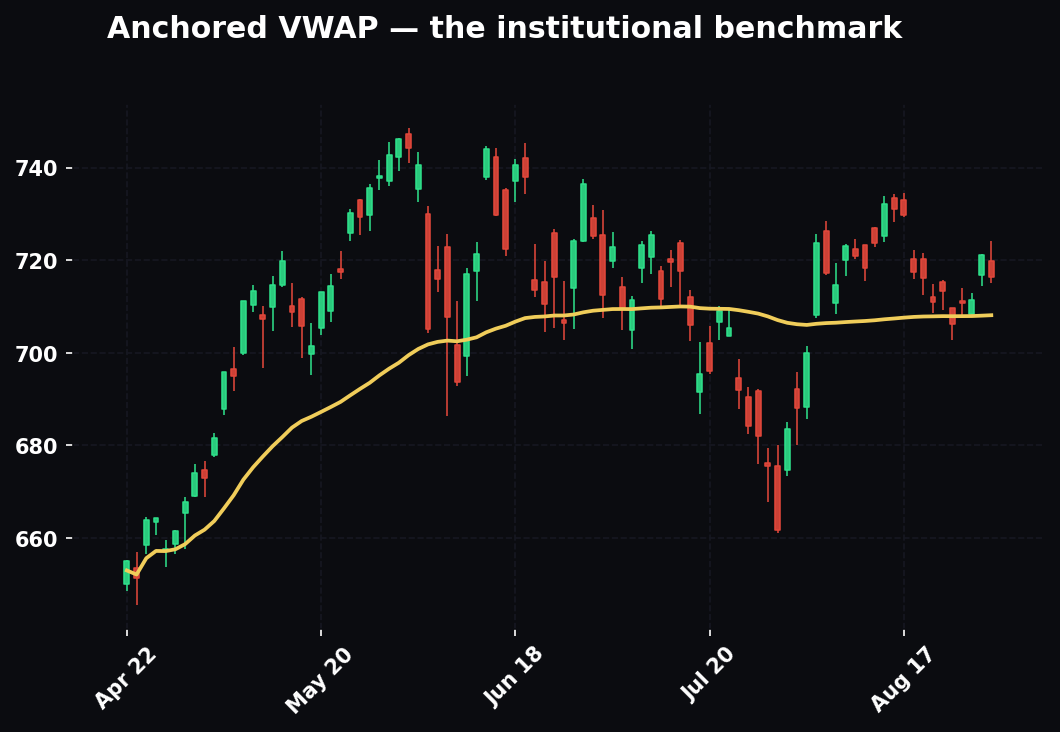
This is exactly why HPT reads options positioning on every chart where the data's available: call walls (big strikes above price that act as resistance/magnets and cap rallies as dealers sell into them), put walls (big strikes below that act as support), and the gamma flip. When SPX is pinned to a call wall at 5000 into the afternoon, that's not a prediction — it's a read of where the hedging pressure is parked. When price breaks below the put wall and the gamma flip, you respect the possibility that the floor just turned into a trapdoor.
How to actually use the walls
A call wall isn't a magic ceiling that can never break — it's a level where dealer hedging leans against upside. As price approaches a big call wall from below in a long-gamma environment, expect the rally to stall and fade, because the dealers who are long those calls sell futures into the rise. That makes the call wall a high-probability trim/short-scalp zone, not a place to chase breakouts. The mirror image holds for put walls: approaching a fat put wall from above, expect dips to get bought, because hedging buys into weakness there. The put wall is your dip-buy zone — until it breaks. And when a wall breaks decisively, its role often flips: a broken call wall can become a shelf of support on the retest, a broken put wall a lid on the bounce.
There's also a subtlety in whose options build the wall. A wall built from customer-bought calls (dealers short) hedges differently than one built from customer-sold calls (dealers long). You usually can't see that decomposition without a good positioning provider — which is the honest limitation below.
A word of honesty, HPT-style: this data has to come from a real source — a GEX terminal, a positioning provider, real open-interest data. Never invent a wall. If you don't have the positioning, say so and trade the price action in front of you. A made-up level is worse than no level, because it gives you false confidence in a number that isn't real.
Regimes: The Same Instrument, Three Different Animals
A 0DTE is not one thing. It behaves completely differently depending on the market regime that day, and the number-one skill in this game is reading the regime first and picking the tactic second. Get this backwards and you'll run a pin strategy into a trend day and hand your account to the machine.
Regime 1 — the pin/chop day (long-gamma, low realized vol)
Signature: price is above the gamma flip, VIX is low or bleeding lower, the day opens with a range and then compresses, and price keeps orbiting a big strike. Realized volatility is dying by the hour. On these days the dealer hedging is a shock absorber, breakouts fail, and the money is in fading the extremes of the range back toward the magnet. Buying premium is hard here because theta eats you while price goes nowhere — this is a seller's regime. Defined-risk credit spreads and iron condors placed outside the expected range are the pros' bread and butter on pin days.
Regime 2 — the trend day (short-gamma, expanding vol)
Signature: price breaks below the gamma flip, VIX is rising, and the tape moves in one direction with shallow or nonexistent pullbacks. Dealer hedging is now an accelerant. Fading gets you flattened. The money is in directional buying with the trend — this is the one regime where buying a 0DTE and holding for a real move actually pays, because the gamma feedback loop keeps the move going and your bought gamma is working with the flow instead of against theta. Selling premium here is how you get the loss that erases a month.
Regime 3 — the high-vol / event day (regime in flux)
Signature: a scheduled catalyst — CPI, FOMC, NFP, quad-witching — or a shock headline. Before the print, the market often coils and pins in a tight anticipatory range. The instant the number hits, gamma can flip in seconds, spreads blow out, and the "pin" you were leaning on vaporizes. On these days the correct default is smaller size, wider stops or no position through the print, and only engaging once the dust settles and a direction establishes. The single most expensive mistake on an event day is treating the pre-print calm as a normal pin and selling premium into it — the print can hand you the max loss on a spread in one candle.
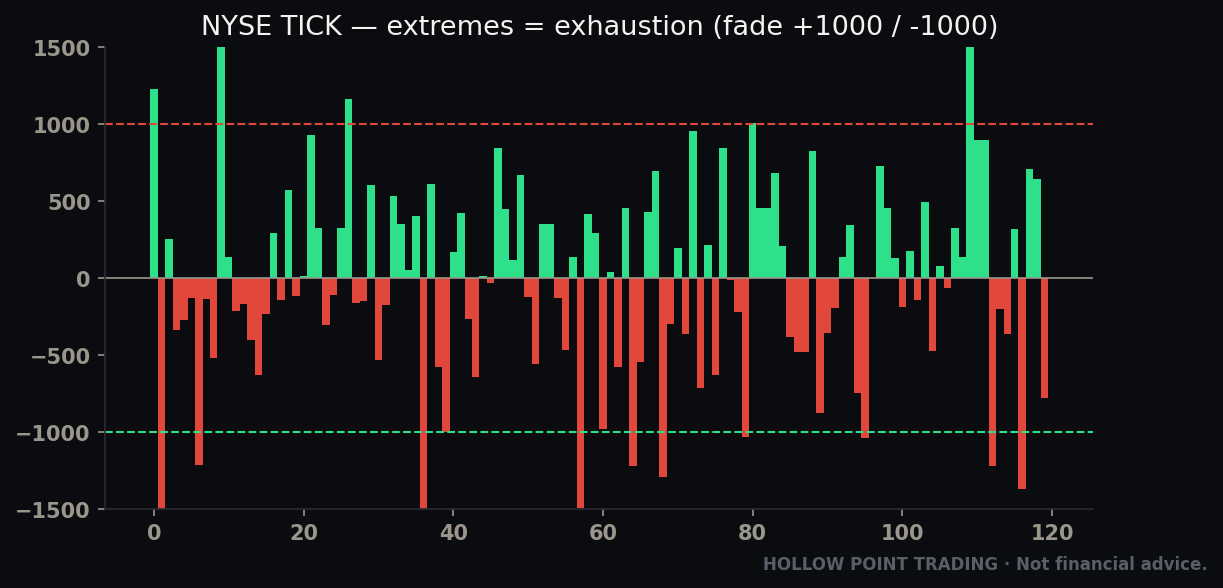
The multi-timeframe read on a same-day option
"Zero days" doesn't mean "one timeframe." The pros build the 0DTE view exactly the way HPT builds any view — top-down across timeframes, then execute on the fast chart.
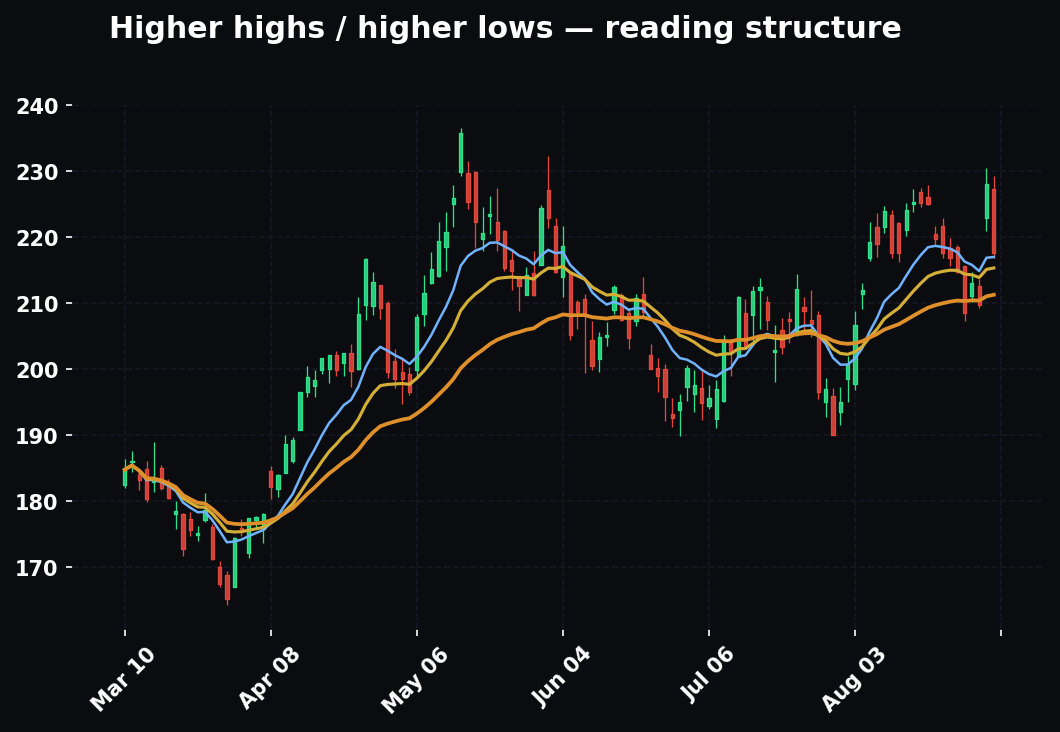
- Daily sets the bias. Where is the index versus its EMA 12/22/55 stack? The daily 55 is the bias tell. If price is above a rising daily 55 and holding, your default lean on the 0DTE is long-side; if it's below a falling 55, your default lean is short-side. You can still scalp counter-trend, but you size it smaller and take profit faster.
- The 15-minute / hourly sets the structure and the levels — prior-day high/low, overnight range, session VWAP, the active swing and its golden pocket. This is where your entry, stop, and target lines actually get drawn.
- The 1–5 minute sets the trigger and the timing — the reclaim, the failed breakout, the momentum push that gets you in with the tape rather than in front of it.
Timeframe-weighted confluence still rules: when the daily bias, the 15-minute level, and the 1-minute trigger all point the same way and line up with the positioning, that's an A+ 0DTE. When they conflict, you either pass or you scalp tiny. The instrument being same-day doesn't shrink the analysis to one chart — it raises the stakes on getting the multi-timeframe read right, because you have no time to be wrong and recover.
Confluence: Stacking 0DTE With the Rest of the Toolkit
0DTE is a vehicle, not a signal. The signal comes from your chart tools lining up. Here's how the pros stack it with three specific tools so the option is just the trigger on a decision that was already made.
Confluence tool 1 — EMA 12/22/55 stack
The HPT trend framework is EMA 12/22/55, not the standard 9/21. On the timeframe you're trading, a clean bullish stack (12 over 22 over 55, all rising, price riding the 12) tells you the trend is intact and dips to the 22 are buyable. A same-day call bought as price holds the rising 22-EMA on the 15-minute, in the direction of the daily 55 bias, is a trade with the wind at its back. The mirror holds for puts in a bearish stack. When price is tangled in the EMAs — all three flat and crossing — that's a chop tell, and chop is a seller's environment, not a place to buy gamma.
Confluence tool 2 — the golden pocket (0.618–0.65 fib)
Draw the fib on the active leg. The golden pocket (0.618–0.65 retracement) is where trends most often resume. A 0DTE call taken as price reclaims the golden pocket on the pullback of an uptrend — with the daily bias long and a put wall sitting just below as a floor — is textbook confluence: three independent reasons the same price matters. The invalidation is clean and obvious: lose the pocket decisively and the thesis is dead, so your stop writes itself. This is the difference between a level-based entry and a "it's going up" entry.
Confluence tool 3 — VWAP and the positioning overlay
Session VWAP is the intraday fair-value line the whole institutional world watches. Above VWAP with VWAP rising is a long-side environment; below a falling VWAP is short-side. Now overlay the positioning: when session VWAP, the drawn horizontal resistance, and the call wall all sit at the same 5020 price, that is a wall of confluence — the highest-conviction fade/trim zone on the chart. When price is pinned between a put wall below and a call wall above with VWAP in the middle, you have a defined range, and the range extremes become your fade points on a pin day. The option strike you choose should sit relative to these levels: buy calls with a target into the wall, not through it; sell credit spreads with the short strike outside the wall where hedging defends you.
The rule that ties it together: the option never leads. The chart tools produce the trade; the 0DTE is only the leverage you apply once confluence and R/R clear the bar. If you find yourself picking the option first and reverse-engineering a reason, stop — that's gambling wearing a costume.
How to Read and Use It: Worked Examples
Theory is nice. Let's put it to work with concrete, plausible numbers. (These are illustrative, not live levels.)
Worked example 1 — the long scalp done right
It's 10:15 a.m. SPX is 5000. Your top-down read says the tape is constructive: overnight NQ held its level, the EMA 12/22/55 stack on the 15-minute is stacked bullish and price is riding the 12, and SPX just reclaimed the prior-day high at 4998 on a clean momentum push. Positioning shows a call wall at 5020 and the gamma flip well below at 4970 — you're in the calm, above-flip zone, so you expect a grind, not a rocket, and you know 5020 is a ceiling where dealers will sell.
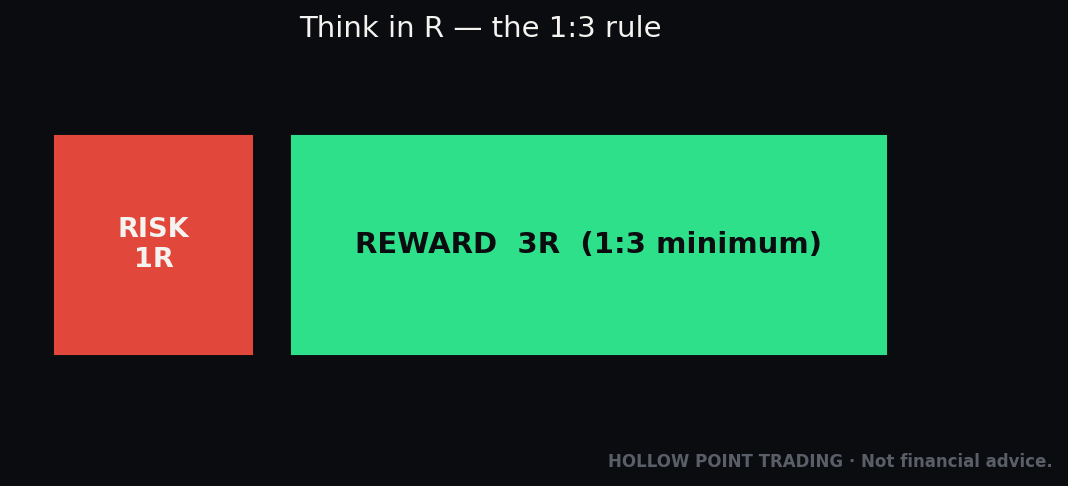
You buy a 5005 call (5 points out-of-the-money) for $1.80 ($180). Your plan is set before you click: stop if SPX loses 4996 (the reclaim fails), first target trim at 5012, runner toward 5018 just under the wall. R/R has to be at least 1:3 or you don't take it. Quick check: risk to your 4996 stop is roughly the premium you'd bleed on a 4-point adverse move, call it $0.70 of option value; your target move to 5012 lifts the call toward $3.40, a $1.60 gain. That's better than 1:2 on the first trim and better than 1:3 on the runner — it clears the gate.
Price grinds to 5012 over twenty minutes. Gamma has lifted your delta; the call is now $3.40. You sell half — that's +89% on that piece, booked. You trail the rest. Price stalls at 5017 into the call wall exactly as the positioning warned, momentum dies, you're stopped on the runner at $2.90. Blended exit crushes your cost. You won because you had a level-based thesis, defined risk, a target, and you respected the wall instead of praying through it.
Worked example 2 — the lottery ticket that teaches the lesson
Same day, different trader, no plan. Sees SPX "going up," buys a 5030 call — 25 points out-of-the-money, 0DTE — for $0.35 because it's "cheap." It's cheap because it's a near-lottery: it needs SPX to blow through the 5020 wall in a couple hours or it's worthless. Price pins at the wall, chops, and by 2 p.m. that $0.35 is $0.06. By 3 p.m. it's a penny. By the close it's zero. No stop, because "it was only $35." Multiply that by twenty sessions and it's a shredded account, one small ticket at a time.
The difference between example 1 and example 2 is not luck. It's structure, level-awareness, and discipline. Trader 1 bought delta near his thesis and respected the wall. Trader 2 bought a tail and prayed. Over a hundred sessions, trader 1's edge compounds and trader 2's raffle tickets bleed to zero — with the occasional bragged-about winner that never covers the graveyard.
Worked example 3 — defined-risk selling (the put credit spread)
You think SPX will not fall below 4980 today. Instead of buying anything, you build a put credit spread: sell the 4980 put, buy the 4970 put as protection. You collect, say, $2.00 net credit ($200). Your maximum loss is capped: the 10-point width minus the credit, so ($10.00 − $2.00) × 100 = $800 max risk, no matter how far SPX crashes. Theta is now working for you — every hour SPX stays above 4980, the spread decays toward your favor. If SPX closes anywhere above 4980, you keep the full $200.
Notice the risk/reward is inverted from the buyer's: you risk $800 to make $200, roughly 1:4 against you on paper. That only makes sense because your probability of winning is high — you're selling a strike below the put wall in a long-gamma regime where hedging defends that floor. The professional edge in premium selling is winning often enough, and cutting the rare loser fast enough, that the math works. The management rule matters as much as the entry: many pros close for a partial profit (say, buy it back at $0.60 for a $1.40 gain) rather than holding to the last dime, because that last dime of theta isn't worth the tail risk of a late-day break.
Worked example 4 — the iron condor on a pin day
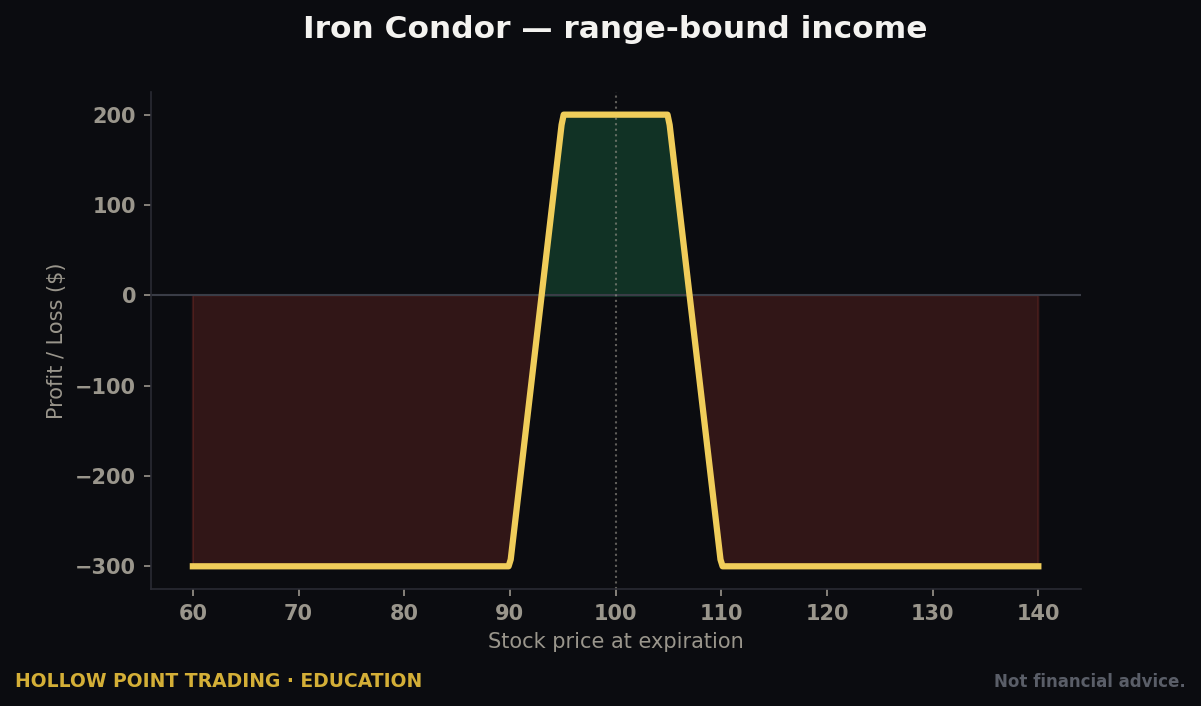
It's a classic pin setup: SPX at 5000, VIX low and falling, above the gamma flip, a call wall at 5025 and a put wall at 4975. You define a range you expect to hold and sell both sides: a call credit spread above (short 5025 / long 5035) and a put credit spread below (short 4975 / long 4985). You collect, say, $3.00 total credit on 10-point wings, so max risk is ($10 − $3) × 100 = $700, and you keep the $300 if SPX closes anywhere between 4975 and 5025. On a genuine pin day, the dealer hedging does your work for you — price orbits 5000 and both spreads decay. The danger is a regime change mid-day: if SPX knifes below the put wall and the flip, your put spread is suddenly in trouble, and the condor's fixed max loss is the reason you can survive being wrong. You'd manage it by closing the tested side when the level breaks rather than hoping it comes back.
Worked example 5 — the trend day where buying finally pays
Different day. 10:40 a.m., SPX has already broken below the overnight low, sliced through the gamma flip at 4990, VIX is up 8%, and every bounce is getting sold within two points. This is a short-gamma trend day — the one regime where buying a 0DTE and holding is the right call. You buy a 4980 put (10 points OTM as price trades 4990) for $2.20. Because dealers are forced to sell into every dip, the move doesn't pull back — SPX grinds to 4960 over the next hour and your put is worth $9.50. You don't scalp this one off at +20%; you trail it, because the regime tells you the move persists. You take it off into a climax or when price reclaims the flip. The tactic inverted from example 1 because the regime inverted. Same instrument, opposite playbook.
Reading the pin — the practical tell
It's 1:30 p.m., SPX has traded in a 6-point range for an hour, sitting right at 5000 where the fat open interest is, realized volatility is dying. That's a pin signature. On a pin day, the edge is fading the extremes of the range back toward the magnet and not buying breakouts that keep failing. But the moment price decisively leaves the pin and clears the gamma flip — say it knifes through 4970 on volume — the character flips to trend, and the same fade that printed all afternoon becomes the trade that blows you up. Read the regime, then pick the tactic. Never the other way around.
How 0DTE Fits the HPT Top-Down Process
0DTE is not a strategy. It's an instrument — a high-leverage expression of a view you already formed. It slots into the exact same top-down funnel HPT runs on everything, and it never, ever replaces that funnel.
Macro first. Is there a catalyst today — CPI, FOMC, jobs, a Fed speaker, quad-witching? 0DTE behavior on a data day is a different sport: dealers reposition violently around the print, gamma can flip in seconds, and the "pin" you were leaning on can vaporize at 8:30 a.m. Central. Know the calendar before you touch a same-day option. A trade that's textbook on a quiet Tuesday is a coin-flip through a CPI print.
Sector and index next. SPX/SPY/QQQ are index products, so your read is the market read. Where's the S&P relative to its EMA 12/22/55 on the daily and the 15-minute? Is NQ leading or lagging ES? What's VIX doing — bleeding (supports the pin/fade) or spiking (respect the trend)? What are DXY and yields saying? Is credit calm or cracking? The index doesn't trade in a vacuum, and a 0DTE on the index is downstream of all of it. If NQ is leading ES higher and VIX is bleeding, your long-side 0DTE has intermarket confirmation; if they're diverging, tighten up.
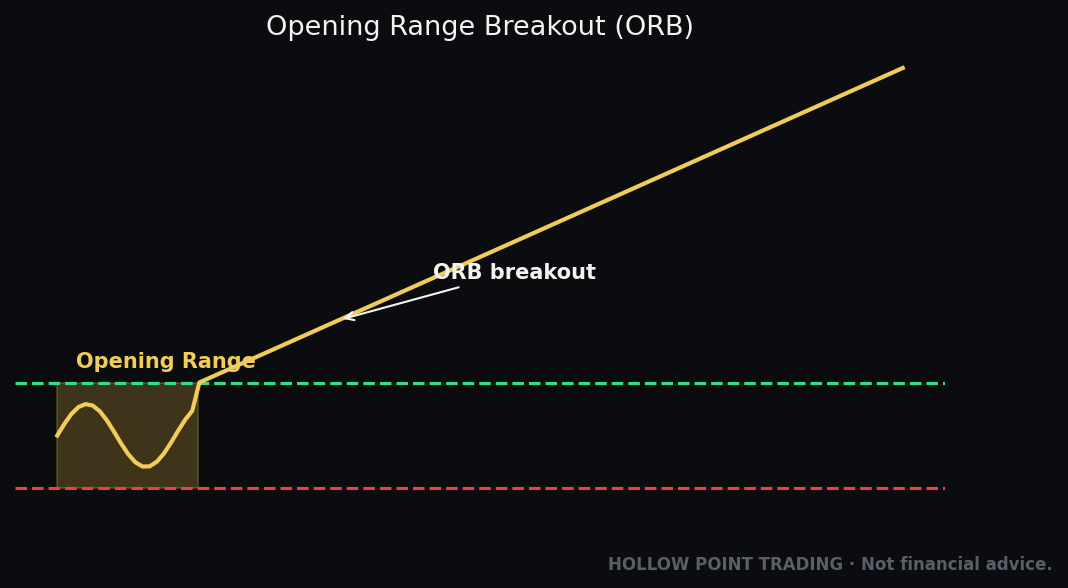
Technical level third. This is where the actual trade lives. Prior-day high/low, overnight high/low, opening range, session VWAP, the drawn horizontals, the golden pocket on the active leg — those are your entry, stop, and target lines. The option is just the vehicle; the chart defines the trade. If you can't state the price that invalidates the idea, you don't have a trade, you have a wish.
Positioning fourth. Overlay the call wall, put wall, and gamma flip on top of the technical level. When a chart resistance lines up with a call wall, that's real confluence — two independent reasons the same price matters. When they conflict, size down and stay nimble. And when you don't have real positioning data, you say so and trade the chart — you never sketch in an imaginary wall to feel more confident.
Behavioral last. Time of day is a variable in 0DTE the way it isn't elsewhere. The first 30 minutes are wild and gamma is still building — spreads are wide, the overnight inventory is being worked off, and false moves are common. Mid-morning (roughly 10:30–11:30) often sets the day's structure. Lunchtime frequently pins as volume dries up. The last hour ("power hour," roughly 3–4 p.m. ET) is where gamma is maximal, decay is savage, and moves are the sharpest — the most dangerous and most opportunity-rich window of the day. Match your tactic to the clock: buy gamma when it's building and moves are real, lean on theta when the pin sets, and treat power hour with a scalper's trigger finger.
Confluence and R/R gate everything. HPT's rule doesn't bend for 0DTE: timeframe-weighted confluence, minimum 1:3 reward-to-risk, defined risk. If the setup doesn't clear that bar, the trade is no trade. Discipline over prediction. The market gives hundreds of setups a day; you only need the ones that line up.
How the Pros Use 0DTE Differently From Beginners
The gap between a professional 0DTE trader and a beginner isn't the win rate on any single trade — it's the entire relationship with the instrument. Here's the contrast, laid out plainly.
Beginners buy; pros mostly sell (with defined risk). The beginner is drawn to the lottery-ticket upside of buying cheap OTM calls. The pro spends most days as a defined-risk seller, harvesting theta with credit spreads and condors, and only buys premium when the regime (a short-gamma trend) actually rewards it. The pro treats buying gamma as a specialist tool for specific days, not the default.
Beginners pick the option first; pros pick the level first. The beginner scans the option chain for a cheap ticket and then finds a reason. The pro identifies the level, the bias, and the positioning, decides the trade, and only then chooses the strike and structure that best expresses it.
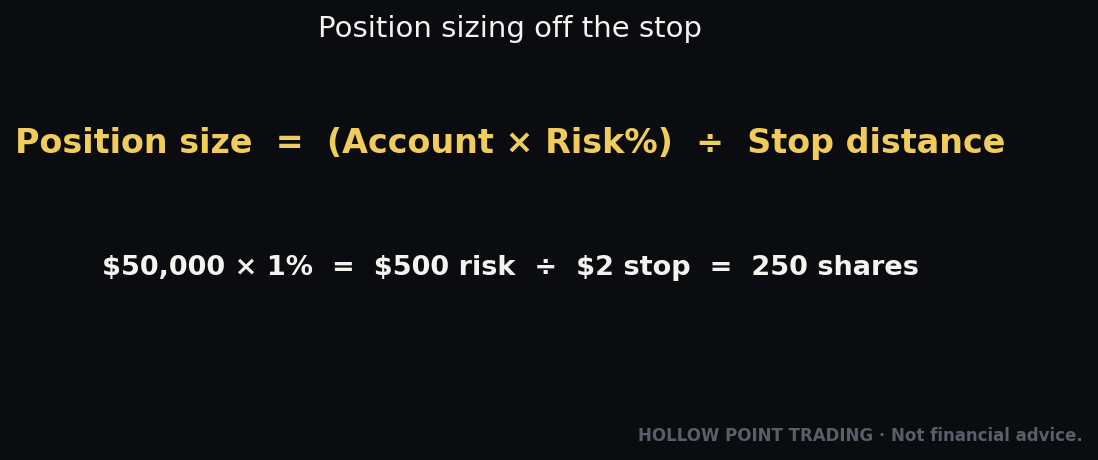
Beginners size off the ticket price; pros size off dollar risk to the stop. "It's only $40" is beginner math. The pro knows a $40 ticket at 20 contracts is $800 of risk swinging thousands intraday, and sizes so that a stop-out is a pre-decided, survivable fraction of the account.
Beginners hold and hope; pros scalp and manage. The beginner lets a winner ride into theta and a loser ride into zero. The pro trims into strength, trails runners, closes credit spreads for a partial profit rather than squeezing the last dime, and cuts the moment the level breaks.
Beginners ignore the dealer; pros read the plumbing. The beginner sees random price action. The pro sees the gamma flip, the walls, and whether hedging is a shock absorber or an accelerant that day — and picks fade-versus-follow accordingly.
Beginners trade every day; pros wait for the setup. The beginner needs action and forces trades in chop. The pro passes on low-confluence days entirely, knowing that not trading a bad regime is itself a winning trade.
The Common Mistakes That Blow Up 0DTE Traders
1. Buying far out-of-the-money "because it's cheap." Cheap is the market's honest quote on how unlikely this is. Deep OTM 0DTEs are the closest thing to a raffle ticket in liquid markets. The occasional 10-bagger you brag about is paid for by a graveyard of zeros you don't post. Trade near-the-money where your thesis actually has delta, or don't trade.
2. No stop, because "the risk is defined by the premium." Technically true — you can only lose what you paid. But that logic is how accounts die by a thousand cuts. A $200 ticket to zero, twenty times, is $4,000. Set a price stop on the underlying, not just a mental "I'll let it ride." When the level breaks, you're out, even if the option "could come back." It usually doesn't; theta won't let it.
3. Not taking profits. A 0DTE up 120% is a gift the clock is actively trying to take back. Scalp it. Trim into strength. Take the runner off before power hour reverses it. "Let winners run" is great advice for stock and terrible advice for a decaying same-day option — the winner is running toward zero the whole time unless it's deep in the money.
4. Selling naked premium. Selling a 0DTE straddle or naked put feels like free money — theta rains in, you win most days. Then one gap or one short-gamma trend day hands you a loss ten or twenty times your average win, and every green day of the month is gone in an afternoon. If you sell, define the risk with a spread. The long leg is not a cost to minimize; it's the reason you're still here next month.
5. Fighting the gamma regime. Fading a strong short-gamma trend because "it's overextended" is how you get flattened by forced dealer hedging. Below the flip, trends persist longer and harder than seems reasonable. Trade with the regime; use the pin to fade only when you're above the flip and price is genuinely stuck.
6. Over-sizing because the tickets are small. Small ticket price seduces people into 10, 20, 50 contracts. The leverage is enormous. A "small" 0DTE position can swing thousands in minutes. Size off dollar risk to your stop, exactly like any other trade — never off the sticker price of the option.
7. Trading illiquid names and wide spreads. Stick to SPX, SPY, QQQ (and futures/NQ for the tape) where the spreads are tight and the fills are fair. A 0DTE on a thin single-stock name with a 20-cent-wide bid/ask bleeds you on entry and exit before the market even moves.
8. Averaging down into a losing 0DTE. The most expensive sentence in this game is "I'll add here to lower my cost basis." You're adding size to a position the clock is killing. If the level's broken, the thesis is broken. Adding doesn't fix a broken thesis; it just enlarges the loss.
9. Trading through the print without adjusting. Holding a same-day spread into CPI or FOMC because it "looked good pre-print" is how a defined-risk trade turns into a max loss in one candle. Either be flat through the catalyst or explicitly size for the gap. The pre-print pin is a trap, not a pin.
10. Confusing "defined risk" with "safe." A put credit spread has a capped loss — but that cap can still be several times your credit, and it can happen fast. Defined risk means you know the number, not that the number is small. Size the position so the max loss, not the credit, is the survivable amount.
11. Chasing the first fifteen minutes. The open is wild, gamma is still building, spreads are wide, and overnight inventory is being worked off. Beginners get whipsawed buying the first spike. Let the auction settle; the cleaner setups come after the initial noise, once the day's structure declares itself.
12. No written plan before the click. If your entry, stop, first target, and runner target aren't decided before you buy, you will improvise under the fastest decay clock in the market — and improvisation plus 0DTE gamma is how disciplined traders become gamblers in a single afternoon. The plan is the seatbelt for your psychology the way the long leg is the seatbelt for your risk.
Frequently Asked Questions
Is 0DTE just gambling? It can be, and for most retail buyers of cheap OTM tickets, it is. But the instrument itself is neutral — a defined-risk credit spread sold outside a wall in a read regime, with a plan and a stop, is a legitimate probabilistic trade. The difference between gambling and trading here is entirely structure, level-awareness, and discipline, not the product.
What account size do I need? SPX contracts are large — a single spread can carry several hundred to a thousand dollars of defined risk — so small accounts often start with SPY, QQQ, or XSP for finer sizing. The real requirement isn't a dollar figure; it's that a full stop-out on your position is a small, survivable fraction of your account. If one bad 0DTE can meaningfully dent you, you're oversized regardless of account size.
Should I buy or sell 0DTE? Most consistently profitable 0DTE traders are net defined-risk sellers most of the time, harvesting theta, and selectively buy premium only on short-gamma trend days when gamma works for them. Buying cheap OTM calls all day is the losing default. Match the direction of your trade (buy vs. sell) to the regime.
How do I know the gamma flip and walls without expensive tools? You need a real positioning source — a GEX/dealer-positioning provider or genuine open-interest data. If you don't have one, you don't guess: you trade the chart levels (VWAP, prior-day high/low, EMAs, golden pocket) and treat positioning as a bonus when you have it. Never trade off an invented wall.
Why did my option lose money even though I was right on direction? Two usual culprits: you were right but slow (theta ate the gains while price took its time), or you bought too far OTM so the move didn't generate enough delta. On a same-day option, being right eventually isn't enough — you have to be right soon, near-the-money, in the right regime.
When during the day is best to trade? There's no single answer, but the structure is: wild and noisy at the open (let it settle), structure-setting mid-morning, pin-prone at lunch, and maximal gamma/decay in power hour (3–4 p.m. ET). Buyers want the moving windows; sellers want the pin. Match tactic to clock.
Can I hold a 0DTE overnight? No — by definition it expires today. With cash-settled SPX you're paid out in dollars at settlement; with SPY/QQQ an in-the-money option auto-exercises into shares, which is how people wake up owning stock they didn't plan to hold. If you want overnight exposure, that's a different-dated option, not a 0DTE.
The 0DTE Cheat-Sheet
Print this. Read it before the open.
Know your product
- SPX: cash-settled, European (no early assignment), 1256 tax treatment, large notional — the pro's 0DTE.
- SPY/QQQ: share-settled, American (assignment risk if short), smaller — accessible for smaller accounts.
- XSP: one-tenth SPX, cash-settled/European/1256 — the small-account bridge.
Know the Greeks that matter
- Theta = the melt. Brutal and accelerating on expiration day. Your enemy as a buyer, your paycheck as a defined-risk seller.
- Gamma = the acceleration. Highest near-the-money at expiry. The reason for +100% moves and the reason for −100% moves.
- Vega barely matters — 0DTE is nearly pure delta/gamma/theta. No IV cushion to bail out a bad read.
Know your moneyness
- ATM = max gamma, max theta — the scalper's whip zone.
- Near-OTM = your thesis with real delta — the sane place to buy.
- Deep OTM = a raffle ticket priced honestly as unlikely. Don't.
Read the regime before you pick a tactic
- Above the gamma flip → dealers long gamma → calm, mean-reverting, pins → fade the range extremes toward the magnet; sell defined-risk premium.
- Below the gamma flip → dealers short gamma → violent, trending → trade with the move, buy gamma, don't fade.
- Event day → regime in flux → smaller/flat through the print; engage after direction declares.
- Call wall = ceiling/magnet above (trim/fade zone). Put wall = floor below (dip-buy zone). Real data only — never invent a level.
Stack your confluence
- EMA 12/22/55 stack for trend; daily 55 for bias.
- Golden pocket 0.618–0.65 for trend-resumption entries with a clean invalidation.
- VWAP + walls for the fade/trim zones and the day's range.
- Option never leads — the chart makes the trade, the option is just the leverage.
Structure over lottery
- Prefer near-the-money if buying; your thesis needs delta.
- Prefer defined-risk spreads if selling; the long leg is your seatbelt, not a cost to cut.
- If you can't name the price that invalidates it, it's not a trade.
The discipline (non-negotiable)
- Scalp. This is a scalping instrument, not an investment.
- Hard stop on the underlying's level, not a mental one.
- Take profits into strength; trim the winner before the clock takes it back; close credit spreads for a partial rather than squeezing the last dime.
- Minimum 1:3 R/R, timeframe-weighted confluence, or it's no trade.
- Size off dollar risk to your stop — max loss, not the ticket price.
- Never average down a losing 0DTE. Broken level = broken thesis = out.
- Respect the clock: wild open, midday pin, savage power hour.
- Macro calendar first — data days rewrite every rule above.
- Written plan before the click: entry, stop, first target, runner target.
The one-sentence version: A 0DTE option pays you extreme leverage for being right right now and punishes you at that same leverage for being early, wrong, or slow — so define your risk, read the dealer regime, scalp with a stop, and take the money before theta does.
The traders who survive 0DTE aren't the ones with the best predictions. They're the ones with the best rules — who know what they own, who's on the other side, what regime they're in, and exactly where they're wrong. Everyone else is just buying tickets for a lottery the house designed.
Trade the read. Respect the clock. Keep the seatbelt on.
Bound by rules, feared by trade.