
Here's the uncomfortable truth nobody puts on a course landing page: two traders can take the exact same setup, at the exact same price, with the exact same stop and target — and one ends the month green while the other blows up. Same chart. Same signal. Different human.
The difference isn't the strategy. It's what happens in the four seconds between the price hitting your level and your finger on the button. It's what you do after three losers in a row. It's whether you can sit on your hands when the setup isn't there. It's whether you size the same on trade number eight of a red day as you did on trade number one of a green one.
That's trading psychology. Not affirmations, not "visualize success" — the actual mechanical study of how your brain sabotages your account, and the routines that stop it. At Hollow Point we say the job is discipline, not prediction. This is the piece that explains why, and hands you the tools to live it starting Monday. It's long on purpose. The shallow version of this material is everywhere and it changes nobody. The deep version is what actually rewires how you sit in the seat.
The Concept: You Are Trading Against Your Own Wiring
Your brain was built for a world where losing meant dying. Miss a threat, get eaten. Grab the calories now, because tomorrow is not promised. Move with the herd, because the loner on the savanna was the one that got picked off. Those instincts kept your ancestors alive long enough to make you. In the market, every one of them will systematically empty your account.
The market is a machine for extracting money from people who feel too much at the wrong times. Every edge you build in analysis — clean levels, EMA structure, timeframe confluence — gets handed right back at the moment of execution if your nervous system is running the show instead of your rules. The analysis is the easy 20%. The behavior under fire is the hard 80%, and it's the part that actually determines your equity curve.
Understand this framing before anything else: the edge is not in knowing the future. It is in behaving correctly when you don't. You will never eliminate the emotions, and you should stop trying. Professionals feel fear and greed exactly like you do — imaging studies of experienced traders show the same limbic spikes at the moment of risk that a novice shows. The difference is not that the pro feels less. It's that the pro has built a system that fires between the feeling and the action. That gap — the space between the impulse and the click — is the whole game. Everything in this guide is machinery for widening that gap and filling it with a rule instead of a reflex.
Why "just be disciplined" is useless advice
Telling a tilted trader to "be disciplined" is like telling someone mid-panic-attack to "calm down." The part of the brain you're appealing to is the part that goes offline first. Under acute stress — and a losing trade is acute stress — blood and attention route away from the prefrontal cortex (planning, judgment, impulse control) and toward the fast, reactive limbic system. This is measurable. Your working memory shrinks. Your time horizon collapses to the next few seconds. You literally become a different, dumber, more frightened decision-maker at the exact moment the stakes are highest.
This is why discipline can't be a feeling you summon. It has to be a structure you built earlier, while the smart part of your brain was still online. You don't rise to the level of your intentions in the heat of the moment; you fall to the level of your systems. The entire discipline of trading psychology is: make your decisions when you're calm, encode them into rules and routines, and then obey the machine when you're hot.
Let's define the enemies one at a time, then build the routines that beat them.
The Mechanism: The Seven Ways Your Brain Robs You
1. Fear and Greed — The Two Engines
Fear is loss avoidance running hot: you cut a winner early because you can't stand giving back the open profit, or you refuse to take a valid setup because the last one lost, or you never even size up on your best reads because being wrong feels unbearable. Greed is reward-seeking running hot: you size too big, you hold past your target "for more," you add to a winner with no plan because it feels free money, you widen a target mid-trade because a candle looked strong.
Notice they're the same circuit pointed in opposite directions. Both override your pre-planned decision with an in-the-moment feeling. The tell is identical: you did something you did not plan to do. Any time your action diverges from your written plan, one of these two is driving — no exceptions. This is the single most useful diagnostic in this entire guide. You don't need to correctly label the emotion. You only need to notice the divergence.
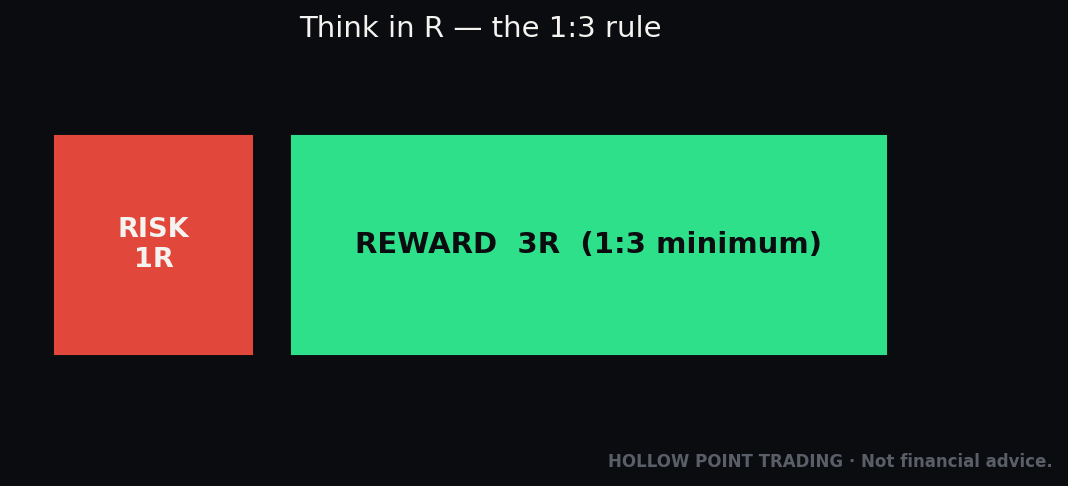
Worked example — greed cutting both ways in one trade. You're long NQ from 20,000, stop at 19,970 (30 points of risk), planned target at 20,090 (90 points, a clean 1:3). Price runs to 20,060. Greed's first move: "This is flying, move the target to 20,150." Now the same feeling flips. Price stalls, ticks back to 20,040. Fear's move: "I don't want to give back 20 points, I'm out." You planned 90, greed talked you out of your target, then fear closed you at 40. You just took a 1.3:1 trade on a setup you built as a 1:3. Do that ten times and you've quietly dismantled the math that made you profitable, while feeling the whole time like you were "managing risk."
2. FOMO — Fear Of Missing Out
The move takes off without you. Your chest tightens. You chase — entering late, at a worse price, with no level beneath you and no stop that makes sense. FOMO is fear wearing greed's clothes: you're not afraid of losing money, you're afraid of watching other people make it.
The mechanism is social and comparative, which is why it's so much stronger now than it was for traders twenty years ago. It gets worse in a chatroom, worse on Twitter, worse the instant someone posts a green screenshot. Comparison is the accelerant. The market runs hundreds of tradable moves a day. Missing one costs you nothing. Chasing one costs you real money at a terrible price, because by definition you're entering after the move has already paid the people who were early — you're buying their exit liquidity. A missed trade is not a loss. It is a $0 event. Burn that in.
Worked example — the two entries. Trader A sees a name break its opening range at 100.20 on volume, with the plan drawn pre-market, and enters at 100.30 with a stop at 99.80 (50 cents risk) targeting 101.80 (1:3). Trader B is scrolling, sees it already at 101.40, feels the pang, and buys at 101.50 "before it goes." Where's B's stop? There isn't a logical one — the nearest structure is back at 100.20, which is $1.30 away and would blow his risk budget, so he invents a tight 30-cent stop with no structure under it. The first pullback, entirely normal, takes him out at 101.20 for a loss. Same trade, same direction, same thesis — one is a disciplined 1:3, the other is a coin flip with the odds inverted. The chart didn't beat Trader B. The clock did.
3. Revenge Trading — The Tilt Spiral
You lose. It stings. So you jump right back in to "get it back" — bigger size, worse setup, zero patience. That loses too, which stings more, so you go bigger again. This is tilt: emotionally compromised decision-making, borrowed from poker, where a bad beat makes a player abandon strategy and start punting chips at the table.
Revenge trading is the single fastest way to turn a manageable red day into a catastrophic one. The mechanism is that the loss registered as an insult, not a cost of doing business, and now your goal has silently switched from "trade my edge" to "make the market pay me back." The market does not know you exist. It cannot pay you back. Every revenge trade is a fresh, independent bet made by your worst, most compromised self.
The anatomy of a blown day. Watch how the size creeps, because the size is the tell. Trade 1: planned 2-contract loss, -$400, fine, within budget. The sting says "make it back fast." Trade 2: 3 contracts on a B-setup, -$700. Now you're down $1,100 and angry. Trade 3: 5 contracts, no real level, just "it has to bounce," -$1,400. Down $2,500. Trade 4: 8 contracts, revenge in full control, and this one gaps against you for -$3,000. In four trades you went from a normal red day to a month-erasing one, and every single decision after Trade 1 was made by a person who was not thinking. The catastrophic loss almost never comes from the setup. It comes from the reaction to the setup that failed.
4. Loss Aversion and the Disposition Effect
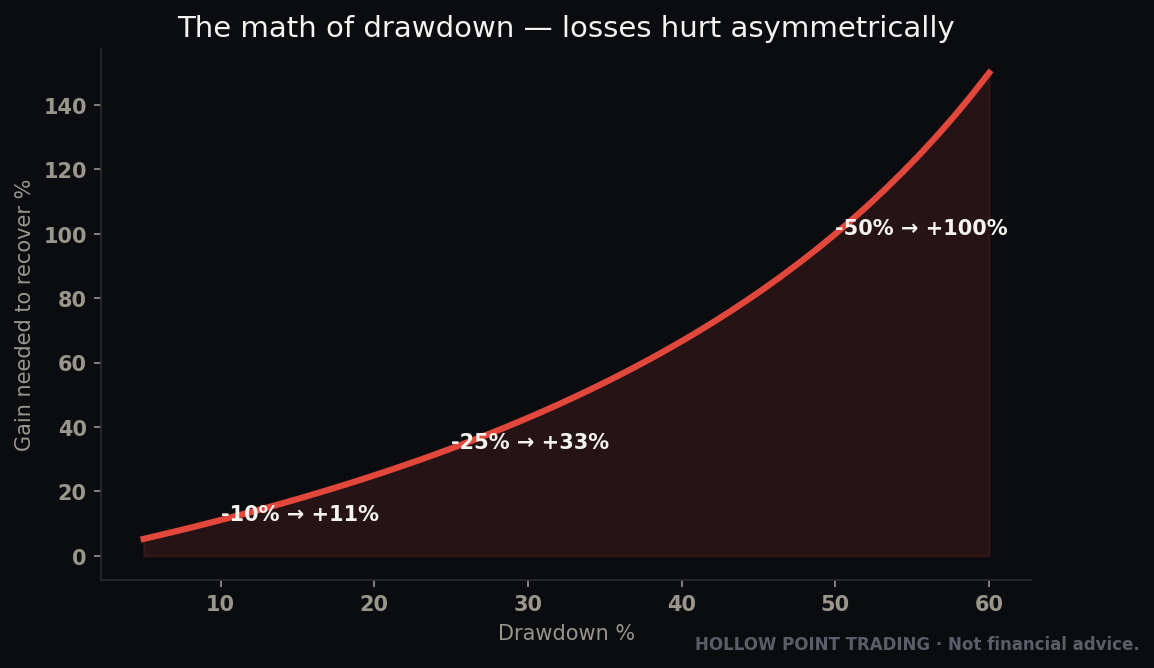
Behavioral economists Kahneman and Tversky nailed this decades ago: a loss hurts roughly twice as much as an equivalent gain feels good. Losing $500 stings about as much as winning $1,000 pleases. This asymmetry — loss aversion — bends every decision you make around a loss, and it does so below the level of conscious thought.
Its ugliest child is the disposition effect: the proven, heavily-documented tendency to sell winners too early and hold losers too long. Why? Selling a winner locks in a gain — that feels good, so your brain wants to do it now, before it can be taken away. Selling a loser locks in a loss — that feels awful, so your brain avoids it, holding and hoping the position comes back so the loss never has to be "realized." So you snatch tiny profits and let losers run into disasters — the exact, precise opposite of the "cut losses, let winners run" rule every book preaches. You already know the rule. Loss aversion makes you break it in real time, and it feels responsible while you do it ("I'm taking profits!" "I'm giving it room!").
The math of the disposition effect. Say your edge, honored cleanly, is: winners average +3R, losers average -1R, win rate 40%. Expectancy per trade = (0.4 × 3) + (0.6 × -1) = +0.6R. Healthy. Now let the disposition effect in. You cut winners at +1.2R on average because you can't stand the giveback, and you let losers run to -1.8R because you keep hoping. Same 40% win rate, same setups. New expectancy = (0.4 × 1.2) + (0.6 × -1.8) = 0.48 - 1.08 = -0.6R per trade. You didn't change your analysis, your setups, or your win rate. You flipped a profitable system into a losing one purely through how you felt about open profit and open loss. That is the disposition effect converting a real edge into a real drawdown, one "sensible" click at a time.
5. Overtrading — Confusing Activity With Progress
You feel like you should be doing something. Flat feels like failure. So you take marginal setups, trade tiny chop, force entries in dead sessions, and treat the lunchtime doldrums like the open. Overtrading is boredom, ego, and the illusion that effort equals results. In most of life, effort correlates with reward. In trading, effort is frequently negatively correlated with results, because the extra effort is spent taking trades that shouldn't be taken. The screen rewards patience and punishes fidgeting.
The costs stack in layers. More trades means more commission and more spread paid — a real, mechanical drag. More trades means more exposure to your own worst impulses, because every entry is another chance to tilt. And most insidiously, more trades means a diluted edge: your win rate and your R-multiple are computed across your A-setups, but the moment you start taking B's and C's to fill the boredom, you're averaging your good expectancy down with mediocre and negative expectancy. Your journal says your edge is +0.6R; your account says -0.1R; the gap is the C-trades you take when you're bored, and you never attribute the damage correctly because each one felt small.
6. The Sunk-Cost Trap
You're down on a position. Instead of honoring your stop, you move it — "I've already risked this much, I can't take the loss now." You average down into a loser to lower your cost basis on a trade that was already, provably, wrong. This is the sunk-cost fallacy: letting money you've already spent and can't recover dictate your next decision.
The correct question is never "how much have I put into this?" It is always: "Given where price is right now, with fresh eyes and no position, is this a trade I would enter?" If the answer is no, you're out — the fact that you're already in doesn't change the answer, it only changes how much it hurts to act on it. The market has no memory of your entry price. Your cost basis is not a level. It is not support. It is a number that matters only to you and to your tax accountant, and it should have zero weight in the decision of what price does next.
Worked example — the reframe that saves the account. You're long a stock at 50.00 with a stop at 49.00. Price grinds to 49.10. Sunk-cost voice: "I'm already down almost a dollar, it's due for a bounce, I'll move my stop to 48.50 to give it room." Reframe: pretend you're flat and looking at this chart cold. Would you buy a stock that just broke its recent structure and is sitting at 49.10 with sellers in control? No — if anything you'd be looking to short it. So there is no version of an honest read where you add long risk here. The stop honors at 49.00, -$1.00, one clean planned unit. The sunk-cost version moves the stop, watches 48.50 fail, freezes, and takes -$2.50 or worse. Same chart. The only variable was whether you let your entry price into the decision.
7. The Common Thread
Look at all seven. Fear, greed, FOMO, revenge, the disposition effect, overtrading, sunk cost. Every single one is the same failure wearing a different mask: an in-the-moment feeling overriding a pre-made decision. That's the whole disease. Seven symptoms, one pathogen.
Which means the cure is also singular, and this is the most important sentence in the guide: you move the decision out of the moment. You decide when you're calm, you write it down, and you obey it when you're hot. You stop trying to win the argument with your limbic system in real time — you'll lose that argument every time it matters — and instead you arrange things so the argument was already settled hours ago by the version of you that could think. Everything below is machinery for doing exactly that.
Process Over Outcome: The Mental Model That Reorganizes Everything
This is the keystone. Get it and the rest of the guide clicks into place. Miss it and no routine will save you, because you'll keep grading your routines by the wrong scoreboard.
A good decision can lose. A bad decision can win. In any single trade, outcome and process are only loosely linked, because the market has enormous randomness baked into every bar. You can do everything right — perfect setup, correct size, honored stop, full confluence — and still lose, because this particular trade was simply one of the losing trades that your edge always, unavoidably, contains. You can do everything wrong — chase, oversize, no stop, revenge — and win, because you got lucky. Over one trade, luck dominates skill. This is not a motivational framing; it's a statistical fact about small samples drawn from a high-variance distribution.
The amateur judges himself by the P&L of the last trade. That's outcome thinking, and it is poison, because it trains you on noise. Win on a reckless trade and your brain files "do that again." Lose on a disciplined trade and your brain files "stop doing that." Outcome thinking systematically rewards your worst behavior and punishes your best whenever luck runs against skill — which, over small samples, is constantly. It is a training signal pointed in exactly the wrong direction, and if you let the daily P&L be your teacher, it will patiently teach you to be a worse trader.
The professional judges himself by whether he followed his process. Did I take a setup that met my written rules? Did I size correctly? Did I honor my stop? Did I stay out when there was nothing there? If yes — that was an A-grade trade whether it won or lost. If no — that was an F-grade trade even if it won. Especially if it won, actually, because a winning F-trade is the most dangerous outcome in the entire game: it pays you to break your rules and begs you to do it again.
The four quadrants, and which one is a trap
Lay it out as a 2×2 — process (good/bad) against outcome (win/loss) — and each box teaches something different:
- Good process, win. The dream. Reinforce it, but don't let it inflate you; a chunk of the credit belongs to variance.
- Good process, loss. The professional's bread and butter. This is the box you must learn to feel neutral about. You did your job; the market rolled a loser inside your favorable distribution. Nothing to fix. If you can sit in this box calmly, you've basically won.
- Bad process, loss. Painful but clean — the market punished you and the lesson is legible. Log it, learn, move on.
- Bad process, win. The trap. The account went up, so the dopamine says "genius." But you got paid for breaking your rules, and if you don't consciously grade this an F, your brain will quietly encode the reckless behavior as correct. The winning trade you should be most worried about is the one you shouldn't have taken.
This is the poker mind. Strong players separate decision quality from results because they know that over one hand results are mostly variance, and over ten thousand hands good decisions win and bad decisions lose with near-certainty. You grade the decision. You let the results compound over the sample.
Your edge only exists across a sample
Practically, this means any one trade is a coin the market flips inside your favorable distribution. If you have a genuine edge and a 1:3 reward-to-risk structure, you can be wrong more than half the time and still make good money — because your winners are three times the size of your losers. Run the math cleanly: risk 1 unit to make 3, and take ten trades. Win just 4, lose 6. Winners: 4 × 3 = +12R. Losers: 6 × 1 = -6R. Net: +6R across ten trades, with a 40% win rate. Push it to 5 winners out of 10 and it's +15R − 5R = +10R. The edge is real and it's large — but it only exists if the distribution is allowed to express itself.
That's the catch that ties process-over-outcome to everything else. The math only holds if you take every valid setup (so the winners you need are actually in the sample) and honor every stop (so the losers stay at 1R and don't balloon). The moment you cherry-pick which A-setups to take based on a feeling, or cut a winner at 1.5R because you got scared, or widen a stop to 2R because you got hopeful, you break the exact math that makes you profitable. Discipline isn't a virtue bolted onto the strategy. Discipline is the strategy — it's the mechanism that lets a positive-expectancy edge actually pay out instead of leaking away one emotional exception at a time.
Discipline, not prediction, is the job — because prediction is where randomness lives and discipline is where your edge lives. You cannot control whether this trade wins; that's the market's coin to flip. You can control, completely, whether you followed your rules. So put all of your self-worth, all of your scorekeeping, on the thing you actually control, and outsource the outcome of any single trade to the sample. A trader who has genuinely internalized this becomes calm, because he has stopped staking his identity on things he can't govern and started staking it on the one thing he can.
How It Fits The Top-Down Process
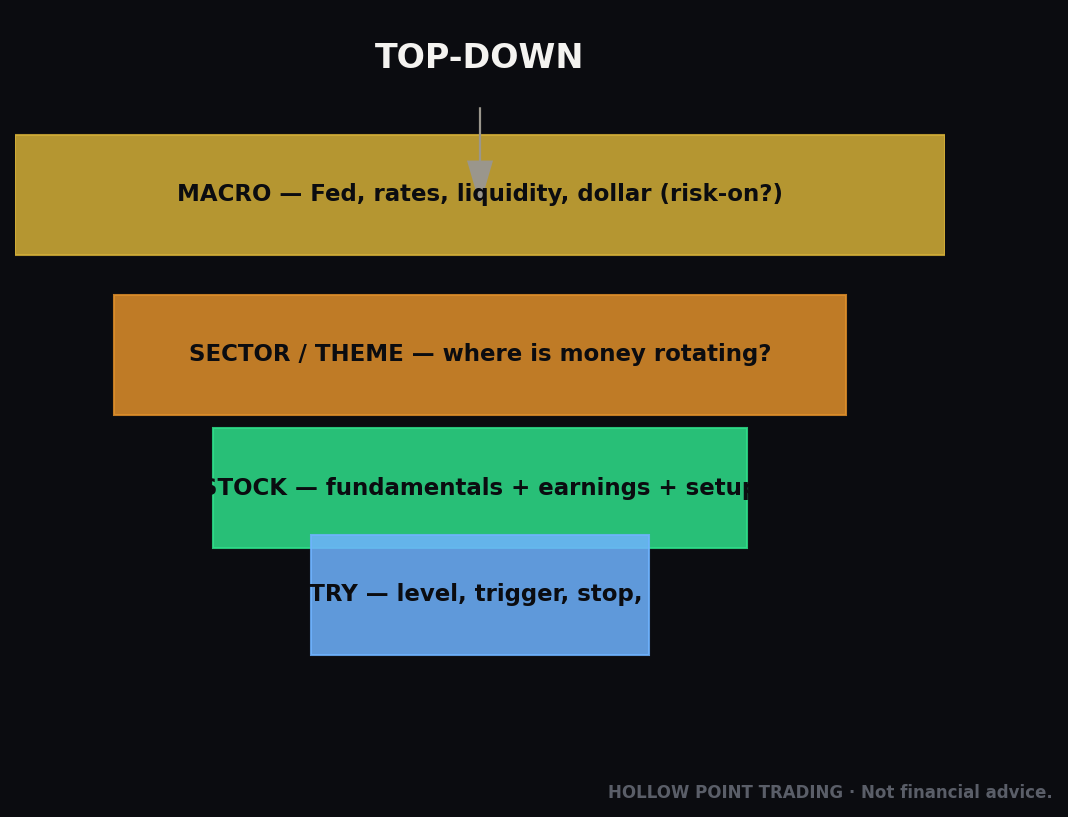
None of this floats in a vacuum. At Hollow Point the analytical process is top-down: macro → sector → stock → setup. Psychology isn't a separate module bolted on the side — it's the operating system that decides whether you actually execute the top-down read or fumble it into a revenge-trade at 10:15am.
Macro sets your posture
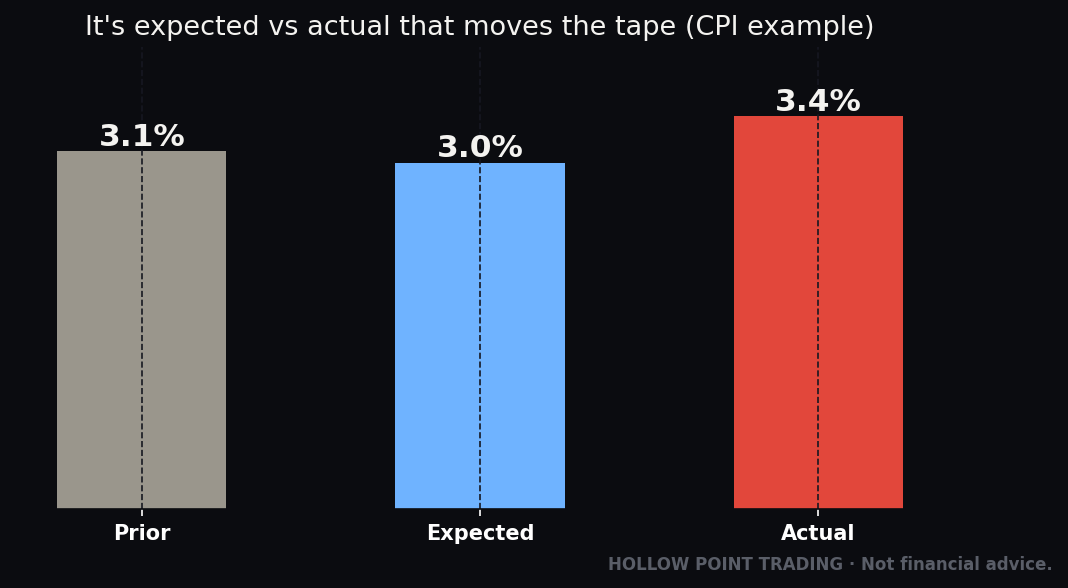
Are we risk-on or risk-off? Is it a Fed day, a CPI print, a jobs number, a big-cap earnings aftermath? The macro read tells you how much chop to expect, how wide to respect stops, and — most importantly — when to simply not trade. Half of discipline is knowing which days are traps before they trap you. A trader who ignores the macro calendar and revenge-trades through a Powell presser isn't fighting the chart; he's fighting his own inability to stand aside on a day that was engineered to whipsaw everyone. The macro check is a psychological defense as much as an analytical one: it pre-authorizes standing aside, so that doing nothing on a landmine day feels like the plan rather than like failure.
Sector and relative strength defang FOMO
This is where FOMO gets neutralized structurally instead of through willpower. Instead of chasing whatever's ripping across your feed, you've already decided — from the top down, in pre-market, calmly — which sectors are leading and which specific names have relative strength worth trading. You're now hunting in a pre-approved field. When some random ticker rockets on the screen, the FOMO impulse has nowhere to land, because that name isn't on your list and taking it would violate a rule you set while calm. You didn't resist the temptation through grit. You removed the temptation from the menu in advance. That's the whole design philosophy: don't out-discipline the impulse, out-architect it.
Stock and setup are where the EMA framework lives
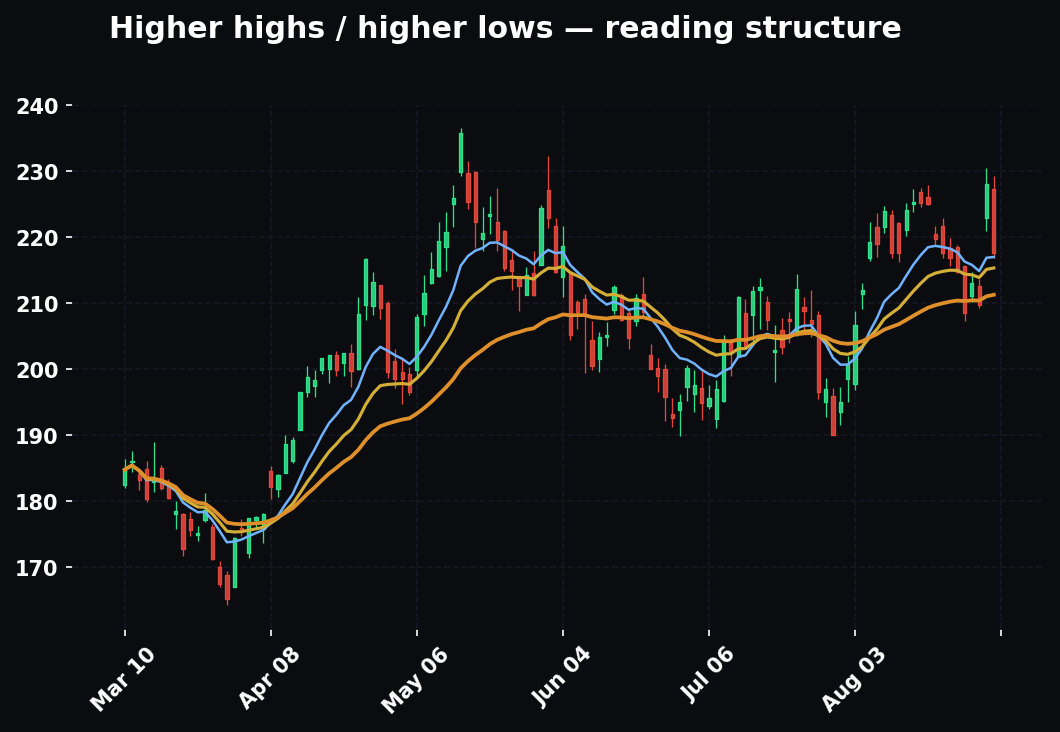
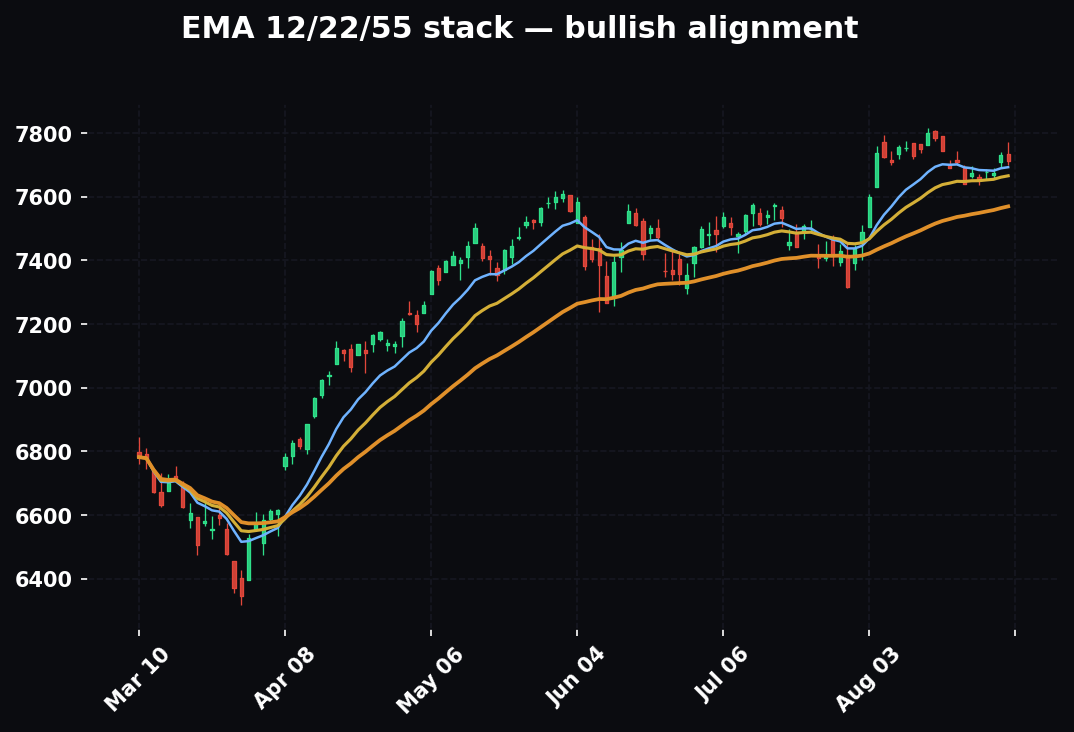
Trend is read off the 12/22/55 EMA stack — price and the fast EMAs above the 55 is an uptrend regime; below is a downtrend regime; the daily 55 EMA is the bias tell. This matters psychologically because it converts "I feel like it's going up" into "price is above a stacked 12/22/55 with the 55 rising and the daily 55 supporting." Feeling becomes criterion. Your entry stops being a gut lurch and becomes a checklist item that either passes or fails. There's nothing to argue with your limbic system about, because the condition is objective — the 22 either held or it didn't.
Timeframe-weighted confluence does the same job on a bigger canvas: higher timeframes outrank lower ones, and the rule tells you in advance, in writing, when a signal is strong enough to act on. A 1-minute buy signal against a daily downtrend regime is a low-weight, easily-ignored blip; the same signal with the daily 55 rising and the 15-minute reclaiming its 22 is a stacked, high-weight go. When the criteria aren't met, there is simply no trade to agonize over. The framework has removed the very discretion that greed and FOMO exploit. This is the deep point: an objective rule is not just an analytical tool, it's an emotional firewall. Every place you replace a judgment call with a criterion, you close a door that emotion was using to get in.
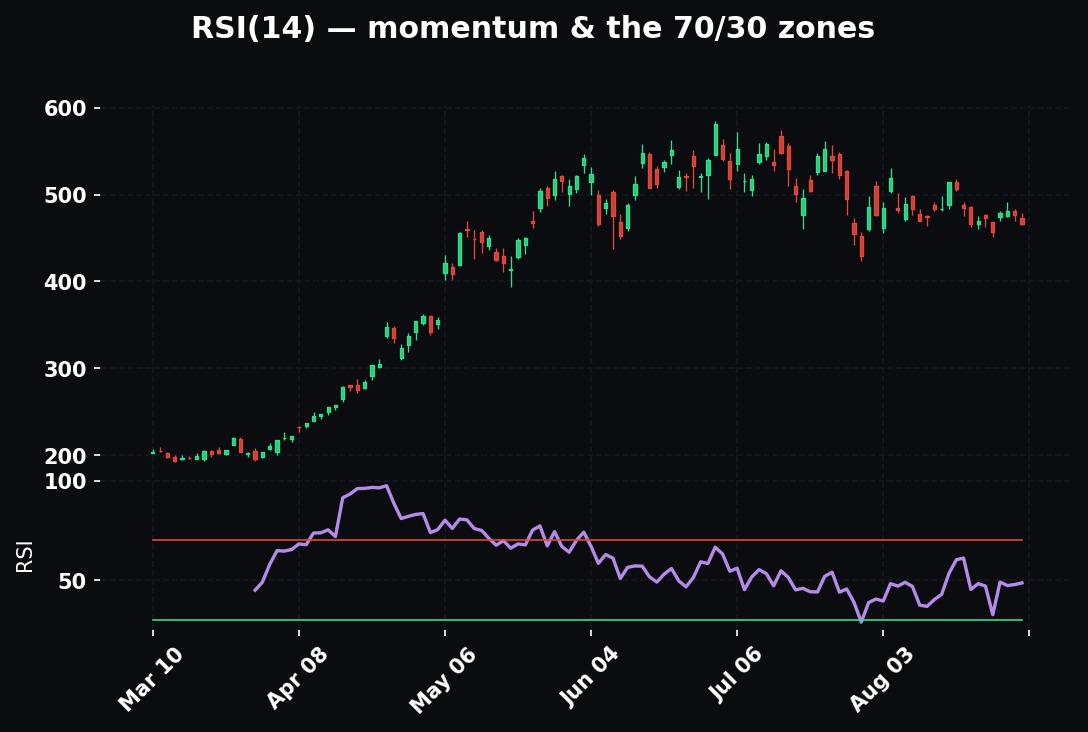
See the pattern across all three levels? A good process is a psychological defense system. The top-down funnel doesn't merely find good trades — it starves the impulses that make you take bad ones. Macro pre-authorizes standing aside. Sector filtering removes chase-bait from the menu. The EMA framework converts feelings into pass/fail criteria. Every objective rule you add is one less doorway for emotion to walk through, which is why traders with a genuine, written process are calmer — not because they feel less, but because they've left emotion fewer places to act.
The Routines: What You Actually Do
Insight changes nothing. You can nod along with every word above and still blow up Monday, because understanding tilt does not prevent tilt any more than understanding gravity prevents falling. Routines change everything, because routines are how you encode the calm decision so the hot brain can just execute it. Here's the concrete machinery.
Pre-Market Prep — Decide While You're Calm
The entire point of pre-market prep is to make your decisions before the emotion arrives. When the bell rings, you should be executing a plan you already wrote, not authoring one on the fly while your heart rate climbs. The prep is where the smart version of you does the thinking so the reactive version of you can just follow instructions.
Before the session, in writing — actual writing, not a vague mental picture:
- Macro check. What's on the calendar today? CPI, FOMC, jobs, major earnings before or after the bell? Assign the whole day a character: trend day likely, chop day likely, or event-risk / stand-aside day. This one label governs everything downstream — your size, your patience, your willingness to stand aside.
- Bias from the top down. Macro posture → leading sectors → your named list of stocks with relative strength. Daily 55 EMA on each name: long bias, short bias, or no-touch. Write the bias down so you can't quietly flip it at 10am because a candle scared you.
- Levels drawn in advance. Prior day high and low, overnight range high and low, the key EMAs, your own horizontals, the round numbers. These are your decision points, and they must be set with a clear head, because a level you draw while in a trade is not a level, it's a rationalization.
- The actual plan, written as if-then. "If ES holds above the overnight low and my name reclaims its 22 EMA on the 15-minute, I'm long toward the prior day high, stop under the 55, size 2 contracts." Written. Specific. Falsifiable. An if-then plan is executable by the hot brain because it requires no judgment — it just checks whether the condition is true.
- Your invalidation. The single price that says the read was wrong. Know it before you're in, because after you're in, loss aversion will start negotiating it wider.
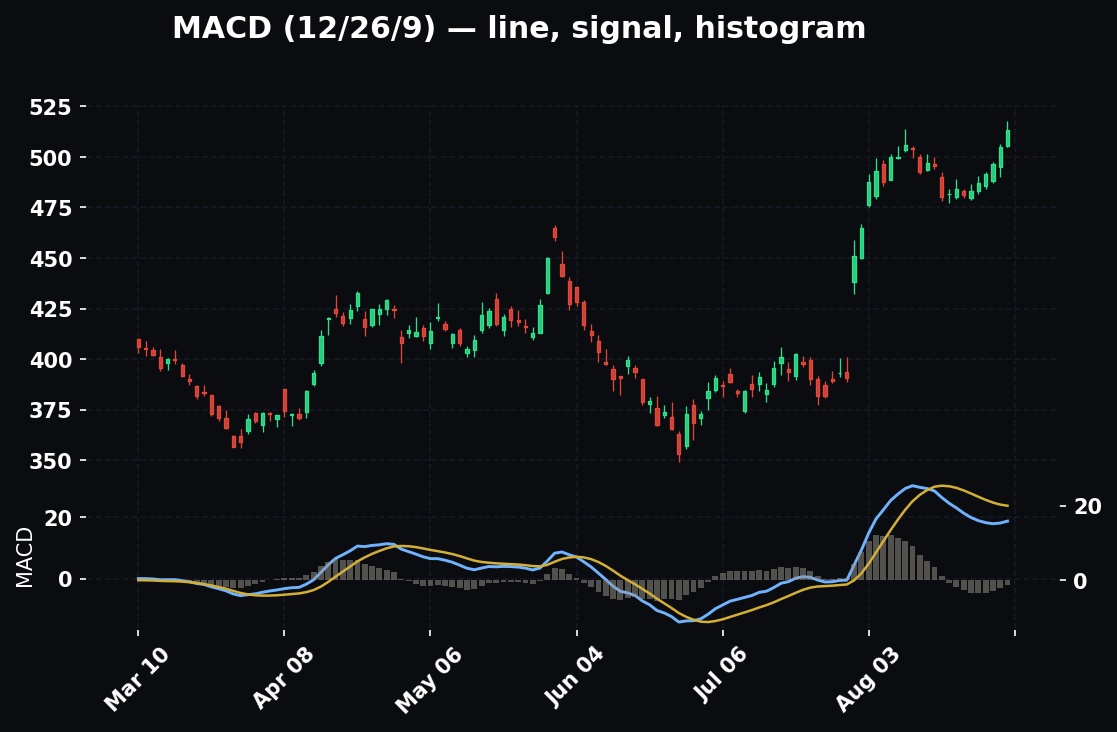
The written plan is a contract between your calm self and your hot self. When you're in the trade and greed says "hold past target," the calm self already voted, in writing, hours ago. You don't re-litigate. You just obey the note. The physical act of writing matters more than traders expect — a plan in your head is infinitely renegotiable, but a plan on paper that you're now overriding forces you to consciously betray yourself, and that friction alone stops a surprising number of bad trades.
Rules — The Non-Negotiables
A rule is only a rule if it's specific, pre-committed, and has no "unless." Vague good intentions ("I'll be disciplined," "I'll manage risk," "I won't overtrade") die on contact with a live tape, because they contain no bright line and so every violation can be rationalized as not-quite-a-violation. Build a short list you can actually keep, each one a bright line you'd know instantly you'd crossed:
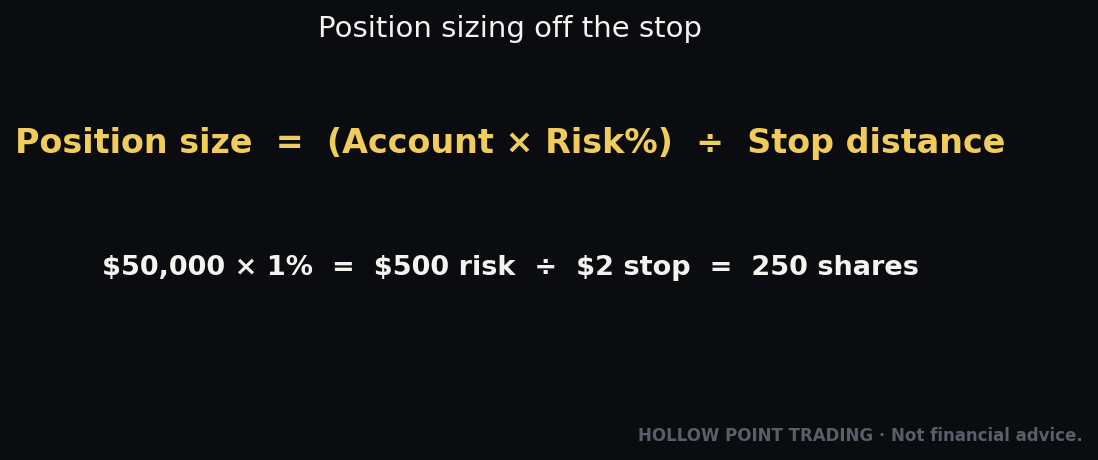
- Max risk per trade — a fixed fraction of the account (many professionals run well under 1% per trade). Sizing is decided by formula from your stop distance, never by how much you like the trade. Conviction does not touch size. This one rule alone caps how much any single tilt-decision can cost you.
- 1:3 minimum reward-to-risk. If the target isn't at least three times the stop distance, it isn't a trade — full stop. This single rule quietly fixes half the disposition effect: it forces you to let winners run toward 3R and it keeps losers small by definition, so the "cut winners / hold losers" instinct has less room to operate.
- Max trades per day and max daily loss. When either hits, you're done. Not "one more good-looking one." Done, platform closed. These are the two hard walls that stop a bad day from becoming a bad month.
- One setup, one plan. No improvising mid-trade. If it's not the trade you planned when you were calm, it's not your trade, however good it suddenly looks.
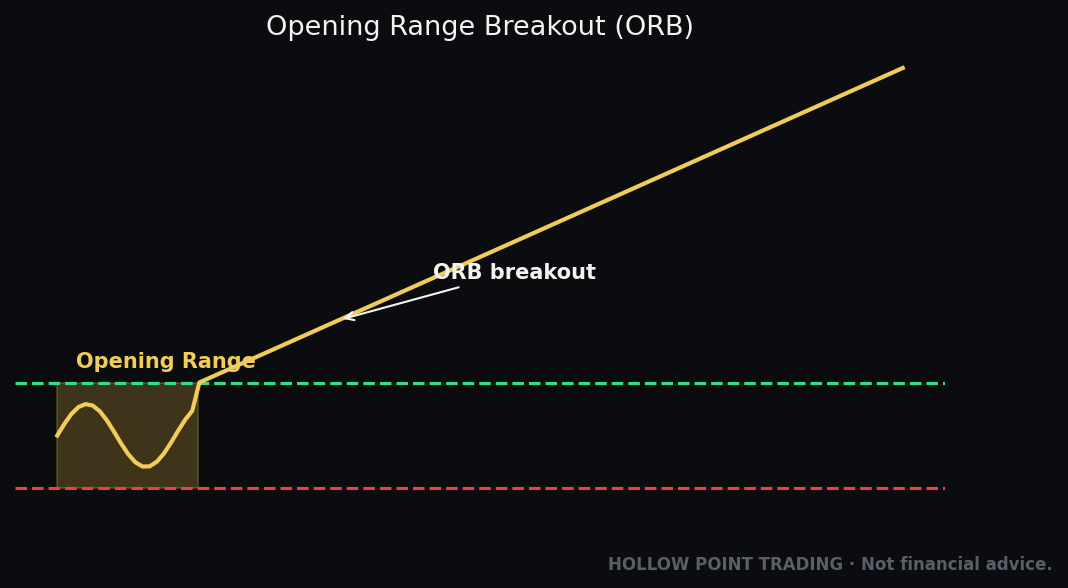
Notice these rules do double duty: they're risk management and they're emotional circuit design. The daily-loss limit is a math rule, but it's also the thing that ends the revenge spiral before Trade 4. Rules that constrain risk are the same rules that constrain tilt, because tilt's primary weapon is size and frequency, and these rules cap both.
Walk-Away Triggers — The Circuit Breakers
These are the specific, pre-defined conditions that physically pull you out of the chair before tilt makes decisions for you. Write them, and honor them exactly like you'd honor a stop:
- Daily max loss hit → platform closed, done for the day. No debate.
- Two losers in a row → mandatory 15-minute walk. Stand up, leave the screen entirely. The walk is a diagnostic: you're checking whether you're still trading your edge or whether you've started trading your feelings. If you can't articulate a clean setup when you sit back down, you stay flat.
- You catch yourself sizing up to "get it back" → that thought is the trigger. The instant you notice it, you're flat and walking. Don't wait to see if the trade works; the thought already told you who's driving.
- You took a trade you didn't plan → stop and log it immediately, before the next entry. An unplanned trade is a warning light for the whole engine.
- Physical tells — clenched jaw, held breath, leaning into the screen, a hot face, your leg bouncing — are data. The body tilts before the mind admits it, so your physiology is often the earliest and most honest signal you have. Learn to read yourself like you read the tape.
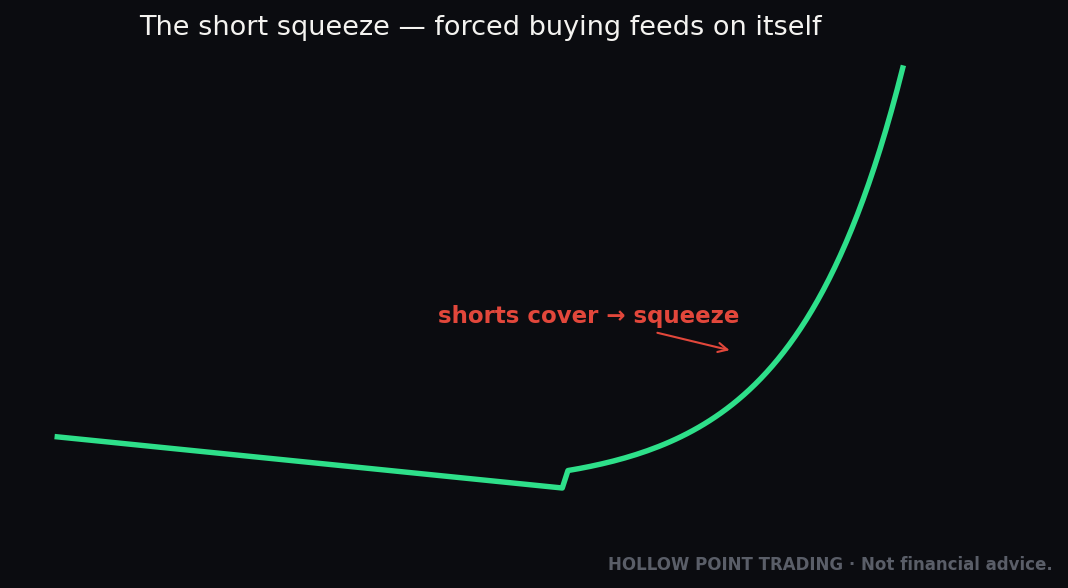
The walk-away trigger is the physical enforcement of "move the decision out of the moment." You cannot reason your way out of tilt while tilted — the reasoning brain is the part that's offline, remember — so the only reliable intervention is to remove the body from the situation and let the physiology reset, which takes real minutes, not seconds. Pre-commit to the removal while calm, because the tilted version of you will never choose to walk; that's precisely what tilt prevents. You're not relying on tilted-you to make a good choice. You're relying on calm-you to have built a rule that tilted-you can't easily wriggle out of.
The Post-Session Review — Grade Process, Not P&L
After the close, log each trade and grade it on process, not outcome. A simple A-through-F on four questions: Did it meet my setup criteria? Did I size right? Did I honor my stop? Did I follow the written plan? An A-grade trade meets all four whether it won or lost. An F-grade trade violated the plan even if it won — and you write the F next to the green number on purpose, so your brain stops mistaking luck for skill.
Track your rule-adherence rate as your primary metric — the percentage of trades that followed your process — and watch that number over time, not the daily P&L. This gives you the single most valuable diagnostic in trading, because it separates your two possible problems:
- Adherence high, results red. You're following your rules and still losing. That's an edge problem — the strategy itself needs work. Go fix the setups, the levels, the R-multiples. Your discipline is fine.
- Adherence low, results anything. You're not following your rules. That's a discipline problem, and no amount of strategy tinkering will fix it. Go fix the routines, the triggers, the size.
You cannot fix either problem until you know which one you have, and only the process-grading separates them. A trader who only journals P&L has no way to tell a broken strategy from broken discipline, so he "fixes" his strategy over and over while the real leak is behavioral — churning through systems, never getting better, because he's treating a psychology problem with an analysis solution.
Multi-Timeframe Discipline: The Same Rules, Scaled
The psychology doesn't change across timeframes, but its tempo does, and that changes which failure modes bite hardest. Knowing this lets you pre-load the right defenses for the game you're actually playing.
On low timeframes (1m–5m scalping), decisions come fast and the dominant enemies are overtrading and tilt. There's a setup every few minutes — most of them garbage — so the temptation to fidget is relentless, and a loss is followed almost immediately by another apparent chance to "get it back," which is jet fuel for revenge. The discipline demand here is frequency control: hard caps on trades-per-hour, and walk-away triggers with a hair-trigger, because the tilt spiral on a 1-minute chart can take four trades in six minutes. Scalpers who survive are ruthless about their max-trades count and treat boredom as the enemy it is.
On the swing timeframes (1H–daily), decisions come slowly and the dominant enemies flip: now it's the disposition effect and sunk cost. You're holding a position for hours or days, which gives loss aversion endless time to whisper — "just take the small profit before it's gone," "give it room over the weekend," "it'll come back Monday." The discipline demand here is conviction management: honoring the original plan across time and news and overnight gaps, not renegotiating the thesis every time a red candle prints on a lower timeframe. Swing traders who survive stop staring at the 5-minute chart while holding a daily-timeframe trade, because the low-timeframe noise is exactly what triggers the disposition effect on the high-timeframe position.
The confluence principle applies to your defenses, not just your entries. Just as higher timeframes outrank lower ones for signals, they should outrank lower ones for emotion. If your trade is a daily-timeframe long that's still structurally intact — price above the daily 55, higher-low sequence unbroken — then a scary 5-minute candle is not information about your trade; it's noise on a timeframe you're not trading. Traders lose enormous amounts of good swing trades by managing them on a timeframe far below the one they entered on, letting 5-minute fear override a daily thesis. Match the timeframe of your attention to the timeframe of your trade. If you entered on the daily, manage on the daily.
Psychology Across Market Regimes
The same trader with the same rules performs very differently in different market weather, and the failure that kills you in one regime is nearly absent in another. Reading the regime is reading which of your demons is about to be strongest.
Trending regime
When a market trends cleanly — price stacked above a rising 12/22/55, higher highs and higher lows marching — the setups work, the winners run, and the danger is not fear. It's complacency and greed. A run of easy winners inflates you; you start sizing up beyond your rules because "this market is easy," you take lazier entries because everything's been working, and you're maximally exposed and overconfident at exactly the moment the trend is most extended and closest to breaking. The discipline demand in a trend is to keep sizing by formula while winning and to respect that your recent success was partly the regime, not purely your genius. The trend will end. The traders it hurts most are the ones who'd concluded they'd figured it out.
Choppy / range regime
In a directionless chop — price knifing back and forth across a flat 55, no follow-through in either direction — the dominant enemies are overtrading and revenge. Breakouts fail and reverse, so every entry gets stopped and then reverses back to where you'd have been right, which is maddening and drives the "one more, this one's real" spiral. Chop is where most accounts bleed out, not through one big loss but through a hundred small stop-outs plus the tilt they generate. The discipline demand is brutal selectivity and reduced size — or, most often, standing aside entirely. Chop is the regime the stand-aside skill was built for. The correct number of trades on a structureless day is frequently zero, and the trader who books zero on a chop day beat the room.
High-volatility regime
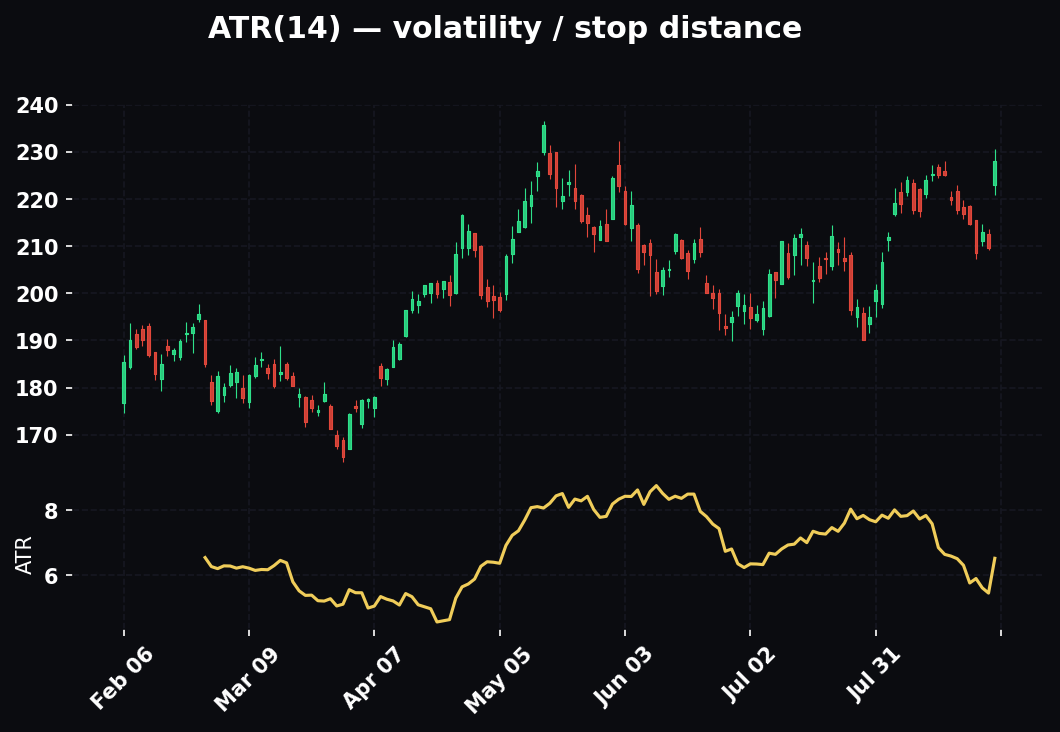
When volatility spikes — event days, gaps, wide ranges, VIX elevated — everything moves faster and bigger, which amplifies every emotion at once. Fear is bigger because the swings against you are bigger; greed is bigger because the swings for you are bigger; a normal-sized position now produces abnormal-sized P&L swings that your nervous system reads as danger even when your risk is technically fine. The discipline demand is mechanical size reduction to match the vol: because the stops must be wider to survive the noise, the position size must come down to keep the dollar risk constant. Trading the same contract size in high vol as in calm conditions means you've silently quadrupled your risk without deciding to. The pros shrink size in high vol precisely so their emotional exposure stays constant, not just their dollar exposure — they know a position that's swinging too hard will eventually make the decisions for them.
Reading the regime is itself a discipline act, because it tells you in advance which demon to guard against. Walk into a trend braced for complacency. Walk into chop braced for overtrading. Walk into high vol braced for amplified everything, with your size already cut. The trader who names the regime pre-market has pre-loaded the right psychological defense before the first tick.
Confluence: How Psychology Stacks With The Tools
Psychology isn't a standalone discipline you practice in a journal and then forget when the chart's live. It's the layer that makes every technical tool actually work, because a tool only pays you if you can execute it under fire. Here's how the mental game interlocks with three concrete pieces of the Hollow Point kit.
With the EMA 12/22/55 framework
The EMA stack is, functionally, an emotion-to-criterion converter. "I feel like longing here" is a feeling that greed and FOMO can hijack. "Price reclaimed the 22 and is holding above a rising 55, daily 55 supporting" is a criterion that either passes or fails with no room for a feeling to sneak in. The confluence is direct: the framework gives you an objective entry condition, and psychology gives you the discipline to only act when the condition is genuinely met and to fully act when it is. Tool without psychology: you see the clean stack, then talk yourself out of the entry because the last trade lost. Psychology without tool: you're disciplined but have no objective criterion, so "discipline" just means agonizing. Together: the stack tells you when, the discipline makes you obey the when.
With the 1:3 reward-to-risk rule
The R/R rule is where risk management and the disposition effect meet head-on. Mechanically, 1:3 lets you be wrong most of the time and still win — but only if you actually let winners reach 3R, and that's a pure psychology problem, because loss aversion will scream at you to bank the profit at 1R every single time. So the tool (a 1:3 structure) and the psychology (the discipline to hold to target against the urge to snatch) are not two things — they're one thing that only works when both halves are present. A 1:3 rule you don't have the discipline to honor is just a 1:1 rule with extra steps. The discipline to hold, and the structural 3R target to hold toward, are the same edge viewed from two sides.
With top-down / relative-strength selection
Top-down selection and FOMO are natural antagonists, and running them together is how you win the fight structurally. The top-down funnel produces a finite, pre-approved list of names with relative strength in leading sectors — decided calmly, pre-market. FOMO produces an infinite, real-time stream of things ripping on your feed. When you've done the top-down work, the FOMO stream has no landing spot: the name isn't on your list, so chasing it would be a rule violation you'd have to consciously commit. The tool (relative-strength filtering) and the psychology (FOMO resistance) reinforce each other — the list makes the resistance nearly automatic, and the resistance makes the list worth building. This is the whole Hollow Point thesis in miniature: you don't beat the impulse with willpower, you architect a process that leaves the impulse nowhere to act.
The HPT "Stand Aside" Skill
If there's one skill that separates survivors from casualties, it's this one, and almost nobody trains it deliberately: the ability to do nothing.
Standing aside — choosing not to trade — is an action, not a default. It's a decision you make actively and grade proudly, and it is frequently the highest-expectancy decision available on the entire menu. No setup that meets your rules? Stand aside. Macro event you can't handicap? Stand aside. Choppy, structureless tape with no follow-through? Stand aside. Already hit your daily loss limit? Stand aside. Feeling emotionally compromised, physically tilted, or foggy? Stand aside. Each of these is a positive choice with positive expected value, not a failure to find a trade.
The reason this is a skill and not just "advice" is that every instinct you own screams against it. Flat feels like failure. Missing a move feels like a loss. Sitting out while the room posts green screenshots feels like weakness, like you're not really trading, like you're wasting the day. Your wiring treats inaction as danger — the savanna brain equates "not doing anything about the opportunity/threat" with getting left behind or eaten. So you have to reframe it, hard and repeatedly, until the reframe becomes reflex: cash is a position. Being flat is not the absence of a bet — it is a bet, specifically the bet that no available setup has positive expectancy right now, which is true far more often than the itchy trader believes. On many days, "flat" is the single best-expectancy position you can hold, and choosing it is you winning, not you failing to play.
The evidence, and how to train it
At Hollow Point we've validated this directly and in real numbers: when signals fire into chop and the tape is a trap, no-entry discipline outperforms — measured, in actual P&L, against the theoretical losses of taking every signal that lit up. The trades you don't take are a real, countable, bankable edge. Standing aside isn't the absence of a strategy. On the wrong day, in the wrong regime, it is the strategy — the winning one.
Train it like a muscle, because it responds to training like one:
- Define the A-setup precisely — full top-down alignment, EMA stack confirming, timeframe confluence stacked, level respected, 1:3 available. Write the definition down.
- Take only those. Let every B and C setup go by, on purpose, and notice that letting them go is the skill you're building, not a missed opportunity.
- Log every stand-aside as a win in your journal, because it is one — it's edge preserved, capital not risked on a negative-expectancy bet. A green "STOOD ASIDE — no A-setup, chop day" entry should feel as good to write as a winning trade, and with practice it will.
- Review the road not taken. After the close, look at the B and C setups you passed. How would they have gone? Over a month of honest logging, most traders discover that the stand-asides collectively saved them more than the marginal trades would have made — which turns the reframe from a belief into a fact you've personally verified.
Over a month, you'll find the days you did the least were often your best, and the quiet, boring, three-clean-trades days outperformed the frantic, twenty-trade ones almost every time. That discovery — made in your own numbers, not taken on faith — is the moment stand-aside stops being advice you resist and becomes a weapon you reach for.
How The Pros Use This Differently From Beginners
Same words, completely different relationship to them. The gap between a beginner and a professional on this material isn't knowledge — the beginner can often recite every concept above. It's where the concepts live. Here's the difference, point by point, because seeing it named accelerates getting there.
Beginners think psychology is something you fix once. They read a guide like this, feel enlightened, and expect to be cured. Pros know it's a daily practice with no finish line — the same way an athlete doesn't "solve" fitness. You maintain it or you lose it, every session, for your whole career. The pro who's been at it twenty years still does pre-market prep and still has walk-away triggers, precisely because he knows the wiring never goes away.
Beginners try to feel less. Pros build systems that make feeling irrelevant. The beginner's plan is "next time I'll stay calm." The pro's plan is a written if-then, a formula-based size, and a hard walk-away trigger, so that whether he's calm or terrified, the action is the same. The pro isn't more zen; he's better-engineered. He assumes he'll feel fear and greed and routes around them structurally.
Beginners grade themselves on money. Pros grade themselves on decisions. Ask a beginner how his day went and he tells you the P&L. Ask a pro and he tells you his rule-adherence rate and whether he took A-setups. The pro has fully internalized that the money is the market's to give over a sample, and the decisions are his to make in the moment — so he scores only what he controls, and stays even-keeled through winning and losing streaks that would emotionally destroy a beginner.
Beginners size by conviction. Pros size by formula. The beginner bets big when he "really likes it," which means he's maximally exposed on exactly the trades where his judgment is most emotionally compromised. The pro's size falls out of a formula from his stop distance and fixed risk fraction — conviction never touches it — so his best-feeling trade and his meh-feeling trade risk the same dollars, and one overconfident read can't blow up the account.
Beginners fear missing out. Pros fear breaking rules. The beginner's anxiety points at the move he might miss. The pro's anxiety, to the extent he has any, points at the rule he might break — because he knows missed moves are $0 events and broken rules are what actually kill accounts. His fear is pointed at the real danger, which makes it useful instead of destructive.
Beginners want to trade. Pros want to make money, and know those are often opposite. The beginner's identity is "I'm a trader," so not trading threatens the identity and feels like failure. The pro's identity is "I'm a disciplined operator of an edge," so standing aside on a bad day confirms the identity rather than threatening it. This is why pros find it easy to sit out and beginners find it agonizing — for the pro, sitting out is being good at his actual job.
The meta-difference: the beginner is fighting his psychology, and the pro has arranged his psychology — built an environment, a routine, and a set of rules where the disciplined action is the path of least resistance. The pro isn't winning the willpower battle every day. He's spent years setting things up so he rarely has to fight it.
Frequently Asked Questions
"I know all of this and I still tilt. What's wrong with me?" Nothing — knowing and doing are different skills using different parts of the brain, and knowledge alone never prevented an impulse. The fix isn't more understanding; it's structure. If you tilt, you don't have a knowledge gap, you have a missing or unenforced walk-away trigger. Go build the mechanical circuit breaker and remove yourself physically, because you cannot think your way out of a state that shuts down thinking.
"How long does it take to fix my trading psychology?" Wrong frame. You don't fix it and finish; you build routines that manage it and then run those routines forever. The realistic goal isn't "become emotionless," it's "get the gap between feeling and action wide enough, reliably enough, that emotion stops reaching the button." That's a practice, like fitness, not a destination.
"Will a bigger account or a better strategy fix my discipline?" No, and this is one of the most expensive myths in the game. A bigger account just gives tilt more fuel — the undisciplined trader doesn't grow out of it with size, he blows up faster and larger. A better strategy handed to an undisciplined trader still loses, because he won't execute it cleanly. Discipline is upstream of both. Fix it first or nothing downstream sticks.
"Should I try to eliminate my emotions?" No, and you can't. Pros feel the same fear and greed you do; the imaging studies are clear. The goal is never to stop feeling — it's to stop acting on the feeling by inserting a rule between the two. Trying to suppress emotion usually backfires, because suppression is effortful and effort is the first thing that fails under stress. Route around emotion structurally instead of trying to delete it.
"How do I actually stop revenge trading in the moment?" You don't, in the moment — that's the trap. The intervention has to be pre-committed and physical: a hard rule that "two losers in a row = 15-minute walk, no exceptions," decided while calm. In the moment, the compromised brain will never voluntarily choose to stop, so you remove the choice by making the walk automatic. Willpower is the first thing tilt burns; don't rely on it.
"What's the single most important number to track?" Your rule-adherence rate — the percentage of trades that followed your written process. It's more important than your P&L because it diagnoses which problem you have (edge vs discipline) and it's the only metric that measures the thing you actually control. Track it daily. Let the P&L be an output.
"Is standing aside really 'trading'? It feels like doing nothing." Standing aside is an active decision with positive expected value, and on the wrong day it's the highest-expectancy decision available — Hollow Point has measured no-entry discipline outperforming signal-following in chop, in real P&L. "Cash is a position." The feeling that it's "doing nothing" is exactly the wiring this guide is teaching you to override.
"How many rules should I have?" Few enough to keep under fire — a short list of bright-line non-negotiables beats a long list you can't hold. Max risk per trade, 1:3 minimum, max trades and max daily loss, one-setup-one-plan, and a couple of walk-away triggers is plenty. A rule you can't keep isn't a rule, it's a wish, and a wall of wishes gives you a wall of excuses.
"I made money breaking my rules. Isn't that proof the rules are too strict?" No — that's the single most dangerous outcome in trading: bad process, good outcome. You got paid for reckless behavior, which trains your brain to repeat it, and the repeat will eventually meet the loss it deserves at a much larger size. Grade that trade an F in your journal specifically because it won, so the lucky payout doesn't quietly rewire you into your own worst enemy.
The Cheat-Sheet
Pin this where you can see it at the open. When you're not sure what to do, do what the card says.
The one law: Every mistake is an in-the-moment feeling overriding a pre-made decision. Move the decision out of the moment.
The mindset:
- Grade the decision, not the result. Good process can lose; bad process can win. The winning trade you should fear most is the one you shouldn't have taken.
- Discipline, not prediction, is the job. You control the process; the sample controls the P&L.
- Your edge only exists across a sample. Take every valid setup; honor every stop. Cherry-picking and cutting winners break the math.
- A missed trade is a $0 event. Cash is a position. Standing aside is an action, and often the winning one.
The enemies, one line each:
- Fear / Greed → you did something you didn't plan.
- FOMO → chasing what already left; buying someone else's exit.
- Revenge / Tilt → trading to get even, not to trade your edge; watch the size creep.
- Disposition effect → selling winners early, holding losers long — profitable system, flipped negative.
- Overtrading → confusing activity with progress; diluting A-setups with C's.
- Sunk cost → letting money already spent drive the next decision; "would I enter fresh?"
The regime read (name it pre-market):
- Trend → guard against complacency and oversizing while winning.
- Chop → guard against overtrading and revenge; default to standing aside.
- High vol → cut size to match wider stops; every emotion is amplified.
The routine:
- Pre-market: write the plan — macro character, top-down bias, levels, if-then entries, invalidation — while calm.
- Rules: fixed % risk, 1:3 minimum R/R, max trades, max daily loss, one-setup-one-plan. No "unless."
- Walk-away triggers: daily-loss hit, two-in-a-row, sizing-up-to-get-it-back, unplanned trade, physical tells → stand up, walk, done.
- Post-session: grade every trade A–F on process. Track rule-adherence, not P&L. High adherence + red = fix the edge; low adherence = fix the discipline.
The check before every entry: Is this the trade I planned? Does it meet my top-down read and 12/22/55 structure? Is R at least 1:3? Is size by formula, not by feeling? Where exactly is my invalidation? Am I in the right state to be clicking? If any answer is shaky — stand aside.
The market will hand you a thousand chances a day to feel something and act on it. Your entire edge is the discipline to let almost all of them pass, and to execute the few that meet your rules exactly as you planned them when you were calm. Prediction is a fantasy sold to beginners; the future stays unknowable no matter how good your read. Process is the job — the one thing fully inside your control, the thing that lets a real edge survive contact with your own wiring. Build the routines, grade the decisions, name the regime, learn to stand aside, and let the sample do what samples do. The trader who wins isn't the one who saw it coming. He's the one who was still in the seat, still following his rules, when it did.
Bound by rules, feared by trade.