
You have probably heard someone say they "bought calls" on a stock. Maybe it was a friend bragging, maybe it was a headline about a trader who turned a few hundred dollars into a small fortune (or lost it all in an afternoon). It sounds like insider language, something reserved for people in glass towers with six screens. It is not. A call option is one of the simplest ideas in all of finance once someone explains it in plain English, and that is exactly what this guide is going to do.
By the time you finish reading, you will understand what a call option actually is, how it makes or loses money, the exact price where it starts to be worth it, why a beginner might choose one over just buying the stock, and — most importantly — the ways calls quietly destroy new traders who do not respect them. We are going to go slow. We are going to define every single term the first time it shows up. And we are going to walk through real-ish numbers together so you can see the machine working.
Let's begin.
What a Call Option Is, in Plain English
Imagine your favorite coffee shop is about to raise its prices. Today a bag of beans costs $20. You have a strong feeling that next month the same bag will cost $30 because a shortage is coming. You do not want to buy fifty bags today and store them in your garage. So instead you go to the owner and say: "Give me a slip of paper that lets me buy a bag for $20 anytime in the next month, no matter what the real price does." The owner thinks about it and says, "Fine, but that slip costs you $2."
You just bought a call option.
A call option is a contract — a legal agreement — that gives you the right, but not the obligation, to buy something at a fixed price for a set period of time. Let's break that sentence apart because every word matters.
- Right, but not the obligation means you get to buy if you want to, but nobody can force you to. If prices fall instead of rise, you simply throw the slip away. You are never on the hook to actually buy the beans.
- Fixed price is the price written on the slip. In options this is called the strike price — the price at which your contract lets you buy. In our coffee example the strike is $20.
- Set period of time means the slip is not good forever. It has an expiration date — the day the contract dies and becomes worthless if you have not used it. In our example, one month.
- The $2 you paid for the slip is called the premium. It is the cost of the option itself. You pay it upfront, and it is gone whether you use the option or not — just like paying for a movie ticket you might not use.
In the stock market, a call option works exactly the same way, except instead of coffee beans, the "thing" you get the right to buy is shares of a stock. A share is simply a tiny piece of ownership in a company — own one share of Apple and you own one very small slice of Apple.
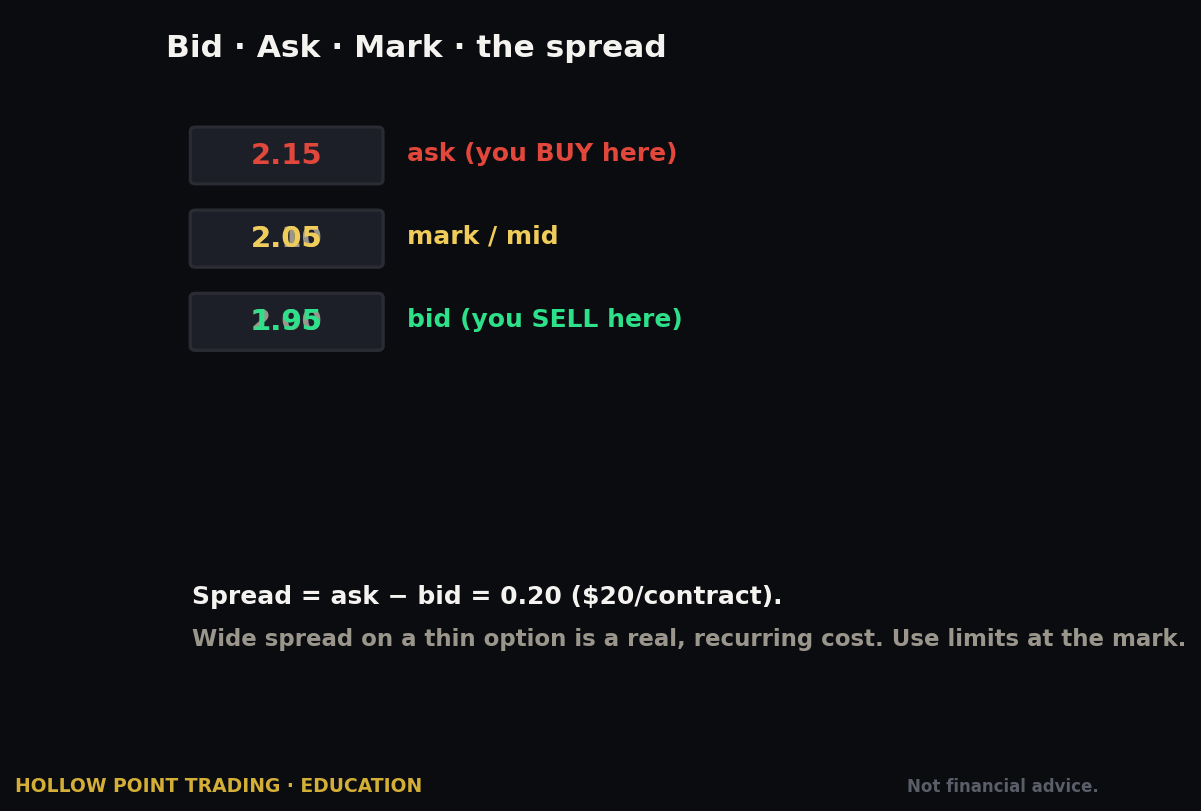
One more detail that trips up every beginner: one option contract almost always controls 100 shares of stock. This is a fixed rule in the U.S. market. So when you see an option priced at "$2," that is $2 per share, and because the contract covers 100 shares, you actually pay $2 × 100 = $200 to own one contract. Keep that ×100 in your head — it is the single most common source of "wait, I lost HOW much?" surprises for new traders.
So, to say it all in one clean sentence: A call option is a contract that, for a premium you pay upfront, gives you the right to buy 100 shares of a stock at a fixed strike price anytime before the option expires.
Why a Complete Beginner Should Even Care
Fair question. If you have never traded anything, why start with an instrument that sounds more complicated than just buying a stock?
Three honest reasons.
First, calls let you profit from a stock going up while risking a small, known amount of money. When you buy a call, the absolute most you can lose is the premium you paid — not a penny more. That $200 is your maximum loss, defined the moment you buy. Compare that to buying the stock itself, where a nasty drop can cost you thousands. There is a real psychological comfort in knowing your worst case before you begin.
Second, calls give you leverage. Leverage is a word you must know cold: it means controlling a large amount of something with a small amount of money. A single call contract controls 100 shares. If those shares cost $100 each, controlling them outright would cost $10,000. But the call might cost you only $300. You are controlling $10,000 worth of stock for $300. When the stock moves, your $300 can grow far faster in percentage terms than the stock did. That is the appeal — and, as we will hammer home later, that is also the danger.
Third, understanding calls is the doorway to understanding the entire options world. Puts, spreads, covered calls, the whole toolkit — all of it is built on the foundation you are laying right now. Learn the call properly and everything else gets easier.
Here at Hollow Point Trading we do not teach options so you can gamble. We teach them as a tool — one that, used with discipline and strict risk rules, can express a view on a stock more efficiently than shares. But a tool in untrained hands is how people get hurt. So let's train.
How a Call Actually Works, Step by Step
Let's slow all the way down and follow a call option through its entire life.
Step 1 — You have a view. You believe a stock is going to go up over some period of time. Calls only make money (from buying them) when the stock rises. If you think a stock will fall, a call is the wrong tool. So step one is always an opinion: "I think this goes up, and roughly by when."
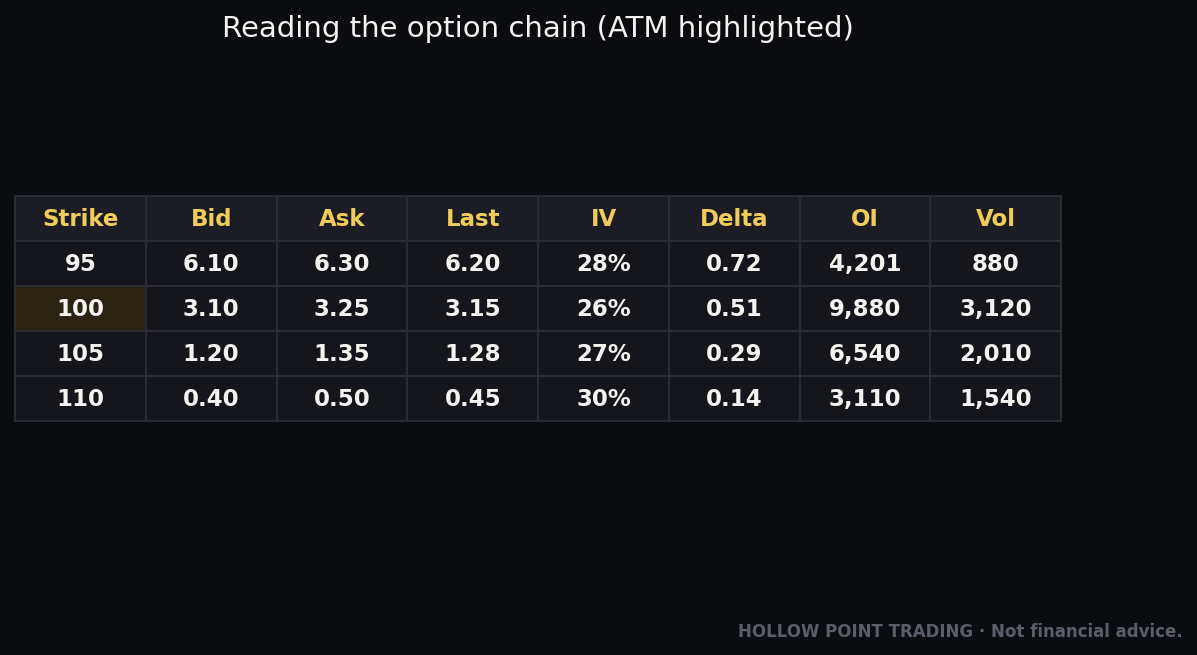
Step 2 — You pick a strike price and an expiration. These are the two dials you turn. The strike is the price you are locking in the right to buy at. The expiration is your deadline. A strike close to the current stock price costs more; a strike far above it costs less (because it is less likely to pay off). A longer expiration costs more than a shorter one (more time for good things to happen).
Step 3 — You pay the premium. You hand over the cost of the contract — premium × 100 shares. That money leaves your account immediately. It is now the maximum you can lose.
Step 4 — Time passes and the stock moves. This is where the drama lives. As the stock price changes, the value of your option changes too. If the stock climbs above your strike, your option gains value. If the stock sits still or falls, your option loses value. And quietly, in the background, time itself eats away at the option's value every single day — a force we will name properly in a moment.
Step 5 — You do one of three things before expiration. Beginners assume you have to "exercise" the option (actually buy the 100 shares). You almost never do. Here are your real choices:
- Sell the option to someone else. Options trade on a market just like stocks. If your option is worth more than you paid, you sell it and pocket the difference. This is what the vast majority of traders do — you close the position for cash and never touch the actual shares. Simple.
- Exercise the option. Use your right to buy the 100 shares at the strike. This requires having the full cash to buy the shares, which beginners usually don't want to do. Rare for small accounts.
- Let it expire. If the option is worthless (stock never got above your strike), you do nothing, it expires, and you lose the premium. That's it. The contract vanishes.
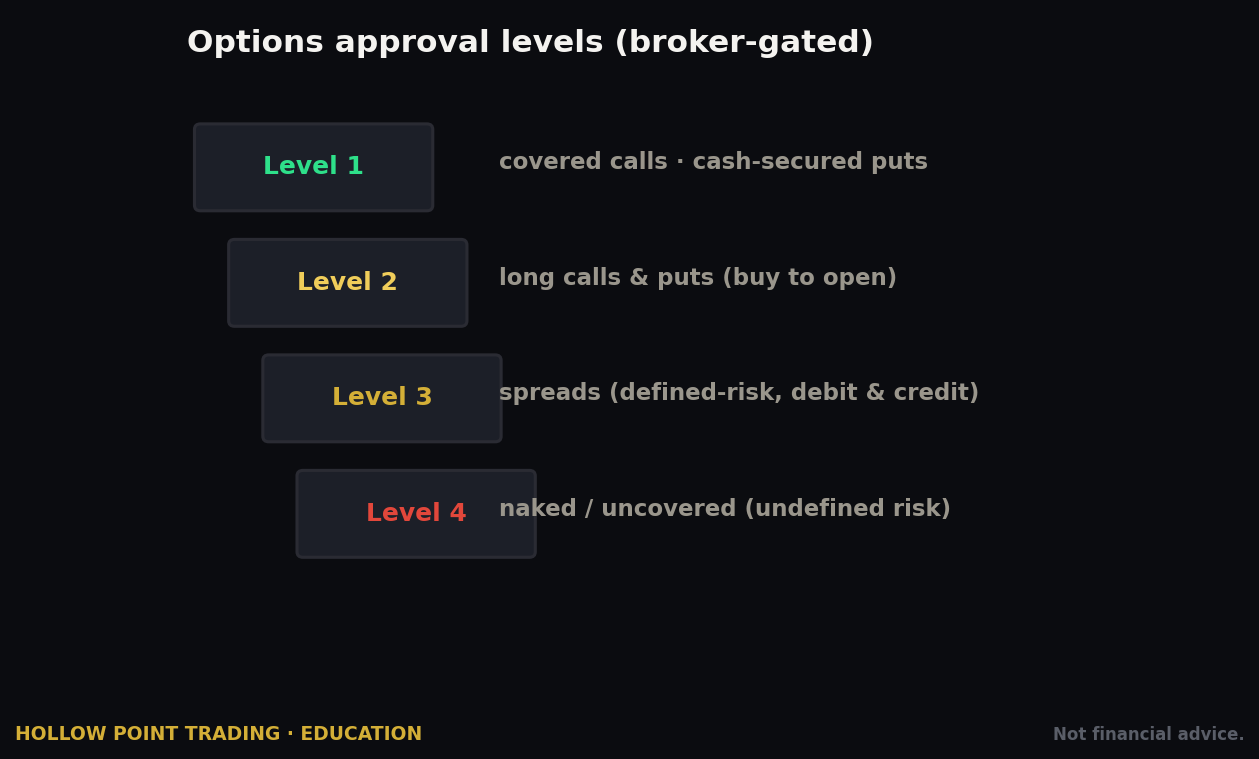
That is the whole lifecycle. View, strike and expiration, premium, waiting, exit. Now let's put numbers to it so it becomes real.
The Payoff: What You Actually Make or Lose
To understand a call's payoff, we need two more pieces of vocabulary.
In the money (ITM): A call is "in the money" when the stock price is above the strike price — the option has real, usable value because it lets you buy cheaper than the market.
Out of the money (OTM): A call is "out of the money" when the stock price is below the strike — the option lets you buy at a worse price than the market, so nobody would use it. It has no built-in value yet.
At the money (ATM): The stock is sitting roughly at the strike price.
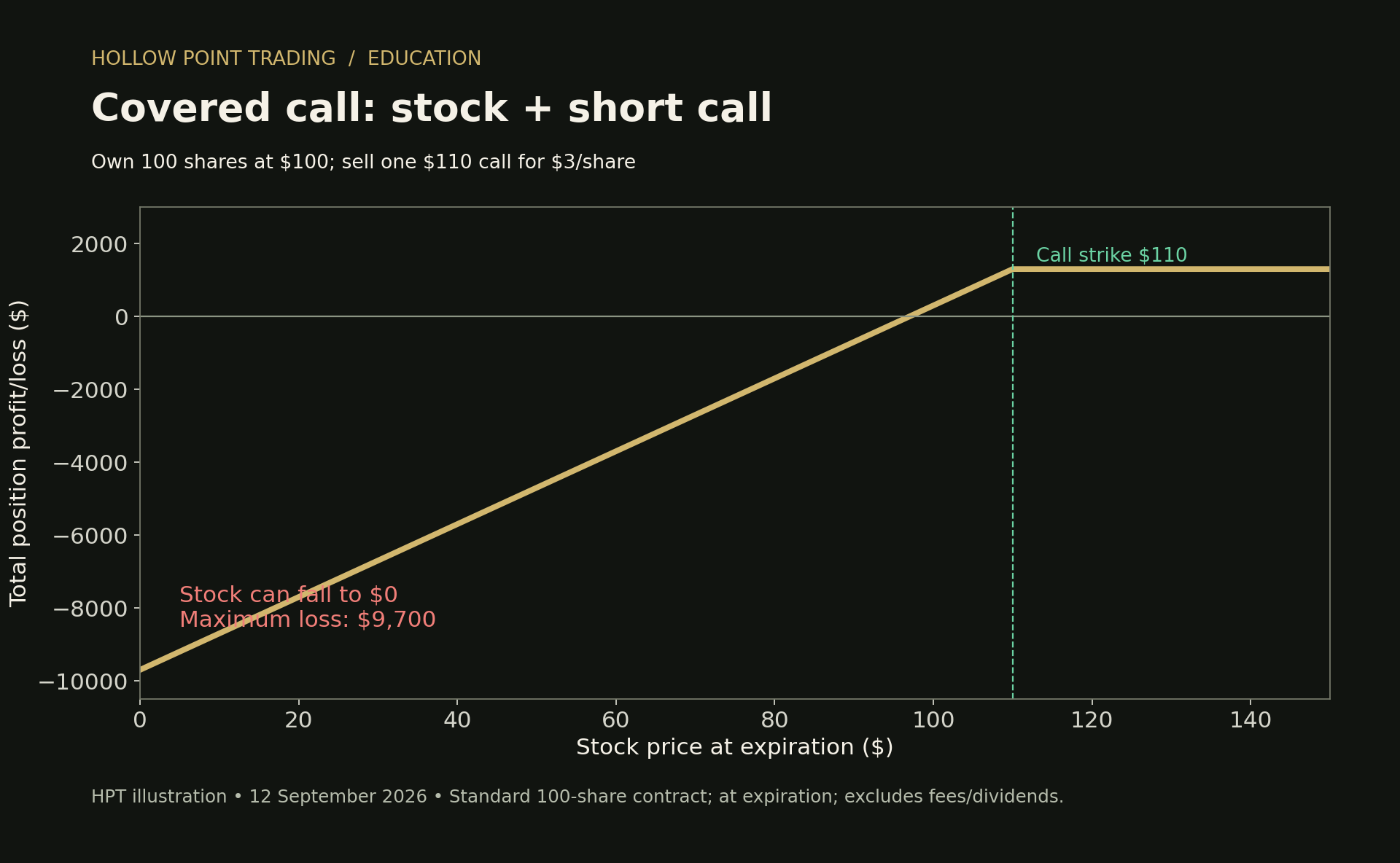
Here is the key idea for the payoff. At expiration, a call is worth exactly one thing: how far the stock is above the strike, and nothing else. That amount is called intrinsic value — the real, baked-in worth of the option. The formula could not be simpler:
Intrinsic value = Stock price − Strike price (and if that number is negative, the value is just zero — an option can never be worth less than nothing).
Let's test it. Say you own a call with a $100 strike.
- If the stock finishes at $110, your option is worth $110 − $100 = $10 per share. Times 100 shares, that contract is worth $1,000.
- If the stock finishes at $103, it's worth $3 per share, or $300.
- If the stock finishes at $100 or anywhere below, it's worth $0. Expired worthless.
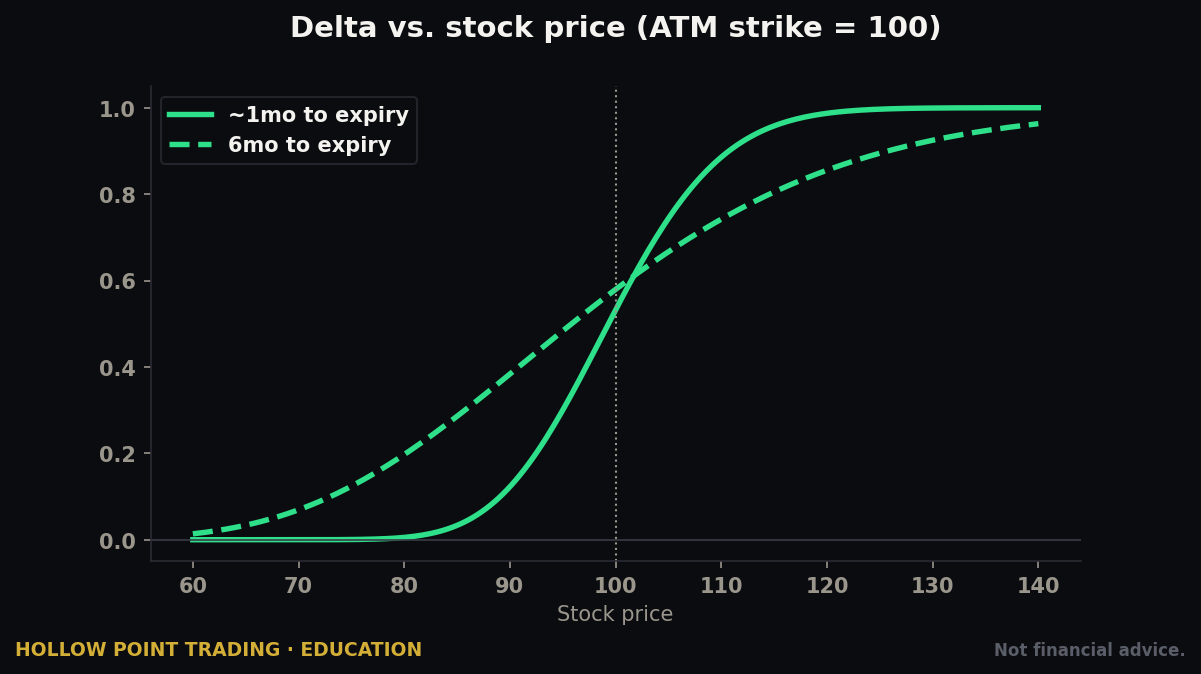
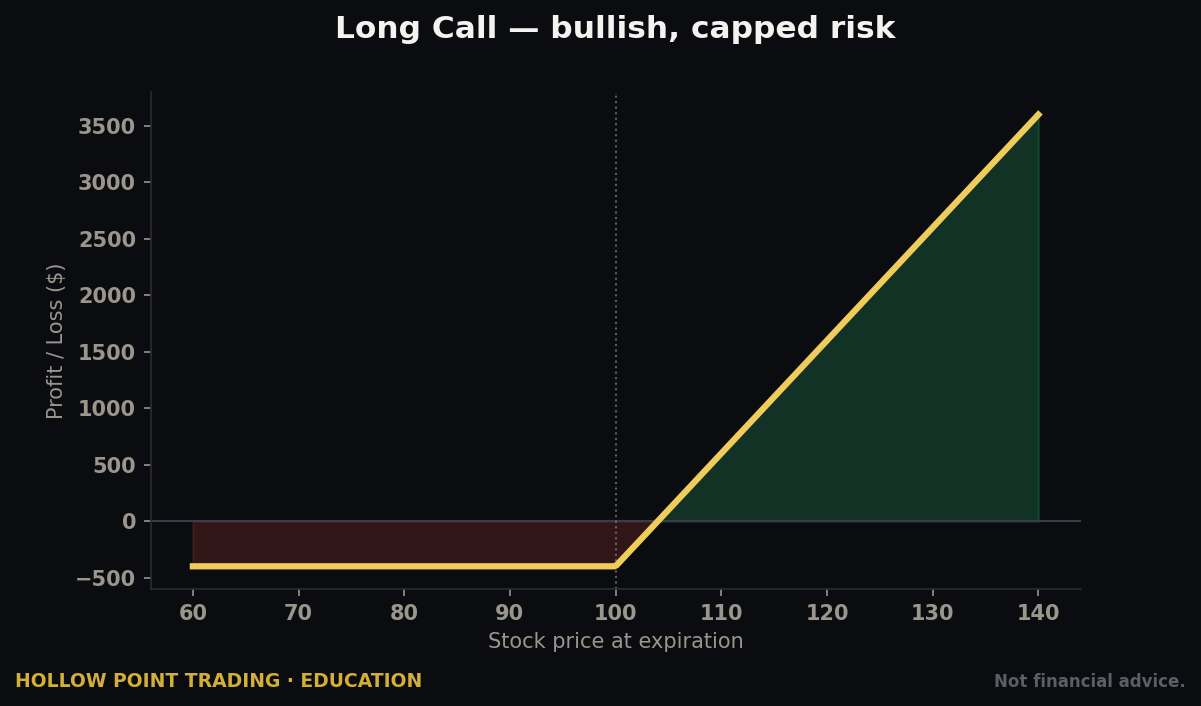
Notice the shape. Below the strike, your outcome is flat — you lose your whole premium, no more, no less, no matter how far the stock falls. It could go to zero and you still only lose the premium. Above the strike, your outcome slopes upward, and it keeps sloping up with no ceiling. This is why people draw the call payoff as a "hockey stick": flat handle on the left, blade rising forever on the right.
That shape is the entire emotional pitch of buying calls: limited, known loss on the downside; large, uncapped potential on the upside. But — and here is the discipline talking — that pitch hides how often the downside actually happens. Most out-of-the-money options expire worthless. The uncapped upside is real but rare. Respect both halves of the picture.
Breakeven: The Exact Price Where You Start Winning
Beginners constantly forget this one, and it costs them. Your option going "in the money" is not the same as you making a profit. Why? Because you paid a premium to get in, and you have to earn that back before you're ahead.
Breakeven is the stock price at which you have earned back exactly what you paid — no profit, no loss. For a call the formula is beautifully simple:
Breakeven = Strike price + Premium paid (per share)
Let's use our $100-strike call that cost $3 per share ($300 for the contract).
- Breakeven = $100 + $3 = $103.
- If the stock finishes at exactly $103, the option is worth $3, which is exactly what you paid. You broke even. Zero profit.
- The stock has to close above $103 for you to make a single dollar of actual profit.
- At $110, you're worth $10, you paid $3, so your profit is $7 per share — $700 profit on a $300 bet.
This is a crucial reframing. When you buy a call, you are not just betting the stock goes up. You are betting the stock goes up enough, fast enough, to clear your breakeven before the option expires. A stock can rise and you can still lose money on the call if it didn't rise past breakeven. Write your breakeven price down before you ever buy. It is the number that matters.
Why Buy a Call Instead of Just Buying the Stock?
Let's put the two side by side with honest numbers so you can feel the difference. Say a stock trades at $100 and you have $1,000 to work with.
Path A — Buy the shares. $1,000 buys you 10 shares. If the stock rises to $110 (up 10%), your 10 shares are worth $1,100. You made $100, a 10% gain. If the stock instead falls to $90, you're down $100. Your gains and losses track the stock one-for-one. Calm, predictable, and you can hold those shares forever — they never expire.
Path B — Buy a call. Suppose a $100-strike call expiring in a month costs $3 per share, so $300 per contract. With your $1,000 you could buy 3 contracts ($900), but let's keep it simple and buy just 1 contract for $300, leaving $700 in cash.
- If the stock rises to $110, your call is worth $10 per share = $1,000. You paid $300. That's a $700 profit — a 233% gain on the money you put into the option. The same 10% move in the stock produced a 233% move in your option. That is leverage.
- But if the stock goes nowhere — say it finishes at exactly $100 — your shares would be flat (no loss), while your call expires worthless and you lose the entire $300. The stock did nothing bad, and you still lost 100% of what you risked.
There is the trade in a nutshell. The call gave you a much bigger percentage gain for the same move and the same up-front dollar risk was smaller ($300 vs $1,000). That's the seductive part. The brutal part: the call can go to zero even when the stock is fine, and it has a deadline the stock never has. Shares are patient; options are on a clock.
So why would a beginner ever pick the call? A few legitimate reasons: you want defined, limited risk (you can't lose more than $300 no matter how ugly it gets); you want to free up cash (you tied up $300 instead of $1,000); or you have a specific, time-bound reason to expect a move (an earnings report, a product launch). The wrong reason — the one that blows up accounts — is "because the percentage gains are bigger." That reasoning ignores the clock and the frequency of total loss.
The Two Hidden Forces: Time Decay and Volatility
Here is what separates people who understand options from people who just get lucky. An option's price is not only intrinsic value. Before expiration, an option is also worth something for its potential — the chance that the stock keeps climbing before the deadline. That extra chunk is called extrinsic value, or time value. And it behaves in two important ways.
Time decay (the pros call it "theta"). Every day that passes, an option loses a little of its time value, even if the stock doesn't move at all — because there's one less day for something good to happen. Think of it as an ice cube slowly melting on the counter. And the melt speeds up as expiration approaches. In the final week or two, a stock sitting still is silently draining your option every single day. This is why simply "being right eventually" is not enough with options. Time is charging you rent the entire time you hold, and the rent gets more expensive near the end.
Volatility. Volatility is just a measure of how much a stock tends to jump around. A jumpy, dramatic stock is more likely to make a big move, so its options cost more (more chance of a big payoff). A sleepy, stable stock has cheaper options. The tricky part for beginners: when big news is expected (like earnings), volatility gets "priced in" — options get expensive right before the event, and then that expensive volatility premium deflates the moment the news is out. New traders buy calls right before earnings, the stock goes up like they predicted, and their calls still lose money because the volatility premium collapsed. This heartbreak has a nickname: the volatility crush. Just know it exists for now.
You do not need to master these forces today. You just need to know they exist, because they explain the two most confusing beginner experiences: "the stock didn't move and my option lost money" (time decay) and "the stock went up and my option lost money" (volatility crush or not clearing breakeven).
A Fully Worked Beginner Example, Start to Finish
Let's tie every piece together with one complete story. We'll invent a company: BrightLeaf Coffee, ticker BLF. (A ticker is just the short symbol a stock trades under.)
The setup. It's the first week of the month. BLF is trading at $50 a share. You've done your homework — you noticed the whole beverage sector has been strong (that's the macro-to-sector thinking we'll come back to), and BLF has a new product launch coming in three weeks that you think will push the stock higher. You have a view: BLF goes up over the next month.
Choosing the contract. You look at the options available. You decide to buy:
- 1 BLF call
- Strike price: $52 (a little above the current $50 — you're betting it climbs past $52)
- Expiration: about 5 weeks out (enough time for the launch to play out — you're deliberately not buying a contract that expires next week, because time decay would eat you alive)
- Premium: $1.50 per share
Because one contract controls 100 shares, your total cost is $1.50 × 100 = $150. That $150 is now the maximum you can lose. Write that down. It's your defined risk.
Your breakeven. Strike + premium = $52 + $1.50 = $53.50. BLF has to be above $53.50 at expiration for you to make an actual profit. Not $52 — $53.50. That $1.50 gap is the premium you have to earn back first.
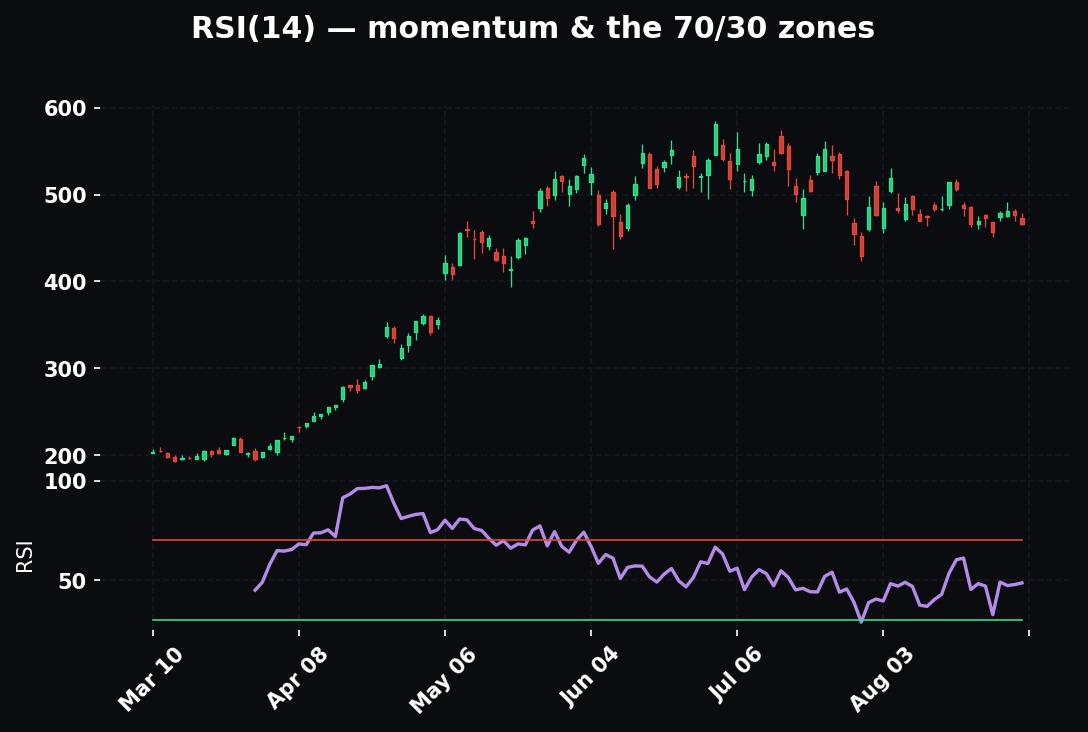
Now let's play out four different endings.
Ending 1 — The launch is a hit. BLF rises to $58. Your call's intrinsic value = $58 − $52 = $6 per share. The contract is worth $6 × 100 = $600. You paid $150. You sell the option for $600 and your profit is $450 — a 300% gain. Meanwhile, someone who bought 100 shares at $50 and sold at $58 made $800 but had to put up $5,000 to do it. Your $150 punched well above its weight. This is leverage working for you.
Ending 2 — Modest rise. BLF drifts to $53. You were right — the stock went up! But it's below your $53.50 breakeven. The option is worth $53 − $52 = $1 per share = $100. You paid $150. So you sell for $100 and take a $50 loss. Read that again: the stock rose and you still lost money, because it didn't clear breakeven. This is the lesson that separates gamblers from students.
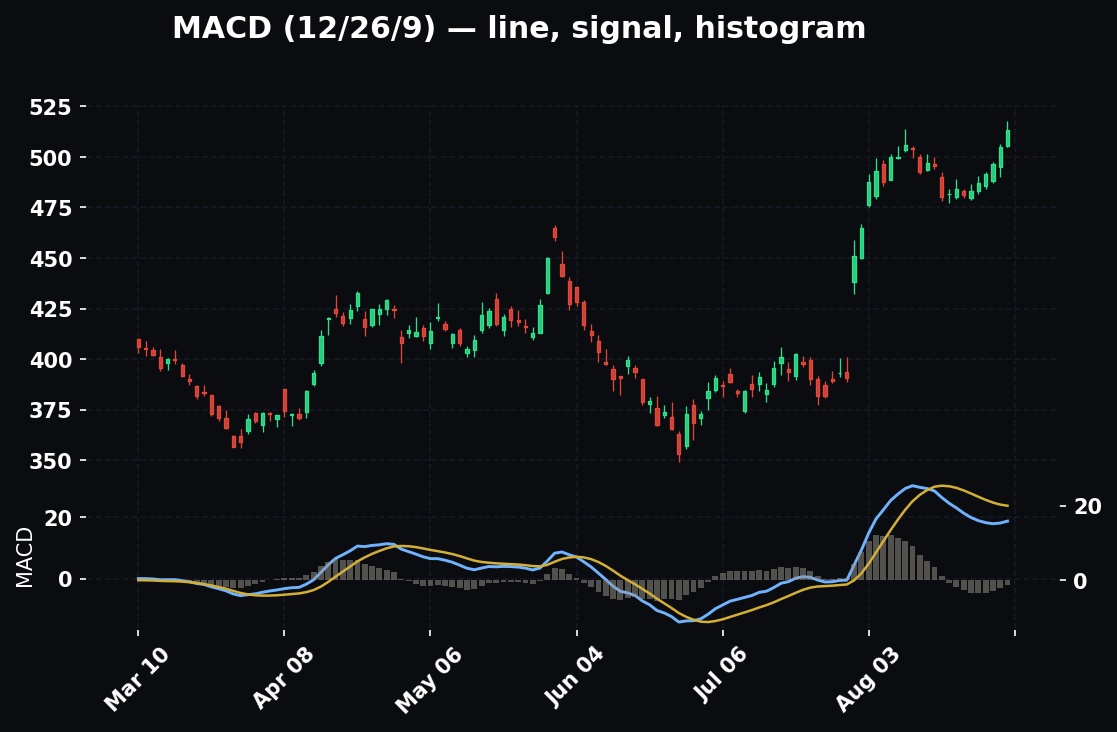
Ending 3 — It goes nowhere. BLF sits at $50. The launch was a dud, the stock stalls. At expiration the option is out of the money (stock below the $52 strike), so its intrinsic value is $0. It expires worthless. You lose your full $150. The stock literally did nothing wrong, and your entire bet evaporated — because the clock ran out. A share-buyer here would be perfectly flat. You are down 100%.
Ending 4 — It falls. BLF drops to $44. Bad news hits, the stock tanks. Your option is deep out of the money and expires worthless. Your loss is $150 — and not a penny more. Here's the flip side of the coin: a person who bought 100 shares at $50 is now down $600. Your defined risk protected you. You lost less in dollars than the share-buyer, even though the stock fell hard. This is the one scenario where the call's capped downside is a genuine gift.
Sit with all four endings together. In two of them (the stock flat, the stock down) you lose everything you put in. In one (small rise) you lose a little despite being directionally right. Only the big, timely move made you real money. That distribution — frequent small/total losses, occasional big wins — is the true nature of buying calls, and it's exactly why discipline and position sizing matter more than being clever about direction.
The Beginner Mistakes That Wreck Accounts
Every one of these is common, and every one is avoidable.
Mistake 1 — Forgetting the ×100. You see "$1.50" and think you're risking $1.50. You're risking $150. Traders have accidentally spent their whole account this way. Always multiply the premium by 100 before you click buy.
Mistake 2 — Buying options that expire this week because they're cheap. Short-dated options are cheap for a reason: they're melting fast and need the move to happen immediately. Beginners are drawn to the low price and the lottery-ticket payoff, then lose 100% again and again. Give your idea time to work. Buy more expiration than you think you need.
Mistake 3 — Confusing "in the money" with "profitable." As Ending 2 showed, the stock can rise and you can still lose. Know your breakeven before you buy, every time.
Mistake 4 — Buying calls right before earnings without understanding volatility crush. You can be right on direction and still lose because the volatility premium deflates. Until you understand this force, keep away from buying options into big scheduled events.
Mistake 5 — Betting money you can't afford to lose. Because a call can go to zero, you must treat every premium as money that might vanish entirely. Never put an amount into a single call that would hurt you to lose. At Hollow Point Trading the rule is to risk only a small, fixed slice of the account on any one idea — never the whole thing, never even close.
Mistake 6 — No exit plan. Decide before you enter: at what profit will you sell, and at what loss will you cut it? Then obey your own plan. Deciding in the heat of a moving market is how emotion takes the wheel.
Mistake 7 — Averaging down on a dying option. When a call is losing and bleeding time value, beginners buy more to "lower their average." This usually just doubles the loss on a wasting asset. A losing option near expiration is often best left for dead.
Your Simple Call-Buying Cheat Sheet
Tape this to your monitor. Before you buy any call, walk the list.
- Direction: Do I genuinely believe this stock goes UP? (Calls only pay on up moves.)
- Timing: By roughly when? Buy an expiration comfortably past that date.
- Strike: Which price am I locking in? (Closer to the stock = pricier but higher odds; farther above = cheaper but longer shot.)
- Premium × 100: What is my TRUE dollar cost and maximum loss? Say the real number out loud.
- Breakeven = strike + premium: What price must the stock beat for me to actually profit? Write it down.
- Position size: Is this a small, fixed slice of my account that I can afford to lose entirely? If losing it would hurt, it's too big.
- Exit plan: At what gain do I take profit? At what loss do I cut? Decide now, in writing.
- Events: Is earnings or big news coming that could crush volatility? If I don't understand that yet, I stay out.
- The clock: Do I understand that time decay is charging me rent every day, faster near expiration?
If you can't answer every line calmly, you're not ready to click buy. That's not a failure — that's discipline.
How the Call Fits the Bigger Hollow Point Picture
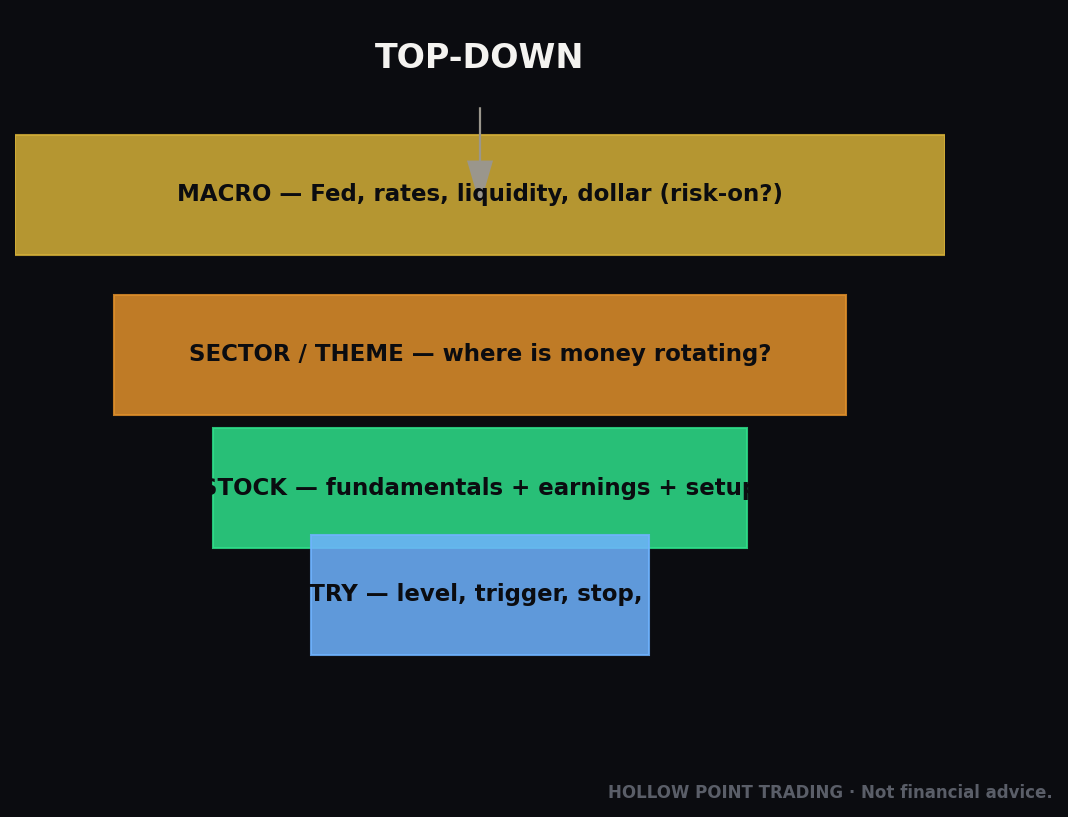
A call option is a tool, and a tool only matters inside a process. At Hollow Point Trading, that process flows in one direction: macro, then sector, then stock.
Macro is the big weather — interest rates, the overall market's mood, whether money is flowing into risk or hiding from it. Sector is the neighborhood — is the group this stock lives in (tech, energy, coffee, whatever) strong or weak right now? Stock is the individual house. You don't buy a call on a stock in a vacuum. You buy it when the macro is supportive, the sector is leading, and the individual stock has a clean setup. In our BLF example, we noted the beverage sector was strong before we ever looked at BLF. That order is not decoration — it's how you stack the odds so your limited-time bet has the wind at its back.
Then comes risk. Everything above serves one master: protecting capital first. The reason we obsess over position size, breakeven, and defined risk is that you cannot trade tomorrow if you blow up today. A call's built-in capped loss is a feature we use on purpose — it lets us take a swing while knowing the exact worst case. But capped loss on one trade means nothing if you bet too big or take twenty of them at once.
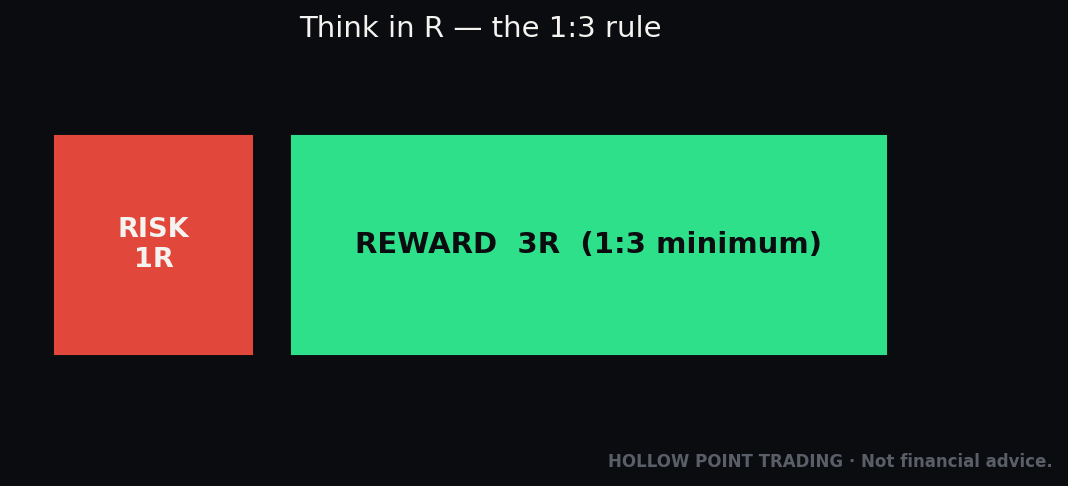
And reward-to-risk. The HPT standard is to look for setups offering at least 1-to-3 reward-to-risk — risking one dollar to potentially make three. That framing keeps you honest. If a call can realistically triple but can also go to zero, you want the structure of your trading — how often you're right, how big your winners are versus your losers — to come out ahead over many trades, not one. You will lose on individual calls. Endings 2, 3, and 4 will happen. The goal is never to win every time; it's to make your winners big enough and your losers small enough that the math works across a long season of trades.
That's the whole philosophy in miniature. Prediction is not the job. Discipline is the job. The call option is simply one of the cleaner ways to express a disciplined, time-bound, defined-risk opinion that a stock is heading higher — a coupon that pays if you're right, fast, and sized correctly, and quietly expires if you're not.
Learn it slowly. Practice it on paper first — most brokers offer a "paper trading" account where you place fake trades with fake money to learn the mechanics with zero risk. Do ten, twenty, fifty of those before a single real dollar is on the line. The market will still be here. Your capital, if you protect it, will be too.
Bound by rules, feared by trade.