
If you have never traded an option in your life, this is the guide written for you. Not the flashy version. Not the "turn $500 into $50,000" version that blows up your account by Friday. The patient, boring, keep-your-money version — the one that walks you through your very first options trade one small step at a time, defines every word the first time it shows up, and shows you real-ish numbers so you can actually follow along.
By the end, you will understand what you are buying, how to pick it, how to place the order without overpaying, and — most importantly — how to get out, with a profit or a small loss, on purpose instead of by accident.
Let's go slow.
What An Option Actually Is (In Plain English)
An option is a contract. That's it. It's an agreement that gives you the right — but not the obligation — to buy or sell a stock at a specific price, before a specific date.
Think of it like a coupon.
Imagine your favorite store sells a jacket for $100. A friend hands you a coupon that says: "You may buy this jacket for $100 anytime in the next month." If the jacket's price jumps to $140 next week, your coupon is suddenly valuable — you can still buy at $100 and you're $40 ahead. If the jacket goes on sale for $70, your coupon is worthless — why use a $100 coupon when the shelf price is $70? You just throw the coupon away. You're only out whatever you paid for the coupon itself.
That coupon is an option. And that little phrase — "you're only out whatever you paid for the coupon" — is the single most important idea in this entire guide. When you buy an option, the most you can ever lose is what you paid for it. Not a penny more. That known, capped, can't-surprise-you risk is exactly why a beginner should start here and nowhere else.
Two kinds of options exist:
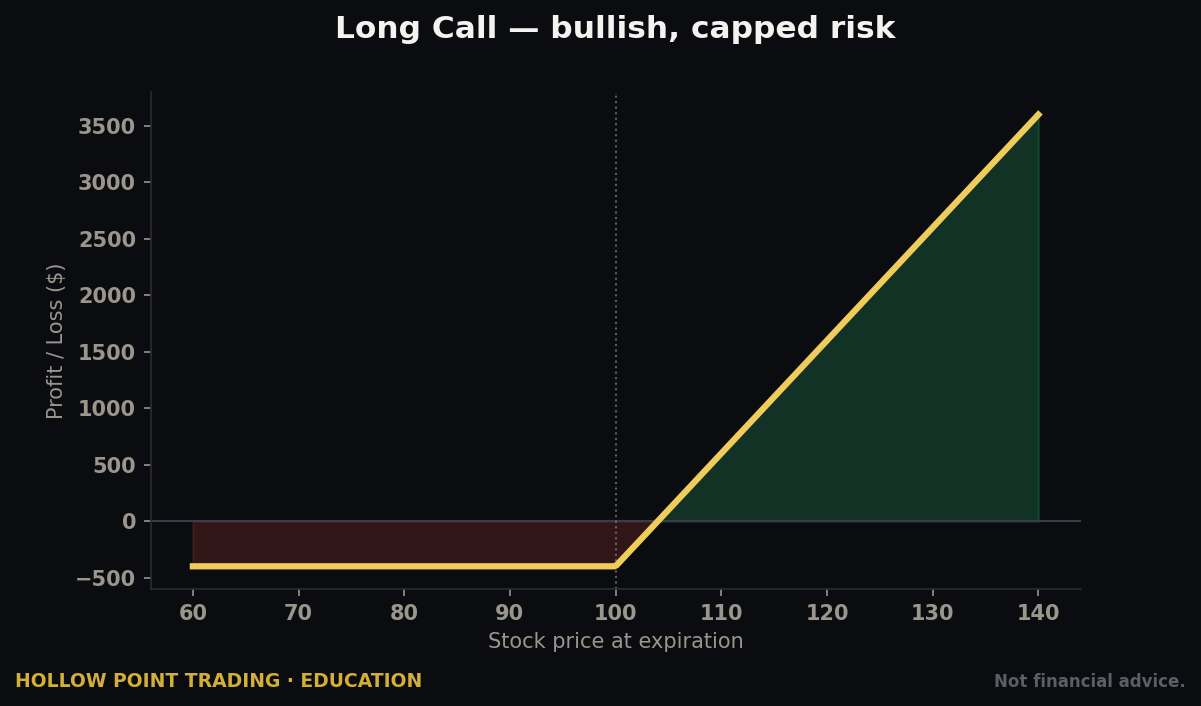
- A call gives you the right to buy a stock at a set price. You buy calls when you think the stock is going up. (The jacket coupon above is a call.)
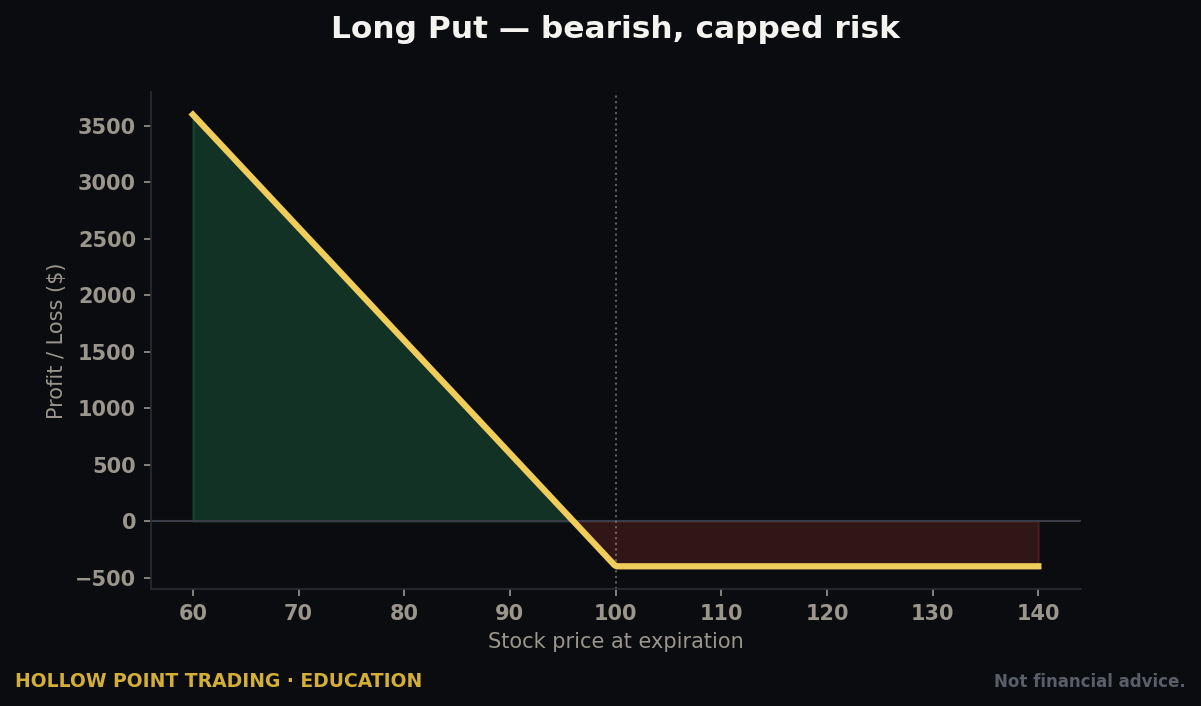
- A put gives you the right to sell a stock at a set price. You buy puts when you think the stock is going down. Think of a put as insurance — it pays off when the price falls.
For your very first trade, we're going to keep it as simple as humanly possible and buy one call option on a stock we think is heading higher. Buying a call is the most beginner-friendly options trade there is: you pay a small amount, your loss is capped at that amount, and your potential gain is large. We learn the whole machine with the safest single gear.
The Words You'll See On The Screen (Learn These Six)
Before you place anything, you need six words. Read these once, slowly. Everything else in options is built on top of them.
Strike price. The set price in your contract — the "$100" on the jacket coupon. This is the price at which your call lets you buy the stock. If a stock trades at $50 and you buy a call with a $52 strike, your coupon lets you buy at $52.
Expiration date. The day your coupon expires. After this date the contract is dead and gone. Options come with dozens of expiration dates to choose from — this Friday, next month, six months out, a year out. Later dates cost more (more time = more chances to be right).
Premium. The price you pay for the option itself — what the coupon costs you. This is quoted per share, but here's the catch that trips up every beginner: one options contract controls 100 shares. So if the premium is quoted at $2.00, one contract actually costs you $2.00 × 100 = $200. Always multiply by 100. Always.
In the money / out of the money. An option is "in the money" (ITM) when using it would make you money right now. A $52-strike call is in the money when the stock is above $52. It's "out of the money" (OTM) when the stock is below $52 — the coupon isn't useful yet, but it could become useful if the stock rises. Out-of-the-money options are cheaper because they're a bet on movement that hasn't happened.
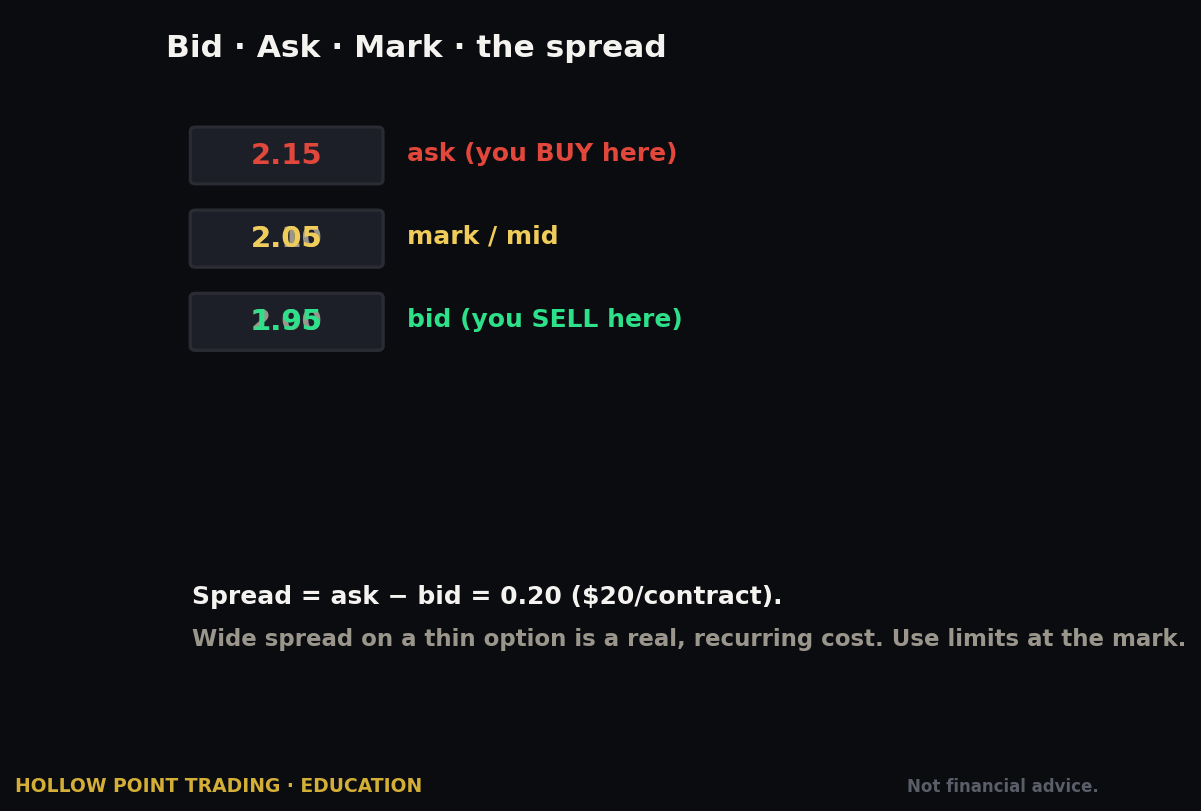
The bid, the ask, and the mark. The bid is the highest price a buyer is currently willing to pay. The ask is the lowest price a seller will accept. The mark (also called the "mid") sits right in the middle — the fair midpoint between them. If the bid is $1.95 and the ask is $2.05, the mark is $2.00. Remember the mark. We'll use it to place a smart order in a minute.
Implied volatility (IV). A fancy phrase for one simple idea: how much drama the market expects from this stock. High implied volatility means the market expects big swings — and big swings make options expensive. Low IV means calm is expected and options are cheaper. You don't need to master this on day one. You just need to know that buying options when IV is very high means you're paying up, and a stock can go your direction while your option still loses value because the drama fizzles out. (More on that trap later.)
Why A Beginner Should Care About Any Of This
Fair question. Stocks are simpler. Why bother?
Three honest reasons.
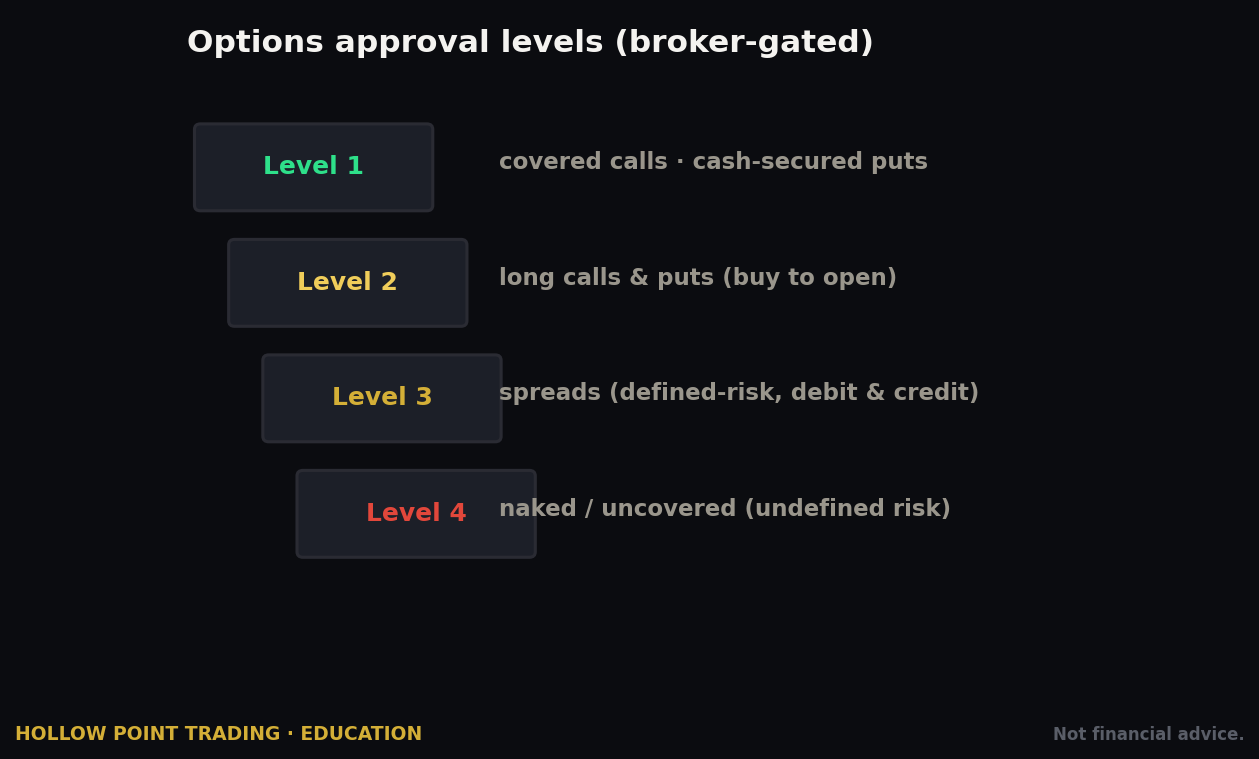
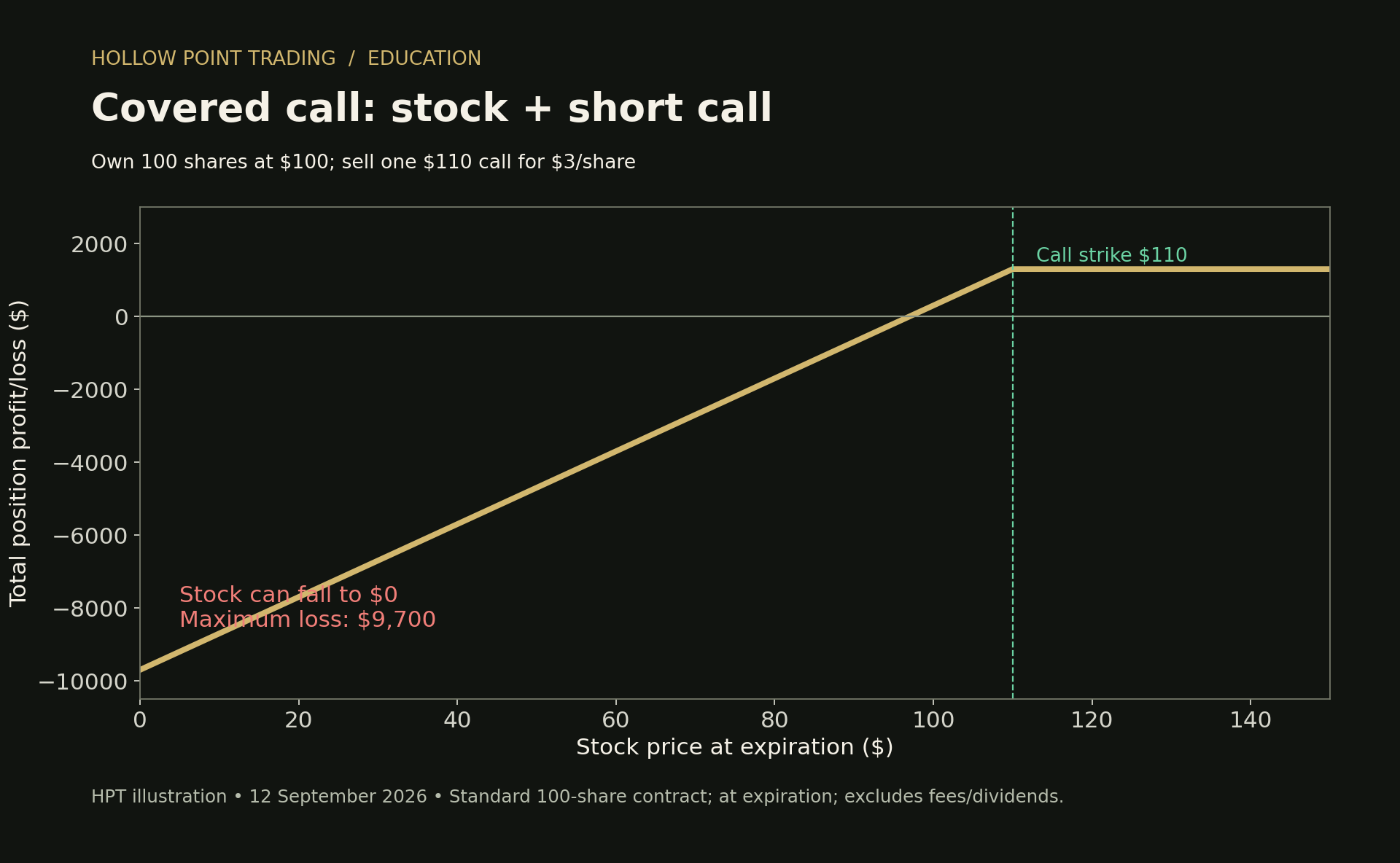
Defined risk. When you buy a single call or put, you know your worst case before you click the button. If you buy one call for $200, the absolute most you can lose is $200 — even if the company collapses to zero overnight. You can't say that about buying the stock outright on margin, and you certainly can't say it about the dangerous options strategies beginners should never touch. Knowing your maximum loss in advance is the foundation of protecting your capital, and protecting capital comes before everything else.
Leverage — used gently. A small amount of money can control a larger position. That cuts both ways: it magnifies gains and losses in percentage terms. For a beginner, leverage is a sharp tool you respect, not a toy you swing around. We use the smallest possible amount so a mistake teaches a lesson instead of emptying an account.
It teaches discipline. Options have a built-in clock (expiration) and a built-in cost of being wrong. They force you to have a plan for getting out before you get in. That habit — deciding your exit before your entry — is worth more than any single trade.
At Hollow Point Trading, the order of operations is always the same: protect capital first, then think about profit. Options, done the beginner way, are one of the cleanest ways to practice that.
Step By Step: Your First Trade From Top To Bottom
Here's the whole path. We'll walk each step, then do a complete worked example with numbers.
Step 1 — Start With The Big Picture, Not The Option
Beginners open the options screen first. That's backwards. The option is the last decision, not the first.
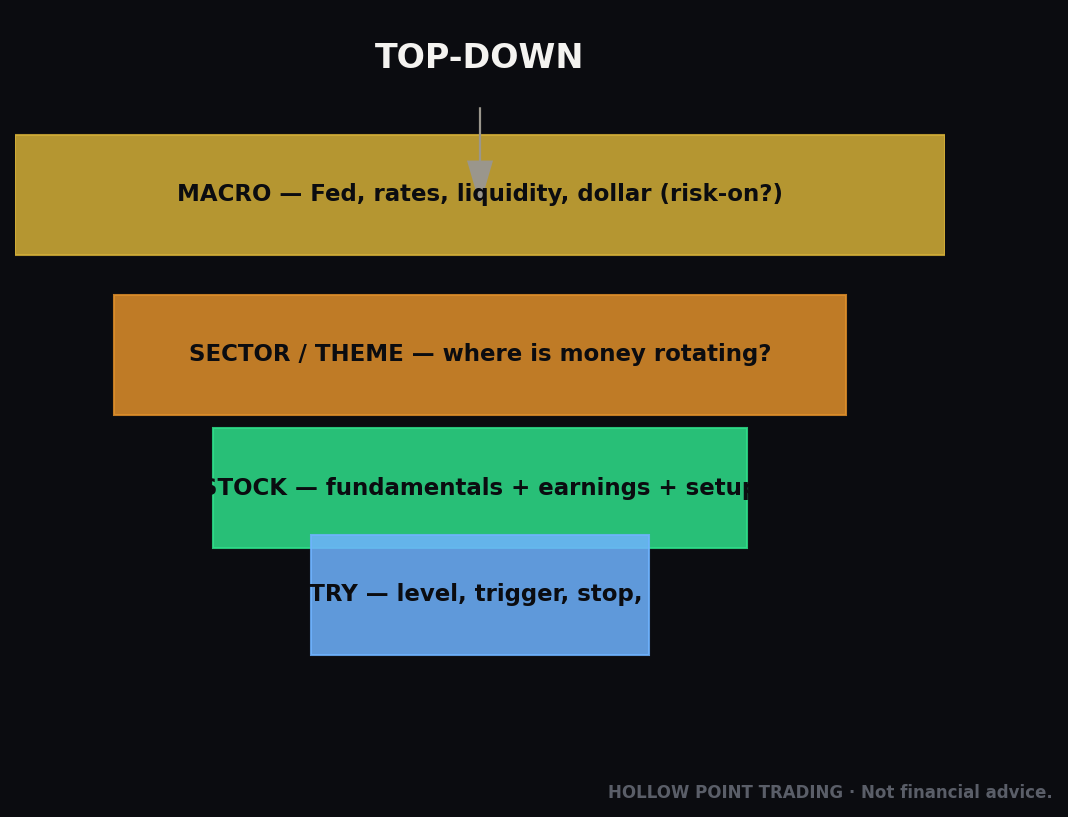
The HPT way of thinking flows top-down: macro → sector → stock.
- Macro is the whole market's mood. Is the broad market (think of the S&P 500 as the "market's average") trending up, trending down, or chopping sideways? Are we in a calm week or a scary-headline week? You don't fight the ocean. If the whole market is falling apart, that is not the day to buy your first call.
- Sector is the neighborhood. Stocks travel in packs — technology, energy, banks, healthcare. If technology as a group is strong, a strong tech stock has the wind at its back.
- Stock is the individual name. Only after the market and the sector look supportive do you pick the actual stock — ideally one that's a leader in a strong sector, in an agreeable market.
You want all three pointing the same way. That alignment is called confluence — multiple independent things agreeing. One reason to take a trade is a hope. Three reasons agreeing is a setup.
For your first trade, pick a large, well-known, heavily traded company — the kind of stock millions of people trade every day. Big, liquid stocks have tight bid-ask spreads (the gap between buy and sell prices is small), which means you're not losing a chunk of money just getting in and out. Avoid tiny, thinly traded names for your first ride.
Step 2 — Pick Your Direction And Your Timeframe
Decide two things in plain words before touching the options chain:
- Which way? "I think this stock goes up over the next few weeks." Up = call. Down = put. First trade, let's say up. We buy a call.
- How long do I need to be right? This decides your expiration. If your idea is "up over the next month," you do not buy an option expiring this Friday. Give your idea room to breathe.
Here's a rule that will save you real money: buy more time than you think you need. Options lose value every single day as expiration approaches — that slow bleed is called time decay (the industry word is theta). It's like an ice cube melting; the closer to expiration, the faster it melts. A beginner who buys an option expiring in three days is standing in the sun holding an ice cube. Buy 30 to 60 days of time for a swing-trade idea, so the melt is slow and you have room to be right.
Step 3 — Pick The Strike Price
Now we choose which strike. Beginners agonize here, so here's a simple framework.
Strikes come in three flavors relative to where the stock trades right now:
- Deep in the money — strike well below the current price. Expensive, but moves almost dollar-for-dollar with the stock. Safer, less leverage.
- At the money (ATM) — strike right around the current price. Balanced cost, balanced sensitivity. This is the beginner's home base.
- Out of the money — strike above the current price. Cheap, exciting, and the most likely to expire worthless. This is where beginners lose money fastest chasing lottery tickets.
For your first trade, choose a strike at the money or slightly in the money. Yes, it costs a bit more than the cheap out-of-the-money option. You're paying for a higher probability of the trade actually working. Cheap options are cheap for a reason: they usually expire worth nothing.
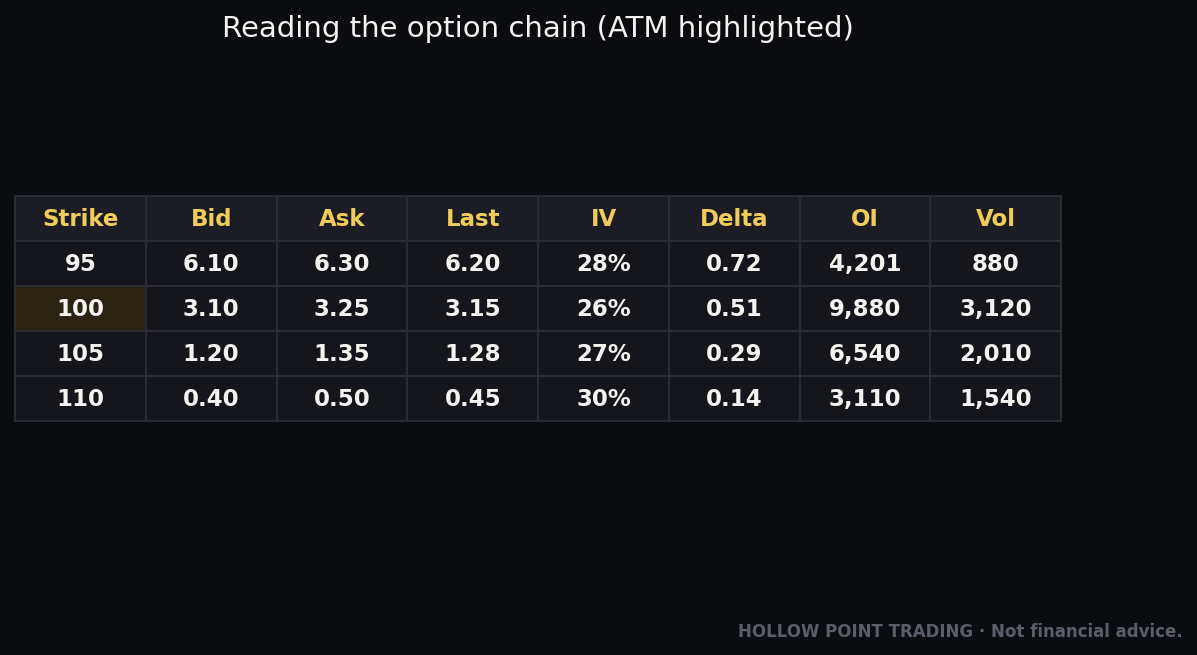
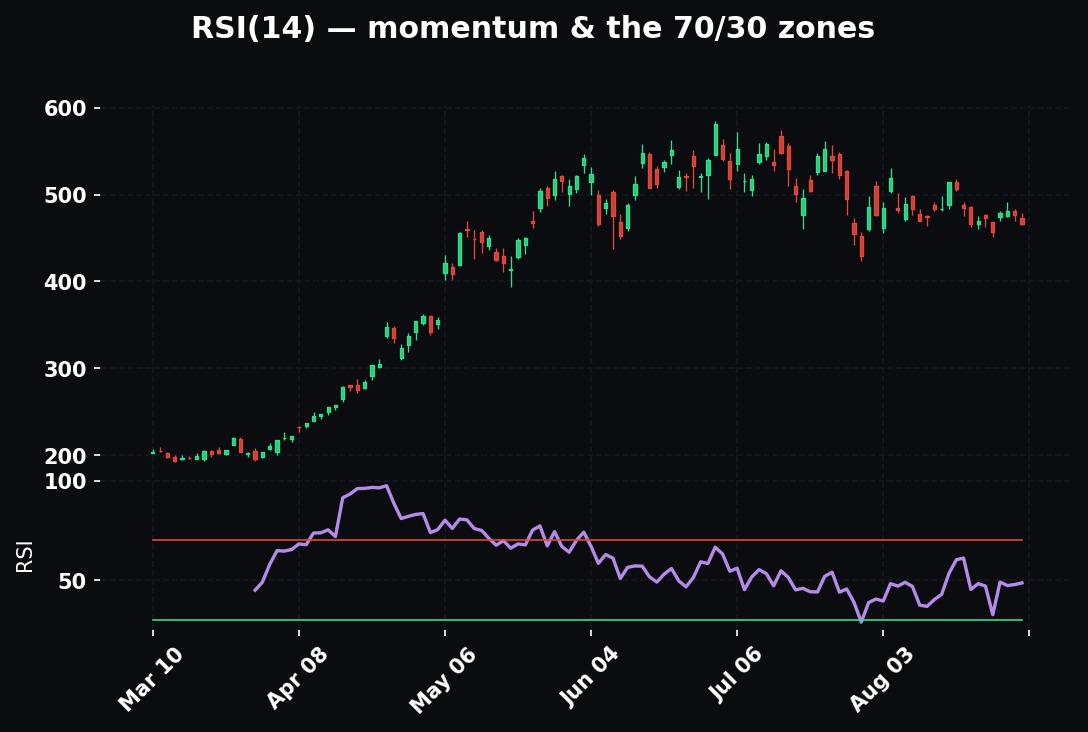
There's a number on the options screen called delta that helps here. Delta (a value between 0 and 1 for calls) roughly tells you two things at once: how much the option moves for a $1 move in the stock, and a rough sense of the option's odds of finishing in the money. A delta of 0.50 means the option gains about $0.50 for every $1 the stock rises, and loosely implies a coin-flip chance of finishing in the money. For a first trade, a delta around 0.50 to 0.60 is a sensible, balanced choice. You don't have to calculate anything — the number is printed right there on the chain.
Step 4 — Read The Chain And Find The Mark
The options chain is the table your broker shows: rows of strikes, columns of bid, ask, last price, volume, and delta, split into calls on one side and puts on the other. It looks intimidating. It's just a menu.
Find your chosen expiration date at the top. Find your chosen strike in the rows. Look at the bid and ask for that specific call. The midpoint between them is your mark — the fair price. That's the number we're going to try to pay.
Also glance at volume and open interest (how many contracts traded today, and how many exist in total). You want these to be healthy — hundreds or thousands, not single digits. Healthy numbers mean the option is liquid, the bid-ask spread is tight, and you'll be able to sell it later without getting fleeced. A wide gap between bid and ask (say bid $1.20, ask $1.80) is a warning sign — skip it.
Step 5 — Place The Order: A Limit Order At The Mark
This is where beginners overpay, so slow down.
There are two order types you need to know:
- A market order says "fill me right now at whatever price is available." Convenient, but with options it often means you pay the full ask price — the most expensive number on the screen. Don't do this.
- A limit order says "fill me, but only at this price or better." You are in control. This is what we use.
Set a limit order to buy one contract at the mark — that fair midpoint. Using our example, bid $1.95, ask $2.05, mark $2.00 — you place a limit buy at $2.00. Often the order fills right at the mark or a penny either side. If it doesn't fill in a minute or two, you can nudge your limit up by a cent or two, but never just leap to the ask. Those pennies, times 100 shares per contract, times every trade for the rest of your life, add up to real money.
One contract. Not five. Not "as many as I can afford." One. Your first trade is tuition, and you want the class to be cheap.
Step 6 — Write Your Plan Before You're Filled
Before you click submit, write three numbers on paper (yes, actual paper or a notes app):
- My entry: what I paid. ($2.00 → $200 total.)
- My exit if I'm right (profit target): where I take money off the table.
- My exit if I'm wrong (stop): where I admit the idea failed and cut it.
If you don't have all three written before you enter, you don't have a trade — you have a hope. This plan is the difference between a trader and a gambler.
Managing The Trade: Reward-To-Risk, The HPT Way
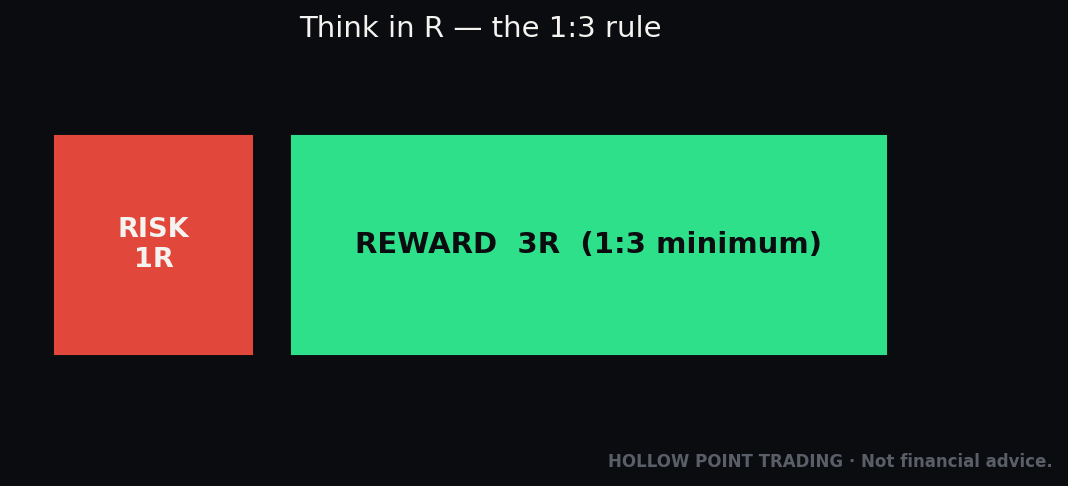
Here's the number that runs the whole show at Hollow Point Trading: 1:3 reward-to-risk.
It means: for every $1 you're willing to lose if you're wrong, you aim to make $3 if you're right. Risk a dollar to make three.
Why does this matter so much? Because it means you can be wrong more often than you're right and still make money. Watch:
Say you make ten trades, risking $100 each. You're wrong six times and right only four times — a losing record most people would be ashamed of.
- Six losses × $100 = –$600
- Four wins × $300 (that's the 1:3 payoff) = +$1,200
- Net result: +$600. Profitable, while being wrong 60% of the time.
That is the quiet magic of reward-to-risk. You don't need a crystal ball. You need your wins to be bigger than your losses, and a rule that enforces it. Prediction is a fool's game; structure is a winner's game.
So for our trade: we paid $200. We are risking, let's say, half of it — $100 — as our maximum acceptable loss. That means our profit target should be three times that risk: +$300. We're looking to sell the option somewhere around $500 total ($200 cost + $300 gain), and we're willing to cut it if it falls to around $100 total (a $100 loss). Those become the two exit numbers on your paper.
A Fully Worked Beginner Example (Follow Every Number)
Let's do the whole thing start to finish with a made-up but realistic stock. We'll call it Northwind Corp, ticker NWC.
The setup (top-down). The broad market has been grinding higher for two weeks — macro is calm and constructive. The technology sector is leading — the neighborhood is strong. NWC is a large, heavily-traded tech name sitting just above a price level it bounced off of twice before, which suggests buyers keep showing up there. Macro up, sector up, stock up. Three arrows agree. That's confluence. Good enough for a first, small trade.
The direction and timeframe. I think NWC drifts higher over the next month or so. Direction: up → buy a call. Timeframe: about a month, so I'll buy an expiration roughly 45 days out — plenty of time so the ice cube melts slowly.
The stock price. NWC currently trades at $50.00.
The strike. I want at-the-money for balance, so I look at the $50 strike call. I check its delta: 0.54. Good — balanced sensitivity and roughly even odds. That's my strike.
The chain. For the $50 call, 45 days out, I see:
- Bid: $1.95
- Ask: $2.05
- Mark (midpoint): $2.00
- Volume: 3,400. Open interest: 22,000. Nice and liquid. Tight spread.
The order. I place a limit order to buy 1 contract of the NWC $50 call at $2.00. It fills at $2.00.
My total cost: $2.00 × 100 = $200. That $200 is the entire amount I can lose. My risk is defined and known. I can sleep.
The written plan.
- Entry: $2.00 ($200 total).
- Risk I'll accept: $100 (half the premium). Stop-out around option price $1.00 ($100 total).
- Profit target (1:3): +$300, so I'll look to sell around option price $5.00 ($500 total).
Now we wait and manage. Two things can happen.
Scenario A — the trade works. Over the next three weeks NWC climbs from $50 to $55. My $50 call is now deep in the money. Because of that 0.54 delta (and delta rising as the option goes in the money), the option's value has climbed from $2.00 to roughly $5.20. My contract is now worth about $520.
I hit my target. Do I get greedy and hold for more? No. I placed a limit order to sell 1 contract at $5.00 (near the mark), it fills, and I collect roughly $500 — a $300 profit on $200 risked. That's my 1:3. I took the win off the table on purpose. The stock might keep running or it might reverse tomorrow; that's no longer my problem, because I followed my plan. Taking profit at your target is discipline, not cowardice.
Scenario B — the trade fails. Instead, NWC drifts down to $48 over two weeks. Sector wobbled, the setup didn't play out. My $50 call has lost value plus melted from time decay — it's now worth about $1.00. I've hit my stop.
Here's the moment that separates traders from hopers. I do not tell myself "it'll come back." I do not average down and buy more to lower my cost. I follow the plan: I sell the contract for about $1.00, collect $100, and accept the $100 loss. The idea was wrong. Small loss, lesson learned, capital preserved to fight another day. That $100 loss is survivable — and survivability is the whole game.
Notice what just happened across both scenarios: because I risked $100 to make $300, one win pays for three losses. I don't have to be right often. I have to be disciplined always.
The Beginner Mistakes To Avoid (Every One Of These Will Cost You)
Read this section twice. These are the exact ways new options traders blow up.
Buying weekly, out-of-the-money "lottery tickets." The cheap call expiring in three days feels exciting and affordable. It is the fastest way to lose 100% of your money. Time decay is brutal that close to expiration, and out-of-the-money means the stock has to move and hurry. Skip it. Buy time and buy closer to the money.
Forgetting to multiply by 100. "It's only $2." No — it's $200. Every contract is 100 shares. People buy "just five contracts" of a $3 option thinking they spent $15 and discover they spent $1,500. Always multiply.
Using market orders and overpaying the spread. Clicking "buy at market" hands the seller the full ask price and does the same in reverse when you sell. Over a trading life, that leak drains accounts quietly. Limit orders at the mark, always.
Trading illiquid options. A stock nobody trades has options with wide bid-ask spreads. You might buy at $1.80 and only be able to sell at $1.20 minutes later — down 33% before the stock even moves, just from the spread. Stick to big, liquid names with healthy volume and open interest.
Position sizing like a maniac. Putting a big chunk of your account into one option because you're "sure" is how one bad trade ends the game. First trades should be an amount you'd be genuinely fine losing entirely. One contract. Tiny.
No exit plan. Entering without a written target and stop means your emotions manage the trade — and emotions sell winners too early and hold losers forever. Write the three numbers first.
Holding a loser hoping it "comes back." Hope is not a strategy. Your stop exists precisely so a small loss doesn't become a total one. Honor it.
Buying into sky-high implied volatility, then getting crushed. This one's subtle. Right before big scheduled events (like an earnings report), IV inflates and options get expensive. After the event, IV collapses — an effect nicknamed "IV crush." You can guess the direction correctly and still lose money because the drama premium evaporated. For a first trade, avoid buying options right before earnings. Learn the machine on ordinary days first.
Revenge trading. Lost on a trade, so you immediately pile into another to "win it back." This is emotion driving the bus. Close the laptop. The market's open tomorrow.
Your First-Trade Cheat-Sheet
Tape this next to your screen. Every box should be checked before you click buy.
Before you enter:
- [ ] Macro, sector, and stock all point the same way (confluence). ✔ three arrows agree
- [ ] Big, liquid, well-known stock — tight spreads, healthy volume.
- [ ] Direction chosen in plain words. Up = call, down = put.
- [ ] Expiration 30–60 days out (buy more time than you think you need).
- [ ] Strike at-the-money or slightly in-the-money, delta around 0.50–0.60.
- [ ] Option is liquid: solid volume + open interest, narrow bid-ask spread.
- [ ] Not right before earnings (avoid IV crush on your first ride).
When you enter:
- [ ] One contract. (Remember: ×100 = your real cost.)
- [ ] Limit order at the mark, never a market order.
- [ ] Three numbers written down: entry, profit target, stop.
- [ ] Reward-to-risk is at least 1:3.
While you manage:
- [ ] Hit the target? Sell. Take the win. No greed.
- [ ] Hit the stop? Sell. Take the small loss. No hope.
- [ ] Never average down on a loser. Never risk what you can't lose.
How This Fits The Bigger Hollow Point Picture
Your first options trade is not really about the option. It's about installing the habits that carry through everything you'll ever trade.
Look at what this one small call actually taught you. You started from the top — macro to sector to stock — instead of gambling on a random ticker. You waited for confluence, several independent signals agreeing, rather than acting on a single hope. You defined your risk before entering, so the worst case could never surprise you. You structured the trade at 1:3 reward-to-risk, so being wrong more often than right can still leave you profitable. And you took your exit — win or lose — by plan, not by emotion.
That's the whole philosophy in miniature. Protect capital first. Discipline over prediction. Small, survivable losses and larger, planned wins. Rules that hold when your feelings don't.
Nobody's crystal ball works. The market will humble anyone who tries to predict it. What does work — reliably, across decades, across every good trader who lasts — is a repeatable process followed with discipline when it's boring and when it's scary. Your first trade is where that process is born. Keep it tiny. Keep it clean. Keep the notes. Do it again. And again. The size grows later; the rules never change.
You now know enough to place a real first options trade the careful way — pick the setup, pick the strike, pick the expiration, order with a limit at the mark, manage to a plan, and take your profit or your loss on purpose. That's not a small thing. That's the foundation.
Go slow. Stay small. Follow the rules.
Bound by rules, feared by trade.