
Imagine you walk into a store, pick up a price tag that says "$3.50," and you have absolutely no idea what you're buying, why it costs $3.50, or whether that number will be $6 or $0 by Friday. That's what buying an option feels like for most beginners. They see a price, they click "buy," and then they watch a number wiggle up and down all day without understanding a single thing about what's actually moving it.
This guide fixes that. By the end, you'll be able to look at any option price and break it into its two real ingredients — the part that's genuinely "worth something" right now, and the part you're paying purely for time and hope. You'll understand why an option can lose money even when the stock does exactly what you predicted. And you'll finally know what that $3.50 is actually buying you.
Let's start with the word itself.
What "Premium" Actually Means (In Plain English)
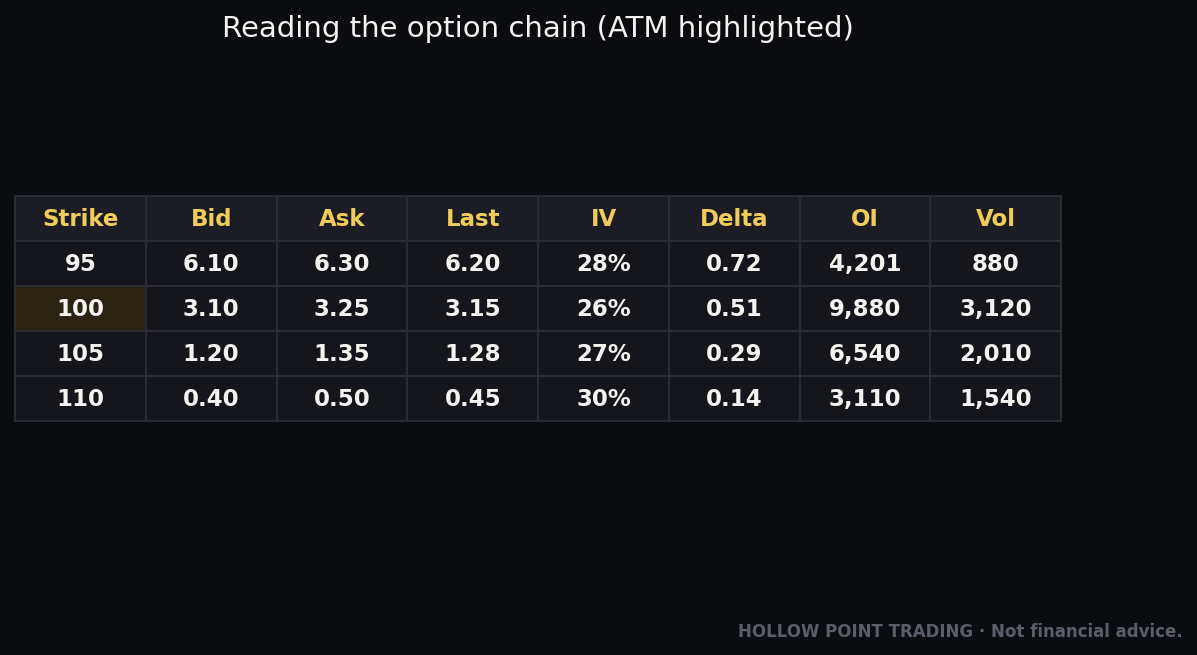
When you buy an option, the price you pay is called the premium. That's it. That's the whole word. The premium is simply the cost of the option — the money that leaves your account to buy it.
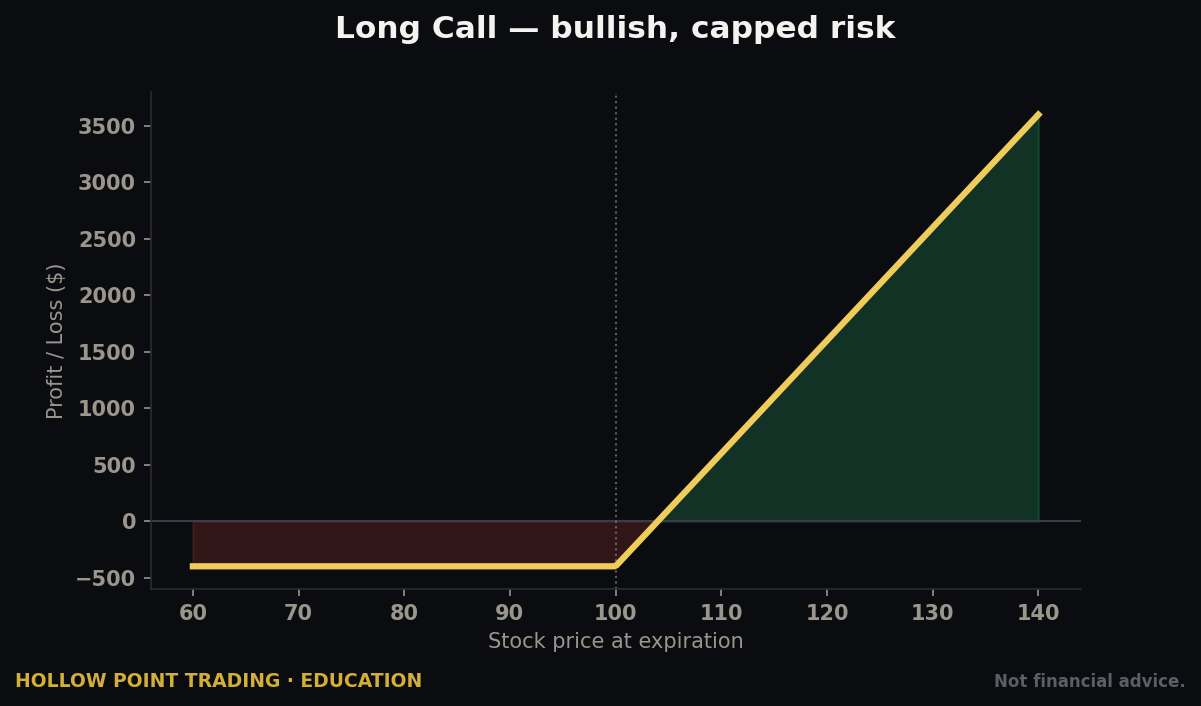
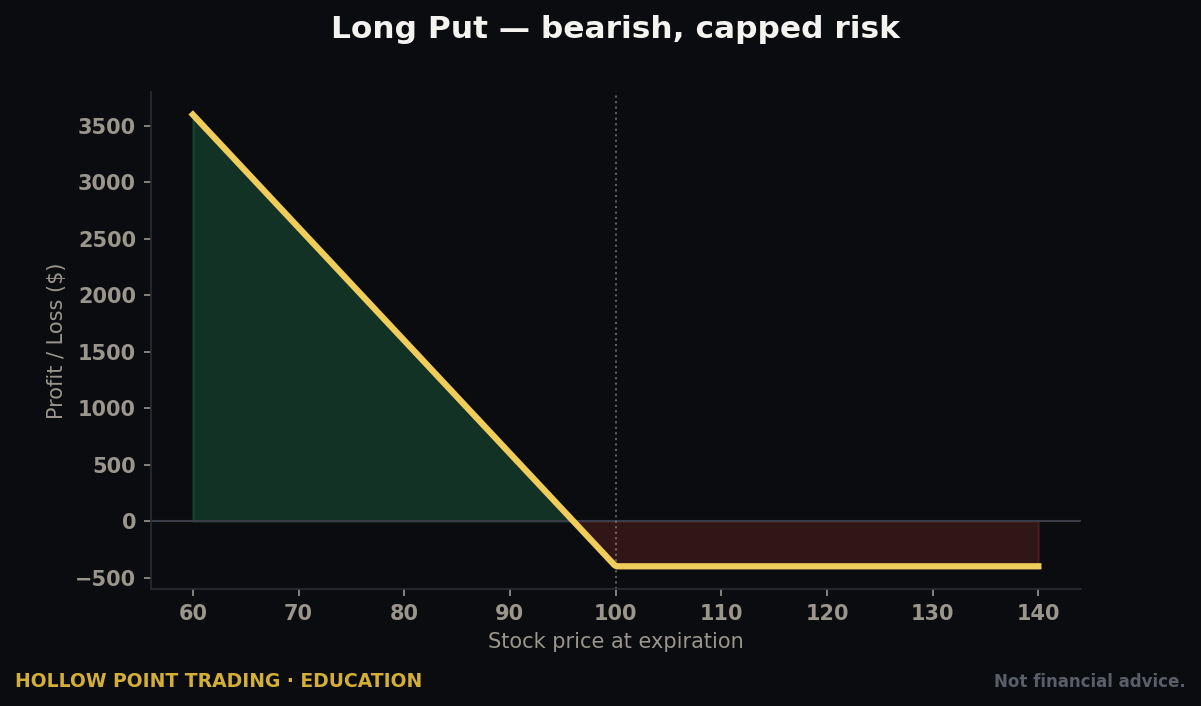
Quick refresher, because we assume zero prior knowledge: an option is a contract that gives you the right — but not the obligation — to buy or sell a stock at a specific price before a specific date. A call option gives you the right to buy a stock at a set price. A put option gives you the right to sell a stock at a set price. That set price is called the strike price (or just "strike"). The last day the contract is alive is the expiration date.
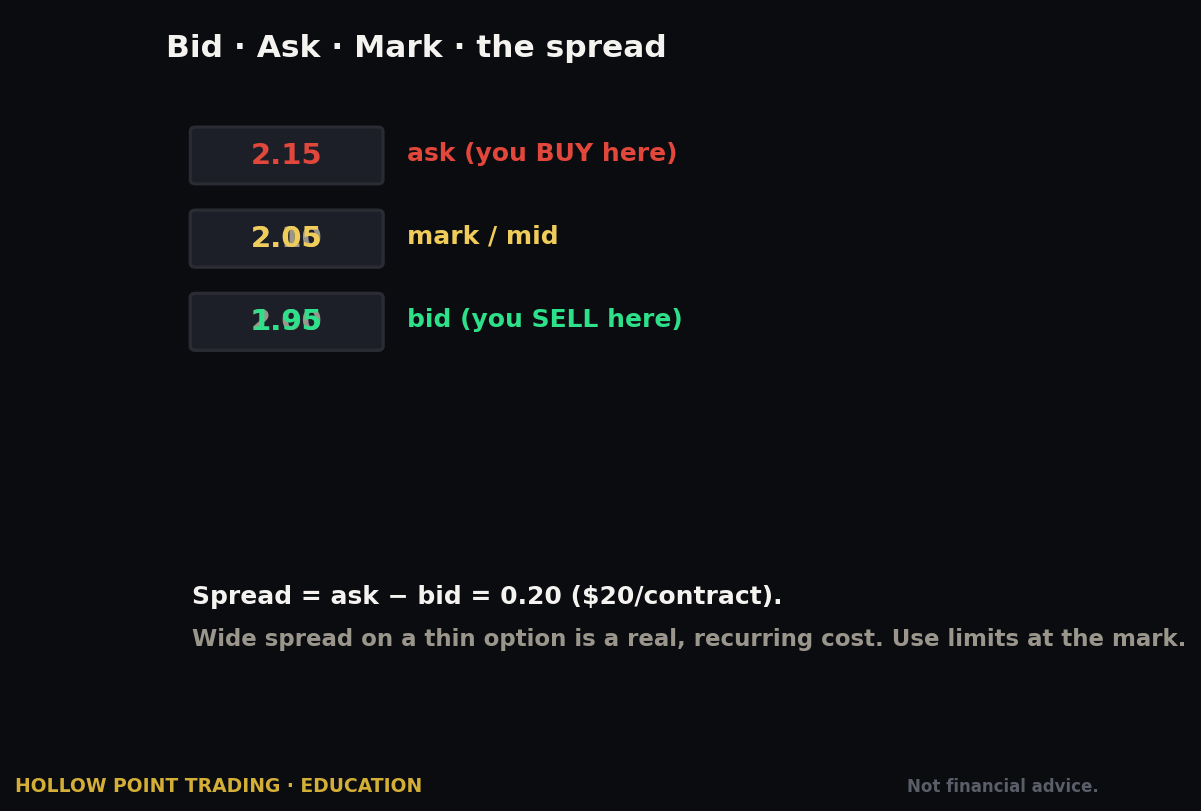
So the premium is what you pay for that contract. Here's the one detail that trips up every beginner: options are quoted per share, but one contract controls 100 shares. So if an option is quoted at $3.50, you don't pay $3.50 — you pay $3.50 × 100 = $350 for one contract.
Write that on your hand: quoted price times 100 equals what actually leaves your wallet. Beginners blow up accounts because they see "$3.50" and think it's cheap, not realizing they're spending $350 per contract, and $3,500 if they buy ten.
Now — the premium is not one solid lump of money. It's actually made of two separate pieces glued together. Understanding these two pieces is the entire point of this guide, because almost every mistake beginners make comes from not knowing which piece they're paying for.
Those two pieces are:
- Intrinsic value — the part that's genuinely worth something right now.
- Extrinsic value — the part you're paying for time and possibility (also called time value).
Premium = Intrinsic Value + Extrinsic Value. Always. Every option, every time, no exceptions. Let's take them one at a time.
Piece One: Intrinsic Value — The "Real Right Now" Part
Intrinsic value is the amount of money an option would be worth if you had to use it this very second. It's the "already in the money" part of the price — the portion that isn't hope, isn't time, isn't a bet on the future. It's real, cash-value, right-now worth.
Here's the cleanest way to think about it. An option has intrinsic value only when the strike price is on the good side of where the stock is actually trading.
Let's use a call option (the right to buy). Say a stock is trading at $105, and you own a call with a $100 strike. That call lets you buy the stock at $100 when everyone else has to pay $105. That right is worth real money — specifically, $5 per share. You could exercise it, buy at $100, sell at $105, pocket $5. So this call has $5 of intrinsic value.
The formula for a call:
Call intrinsic value = Stock price − Strike price (and never less than zero)
If the stock is at $105 and the strike is $100: $105 − $100 = $5 intrinsic.
Now flip it. If that same $100-strike call had the stock trading at $95, why would you ever use your right to buy at $100 when you could just buy in the open market at $95? You wouldn't. So the intrinsic value is zero. Not negative — options never have negative intrinsic value, because you're never forced to use a right that hurts you. It just floors at zero.
For a put option (the right to sell), it's the mirror image. A put has intrinsic value when the stock is below your strike, because you get to sell high while the market is low.
Put intrinsic value = Strike price − Stock price (and never less than zero)
Stock at $95, you own a $100-strike put: $100 − $95 = $5 intrinsic. You can sell at $100 when the stock's only worth $95. Real money.
This gives us three pieces of vocabulary you'll hear constantly. They just describe whether an option currently has intrinsic value:
- In the money (ITM) — the option has intrinsic value. Your strike is on the profitable side. (Call: stock above strike. Put: stock below strike.)
- At the money (ATM) — the stock is sitting basically right at your strike. Intrinsic value is roughly zero.
- Out of the money (OTM) — the option has no intrinsic value. Your strike is on the wrong side. (Call: stock below strike. Put: stock above strike.)
Here's the beginner gut-punch buried in that list: an out-of-the-money option has zero intrinsic value. So if you buy an OTM option — which beginners love, because they're the cheapest — one hundred percent of what you paid is the other piece: time value. You are buying pure hope. More on why that matters in a moment.
Piece Two: Extrinsic Value — The "Time and Hope" Part
Extrinsic value is everything in the premium that isn't intrinsic value. It's the price you pay for the possibility that the option becomes more valuable before it expires. Because time is the biggest driver of that possibility, extrinsic value is almost always just called time value. Same thing.
You already know how to find it, because the two pieces always add up to the whole premium:
Extrinsic value = Premium − Intrinsic value
Let's make it real. Stock at $105, $100-strike call, and the option's premium (its market price) is $7. We know intrinsic value is $5 (from $105 − $100). So:
Extrinsic value = $7 − $5 = $2
That $2 is the "time and hope" money. You're paying $5 for the right that's genuinely worth $5 today, and an extra $2 on top for the chance the stock climbs even higher before expiration. If the option expired right now, that $2 would vanish — you'd only collect the $5 of real value.
Why would anyone pay that extra $2? Because there's still time on the clock, and time means the stock could move further in your favor. The market charges you for that opportunity. Think of it exactly like a plane ticket that's refundable versus non-refundable — you pay extra for the flexibility and the chance to change your mind. Extrinsic value is the "flexibility premium" of the options world.
Two big forces pump up extrinsic value:
- Time remaining. More days until expiration = more chances for the stock to move = more expensive time value. A call with 90 days left has far more extrinsic value than the same call with 3 days left. Time is opportunity, and opportunity costs money.
- Expected movement (volatility). If a stock is expected to swing around wildly — say, right before an earnings announcement — the option's extrinsic value balloons, because a wild swing could hand the option buyer a big win. This "expected wildness" has a name: implied volatility, or IV. High IV = fat, expensive time value. Low IV = thin, cheap time value. You don't need the math yet; just burn in the concept: the more the market expects a stock to move, the more you pay for its options.
Here's the trap, stated plainly: extrinsic value is the part of the premium that melts away to zero by expiration, guaranteed. Not "maybe." Guaranteed. At the moment an option expires, it has no time left, so it can have no time value — only intrinsic value survives. Every dollar of extrinsic value you paid is on a countdown timer to zero.
That melting has a name, and it deserves its own section, because it's the single most important thing a beginner must understand before risking a dollar.
Why Options Lose Value Over Time: Meet "Theta"
The slow, daily bleed of extrinsic value as expiration approaches is called time decay. In options language it's measured by a Greek letter, theta (θ). You'll hear traders say "theta is eating my position" or "I'm getting killed by decay." They mean the time-value portion of their option is shrinking a little every single day, just because a day passed.
Think of an option like a block of ice you bought on a warm day. The intrinsic value is the solid, permanent core — a rock in the middle that won't melt. The extrinsic value is the ice around it, slowly dripping away. The closer you get to expiration (the warmer it gets), the faster it melts. And on expiration day, all the ice is gone — you're left holding only the rock, whatever it's worth.
The cruel twist that surprises every beginner: time decay speeds up as expiration gets closer. It's not a straight, even drip. An option loses its time value slowly at first, then faster and faster in the final couple of weeks, and brutally in the last few days. A curve, not a line. So those "cheap" options expiring this Friday? They're cheap precisely because their time value is evaporating by the hour.
And here's the part that makes people quit trading in frustration before they understand it: you can be right about the direction and still lose money.
Picture it. You buy a call. You're convinced the stock goes up. And it does go up — a little. But it goes up slowly, and meanwhile time decay ate your extrinsic value faster than the small move added intrinsic value. Net result: you were right, and you still lost. This happens to beginners constantly, and they never understand why until someone explains time value to them. Now someone has.
The stock doesn't just need to move your way. It needs to move your way enough, and fast enough, to outrun the melting ice. That's the real bar. Miss it, and being "right" doesn't save you.
Putting It Together: A Fully Worked Beginner Example
Let's walk through one trade from start to finish, tracking both pieces of value the whole way. We'll keep the numbers clean and round.
The setup. A stock called XYZ is trading at $50. You think it's heading higher over the next few weeks. You buy one call option with a $50 strike (right at the money) expiring in 30 days. The premium is quoted at $2.00.
First, what did you actually pay? $2.00 × 100 shares = $200. That's your total cost, and — critical beginner rule — that $200 is also the most you can lose. An option buyer can never lose more than the premium paid. That's the one genuinely friendly feature of buying options: your downside is capped at what you put in.
Now let's break that $2.00 premium into its two pieces on day one:
- Stock is $50, strike is $50. Intrinsic value = $50 − $50 = $0.
- Extrinsic value = premium − intrinsic = $2.00 − $0 = $2.00.
So on day one, your entire $200 is time value. Pure "time and hope." That solid ice core? There isn't one yet. It's all melting ice.
Scene one: two weeks pass, stock goes nowhere. XYZ is still at $50. You were neither right nor wrong — the stock just sat there. But 15 days ticked off the clock, and time value bled out. The option might now be worth around $1.20. You've lost $80 (from $200 down to $120) and the stock didn't even move. Welcome to theta. This is the lesson that costs beginners real money when they learn it live instead of here.
Scene two: the stock finally moves. In the next few days, XYZ climbs to $53. Now let's break down the premium again with, say, 10 days left. Suppose the option is now trading at $3.50:
- Intrinsic value = $53 − $50 = $3.00 (this is now real, solid, right-now value — your ice core has formed).
- Extrinsic value = $3.50 − $3.00 = $0.50 (the time value has shrunk from $2.00 to $0.50 because expiration is close and decay accelerated).
Notice what happened. Your option went from $2.00 to $3.50 — a $150 gain per contract — but the makeup changed completely. Early on it was all time value. Now it's mostly intrinsic. The stock did the heavy lifting to build intrinsic value faster than decay could destroy time value. That's the whole game.
Scene three: expiration day. It's the last day. XYZ is at $53. There's no time left, so extrinsic value is exactly $0. The option is worth only its intrinsic value:
- Intrinsic value = $53 − $50 = $3.00, i.e. $300.
You paid $200, the option is worth $300, you made $100 (a 50% return). Good trade. But look how close it was to a disaster — if XYZ had stalled at $50 instead of climbing, that same option would have expired at exactly zero and you'd have lost the entire $200. Same "correct-ish" view of the stock, wildly different outcomes, and the difference was how much and how fast it moved versus the melting clock.
That's a beginner's entire education in one trade: the premium is two pieces, one piece melts, and the stock has to move enough to beat the melt.
What Makes a Premium Go UP or DOWN
Now that you know the two pieces, you can finally understand why an option price moves. There are really only four levers, and each one pushes on a specific piece.
Lever 1 — The stock price moves. This is the obvious one. For a call, stock up = premium up (intrinsic value grows). Stock down = premium down. For a put, it's reversed. This is the lever beginners focus on almost exclusively — and it's only one of four.
Lever 2 — Time passes (theta). Every day that goes by, extrinsic value shrinks a little. This lever only pushes down, and it never stops, never sleeps, and speeds up near expiration. Time is the one force working against an option buyer 24/7.
Lever 3 — Implied volatility changes (IV). When the market suddenly expects a stock to move more — fear spikes, big news looms, earnings approach — extrinsic value inflates and premiums rise even if the stock hasn't moved at all. When that expectation calms down, extrinsic value deflates and premiums fall. This one blindsides beginners constantly, especially around earnings. They buy a call before earnings, the stock jumps the direction they wanted... and the option still loses money, because IV collapsed the moment the news came out. This is called IV crush, and it's a graveyard for beginners who don't understand extrinsic value. You now do.
Lever 4 — Interest rates and dividends. These nudge premiums too, but for a beginner they're a rounding error compared to the first three. File them under "exists, mostly ignore for now."
So when your option price wiggles, ask: Which lever just moved? Stock? Time? Volatility? Nine times out of ten it's one of the first three, and understanding which one is the difference between panicking and knowing exactly what happened.
The Beginner Mistakes to Avoid
These are the specific, expensive, over-and-over mistakes that come directly from not understanding premium and value. Read them twice.
Mistake 1: Buying cheap, far-out-of-the-money options because they "only cost $20." Remember: an OTM option has zero intrinsic value. You're paying 100% time value — pure melting ice with no solid core. These are cheap for a reason: they usually expire worthless. Beginners buy a fistful of them like lottery tickets and lose the whole stack. Cheap is not the same as good value.
Mistake 2: Forgetting the ×100. Seeing "$4.00" and not registering that it's $400 per contract. Then buying five. Then owing $2,000 they didn't mean to risk. Always multiply by 100 before you click.
Mistake 3: Ignoring time decay on short-dated options. Those options expiring this Friday feel cheap and exciting. But their time value is evaporating by the hour. Unless you really know what you're doing, ultra-short expirations punish beginners hardest, because decay is at its most violent.
Mistake 4: Being "right" and still losing, then blaming the market. The stock went your way but too slowly, and decay ate you alive. That's not the market being unfair — that's you not accounting for the melting ice. Build the melt into your plan before you enter.
Mistake 5: Buying options right before earnings without understanding IV crush. You pay a fat, inflated premium (high IV), the news drops, IV collapses, and your option deflates even if you called the direction. If you don't understand extrinsic value, this feels like a betrayal. If you do, you saw it coming.
Mistake 6: Not knowing which piece you're paying for. Before every trade, split the premium: how much is intrinsic (real, right-now value) and how much is extrinsic (melting time value)? If you can't answer that, you don't understand the trade you're about to make. Full stop.
Your Premium and Value Cheat-Sheet
Tape this next to your screen. This is the whole guide compressed into something you can use Monday morning.
The core equation:
- Premium = Intrinsic Value + Extrinsic Value
- What you pay = Quoted price × 100
Intrinsic value (the "real right now" part):
- Call: Stock price − Strike (floored at zero)
- Put: Strike − Stock price (floored at zero)
- Never negative. Survives expiration.
Extrinsic value (the "time and hope" part):
- Extrinsic = Premium − Intrinsic
- Melts to zero by expiration, guaranteed.
- Bigger when: more time left, higher expected movement (IV).
The three money zones:
- In the money (ITM) = has intrinsic value.
- At the money (ATM) = stock ≈ strike, ~zero intrinsic.
- Out of the money (OTM) = zero intrinsic, all time value.
The four levers that move a premium:
- Stock price (moves intrinsic)
- Time passing / theta (shrinks extrinsic — always down)
- Implied volatility (inflates/deflates extrinsic)
- Rates & dividends (minor — ignore for now)
Before every single trade, ask:
- What did this actually cost me (× 100)?
- How much is intrinsic vs. extrinsic?
- How much and how fast must the stock move to beat time decay?
- Is there an earnings report before expiration? (IV crush risk.)
- Is the most I can lose an amount I'm genuinely fine losing?
If you can answer those five questions out loud, you understand more about what you're paying for than most people who've been clicking "buy" for years.
How This Fits the Bigger Hollow Point Picture
At Hollow Point Trading, we don't teach you to predict the future. We teach you to protect capital first and let disciplined process do the rest. Understanding premium and value is the foundation that makes that possible — here's how it connects to everything else you'll learn.
Discipline over prediction. Notice that everything in this guide is about understanding what you're holding, not guessing where the stock goes. A beginner who knows their option is 100% melting time value with three days left doesn't need a crystal ball — they already know the odds are stacked against them, and they can simply choose not to take that trade. Knowledge replaces hope. That's the entire HPT mindset in miniature.
Protecting capital first. The reason we hammer on the ×100 rule, on OTM lottery tickets, on time decay — it's all capital protection. You can't compound an account you keep blowing up on melting ice. Knowing exactly what your premium buys, and exactly how much you can lose (never more than you paid, as a buyer), is risk management before the trade even starts.
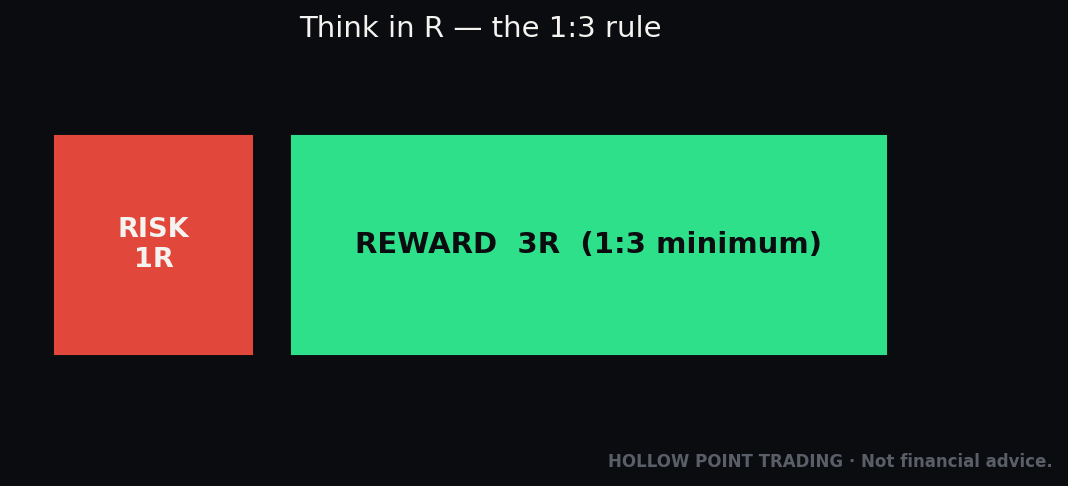
Reward-to-risk, 1:3. HPT looks for trades where the potential reward is at least three times the risk. You can't even calculate that ratio until you understand what your option costs and what it can realistically become. Premium is your risk — the whole $200 in our example. To justify risking it, the realistic reward should be around $600. That framing only exists once you understand value.
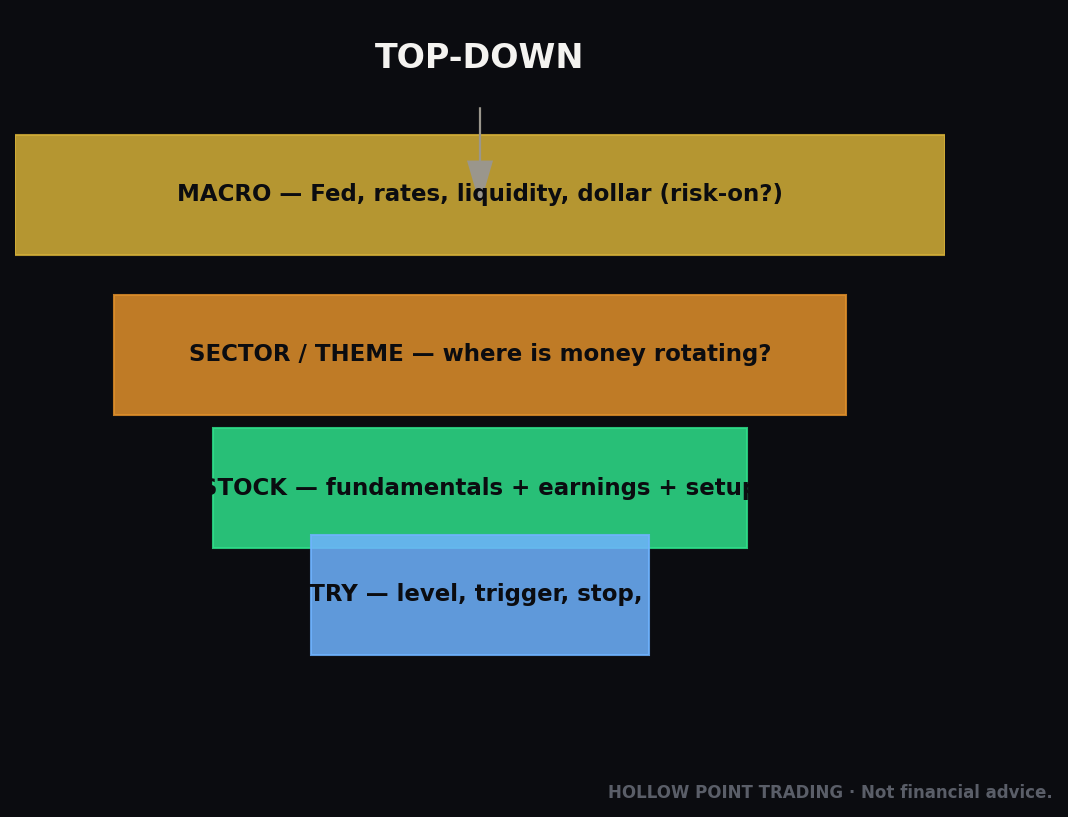
Macro → sector → stock. The bigger HPT method starts with the broad market (macro), narrows to strong sectors, then to individual stocks. Options are the final tool you reach for once that top-down work points you at a specific name — and even then, you now know not every option on that name is worth buying. The right strike and the right expiration, with the right mix of intrinsic and extrinsic value, is what turns a good idea into a good trade.
Master this one concept — what you actually pay for, and how it lives and dies over time — and you've built the floor the entire house stands on. Everything else in options is a variation on the two pieces you just learned: the part that's real, and the part that melts.
Now go split a premium. Pick any option, anywhere, and break it into intrinsic and extrinsic before you'd ever consider buying it. Do that a hundred times and it becomes instinct — and instinct, built on rules, is exactly what keeps you in the seat when everyone else is getting washed out.
Bound by rules, feared by trade.