
Most people learn one way to make money in the stock market: buy a stock, wait for it to go up, sell it higher. That's it. Buy low, sell high. It's the only move they know.
But markets don't only go up. They fall. Sometimes they fall hard and fast. And here's the question almost every beginner eventually asks: "If I think a stock is about to drop, is there a way to actually make money from that? Or a way to protect the shares I already own?"
The answer to both is yes. The tool is called a put option. And by the end of this guide, you'll understand it well enough to explain it to a friend at dinner — and, more importantly, to use it carefully yourself.
We're going to go slow. We'll define every single word the first time it shows up. We'll use small, clean numbers you can check on a napkin. And we'll keep coming back to the one thing that matters most at Hollow Point Trading: protecting your money first, being right about direction second.
Let's begin.
What Is a Put, in Plain English?
Let's start with the simplest possible definition and build up from there.
A put option is a contract that gives you the right — but not the obligation — to sell a stock at a specific price, on or before a specific date.
Read that again slowly, because every word is doing a job:
- A contract — it's a legal agreement between you and another trader, handled automatically by the exchange. You're not making a handshake deal with a stranger; the market matches you up.
- The right, not the obligation — you may sell if you want to. You're never forced to. If it doesn't work out, you can just walk away. (This is the magic of options: your choices stay open.)
- To sell — this is the key word that makes a put a put. A put is about selling. Its cousin, the call option, is about buying. If you ever mix them up, just remember: Put = the right to Put the stock away (sell it, get rid of it).
- At a specific price — this locked-in price is called the strike price. It never changes for the life of the contract.
- On or before a specific date — this deadline is called the expiration date, or just "expiration." After that day, the contract is gone.
So a put is basically a coupon that says: "I'm allowed to sell this stock for $100 anytime before the third Friday of next month — no matter how low the actual price falls."
Now, why would anyone want the right to sell at a fixed price?
Because if the stock falls below that fixed price, your right to sell high becomes valuable. Imagine you hold a coupon letting you sell something for $100, and that something is now only worth $70 in the real world. Your coupon is worth about $30, because you could buy the thing for $70 and sell it for $100 using your coupon. That $30 gap is real money.
That's the whole idea. A put gains value when the stock goes down. That's what makes it the tool for betting on a decline — or for protecting yourself against one.
A Few More Words You'll Need (Defined Simply)
Before we go further, let's nail down the small vocabulary you'll see over and over. Don't memorize — just get familiar. We'll use each of these in the examples.
- Underlying — the actual stock the option is based on. If you buy a put on Apple, Apple is the "underlying." Think of the option as a bet riding on top of the real stock.
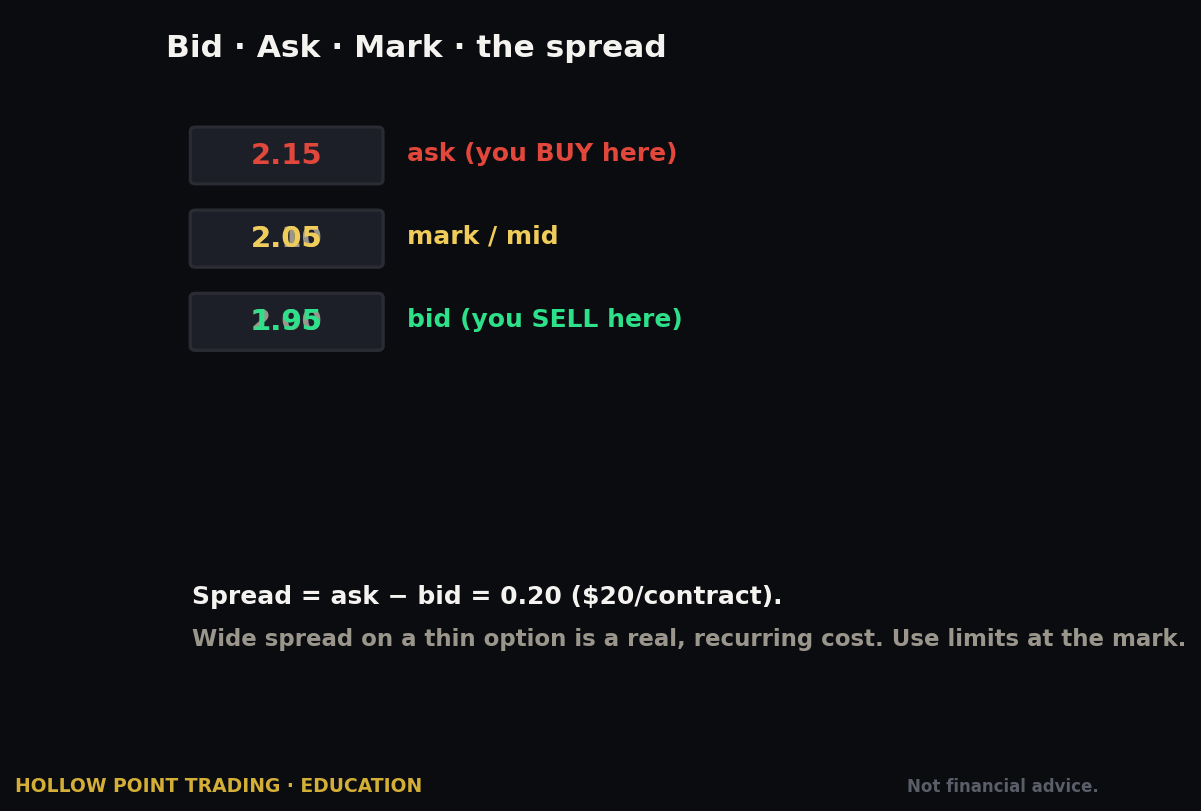
- Premium — the price you pay to buy the option. It's the cost of the coupon itself. When you buy a put, the premium is the money that leaves your account. It's yours to lose, and it's the most you can lose.
- Contract = 100 shares — this trips up every beginner, so burn it in now. One option contract controls 100 shares of the underlying stock. So if an option is quoted at $2.00, one contract actually costs $2.00 × 100 = $200. The price you see is per share; you multiply by 100 to get the real dollars.
- In the money (ITM) — for a put, this means the stock price is below your strike. Your right to sell high is worth something real. The coupon has cash value.
- Out of the money (OTM) — for a put, the stock is above your strike. Your right to sell isn't useful yet, because you could get a better price in the open market. The coupon is only worth "maybe someday" money.
- At the money (ATM) — the stock is sitting right about at your strike price.
- Intrinsic value — the "real, right now" portion of the option's price. For a put, it's how far the stock is below your strike. Strike $100, stock $92 → $8 of intrinsic value.
- Time value — the "maybe it gets even better before expiration" portion. The extra you pay for hope and time. Time value slowly melts away as expiration approaches — this melting is called time decay (you may hear the fancy Greek word theta, but just think "the ice cube melting").
That's the whole starter vocabulary. Nine words. You've got them.
Why a Beginner Should Even Care About Puts
Fair question. If you're new, why not just stick to buying stocks?
Here are the three honest reasons puts matter, even for beginners:
1. They let you profit when you're pessimistic. Buying a stock only pays off when things go up. But you'll have plenty of moments when you look at a company or the whole market and think, "This is heading down." Without puts, that insight is worthless — you can only sit on your hands. A put turns a bearish opinion ("bearish" = expecting prices to fall) into a position you can actually hold.
2. They cap your loss at a known, small number. When you buy a put, the absolute most you can lose is the premium you paid. Not a penny more. You know your maximum loss the moment you enter — before anything happens. For a beginner, that is a huge deal. It means you can never get one of those horror-story losses that wipe out an account overnight. Your downside is fenced in.
3. They're insurance for stock you already own. This is the use even conservative, long-term investors love. If you own shares and you're nervous about a drop, a put acts exactly like an insurance policy on those shares. We'll walk through this in detail — it's called a protective put, and it might be the single most sensible thing a beginner can learn about options.
At Hollow Point Trading, we don't teach options as a way to gamble. We teach them as tools. A put is a precision tool for two jobs: betting on a decline with strictly limited risk, and insuring what you own. Keep those two jobs in mind and you'll never misuse it.
How Buying a Put Actually Works, Step by Step
Let's walk through the mechanics as if you're placing your very first put trade. We'll keep it concrete.
Step 1 — You have a view. You look at a stock — let's call it a made-up company, "Downing Corp," trading at $100 a share. Maybe earnings look shaky, maybe the chart is rolling over, maybe the whole sector is weak. You believe the price is going to fall over the next month.
Step 2 — You choose a strike price. You decide the level you want your "right to sell" locked at. Say you pick a strike of $100 — right where the stock is now (at the money). This means: no matter what happens, you'll have the right to sell Downing at $100 until expiration.
Step 3 — You choose an expiration date. You pick how long you want the bet to run. Longer = more time for your view to play out, but more expensive (more time value). Say you pick an expiration one month away.
Step 4 — You see the premium and do the math. The market quotes this put at $3.00. Remember: that's per share, and one contract is 100 shares. So one contract costs $3.00 × 100 = $300. That $300 leaves your account. It is now your maximum possible loss. Write that number down — it's the number that keeps you safe.
Step 5 — You buy it. You click buy. Congratulations, you own one put contract on Downing Corp: strike $100, one month out, paid $300.
Step 6 — You wait and watch. From here, the put's value moves in the opposite direction of the stock:
- If Downing falls, your put gains value. Good.
- If Downing rises or stays flat, your put loses value. Bad — and it keeps slowly bleeding time value as expiration nears.
Step 7 — You exit. You have two ways to close out, and beginners should almost always use the first:
- Sell the put back to the market before expiration for whatever it's now worth. This is what nearly all traders do. You never touch the actual shares. You bought a coupon; you sell the coupon. Simple.
- Exercise it — actually use your right to sell 100 shares at the strike. This is more involved and usually unnecessary. Just know it exists.
That's the entire lifecycle. Buy the coupon, watch it move, sell the coupon. Let's put real numbers on it.
A Fully Worked Beginner Example
Let's follow one complete trade from open to close, three different ways it could end. Same setup each time. This is the section to reread until it clicks.
The setup:
- Stock: Downing Corp, trading at $100
- You buy 1 put, strike $100, expiring in 1 month
- Premium: $3.00 per share × 100 = $300 total cost
- Your maximum loss, locked in from second one: $300
Ending A — The stock drops (you're right)
A month passes. Bad news hits Downing and it falls to $90.
Your put lets you sell at $100 while the stock is only worth $90. That's a $10-per-share advantage. In option terms, your put is now worth about $10.00 per share of intrinsic value (strike $100 − stock $90 = $10).
- Your put is worth: $10.00 × 100 = $1,000
- You paid: $300
- Your profit: $1,000 − $300 = $700
You more than tripled your money because the stock fell 10%. Notice the leverage: a 10% move in the stock produced a 233% gain on your money. That's the power — and, in the other direction, the danger — of options. Small moves get magnified.
Ending B — The stock rises (you're wrong)
Different month, different outcome. Downing has a great month and climbs to $108.
Your right to sell at $100 is now useless — why would you sell at $100 when the stock's worth $108? Nobody exercises a put that's out of the money. At expiration, the put expires worthless.
- Your put is worth: $0
- You paid: $300
- Your loss: $300
And that's it. You lost your $300 premium — every penny of it, but not one penny more. The stock went against you by 8%, and you didn't get a margin call, didn't owe anybody money, didn't lose your shirt. Your loss was capped at the exact number you knew going in. This is the built-in safety of buying options: you can be dead wrong and still only lose what you spent.
Ending C — The stock barely moves (the sneaky one)
Now the outcome beginners underestimate. A month passes and Downing is at $99 — down a tiny bit, roughly flat.
You'd think: "It went down, so I should make money, right?" Not quite. Your put is worth only about $1.00 of intrinsic value (strike $100 − stock $99).
- Your put is worth: $1.00 × 100 = $100
- You paid: $300
- Your loss: $300 − $100 = $200
Wait — the stock fell and you still lost money? Yes. This is the most important lesson in the whole guide. Being right about direction isn't enough. The stock has to move enough, and fast enough, to beat what you paid. You paid $3.00 of premium; the stock only fell $1.00. The other $2.00 you paid was time value, and it melted away (time decay) as expiration arrived.
The point where you exactly break even at expiration is called the breakeven price. For a bought put, it's simple:
Breakeven = strike price − premium paid
Here: $100 − $3.00 = $97. The stock has to close below $97 at expiration for you to make a profit. Above $97, you're losing something; below $97, you're winning. Memorize that little formula — it tells you the truth about every put you'll ever consider.
The Payoff, Drawn Out
Let's picture the whole thing as a shape, because seeing it once makes it permanent.
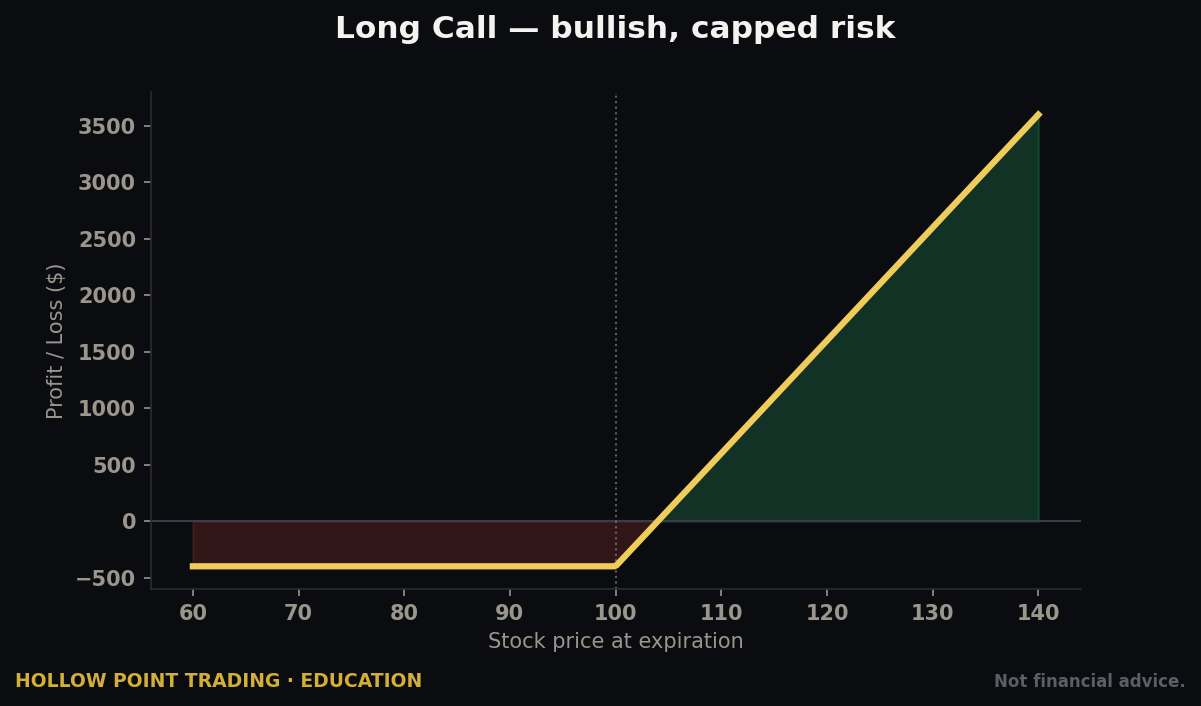
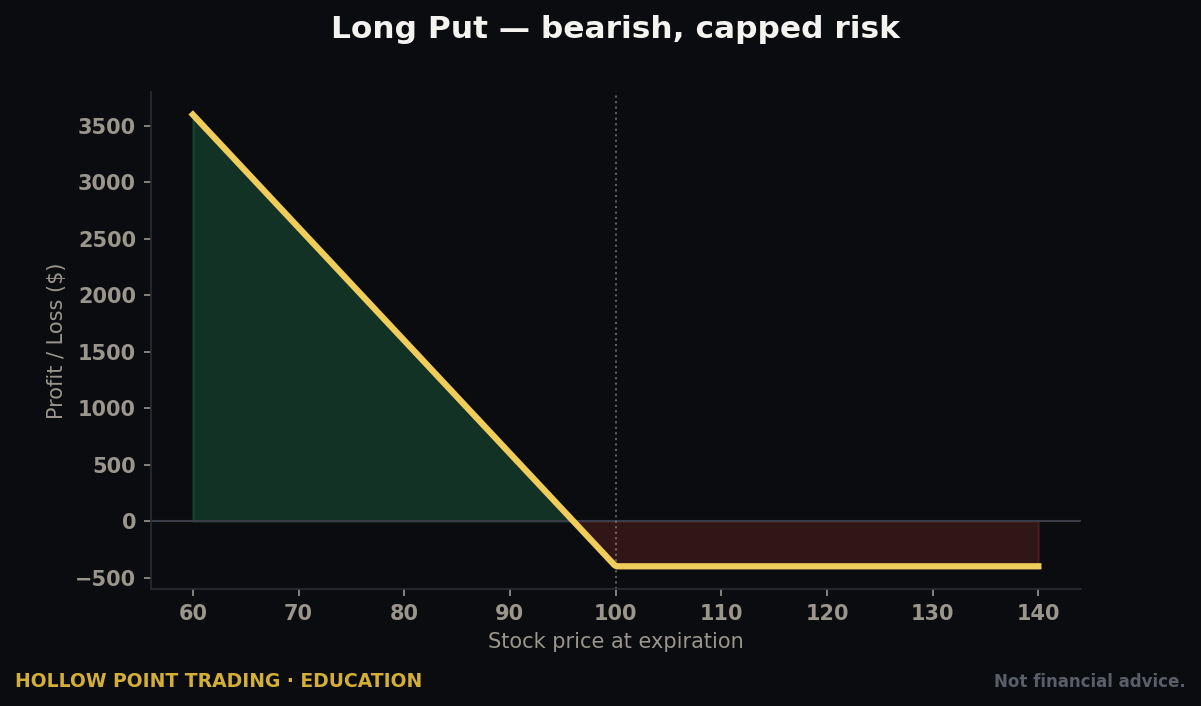
Imagine a graph. The bottom (horizontal) axis is the stock price at expiration. The side (vertical) axis is your profit or loss. For a bought put, the line looks like a hockey stick lying down and pointing left:
- Far right (stock high): a flat line sitting at −$300. No matter how high the stock goes — $108, $120, $200 — you lose the same $300 and never more. The flatness is your safety.
- The bend at $100 (your strike): the line starts angling upward as the stock falls below the strike.
- The breakeven at $97: the line crosses zero. This is where profit begins.
- Far left (stock low): the line keeps climbing. The lower the stock goes, the more you make. The theoretical maximum happens if the stock goes to $0 — then your put is worth the full $100 strike × 100 = $10,000, minus your $300 cost.
Two takeaways from the shape:
- Your loss is flat and capped (that right-side plateau). This is why buying puts is beginner-friendly. You can't be surprised by the downside.
- Your profit grows as the stock falls, all the way down to zero. Big room to the upside of your bet.
Compare this to the other, riskier way people bet against stocks — "short selling," where you borrow shares and sell them. With short selling, if the stock rises, your losses can grow without limit, because a stock can rise forever. A bought put has no such nightmare. Your worst case is always just the premium. For a beginner, that difference is everything.
Puts as Insurance: The Protective Put
Now the use that even careful, long-term investors reach for. Forget betting for a second. Let's talk about protecting something you already own.
Say you own 100 shares of Downing Corp, bought at $100, now worth $100 (so $10,000 of stock). You love the company long-term, you don't want to sell, but there's a scary event coming up — an earnings report, an election, a Fed meeting — and you're worried about a sudden drop.
You can buy a protective put: a put on the stock you already own. It works exactly like insurance on a car or a house.
- Your strike price is like the coverage level — the floor below which you're protected.
- Your premium is like the insurance payment you make.
- The expiration is how long the policy lasts.
Let's make it concrete. You buy 1 put, strike $95, one month out, for a premium of $2.00 ($200 total).
Now watch what this does. No matter how far Downing falls, you have the right to sell your shares at $95. Your shares can never effectively be worth less than $95 to you while the put is alive. You've built a floor.
If the stock crashes to $80:
- Your shares lost $20 each → −$2,000 on the stock. Ouch.
- But your put is now worth about $15 per share ($95 − $80) × 100 = +$1,500.
- Net damage: −$2,000 + $1,500 − $200 premium = −$700, instead of −$2,000.
The put softened a $2,000 blow down to $700. That's insurance doing its job. You capped your pain.
If the stock rises to $115 instead:
- Your shares gained $15 each → +$1,500.
- Your put expires worthless → you lose the $200 premium.
- Net: +$1,500 − $200 = +$1,300. You still profit nicely, minus the small cost of the "policy" you didn't end up needing.
And that's the trade-off with insurance: when nothing bad happens, you're a little poorer for having bought protection you didn't use. Just like car insurance in a year you don't crash. But when something bad does happen, you're deeply grateful you had it.
A protective put is how you hold a stock through a nerve-wracking period without lying awake at night. You define your worst case in advance. That's pure Hollow Point thinking: protect capital first.
The Beginner Mistakes to Avoid
Every new put buyer makes some of these. Read them now so you can skip the tuition.
1. Forgetting the ×100. An option quoted at "$4.50" costs $450 per contract, not $4.50. People buy "just five contracts" thinking they're spending $22.50 and get a $2,250 bill. Always multiply by 100. Always.
2. Buying too little time. A put expiring in three days is cheap for a reason — it needs the stock to move now. Time decay eats short-dated options alive. Beginners chronically buy too little time, watch the ice cube melt, and lose even when the stock drifts their way. Give your idea room: weeks, not days, when you're learning.
3. Being right on direction but still losing (the Ending C trap). As we saw, the stock has to move past your breakeven, not just wiggle in your favor. Before every trade, calculate breakeven (strike − premium) and ask honestly: "Do I really believe it'll get past that?"
4. Buying way out-of-the-money "lottery tickets." A cheap put far below the current price feels like a great deal — huge payout if it hits. But it almost never hits. Those cheap puts are cheap because they're unlikely. Stacking your account with lottery tickets is how beginners bleed out slowly. Cheap is not the same as good value.
5. Risking too much on one trade. Because puts can multiply your money, beginners get greedy and dump a big chunk of their account into one bet. Even with capped loss, losing 30% of your account on a single put is a disaster. Risk a small, fixed slice each time. Small enough that ten losses in a row wouldn't hurt you.
6. Not having an exit plan. Decide before you enter: at what profit will you sell? At what loss will you cut it? Write it down. The middle of a fast-moving trade is the worst time to invent a plan. Emotion will make the decision for you, and emotion is a terrible trader.
7. Confusing puts with calls. Under stress, people fat-finger the wrong one. Put = profit when down. Call = profit when up. Say it out loud before you click.
8. Holding to expiration out of hope. A losing put doesn't get better because you want it to. If your reason for the trade is gone, the trade is gone. Take the loss and keep your capital for the next setup. Discipline over prediction — every time.
Your Put-Buying Cheat-Sheet
Tape this near your screen. It's the whole guide compressed to what you'll actually reach for.
The one-line definition
A put = the right (not the obligation) to sell a stock at a set price by a set date. It gains value when the stock falls.
The two jobs a put does
- Bet on a decline — with loss capped at the premium.
- Insure shares you own — the protective put.
The must-know numbers
- 1 contract = 100 shares. Quoted price × 100 = real cost.
- Max loss (when buying) = the premium. Never more.
- Breakeven = strike − premium. Stock must close below this to profit at expiration.
Before you click "buy," ask:
- [ ] Do I actually expect this to fall, and fall enough?
- [ ] Where's my breakeven — and do I truly believe price gets past it?
- [ ] Did I give it enough time (weeks, not days)?
- [ ] Is the dollar cost (price × 100) small vs. my total account?
- [ ] What's my exit — the profit I'll take, the loss I'll cut?
- [ ] Am I sure this is a put, not a call?
Remember the shape: flat, capped loss to the right; growing profit as the stock falls to the left. Safe downside, roomy upside. That's why beginners buy puts rather than doing riskier things.
Remember the ice cube: time value melts every single day. Time is working against a put buyer. Don't dawdle, and don't overpay for hope.
How Puts Fit the Bigger Hollow Point Picture
Here's where we zoom out, because a tool means nothing without a framework to use it in.
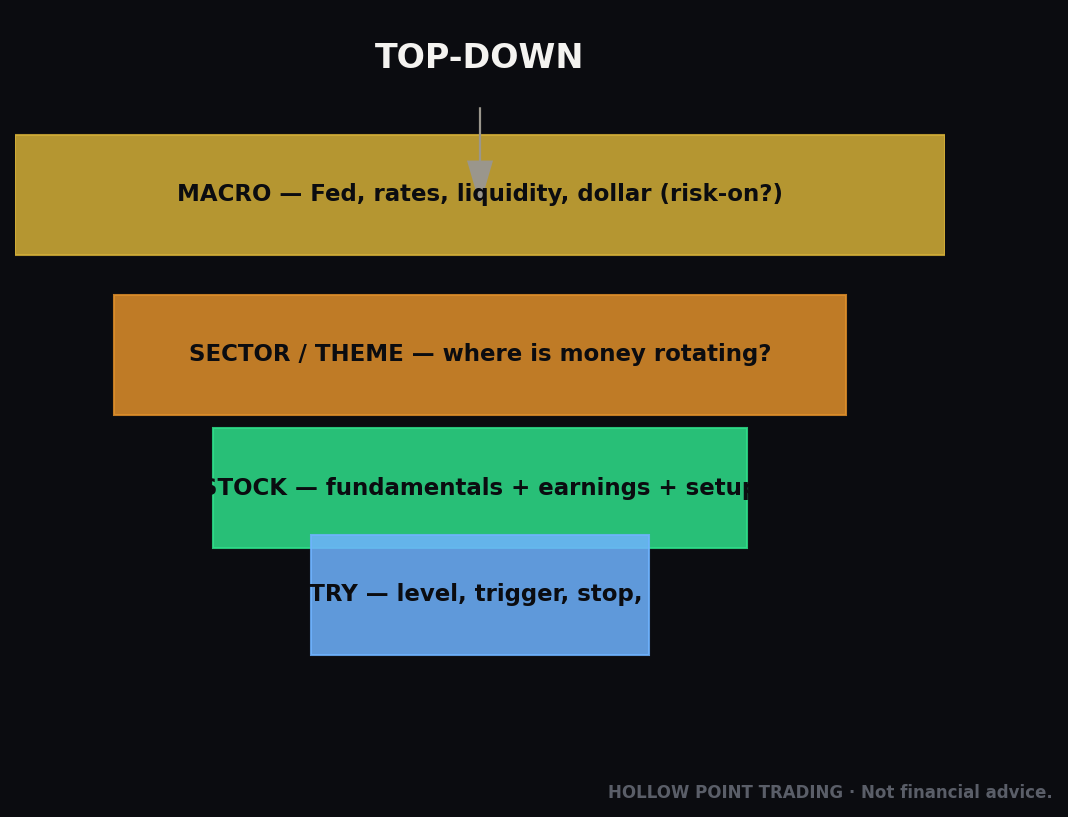
At Hollow Point Trading, we don't start with "what option should I buy?" We start much higher up and work down. The order is always macro → sector → stock:
- Macro — What's the overall market doing? Is the tide coming in or going out? Are interest rates, the economy, and broad sentiment supportive or scary?
- Sector — Within that tide, which groups of stocks are strong and which are weak? Is money flowing into tech and out of energy, or the reverse?
- Stock — Only then do we look at the individual name, and only the ones swimming with the current, not against it.
A put fits at the very bottom of that funnel. When your macro read says the market's rolling over, your sector read says a group is weak, and your stock read says a specific name is breaking down — that's when a put earns its place. The put isn't the idea. The put is the expression of an idea you built from the top down. Beginners get this backwards: they fall in love with an option first and hunt for a reason second. Do it the HPT way — reason first, tool second.
Two more principles anchor everything:
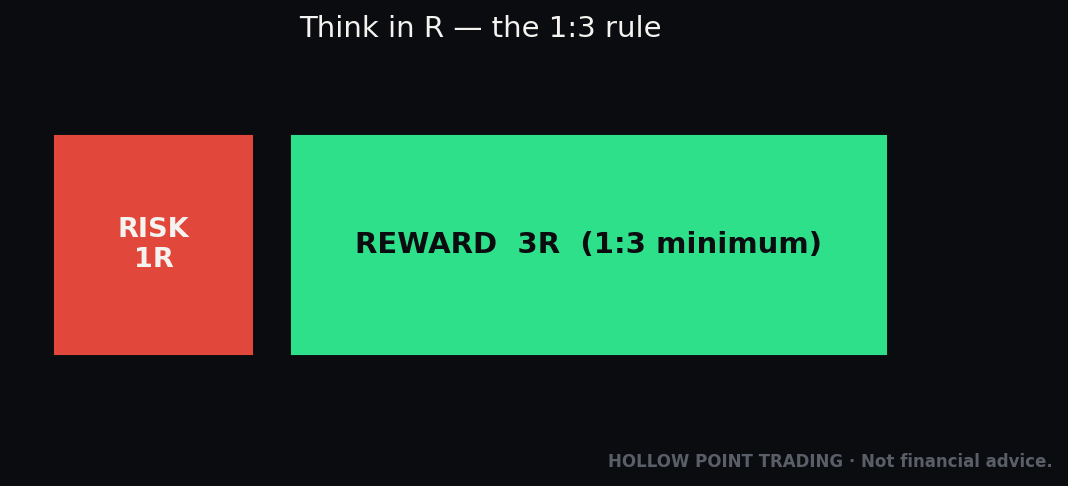
Reward-to-risk of at least 1:3. We want every trade to offer a potential reward at least three times the size of what we're risking. If a put trade risks $300, we want a realistic path to $900 or more. That single filter throws out most bad trades before they can hurt you. It means you can be wrong more often than right and still come out ahead — because your winners are big and your losers are small. Run the math before you enter; if the setup can't offer 1:3, pass on it. There's always another setup.
Discipline over prediction. Nobody knows the future — not us, not anyone. What separates traders who last from traders who blow up isn't better crystal balls; it's better rules, followed even when it's uncomfortable. A put's built-in capped loss is a gift to the disciplined: it forces you to define your risk up front. Honor that. Size small. Take your losses. Let the process, not the emotion, drive the car.
That's the ethos. A put is a scalpel, not a slot machine. In the hands of someone who works top-down, sizes small, demands 1:3, and follows their rules, it's one of the most elegant tools in the whole market — a way to profit from fear and to insure against it, all while knowing your worst case before you begin.
Start there. Paper-trade it first if your broker allows (that means practicing with fake money — do this, seriously). Buy your first real put small enough that the outcome doesn't matter emotionally. Let the lessons land. Then do it again, a little better.
You now understand puts better than most people who've been in the market for years. Go put it to work — carefully, patiently, by the rules.
Bound by rules, feared by trade.