
Most new traders spend ninety percent of their energy on the chart and zero percent on the account the chart lives inside. Then one Tuesday they go to buy the perfect setup and the platform throws a red error — insufficient buying power, this trade would flag your account, funds not yet settled — and the move leaves without them. The chart was right. The plumbing was wrong.
At Hollow Point Trading we teach top-down: macro to sector to stock to trigger. But there's a layer underneath all of that, one nobody markets to you because it isn't sexy — the mechanics of the broker itself. Cash versus margin. Reg-T buying power. Settlement timing. The Pattern Day Trader rule (which, as of 2026, is in the middle of being torn down — more on that below). Options approval tiers. Portfolio margin. These rules don't care about your thesis. They are the walls of the room you trade in, and if you don't know where the walls are, you'll run into them at the worst possible moment.
Here's the thing that separates the traders who last from the ones who blow up in their first year: the professionals treat account mechanics as a first-class part of the trade, not an afterthought. Before a hedge-fund desk puts on a position, someone has already answered the questions "what's our margin usage, what's our settlement exposure, what happens to our buying power if this gaps against us." The retail trader who ignores all of that isn't being bolder — they're just flying blind through the same machinery, hoping they don't hit a wall. This guide makes sure you can see the walls.
Read it once, and the red error messages stop being surprises. Better than that — you start using the plumbing on purpose, letting settlement rules and trade counters enforce the exact selectivity that good trading demands anyway.
The Concept: A Brokerage Account Is a Set of Permissions
Start here, because everything downstream flows from it. When you open a brokerage account, you are not just opening a bucket of money. You are opening a contract that grants you a specific set of permissions — what you can trade, how much you can trade, how fast you can recycle your capital, and what happens if a trade goes against you.
The single biggest mental shift for a new trader is to stop thinking of the account as a wallet and start thinking of it as a license with conditions. A wallet just holds money; you can do anything you want with what's inside. A license grants specific activities under specific rules, and doing something outside those rules gets the license suspended. Your brokerage account is the license. The "suspensions" are margin calls, PDT restrictions, good-faith violation lockouts, and options-level denials.
The three rule-makers who write your permissions
Those permissions are set by three overlapping rule-makers:
- The SEC (Securities and Exchange Commission) — the federal regulator that writes the big-picture law and approves or rejects the rule changes proposed by the self-regulatory bodies.
- FINRA (Financial Industry Regulatory Authority) — the self-regulatory body that writes the detailed rules brokers must follow, including the famous margin rule, Rule 4210.
- Your broker — who can, and routinely does, impose rules stricter than the regulators require. This last part trips people up constantly. When your broker won't let you do something the "rules" technically allow, it's usually the broker's own house policy, not the law.
That third layer is the one that catches even experienced traders. FINRA sets a 25% maintenance-margin floor, but your broker is free to require 35%. FINRA's PDT rule is built around a $25,000 threshold, but some brokers historically required $25,000 plus a buffer before they'd let you resume day trading. There is no such thing as "what the rules allow" in the abstract — there is only what your broker allows, which is the intersection of federal law, FINRA rules, and house policy, always taking the strictest of the three.
The two questions that solve 80% of the confusion
Two federal frameworks set the outer boundary of all margin activity:
- Regulation T ("Reg-T") — the Federal Reserve rule governing how much credit a broker can extend you to buy securities. This is where "50% margin" comes from.
- The settlement cycle — how long the actual transfer of cash and shares takes to finalize after you click buy or sell.
Everything in this guide is a specific application of those two ideas: how much can I borrow, and how fast does my money become real again. Get those two questions answered for your account and you've solved 80% of the confusion. The margin call, the buying-power number, the day-trade counter, the good-faith violation — every one of them is a downstream consequence of "how much credit" and "how fast settlement." Keep those two anchors in mind as you read and nothing here will feel arbitrary.
The Mechanism, Part 1: Cash Accounts vs. Margin Accounts
There are two fundamental account types for trading securities. Choosing between them is the single most consequential setup decision you'll make, and most people click through it without understanding the trade-off. It is worth understanding deeply, because the choice quietly determines which entire categories of problem can ever happen to you.
The cash account
A cash account is exactly what it sounds like: you can only buy with money you actually have and that has settled. No borrowing. If you have $5,000 in settled cash, you can buy $5,000 of stock — not a dollar more. When you sell, you must wait for the proceeds to settle before you can reuse them without restriction (that's the T+1 rule, covered below).
The upside of a cash account is that it is immune to two whole categories of danger: you cannot be issued a margin call, and you cannot lose more than you put in, because you never borrowed anything. The Pattern Day Trader rule — the $25,000 gorilla — also does not apply to cash accounts, because PDT is a margin rule. For a small, disciplined account, a cash account is a legitimately underrated choice.
There's a psychological dimension people underrate here. In a cash account, the worst thing that can happen on any single trade is that the position goes to zero and you lose what you put into it. There is no overnight gap that turns into a debt you owe the broker. There is no forced-liquidation phone call. For a trader who is still learning to manage emotions — which is most of the first two years — removing the catastrophic tail is worth more than the leverage they're giving up. You cannot be blown into a negative balance by a cash account. That single fact has kept more small traders in the game than any indicator.
The downside: your capital moves in slow motion. Sell today, and depending on the security your cash isn't fully free again until tomorrow. Trade actively in a cash account and you'll constantly bump into settlement rules and their violations (good-faith and free-riding, coming up). A cash account also cannot short stock — shorting requires borrowing shares, which is a margin activity — so an entire direction of trading is closed to you.
The margin account
A margin account lets the broker lend you money against the value of the securities you hold. Two things happen the moment you enable margin:
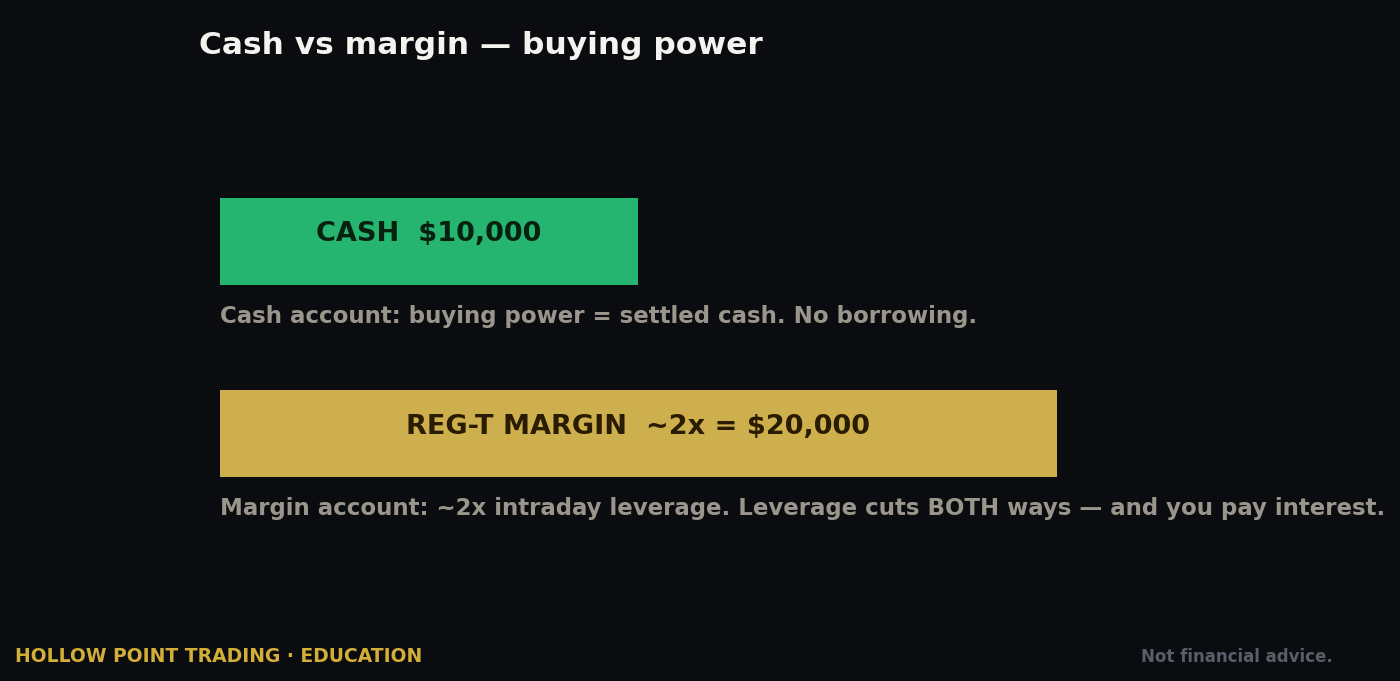
- You get leverage and speed. Under Reg-T, the broker can extend credit so that you only put up 50% of the price of a marginable stock — meaning $5,000 of cash can control roughly $10,000 of stock. Just as importantly, margin accounts let you trade with unsettled proceeds, so your capital effectively recycles instantly. You sell, you re-buy, no waiting. You can also short, which opens the other half of the market to you.
- You accept risk and rules. You now pay interest on borrowed money — and margin interest is not trivial; in a higher-rate environment it can run 8–13% annualized, charged daily on the borrowed balance. You can receive a margin call — a demand to add cash or close positions when your equity drops too low. And you become subject to the day-trading margin rules, historically including PDT.
Here is the mental model: a cash account is a debit card — you spend what you have. A margin account is a secured credit line — you spend the broker's money against your collateral, and they can call the loan. And like any secured credit line, the lender's protections come first. When the collateral drops in value, the lender doesn't wait politely; they demand more collateral or they sell yours. The order of operations always favors the broker, because it's the broker's money at risk once you've borrowed.
A subtle point most guides skip: enabling margin does not force you to use it. You can hold a margin account and never borrow a dollar — trading only your own settled and unsettled cash. Many disciplined traders do exactly this: they want the speed of a margin account (no settlement violations, instant recycling of proceeds, the ability to short) without the leverage. If you never buy more than your actual cash balance, you'll never pay margin interest and you'll never face a margin call, even inside a margin account. The margin account gives you the option to borrow; it doesn't compel it.
The Mechanism, Part 2: Reg-T, Margin & Buying Power
"Buying power" is the number that actually governs what you can click. Understanding how it's calculated ends the mystery of the insufficient buying power error — and, more importantly, stops you from confusing the broker's leverage with your own money.
Initial margin (Reg-T, 50%)
Under Regulation T, when you buy a marginable stock on margin, you must put up at least 50% of the purchase price; the broker can lend the other 50%. So a fully margined account has, at the start of the day, roughly 2x the buying power of its cash.
$10,000 of cash → up to $20,000 of overnight stock buying power.
That 2x is overnight (Reg-T) buying power. Day-trading buying power is historically larger (up to 4x for PDT-designated accounts), which is exactly why the day-trading rules exist — the leverage is bigger, so the guardrails are tighter. Note also that not every security is marginable at 50%. Low-priced stocks (often under $3–5), recent IPOs, highly volatile names, and leveraged ETFs frequently carry higher initial requirements set by the broker — sometimes 75% or 100%, meaning no leverage at all on that specific ticker. The "2x" is a default for liquid, established stocks, not a universal law.
Maintenance margin (25% floor)
Once you hold a position, FINRA requires you keep at least 25% of its market value as equity (brokers often set this house minimum at 30–40%). This is the maintenance margin. If the stock falls and your equity slips below the maintenance line, you get a margin call: add cash or the broker liquidates positions — often at the worst possible moment, without asking you which one to sell.
The gap between the 50% you put up initially and the 25% you must maintain is your cushion. That cushion is what a losing trade eats through before the broker steps in. Understanding exactly how fast leverage burns through that cushion is the difference between exiting on your own terms and getting a forced-liquidation notice.
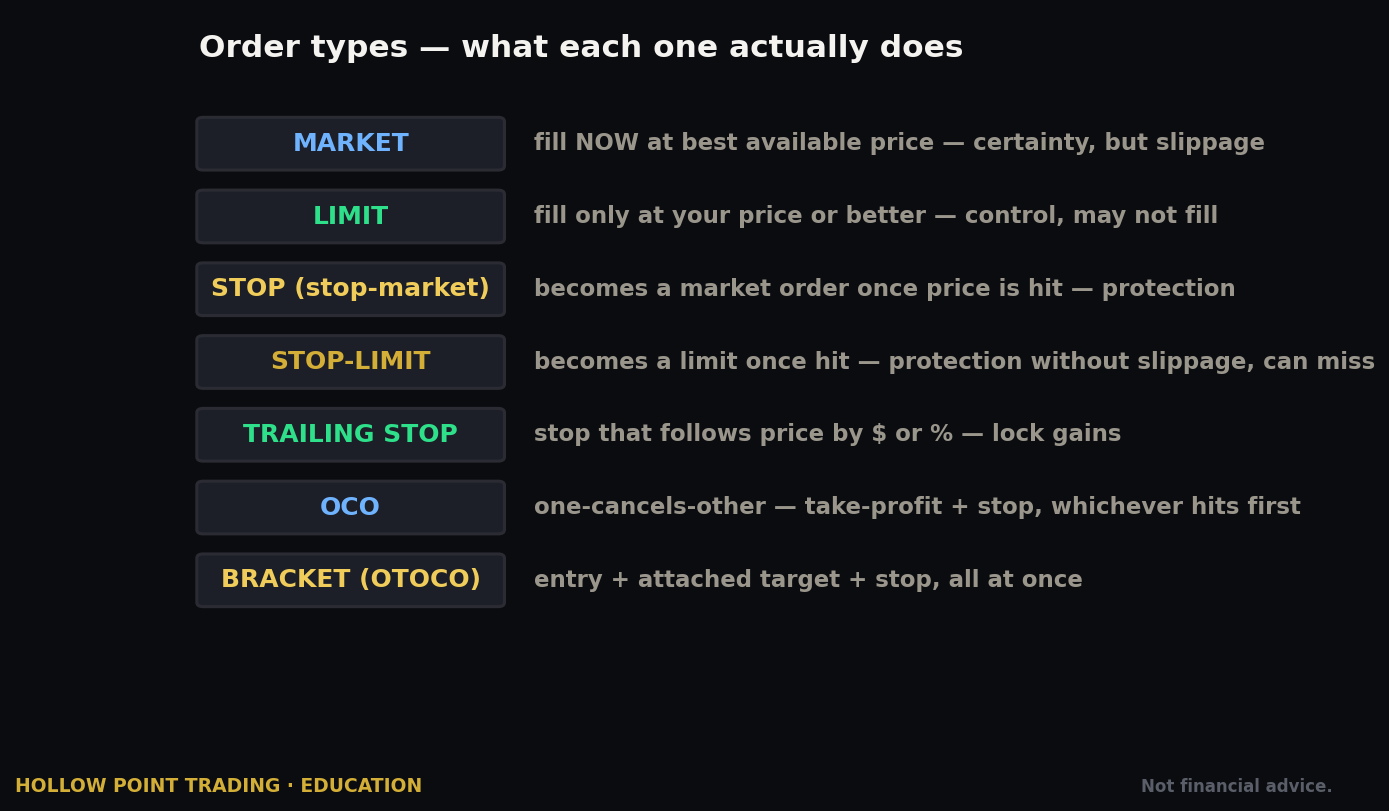
Worked example — how a margin call is born
You deposit $10,000. You use full Reg-T leverage to buy $20,000 of a stock (200 shares at $100). You borrowed $10,000 from the broker.
- The stock drops to $70. Position value = $14,000.
- You still owe the broker $10,000. Your equity = $14,000 − $10,000 = $4,000.
- Maintenance requirement at 25% = 25% × $14,000 = $3,500. You're above it — barely.
- The stock drops to $65. Position = $13,000, equity = $3,000, requirement = $3,250. You're now below. Margin call. Add cash or the broker sells.
Notice what leverage did: the stock fell 35%, but your equity fell 70%. Leverage cuts both ways, and the maintenance line is the trapdoor.
Working the same example backwards — finding your margin-call price before you enter
The professional move is to compute the margin-call price before you click buy, not to discover it in a notification. Here's the formula for a fully-margined long:
Margin-call price = (loan amount) ÷ (shares × (1 − maintenance %))
Using the numbers above: loan = $10,000, shares = 200, maintenance = 25%.
Margin-call price = $10,000 ÷ (200 × 0.75) = $10,000 ÷ 150 = $66.67.
So the instant you put that trade on, you already know: if this stock touches $66.67, I'm getting a call. Now compare that to where your chart says the trade is wrong. If your technical stop is at $72 — above $66.67 — you're fine; you'll exit on your own signal long before the broker acts. But if your technical stop is at $60 — below $66.67 — you have a problem: the broker will liquidate you at $66.67 before your thesis is even invalidated. That's a position that's sized wrong for the account, and you'd know it before entering. This is the arithmetic reason HPT insists on 1:3 R/R and predefined stops — you close on your terms, before the broker closes for you.
The house-requirement wrinkle
Rerun the same example with a broker maintenance requirement of 35% instead of 25%:
Margin-call price = $10,000 ÷ (200 × 0.65) = $10,000 ÷ 130 = $76.92.
The stricter house rule moves your liquidation point from $66.67 all the way up to $76.92 — the stock only has to fall about 23% now, not 33%, to get you called. This is exactly why "read your own margin agreement" is not boilerplate advice. Two traders in identical positions at two different brokers have their trapdoors in completely different places. Know which one is yours.
The Mechanism, Part 3: Settlement, T+1, and the Cash-Account Violations
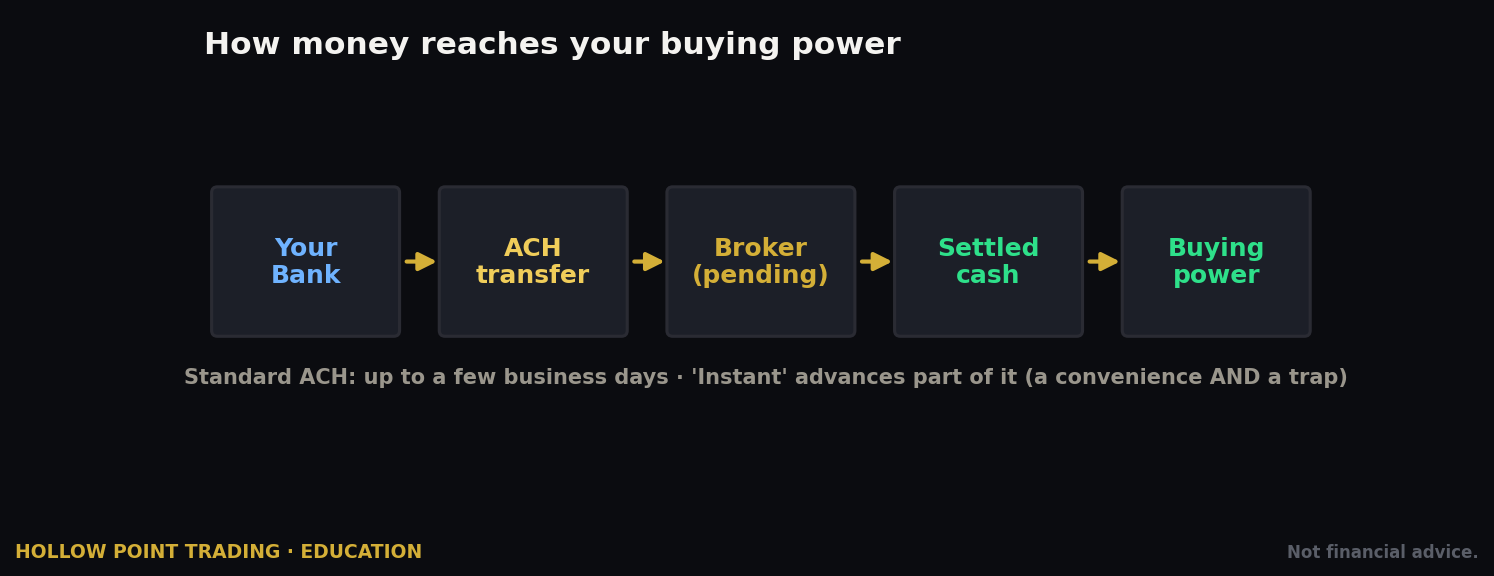
When you buy or sell, the trade doesn't finalize instantly. Settlement is the moment cash and shares actually change hands in the back-office plumbing. As of May 28, 2024, U.S. equities and ETFs settle at T+1 — trade date plus one business day. (Options also settle T+1.) Buy a stock Monday, it settles Tuesday. Sell it Monday, your cash is fully settled and free Tuesday.
An important detail: T+1 counts business days, not calendar days, and it respects market holidays. Sell on a Friday and your proceeds don't settle until Monday (the next business day), not Saturday. Sell on the Thursday before a Friday market holiday and settlement slides to the following Monday. Active cash-account traders who don't track the business-day calendar walk straight into violations around long weekends, because the money they think is free hasn't caught up yet.
This settlement math matters only in a cash account, because a margin account lets you trade with unsettled funds freely. In a cash account, using money before it settles creates two specific violations.
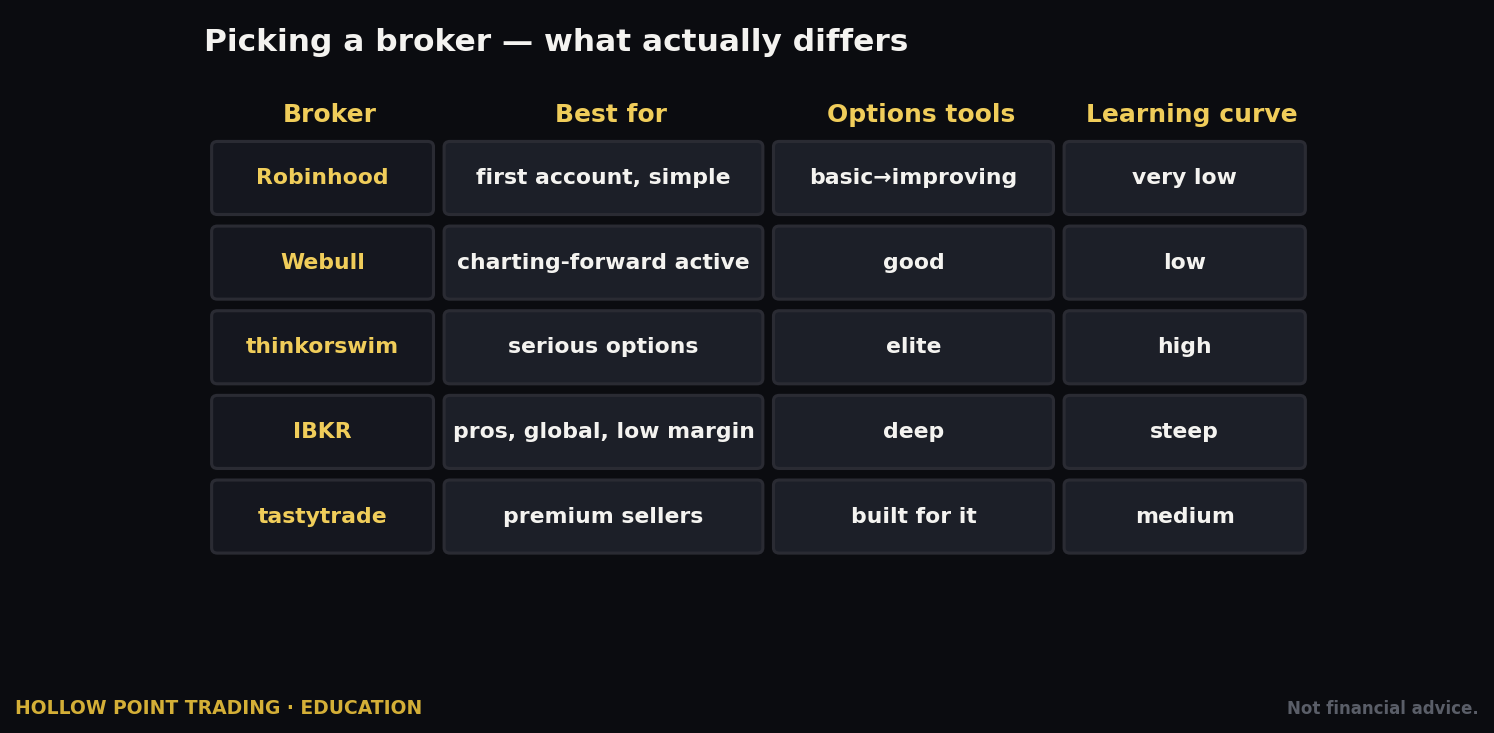
Good-faith violation (GFV)
A good-faith violation happens when you buy a security with unsettled proceeds and then sell that new position before the funds you used had settled.
Worked example, cash account, $0 settled cash to start:
- Monday: You sell Stock A for $5,000. Those proceeds won't settle until Tuesday (T+1).
- Monday, later: You use that same $5,000 of unsettled cash to buy Stock B.
- Monday, even later (or before Tuesday's settlement): You sell Stock B for a profit.
You just committed a GFV — you sold B "in good faith" that A's cash had settled, but it hadn't. The fix: if you buy with unsettled proceeds, hold the new position until the original sale settles before you sell it. Rack up three GFVs in a rolling 12 months and most brokers restrict you to settled-cash-only trading for 90 days. There's no fine — the penalty is a handcuff on your account.
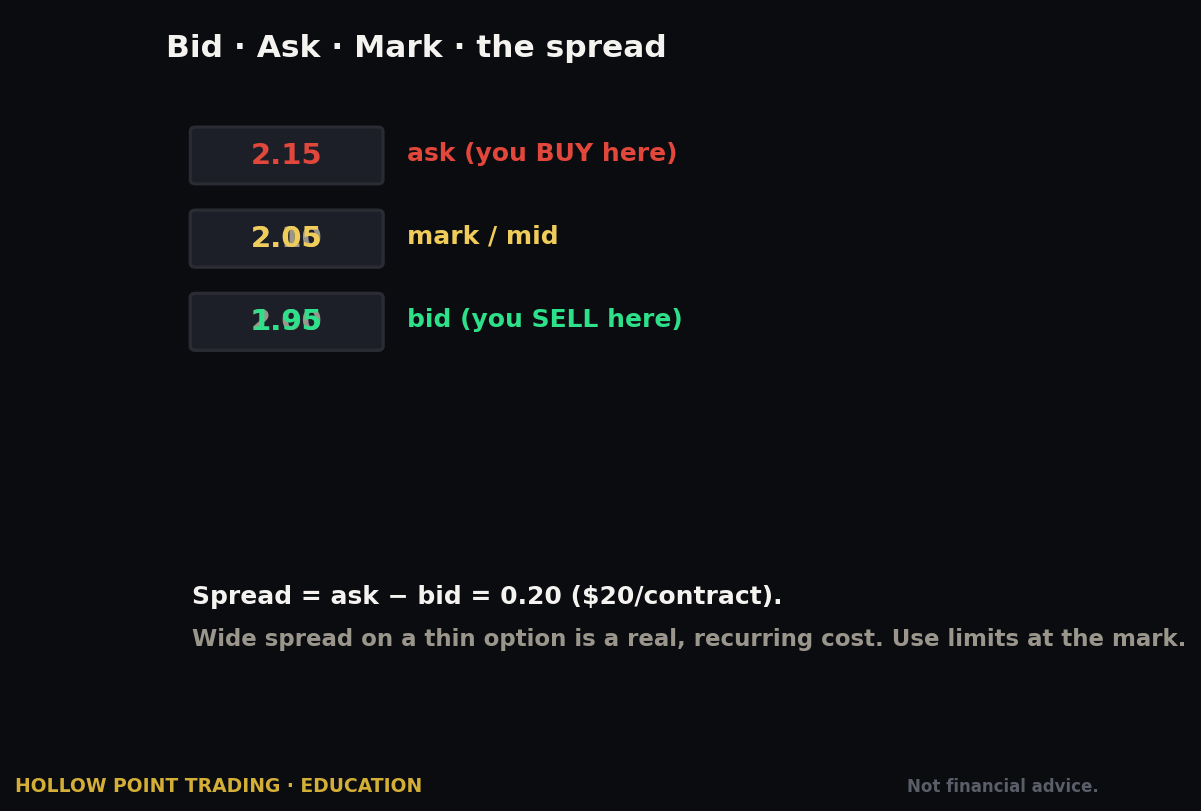
A cleaner way to think about GFV: the "settled bucket" model
The trap in the example above is that the account showed $5,000 of "available funds" on Monday, so it felt fine to trade. The number lied — it was available to buy but not yet settled to sell out of quickly. The mental fix is to picture two buckets:
- The settled bucket — cash whose prior trades have fully cleared. Money here can be used to buy something you then sell the same day, no restriction.
- The unsettled bucket — proceeds from a sale that hasn't reached T+1 yet. You can spend this to buy, but whatever you buy with it must be held until the underlying cash settles.
A GFV is nothing more than selling a position that was funded from the unsettled bucket before that bucket cleared. If you only ever "day trade" out of the settled bucket, you can never trigger a GFV, no matter how fast you trade. The discipline, then, is to always know which bucket funded the position you're about to sell.
Free-riding violation
Free-riding is worse. It's buying a security and then selling it to pay for the original purchase — i.e., you never actually had the money. Buy $5,000 of stock in a cash account with $0 available, then sell it to cover the buy. That's a free-ride, and it triggers a hard 90-day settled-cash-only restriction on the first offense under Reg-T (specifically Regulation T, Section 220.8, the cash-account provision). The rule exists to stop people from trading on money they don't possess — essentially taking a free intraday loan the broker never agreed to extend.
The difference between GFV and free-riding in one line: a GFV reuses unsettled proceeds from a real prior sale too early; free-riding buys with money that was never there at all and relies on selling the new position to fund itself. GFV is a timing foul; free-riding is buying on credit you don't have.
The clean way to never see either violation: in a cash account, trade only with fully settled cash. Slower, but bulletproof. If that cadence is too slow for how you want to trade, that's not a signal to bend the rules — it's a signal that you want a margin account, where neither violation can occur.
The Big One: The Pattern Day Trader Rule — and Its 2026 Demolition
This is the rule that has confused, frustrated, and gated small traders for over two decades — and it is being dismantled right now, in 2026. You need to understand both the old rule and the new framework, because during the transition many brokers are still enforcing the old one.
The old PDT rule (2001–2026)
Under the historical FINRA Rule 4210:
- A day trade = buying and selling (or shorting and covering) the same security on the same day. Note the pairing: it's the round trip that counts. Buying 100 shares in the morning and selling them in the afternoon is one day trade. Buying 300 shares in three separate lots and selling all 300 at once can still be one day trade in the same security.
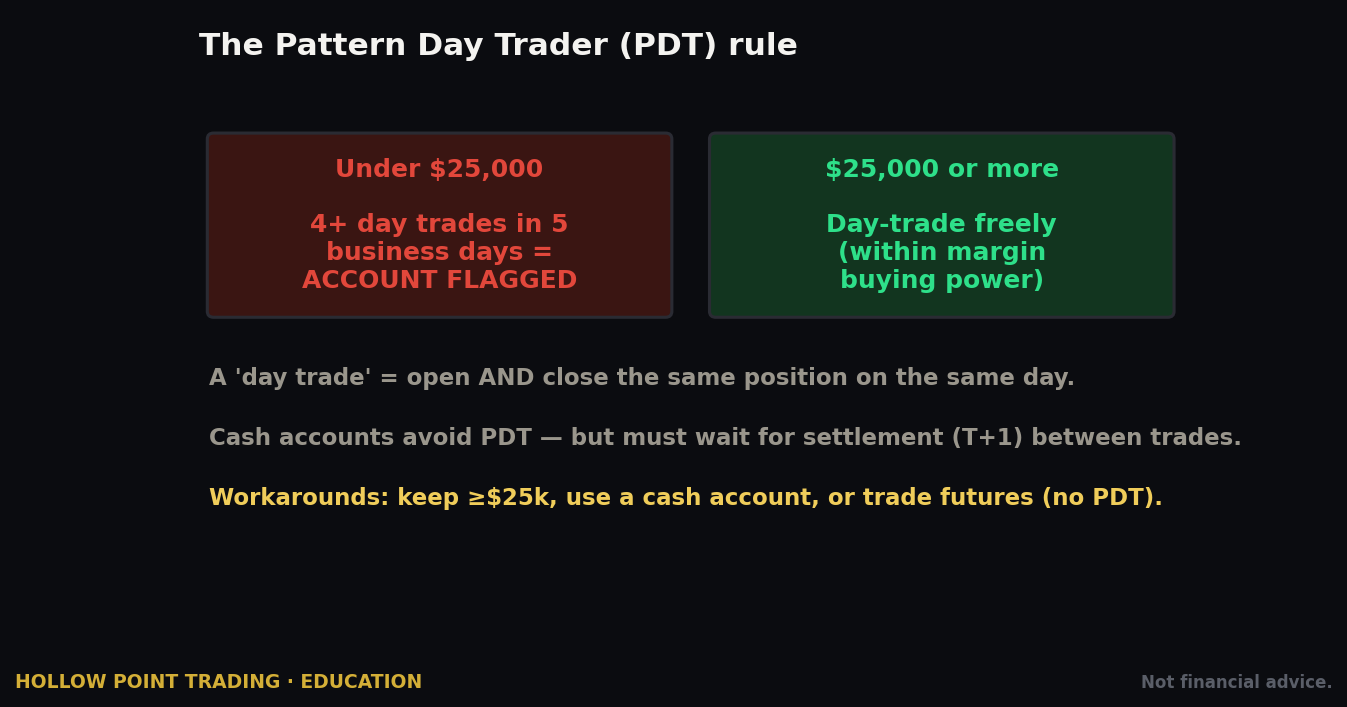
- If you executed 4 or more day trades within any rolling 5 business days in a margin account, and those trades were more than 6% of your total activity in that window, you were flagged a Pattern Day Trader.
- Once flagged, you were required to maintain $25,000 in equity in that account at all times. Drop below $25k and you were locked out of day trading until you topped it back up.
- Break the rule without the equity and you'd get an equity call and typically a 90-day restriction to closing trades only.
Crucially, this only ever applied to margin accounts. Cash accounts were never subject to PDT — which is why the classic workaround for small accounts was simply trade in a cash account and respect T+1 settlement.
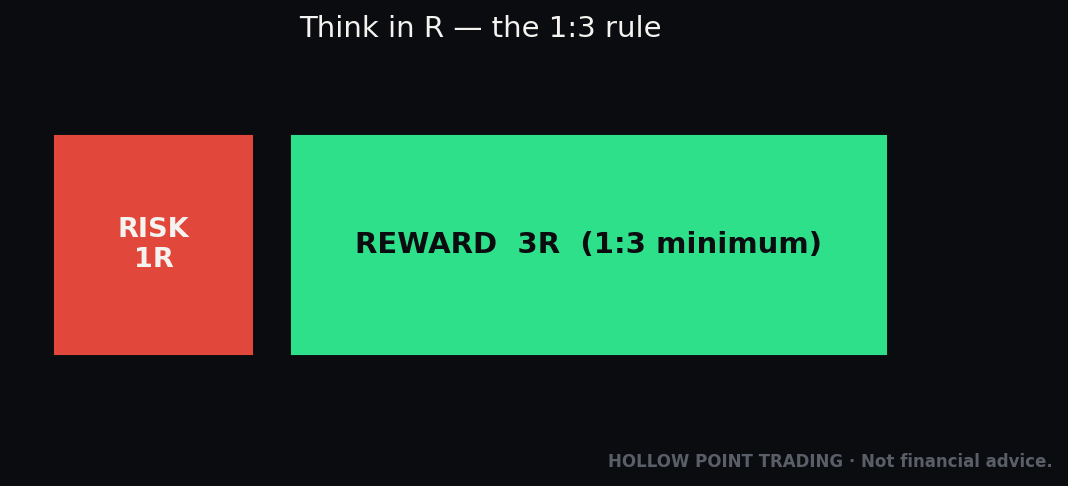
How traders legitimately traded around the old rule
Because so many people are still living under broker enforcement of the old rule during the phase-in, here are the legitimate workarounds, none of which involve breaking anything:
- Use a cash account. No PDT, ever. The only cost is settlement — you cycle the same dollars only as fast as T+1 allows. Fund it with enough cash that you always have settled money to deploy, and you can effectively day trade around the settlement calendar. A trader who splits capital into thirds and rotates through the settled bucket can take a trade essentially every day without ever touching PDT or a GFV.
- Count your day trades. You get 3 in any rolling 5 business days on a sub-$25k margin account. Treat them as scarce ammunition — spend them only on A+ setups. This is pure HPT discipline: fewer, better trades. Keep a literal tally; the "rolling 5 business days" window is easy to miscount because a trade you made last Wednesday only frees up this Wednesday.
- Swing instead of scalp. Enter one day, exit the next — it's not a day trade at all. Not a workaround so much as a different (often better) style for a small account. A held-overnight position sidesteps the entire PDT machinery.
- Two brokers. Some traders split accounts to get 3 day trades at each. Legal, but it fragments your risk management — know your total exposure across both, because the market doesn't care that your risk is spread across two logins.
- Trade instruments PDT doesn't touch the same way — futures and spot forex live under different regulators (the CFTC/NFA), not FINRA's PDT rule. A single NQ or MES futures contract can be day-traded freely regardless of account size. Different leverage, different risks, different tax treatment; not a free lunch, but a genuinely separate rulebook.
The 2026 change — what actually happened
On April 14, 2026, the SEC approved FINRA's proposal to eliminate the $25,000 minimum-equity requirement and the entire "Pattern Day Trader" designation. The amendments to Rule 4210 became effective June 4, 2026.
The four-day-trades-in-five threshold is gone. The $25k floor is gone. In their place is a modernized, risk-based intraday margin standard: instead of a blunt count of trades and a fixed dollar wall, firms must monitor your actual intraday market exposure and margin deficiency throughout the day. In plain English — you can now day trade as much as your account's real risk supports, sized to what you're actually holding at any moment, not to an arbitrary trade counter.
This is a genuinely more rational system. The old rule punished a trader for the number of times they clicked rather than the risk they were carrying. A cautious trader making four tiny scalps got flagged; a reckless trader holding one enormous leveraged position overnight didn't. The new standard tracks the thing that actually matters — how much market exposure your account carries intraday relative to the equity backing it.
The critical practical caveat: brokers were given an 18-month phase-in period, ending October 20, 2027, to build the new intraday-margin systems. So as of this writing (August 2026), many brokers still enforce the old $25k PDT rule while they upgrade. The rule is legally dead; its enforcement is dying at each broker's own pace.
What to do about it: call your broker — or check their PDT/margin help page — and ask one question: "Have you implemented the new Rule 4210 intraday margin standard, or are you still enforcing the $25,000 PDT requirement during the phase-in?" The answer tells you exactly which world your account lives in today. Do not assume the $25k gate is gone for you until your broker confirms it. And don't assume that "no more PDT" means "no more limits" — the new intraday-margin standard can still stop a click if your real-time exposure outruns your equity. The wall moved and changed shape; it didn't disappear.
Options Approval Levels: The Permission Tiers
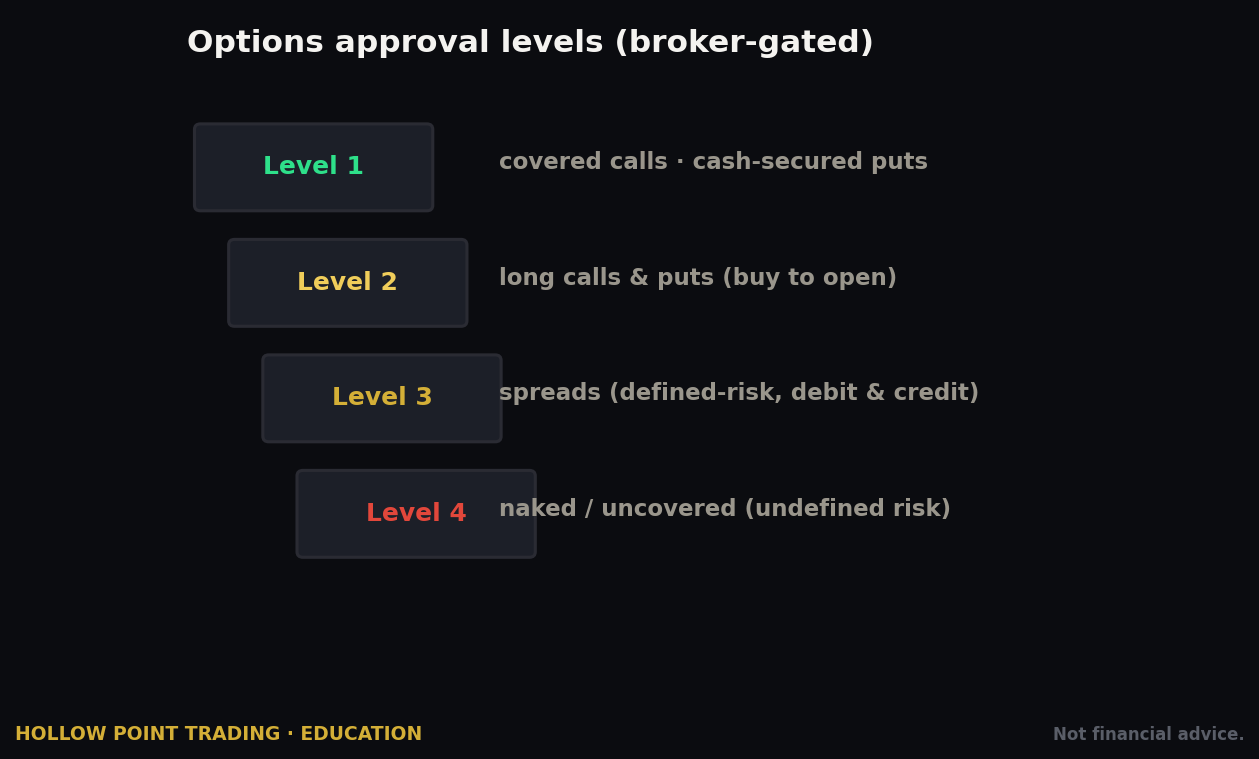
If you want to trade options, your broker gates you into approval levels (sometimes called tiers) based on your experience, income, net worth, and stated objectives on the options application. Higher levels unlock more powerful — and more dangerous — strategies. The exact naming varies by broker, but the ladder is standard:
- Level 1 — the most conservative. Covered calls (selling calls against stock you own) and cash-secured puts (selling puts with cash set aside to buy the shares). Both are "covered," so risk is defined. Often available in a cash account.
- Level 2 — adds long options: buying calls and buying puts outright. Your max loss is the premium paid — defined risk — which is why it's an early tier. This is where most directional retail traders live.
- Level 3 — unlocks spreads: verticals, calendars, iron condors, and other multi-leg defined-risk structures. Because a spread's short leg needs collateral, Level 3 typically requires a margin account.
- Level 4 — the top for most brokers: naked/uncovered option writing — selling calls or puts without an offsetting position. Theoretically unlimited risk on naked calls. Requires substantial margin and the broker's highest scrutiny.
Why the levels are ordered the way they are
The ladder isn't arbitrary; it's sorted by maximum loss shape. Level 1's strategies can't lose more than the stock position or cash already committed. Level 2's long options can lose 100% of a small premium but not a penny more, and never leave you owing money — that bounded downside is exactly why a beginner can be trusted with it early. Level 3 spreads have a defined max loss (the strike width minus the credit), but because they involve a short leg, the broker has to hold collateral and there's assignment risk to manage, so it sits higher. Level 4 is where loss becomes unbounded — a naked call has, in theory, no ceiling on how much it can cost you if the stock rockets. The broker's scrutiny rises in lockstep with how far your maximum loss can run.
A worked example of why the tier must exist first
Say you want to sell a bull put spread on a stock at $100: sell the $95 put, buy the $90 put, for a net credit of $1.50 (i.e., $150 on one contract). Your defined max loss is the $5 width minus the $1.50 credit = $3.50, or $350 per contract. That's a clean, defined-risk income trade — but it requires Level 3 and a margin account, because the broker must hold collateral against the short $95 put. If you only have Level 2 approval when the setup appears, you cannot place it. Not "it's harder" — the order ticket is rejected. The permission to run the strategy has to exist in your account before the chart gives you the trigger.
The practical lesson: your strategy is only as available as your approval level. A trader who plans to run put spreads for income needs Level 3 before the setup appears, not the morning of. Apply for the level your actual plan requires, and be honest on the application — but understand that approval is the broker's gate, and they can decline or downgrade you. Approvals can also take a day or more to process, and some brokers require you to hold a level for a period before upgrading further. Plan the permission the way you'd plan the trade.
Portfolio Margin: The Big-Account Upgrade
Standard Reg-T margin is a rules-based system — fixed 50% initial, 25% maintenance, applied position by position. Portfolio margin (PM) is a risk-based system: instead of applying a flat percentage to each position, it stress-tests your entire portfolio against a range of hypothetical market moves and sets your margin requirement to the worst-case loss the whole book would suffer.
The mechanic under the hood is worth picturing. PM typically shocks your positions across a band of price moves — commonly around ±15% for individual equities, tighter for broad indices — and revalues the entire book at each point. The largest loss the portfolio would take across that whole grid becomes your margin requirement. So margin stops being "the sum of each position's cost" and becomes "the most this collection of positions could plausibly lose together."
For a well-hedged portfolio, this is dramatically more capital-efficient. A position that offsets another (a hedge) reduces your total risk, so PM charges you far less margin than Reg-T's position-by-position math would. Traders running complex, hedged options books can see buying power multiply several times over versus Reg-T. If you're long 100 shares of a stock and also hold a protective put, Reg-T charges you as if those are two separate positions; PM sees that the put cancels much of the stock's downside and charges you for the small residual risk that actually remains.
The double edge of risk-based margining
That same intelligence cuts the other way, and it's the part that hurts people. Because PM sizes your requirement to worst-case portfolio loss, a concentrated or correlated book gets charged more, and — worse — your requirement can change intraday as volatility rises. In a calm market, a PM account might extend 6x buying power on a hedged book. In a volatility spike, the stress-test parameters widen, the worst-case loss grows, and your requirement can balloon in hours — generating a fast, large margin call precisely when the market is disorderly and fills are terrible. Reg-T's dumb, fixed percentages are at least predictable; PM's smart, dynamic requirements can move against you exactly when you can least afford it.
The trade-offs:
- High bar to entry. PM generally requires $100,000+ in account equity (some brokers set it higher, and FINRA's baseline for PM eligibility has historically sat at $100,000 or $125,000 depending on the firm), the top options approval level, and demonstrated experience (often three years).
- Real risk. More leverage means a disorderly, correlated market move can generate a large, fast margin call. PM rewards genuine hedging and punishes concentrated, naked directional bets.
Portfolio margin is not a beginner tool and it isn't a "more buying power" cheat code — it's a professional-grade risk framework that assumes you already manage risk like a professional. The traders who thrive on PM are the ones who were already running hedged, diversified books under Reg-T and simply wanted the capital efficiency their existing discipline had earned. The traders PM destroys are the ones who saw "6x buying power" and heard "6x position size."
Broker Mechanics Across Market Regimes
Here's what almost no beginner guide tells you: the plumbing behaves differently depending on the market's mood. The same account with the same rules feels loose and generous in one regime and tight and hostile in another. Recognizing the regime is part of managing the machinery.
Quiet trending markets
In a calm, orderly uptrend, everything about the plumbing feels frictionless. Maintenance margin is a distant number because your positions are drifting up, not down. Portfolio-margin requirements sit at their tightest (lowest) because implied volatility is low, so the stress-test shocks are small. Buying power feels abundant. This is precisely the regime that lulls leveraged traders into oversizing — the machinery gives no warning signs, so they creep their size up, and then the regime changes.
Choppy, range-bound markets
In chop, the settlement calendar becomes your main antagonist, not margin. Cash-account traders rotating in and out of a range burn through GFV risk fast because they're selling quickly and reusing proceeds. The discipline here is to slow down and respect the settled bucket. Day-trade counters (under old-rule enforcement) also bite hardest in chop, because chop tempts you into many marginal round-trips — exactly the trades the 3-in-5 limit is designed to starve. In a range, the plumbing's scarcity is doing you a favor.
High-volatility / crash regimes
This is where the machinery turns genuinely dangerous. In a volatility spike: maintenance-margin lines get hit as positions gap down; brokers frequently raise house margin requirements on volatile names intraday, moving your trapdoor up without warning; portfolio-margin stress parameters widen, inflating requirements; and forced liquidations happen at the worst fills because everyone is being liquidated at once. A leveraged trader can go from comfortable to margin-called in a single session — not because they did anything new, but because the regime changed the rules of the room around them. The professional response is to carry less leverage into high-vol regimes precisely because the plumbing gets stricter exactly when the tape gets wild. The two tighten together.
Broker Mechanics Across Timeframes
The account rules interact with your holding period in ways that reward matching your style to your account type.
- Scalpers and intraday traders live and die by the day-trade counter (old rule) or the intraday-margin standard (new rule), and by settlement in a cash account. Their entire edge is in recycling capital fast, which is exactly what the plumbing constrains. For this style, a properly configured margin account (or futures) removes the most friction.
- Swing traders (holding days to weeks) largely sidestep PDT entirely — an overnight hold isn't a day trade — but they take on overnight risk, which is where maintenance margin and gap risk matter most. A gap-down on an earnings miss can vault a swing position through its margin line before you can react at the open.
- Position traders and investors (weeks to months) care least about day-trade rules and most about margin interest — carrying a leveraged position for months means paying that 8–13% annualized drag the whole time, which quietly eats returns. For long holds, unleveraged or lightly leveraged is usually correct, and the "cost of the room" is measured in interest, not trade counts.
The lesson: pick the account configuration that matches your dominant timeframe. A scalper in a cash account fights settlement all day; a long-term investor paying margin interest bleeds carry. Match the machinery to the holding period.
Confluence: How Broker Mechanics Combines With Your Other Tools
At HPT nothing is used in isolation — every tool is weighted against the others for confluence. Broker mechanics is the base layer that the technical tools sit on top of. Here's how it interlocks with three of them.
Confluence with your stop / R-multiple framework
Your technical stop and your margin-call price are two different exit triggers, and they must be reconciled before you enter. We computed a margin-call price of $66.67 in the earlier example. Suppose your chart-based stop — say, below a swing low or the 55-EMA — sits at $72. Confluence check: $72 (your stop) is above $66.67 (the broker's stop), so you exit first. Good — you're in control. If instead your chart stop were at $63, the broker would liquidate you at $66.67 before your thesis broke. That mismatch is a sizing error the account is telling you about. Reduce leverage until your margin-call price sits safely below your technical invalidation, and the two tools agree. When your R-multiple math and your margin math point to the same exit hierarchy, that's confluence at the plumbing level.
Confluence with position sizing and the 1:3 R/R rule
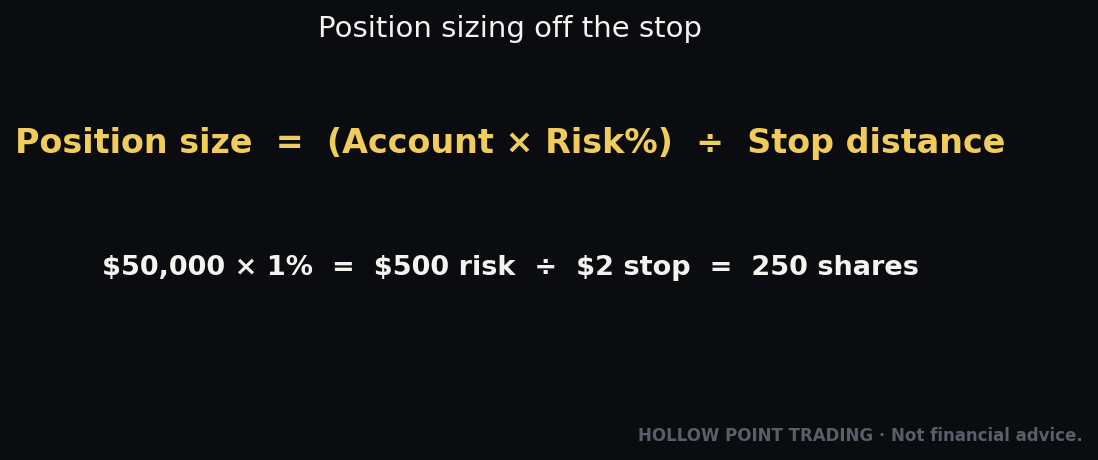
HPT sizes every trade to risk a fixed fraction on a predefined stop, targeting 1:3 reward-to-risk. Leverage doesn't change your risk if you size to the stop distance rather than to available buying power. The mistake is letting "$20,000 buying power" set your size; the discipline is letting "I lose X if this hits my stop" set your size and treating buying power as an irrelevant ceiling. When you size to risk, the margin account's leverage becomes a convenience (you're not tying up all your cash) rather than a temptation (you're not maxing out size). The R/R framework and the margin framework reinforce each other only when risk, not buying power, drives the share count.
Confluence with the settlement calendar as a selectivity filter
Whether it's the old 3-day-trades limit or a cash account's T+1 cadence, a scarcity of "shots" is a confluence filter. If you can only take three day trades in five days, each one has to clear a higher bar — the same higher bar that timeframe-weighted confluence already demands. The plumbing's scarcity and your technical selectivity are pointing at the same behavior: fewer, better trades. Let them agree. When the account limits your shots and your confluence rules limit your setups, the two filters stack, and only the genuine A+ trades survive both.
How to Read and Use It: Worked Scenarios
Concepts stick when you run them through your own account. Here are the common situations, walked step by step.
Scenario A — the $4,000 account that wants to day trade
You have $4,000 and love intraday setups. Your options:
- Margin account under old-rule enforcement: you get 3 day trades per rolling 5 business days. Below $25k, that's your hard limit. Ration them for A+ triggers only.
- Margin account under the new intraday standard (if your broker has implemented it): no trade counter — you can day trade as much as your intraday risk and margin support. Confirm with your broker which regime you're in.
- Cash account: unlimited day trades in the sense that PDT never applied, but you're gated by T+1 settlement — you can only redeploy settled cash, so split your $4,000 into tranches so you always have settled money ready, and never reuse unsettled proceeds (that's a GFV).
Worked tranche plan for the cash account: split $4,000 into two $2,000 buckets. Monday, deploy bucket 1 on a setup and exit same day — those proceeds settle Tuesday. Tuesday, deploy bucket 2 while bucket 1 settles. Wednesday, bucket 1 is free again. You've now got a rotation that lets you take a trade essentially every day, using only settled cash, never touching a GFV, and never limited by PDT. The settlement calendar sets your rhythm; you just have to respect it.
HPT read: on a small account, the settlement/trade-count limit is a feature, not a bug. It forces the discipline of fewer, higher-quality trades — exactly the behavior that survives.
Scenario B — the swing trader who keeps hitting settlement errors
You have a $10,000 cash account and keep getting "unsettled funds" warnings and the occasional GFV. Two clean fixes: (1) switch to a margin account, which lets you trade unsettled proceeds and erases GFV/free-riding entirely (they don't apply to margin accounts); or (2) stay in cash but only deploy settled cash and hold new positions until the funding sale settles. If you don't need leverage and want the psychological safety of no margin calls, option 2 keeps you bulletproof. A middle path exists too: open a margin account but never borrow — you get the settlement-violation immunity and the ability to short, while sizing so you never exceed your own cash, so you never pay interest and never face a call.
Scenario C — the trader ready for defined-risk options income
You want to sell put spreads on names you'd happily own. That's a Level 3 strategy needing a margin account. Action before the setup: apply for Level 3, enable margin, and know your spread's max loss = width of the strikes − credit received. The permission has to exist before the trigger fires. Preparation is a broker-mechanics task, not a chart task. Concretely: if you intend to sell $5-wide put spreads for around $1.50 credit, each contract ties up collateral against a $350 max loss — so before the setup even appears, you know your per-contract risk, you've confirmed Level 3 is approved, and margin is enabled. The morning the chart triggers, there's nothing to scramble for.
Scenario D — the account that gets liquidated overnight on a gap
You hold a leveraged margin position into an earnings report, comfortable because you were well above maintenance at the close. The stock gaps down 25% at the open. Because you were leveraged 2x, your equity gaps down roughly 50%, blowing straight through your maintenance line before you can act — and the broker liquidates at the opening print, one of the worst fills of the day. The lesson isn't "never hold overnight"; it's that maintenance margin plus gap risk is the single most dangerous combination in the plumbing, because a gap skips right over the orderly margin-call-then-decide process. The defense is to carry less leverage into known binary events, or to define risk with options (a long put or a spread) so the gap can't produce a debt. Overnight leverage is the one place where the broker's stop can fire before any human stop possibly could.
How It Fits the HPT Top-Down Process
At Hollow Point Trading the process runs macro → sector → stock → trigger, weighted by timeframe confluence, sized to 1:3 R/R, executed with discipline over prediction. Broker mechanics isn't a competing framework — it's the layer beneath the trigger, the "can I even take this, and at what size" gate.
Fold it in like this:
- Before macro, set the room. Account type, approval level, and margin status define the universe of trades you're allowed to express. There's no point building a beautiful put-spread thesis in a cash account with Level 2 approval — the permission doesn't exist. Configure the account to your strategy first.
- Position sizing is a margin question. HPT's 1:3 R/R depends on a stop you actually honor. Leverage changes what your stop costs your equity (remember Scenario B's math: a 35% move became a 70% equity swing). Size so that your predefined stop triggers before any maintenance-margin line does. The broker should never be the one deciding when you exit.
- Trade-count and settlement are confluence filters in disguise. Whether it's the old 3-day-trades limit or a cash account's T+1 cadence, a scarcity of "shots" enforces the exact selectivity HPT already demands: only the highest-confluence setups earn a bullet. Let the plumbing reinforce the discipline.
- Discipline over prediction includes the account. A margin call is what happens when prediction beats discipline. Knowing the maintenance line, the settlement calendar, and your day-trade budget in advance is discipline applied to the machinery — the same ethos, one layer down.
How the Pros Use It Differently From Beginners
The rules are identical for everyone. What separates a professional's relationship with the plumbing from a beginner's is entirely a matter of sequence, sizing, and attention.
Beginners discover the rules; pros configure for them. A beginner meets the PDT rule the day they get the equity call. A professional set up the account type, options level, and margin status to match their strategy before the first trade, so the rules never surprise them. The plumbing is a pre-trade checklist item, not an in-trade obstacle.
Beginners see buying power as size; pros see it as a ceiling to stay far below. The $20,000 buying-power number is an invitation to a beginner and an irrelevance to a professional, who sizes off risk-per-trade and typically uses a small fraction of available buying power. The pro's usual margin utilization is low precisely so that a volatility spike or an intraday requirement change never forces their hand.
Beginners react to margin calls; pros never receive them. For a professional, a margin call means a risk-management failure already happened upstream. They compute their liquidation price before entry, size so it sits well beyond their technical stop, and exit on their own signal every time. The call is a thing they've engineered out of existence, not a thing they respond to.
Beginners treat leverage as more firepower; pros treat it as capital efficiency. The pro uses margin so they don't have to tie up 100% of cash in one position, freeing capital for diversification or hedges — not to control a bigger position than their risk budget allows. Same tool, opposite purpose.
Beginners ignore the regime; pros scale the machinery to it. A professional carries less leverage into high-volatility regimes precisely because they know house requirements and PM stress parameters tighten exactly when the tape gets wild. They read the room's mood and adjust their footprint, rather than running static size into a changing environment.
Beginners read the marketing; pros read the margin agreement. The professional knows their broker's specific house maintenance requirement, their specific PDT-transition status, their specific list of hard-to-margin securities — because those, not the generic regulator defaults, are the rules that actually stop the click.
The Common Mistakes
The errors below cost real money and real setups. Each is fully avoidable once you know the plumbing.
- Confusing buying power with cash. A $10,000 margin account showing "$20,000 buying power" hasn't magically doubled — that's 2x Reg-T leverage, half of it borrowed and owed back with interest. Trade the cash, respect the leverage. The single most common blow-up starts here: someone treats the leveraged number as their money and sizes every trade against it.
- Getting surprise-liquidated by a margin call. Traders who don't know their maintenance line let the broker pick their exit — usually the worst fill of the day, and not necessarily the position they'd have chosen to close. Know your maintenance floor and your margin-call price before you enter, and stop out on your own terms first.
- Racking up good-faith violations in a cash account. Reusing unsettled proceeds and selling before settlement feels like normal fast trading — until the third GFV locks you into settled-cash-only for 90 days. If you want to trade fast, use a margin account; if you want a cash account, respect the settled bucket.
- Forgetting that settlement counts business days. Selling Friday means Monday settlement, not Saturday; a holiday pushes it further. Traders who don't track the business-day calendar walk into violations around long weekends because their "available" cash hasn't caught up.
- Assuming the PDT rule is already gone for you. It's legally eliminated as of June 4, 2026, but brokers have until October 2027 to implement the replacement, and many still enforce the $25k gate during the phase-in. Confirm your broker's status before you plan around it — and remember the new intraday-margin standard is still a limit, not a free-for-all.
- Breaking PDT with a sub-$25k margin account. Under old-rule enforcement, a 4th day trade in 5 days when you're under $25k triggers an equity call and often a 90-day closing-only restriction. Count your trades against the rolling window, or use a cash account.
- Applying for the wrong options level — or lying to get a higher one. If your plan needs spreads (Level 3) or naked writing (Level 4), apply before the setup appears; approvals can take days. And don't inflate your net worth or experience to jump tiers; you're arming yourself with risk your account — and your skill — can't actually absorb.
- Carrying leverage into a binary event. Holding a leveraged position through earnings or an FDA decision invites the one exit you can't control: a gap that skips your margin line before any human stop can fire. Define the risk with options or cut the leverage before known catalysts.
- Treating portfolio margin as free leverage. PM rewards genuinely hedged books and brutally punishes concentrated directional bets, and it can raise your requirement intraday when volatility spikes. It is a professional risk framework, not a buying-power hack.
- Ignoring margin interest on long holds. Carrying a leveraged position for months quietly bleeds 8–13% annualized against you. For position trades, leverage is a cost center, not an edge.
- Not reading your own margin agreement. Brokers routinely set house requirements stricter than FINRA's — higher maintenance margins, higher PDT thresholds, restricted-security lists. Your broker's rules, not the regulator's, are the ones that actually stop your click. Read them.
- Letting buying power set position size. The disciplined trader sizes off risk-per-trade and a predefined stop; the undisciplined one sizes off the biggest number the platform will let them enter. The first survives drawdowns; the second gets liquidated by them.
Frequently Asked Questions
Can I lose more money than I put into my account? In a cash account, no — your maximum loss is what you invested, because you never borrowed. In a margin account, yes — a gap or a fast move against a leveraged position (or a naked short option) can leave you owing the broker beyond your deposited equity. This asymmetry is the strongest argument for cash accounts while you're still learning.
Does the 2026 PDT change mean I can day trade a $500 account freely now? Legally, the $25k floor is eliminated as of June 4, 2026. Practically, it depends entirely on whether your broker has implemented the new intraday-margin standard or is still enforcing the old $25k rule during the phase-in through October 2027. Call and ask. And even under the new standard, your intraday exposure can't outrun your account's real risk capacity — a very small account still can't carry large intraday size.
Is a cash account or a margin account better for a beginner? For most beginners with small accounts, a cash account is the safer classroom: no margin calls, no PDT, no possibility of owing money, and the settlement rhythm naturally enforces selectivity. Move to margin when you have a specific need — shorting, spreads, faster capital recycling — and the discipline to size off risk rather than buying power.
How do I find my exact margin-call price? For a fully-margined long: margin-call price = loan amount ÷ (shares × (1 − maintenance %)). Use your broker's house maintenance percentage, not the generic 25%, because the house number is what actually triggers the call. Compute it before you enter.
What's the real difference between a good-faith violation and free-riding? A GFV reuses unsettled proceeds from a genuine prior sale too early — a timing foul. Free-riding buys with money that was never in the account at all and sells the new position to fund the purchase — buying on credit you don't have. GFV gives you three strikes in 12 months; free-riding restricts you on the first offense.
Do futures have a PDT rule? No. Futures fall under the CFTC/NFA, not FINRA, so the PDT rule never applied to them. This is why some small-account traders use micro futures (like MES or MNQ) to day trade without a $25k threshold — at the cost of a different, often higher, leverage-and-risk profile and different tax treatment.
Will enabling margin force me to borrow or pay interest? No. A margin account gives you the option to borrow; it doesn't compel it. If you never buy more than your own cash balance, you pay zero margin interest and can't be margin-called, while still gaining settlement-violation immunity and the ability to short.
Why did my broker suddenly increase the margin requirement on a stock I already own? Brokers raise house margin requirements on individual names when volatility spikes, when a stock becomes hard to borrow, or ahead of major events. It can happen intraday and it moves your liquidation price against you. It's in your margin agreement that they can do this — which is exactly why carrying heavy leverage in volatile names is dangerous.
The Cheat-Sheet
Pin this. It answers the "what am I allowed to do right now" question fast.
Account types
- Cash account: settled cash only. No margin calls, no PDT, no leverage, no shorting. Can't lose more than you invest. Watch for GFV & free-riding. Best for small, disciplined, no-leverage traders.
- Margin account: borrow up to 50% (Reg-T), trade unsettled funds freely, can short, no GFV/free-ride possible. Subject to margin calls and (historically) PDT. Interest on borrowed money. Enabling ≠ borrowing — you can hold one and never use leverage.
Reg-T margin
- Initial: 50% down → ~2x overnight buying power. (Higher for volatile/low-priced names.)
- Maintenance: 25% FINRA floor (brokers often 30–40%). Below it → margin call.
- Margin-call price (long): loan ÷ (shares × (1 − maintenance %)). Compute before entry.
Settlement
- T+1 for stocks, ETFs, and options — trade date + 1 business day. Holidays and weekends extend it.
- Matters only in cash accounts. Margin accounts sidestep it.
Cash-account violations
- Good-faith violation: sell a position bought with unsettled cash before that cash settles. 3 in 12 months → 90-day settled-cash-only.
- Free-riding: buy, then sell to pay for the buy (money never there). First offense → 90-day settled-cash-only.
- Bulletproof rule: trade only out of the settled bucket.
Pattern Day Trader (in transition, 2026)
- Old rule: 4+ day trades in 5 business days in a margin account → must hold $25,000. Under $25k → limited to 3 day trades / 5 days. Never applied to cash accounts.
- New rule (effective June 4, 2026): $25k floor and PDT designation eliminated, replaced by a risk-based intraday margin standard. Broker phase-in through Oct 20, 2027 — many still enforce the old $25k gate. Confirm with your broker. Still a limit, not a free-for-all.
Options approval levels
- L1: covered calls, cash-secured puts.
- L2: long calls/puts (defined risk, bounded loss).
- L3: spreads (needs margin account; max loss = width − credit).
- L4: naked/uncovered writing (unlimited risk, top scrutiny).
- Apply before the setup; approvals take time.
Portfolio margin
- Risk-based, whole-portfolio margining. Far more efficient for hedged books; requirement can rise intraday in high vol.
- Entry bar: ~$100k+ equity, top options level, ~3 years' experience. Pro tool, not a beginner cheat code.
Regime cheat
- Quiet trend: plumbing feels loose — don't let it tempt oversizing.
- Chop: settlement + trade-count limits bite; slow down.
- High vol: house margin and PM requirements tighten intraday; carry less leverage.
The one-line HPT rule for all of it: Configure the account to the strategy before the setup appears — permission is a pre-trade task, not a trigger-time scramble.
Broker mechanics is the least glamorous layer of trading and the one that quietly ends more small accounts than any bad chart read. The good news is that it's finite — a handful of rules that don't change day to day, unlike the tape. Learn them once, set your account up to match your actual strategy, compute your margin-call price before every leveraged entry, respect the settled bucket in a cash account, confirm where your broker stands on the 2026 PDT transition, and you'll never again watch a clean setup leave without you because of a red error message. The chart is the art. The account is the room. Know the room, and it stops being a cage and starts being an edge.
Bound by rules, feared by trade.