
You did the work. You ran the top-down. Macro says risk-on, the sector is leading, the stock is above its rising EMA 12/22/55 stack, and you found a clean entry with a stop that gives you 1:3. You are right about the trade.
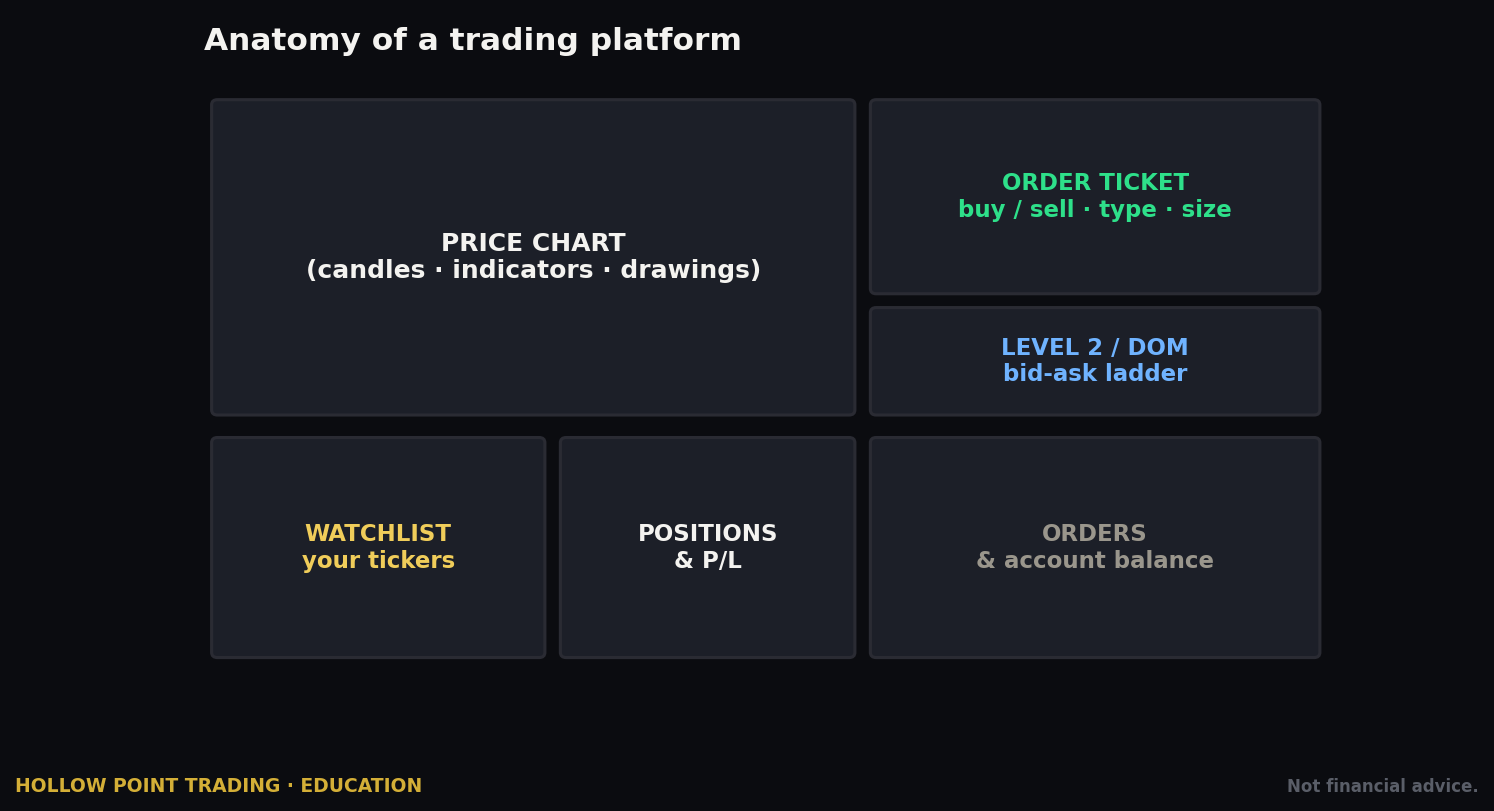
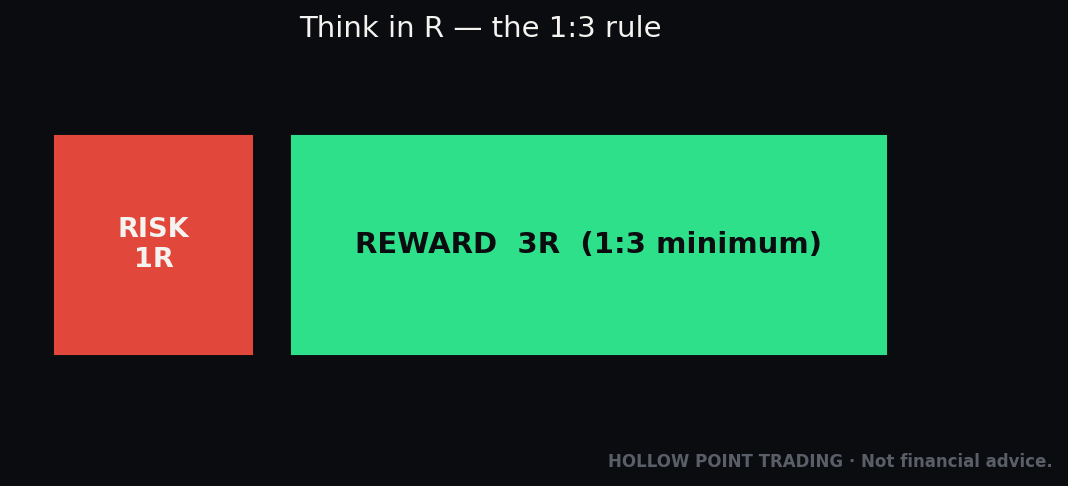
Then you fumble the order ticket, buy the top tick with a market order into thin premarket liquidity, get filled forty cents worse than you planned, your stop is now inside your risk instead of below it, and a trade that was supposed to risk one to make three quietly becomes one-to-two. You were right and you still lost money. Not because of the read. Because of the last click.
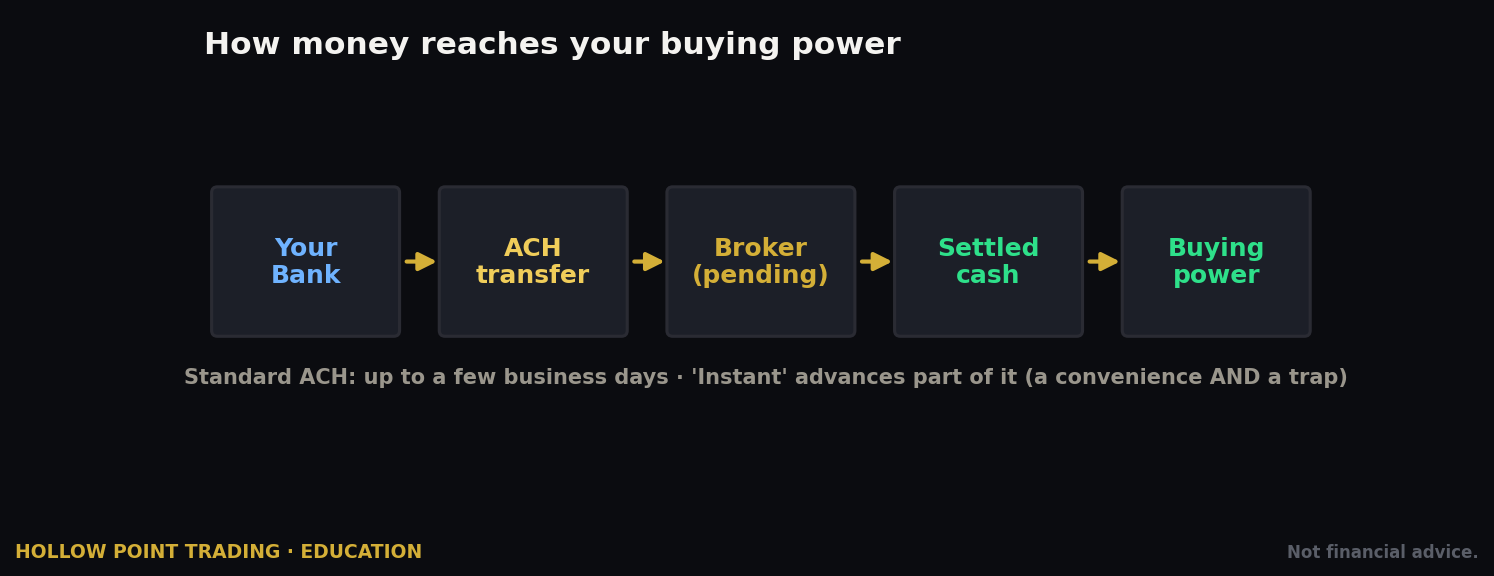
The order ticket is the least glamorous part of trading and the part that separates people who keep their edge from people who donate it back to the market one bad fill at a time. Most traders spend ninety percent of their study time on entries and signals — the glamorous, screenshot-able part — and almost none on the mechanical act of getting into and out of the position. That ratio is exactly backwards for where the money actually leaks. Your edge on any single trade might be a few tenths of a percent. The spread you needlessly pay, the slippage you invite, the stop you place on top of a liquidity pool instead of beyond it — those are also measured in tenths of a percent, and they fire on every trade whether you win or lose. Get the order mechanics wrong and you are running a small, permanent tax against a small, fragile edge.
This is the definitive HPT guide to every order you will ever use — what it is, exactly how the mechanism works, when to reach for it, how it behaves in trending versus choppy versus high-volatility markets, how it changes across timeframes, how it stacks with the rest of your read, and the specific ways each one costs beginners money. Read it once, keep the cheat-sheet, and stop leaking edge at the checkout counter.
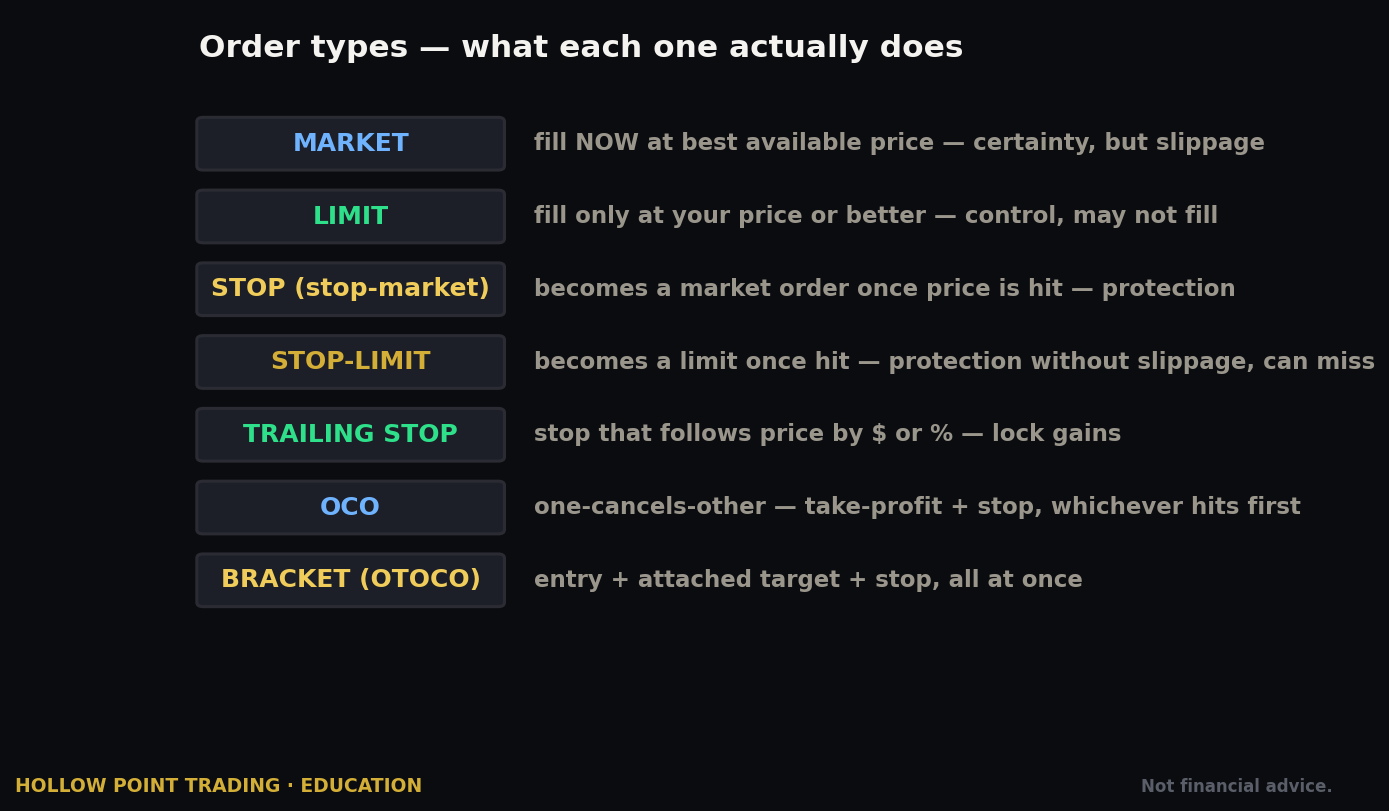
The Concept: An Order Is a Conditional Instruction, Not a Wish
Here is the mental model that fixes 80% of order mistakes before they happen. Every order is a set of conditions you hand to the exchange, and the exchange executes it mechanically the instant those conditions are met — with no judgment, no mercy, and no idea what you meant.
That is it. An order is code. You are programming a robot that will do exactly what you typed, including the parts you didn't think through. The market does not read intent. If you tell it "sell everything the moment price touches this number," it will sell everything the moment price touches that number — including a one-second wick down that immediately reverses, leaving you flat at the low while the trade you were right about runs to your target without you.
This "order as code" frame is worth sitting with, because it reframes every mistake in this guide as a specification bug rather than bad luck. You didn't get unlucky when your stop-limit failed to fill in a gap — you wrote a condition ("sell, but never below X") that could not be satisfied under the conditions that occurred, and the machine honored your spec perfectly. You didn't get robbed when your market order slipped in a fast tape — you wrote "fill me at any price" and the machine gave you any price. Once you see orders as programs you are shipping to an unforgiving runtime, you start reading them back the way a careful engineer reads code before deploying to production. That single habit is worth more than any indicator.
So before we go one layer deeper, internalize the two things that make every order tick:
Price condition — what has to happen for the order to become active or fill. A limit order's condition is "only at this price or better." A stop order's condition is "wake up and act once price trades through this trigger." Some orders have two conditions stacked (a stop-limit has a trigger and a price ceiling); some have a time condition bolted on (fill within this instant or die). Every exotic order in this guide is just primitive conditions combined.
Certainty vs. price trade-off — the master dial behind every choice. You can have certainty of execution (you will get filled) or certainty of price (you will get your number), but almost never both at once. Every order type is just a different setting on that dial. Understanding a new order type is really just asking: where does this one sit between "I need to be filled" and "I need my price"? When you catch yourself unsure which order to use, stop and ask which side of that dial this specific trade actually needs. A protective stop on a position you must be out of lives at the "filled" end. A patient entry at a level you like lives at the "my price" end. Name the need and the order picks itself.
Two vocabulary terms to define once and reuse everywhere:
Slippage — the difference between the price you expected and the price you actually got. Positive slippage helps you; negative slippage hurts. It comes from the market moving in the moment between your click and your fill, and from the spread you have to cross. Slippage is not a rare accident — it is a baseline cost that scales with how fast the market is moving, how thin the book is, and how aggressive your order is. On a calm tape in SPY it rounds to zero. In a small-cap on an earnings gap it can be a multiple of your intended risk.
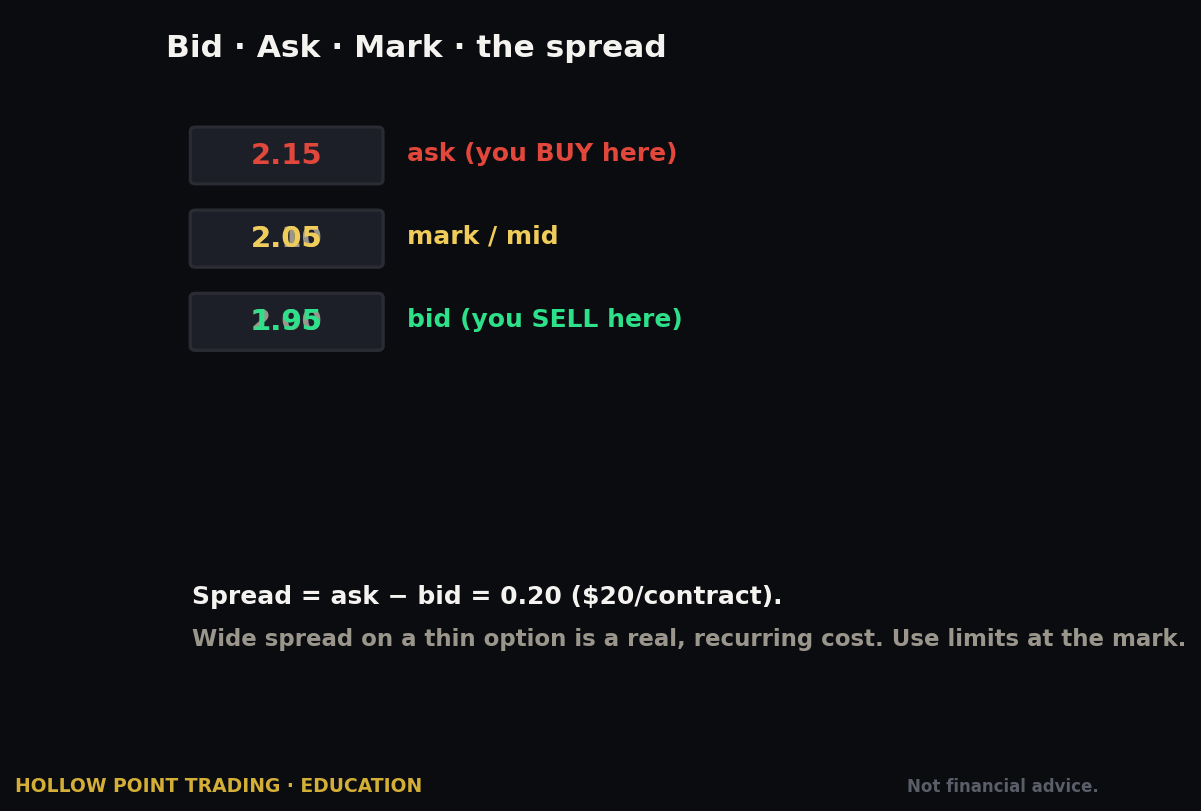
The spread — the gap between the bid (the highest price a buyer is currently willing to pay) and the ask (the lowest price a seller is currently willing to accept). When you buy "at market," you pay the ask. When you sell "at market," you receive the bid. That gap is a real cost you pay every single round trip, and it widens exactly when you can least afford it — fast markets, news, illiquid names, and outside regular hours. A one-cent spread on a $100 stock is a rounding error. A fifteen-cent spread on that same stock during a premarket news spike is a fifteen-basis-point tax on the round trip before the trade has done anything.
Hold those three ideas — order-as-code, the certainty dial, and the spread — and every order below becomes obvious. They are the physics. Everything else is engineering.
Who is on the other side of your order
One more idea that makes the mechanics click: for every order you send, someone or something is on the other side, and the two of you are not symmetric. When you send a market order, you are taking liquidity — you are removing a resting order someone else placed. When you send a limit order that sits in the book, you are providing liquidity — you are the resting order someone else will take. Takers pay the spread; providers, in effect, collect it. Most of the fast, professional flow you are trading against is providing liquidity and letting impatient takers pay them the spread thousands of times a day. Every time you default to a market order, you volunteer to be the impatient taker. A huge part of trading like a professional is simply choosing, whenever the trade allows it, to be the patient side of that transaction.
The Mechanism: The Two Atoms Everything Is Built From
There are really only two primitive orders. Everything else in this guide is a combination, a condition, or a time-rule bolted onto these two. Learn the atoms and the molecules assemble themselves.
The Market Order — certainty of execution, zero certainty of price
A market order says: fill me right now, at whatever the best available price is. You are crossing the spread to take liquidity that already exists. If you are buying, you lift the ask; if you are selling, you hit the bid.
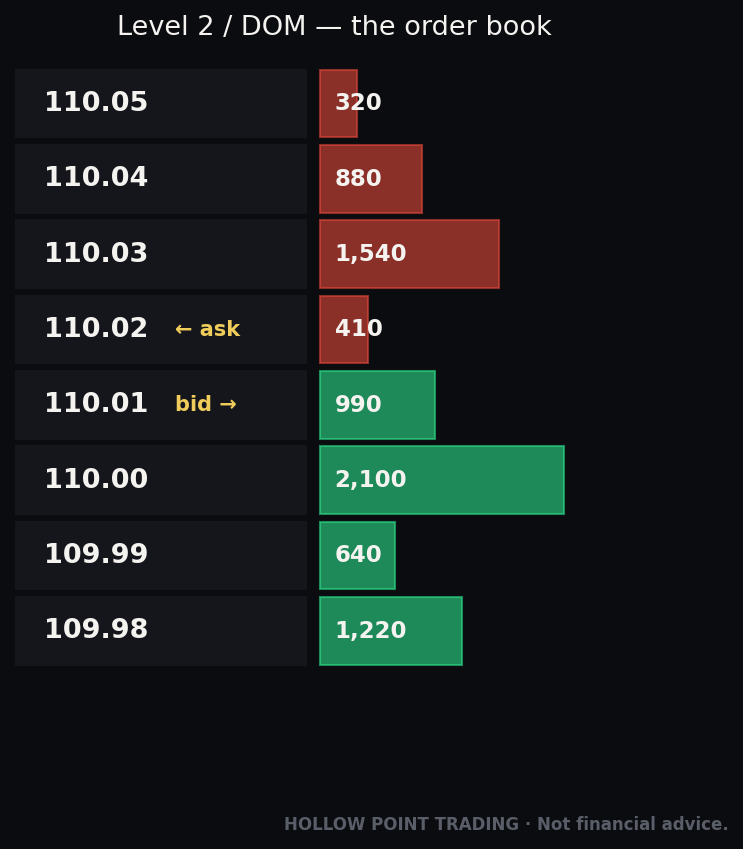
The mechanism: your order walks the order book. It takes the best-priced shares available, then the next best, then the next, until it is completely filled. Picture the book as a staircase. On the ask side, the first step might be 500 shares at $100.05, the next 800 at $100.06, the next 300 at $100.08, and so on up the staircase. A market buy for 400 shares clears entirely on the first step at $100.05 and you never feel the staircase exists. A market buy for 5,000 shares walks up several steps, and your average fill is the volume-weighted blend of every step you ate — maybe $100.07 average, two cents worse than the quote you saw. In a liquid name like SPY or a front-month e-mini, the book is so deep that a normal-sized order fills at basically one price and the spread is a penny or a tick. In a thin name, or a large order in something that trades a few hundred shares at a time, that staircase is short and steep, and the average fill can be dramatically worse than the top-of-book quote you clicked on.
What you get: near-guaranteed execution — in normal conditions a market order in a listed security will fill, period. What you pay: the spread, plus any slippage from the book being thin or the market moving between click and fill. In fast conditions a market order is a signed blank check. You are telling the exchange "I accept whatever price exists at the moment my order arrives," and in a fast tape that price is a moving target you cannot see.
The market order has exactly one honest use case: you must be filled right now and you accept any price to make that happen. A true stop-out on a position gapping against you. An emergency flatten before a halt. A liquid, penny-wide name where the spread is trivial and speed matters. Outside those, reaching for a market order is almost always leaving money on the table that a marketable limit would have kept.
The Limit Order — certainty of price, zero certainty of execution
A limit order says: fill me only at my price or better, and if you can't, wait — or don't fill at all. A buy limit fills at your limit price or lower. A sell limit fills at your limit price or higher. "Or better" always means better for you.
The mechanism: your limit order joins the order book as resting liquidity — it sits there advertising your price until someone chooses to trade against it, or until price comes to you and fills you. You are now a liquidity provider, not a taker. There is a queue: if three hundred other traders posted a buy at your exact price before you did, you are behind them in line, and price has to trade through your level (or enough sellers have to hit that price) for the queue ahead of you to clear before you get filled. This is why a limit exactly at an obvious level sometimes doesn't fill even though price "touched" it — price tagged the level, filled the front of the queue, and reversed before reaching you.
The trade-off is stark and permanent: you will never pay worse than your number, and you might never get filled at all. Price can tick to one cent above your buy limit, reverse, and run away without you. You were "right" and you caught nothing. That is the tax on price certainty, and it is a real tax — a limit order at a great level that the market front-runs is a missed winner, and missed winners hurt even though they never show up on your P&L.
What you get: price control, no negative slippage, and you collect the spread instead of paying it. What you pay: execution risk — the trade can leave without you, and a partial fill can leave you with a smaller position than you wanted while you assume you're full size.
Everything else in this guide is these two atoms plus a trigger and a clock.
The Molecules: Triggers, Trails, Clocks, and Qualifiers
Stop Order (a.k.a. Stop-Market)
A stop order is a dormant market order with a trigger price. It does nothing — it isn't even in the visible book, so other traders can't see it resting — until price trades through your stop level. The instant it triggers, it converts into a market order and fills at whatever is available.
Two flavors by direction:
- Sell-stop — placed below current price. Used to cut a long position. "If price falls to my stop, get me out at market."
- Buy-stop — placed above current price. Used to cut a short, or to enter long on a breakout. "If price rises to my trigger, buy at market."
The critical, expensive truth beginners miss: a stop-market guarantees you exit, not the price you exit at. In a gap or a fast flush, your stop triggers and then fills wherever the market actually is — which in a gap-down can be far below your stop. Your $50 stop on a stock that gaps to $44 overnight fills near $44, not $50. The stop did its job (you're out); it just couldn't defy physics, because no shares traded between $50 and $44 for it to fill against.
There's a subtlety worth knowing: brokers and exchanges define the trigger as either the last traded price, the bid/ask, or a mark price, and the choice matters on fast wicks. A stop that triggers on the last print can be tripped by a single aberrant tick; a stop that triggers on the bid (for a sell-stop) is slightly more robust. Know which your platform uses, because it explains the occasional "I got stopped and it never actually traded there on my chart" mystery — your chart may show last-price candles while your stop watched the bid.
Stop-Limit Order
Same trigger as a stop, but instead of converting to a market order, it converts to a limit order at a price you specify. You set two numbers: the stop (the trigger) and the limit (the worst price you'll accept once triggered).
This solves the "filled way below my stop" problem — and creates a scarier one. If price blows straight through both your stop and your limit (a real gap, a halt-and-reopen, a flash flush), your limit order rests unfilled and you are still in the position while it keeps going against you. You wanted protection and you got a decoration. The gap between your stop and your limit is a bet: a wider gap makes a fill more likely but accepts more slippage; a tighter gap controls price but raises the odds of no fill exactly when you need one.
Rule of thumb: stop-limits are for entries and for taking profit where price certainty matters and you can afford to miss. For a hard protective stop on a position you must be out of, a stop-market is usually the honest choice — you accept slippage in exchange for actually getting out. Choosing protection means accepting you don't control the exit price. Choosing price control means accepting you might not exit. There is no free version, and any product that promises you both is hiding the failure mode in the fine print.
Marketable-Limit Order — the fill most pros actually use
Here is the quiet workhorse almost no beginner is taught. A marketable limit is a limit order priced through the current market — for a buy, you set the limit a few ticks above the ask; for a sell, a few ticks below the bid.
Because it crosses the spread, it fills immediately like a market order would — but the limit acts as a slippage cap. You get market-order speed with a hard ceiling on how bad the fill can be. If the market is moving faster than your limit allows, you simply don't get the runaway portion; the rest rests at your limit or cancels, depending on your settings. The genius of it is that in the common case — the market is where you thought it was — you often get price improvement, filling at the ask instead of through it. And in the bad case — the market just jumped — you are protected from the exact runaway fill that a market order would have handed you.
Think of the marketable limit as a market order that has been told "yes, but not past here." How far through the market you price it is a dial: one tick through is aggressive price protection but risks a partial in a fast tape; five or ten ticks through behaves almost like a market order but still catches a genuine runaway. Match the aggressiveness to the liquidity — one or two ticks in a deep name, a wider cushion in something thinner where you still need the fill.
This is how you should enter and exit almost everything liquid. A raw market order in anything but the deepest names is you telling the market "surprise me." A marketable limit says "fill me now, but not worse than X." Same speed, capped downside. If you take one order-mechanics upgrade from this entire piece, make it this one.
Trailing Stop — Fixed and Percentage
A trailing stop is a stop that moves. You define a trailing distance — either a fixed dollar/point amount or a percentage — and the platform automatically ratchets your stop in the direction of profit, never against you.
- Fixed trailing stop: "keep my stop $2.00 below the highest price reached." Stock runs from $50 to $58, your stop has climbed to $56. Price then falls to $56 → you're out, having locked most of the run.
- Percentage trailing stop: "keep my stop 5% below the high-water mark." Same idea, but the distance scales with price and volatility.
The mechanism: the stop only moves in your favor. On every new extreme (new high for a long), the trail resets tighter. On a pullback, it holds — it never loosens. When price retraces by your trailing distance, it triggers exactly like a normal stop (as a market order, with all the gap/slippage caveats). One practical wrinkle: a client-side trailing stop lives on your broker's server and needs your platform connected or the broker's servers to be tracking it; a native exchange trail is rarer. Know where your trail actually lives, because a trail that only updates while your app is open is a different animal from one the broker maintains for you.
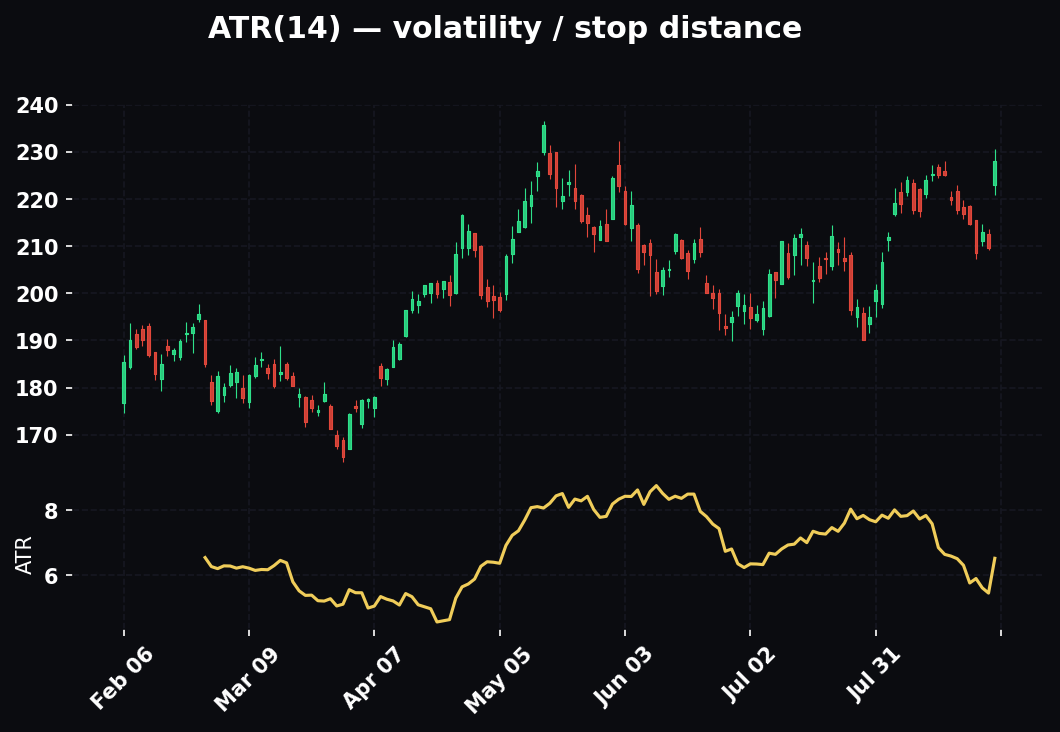
The trade-off is the eternal protection vs. whipsaw tension. Trail too tight and normal noise stops you out before the move develops. Trail too loose and you give back a chunk of the gain before it triggers. The fix isn't a magic number — it's setting the trail to the instrument's actual volatility (ATR is the standard tool) and to the timeframe you're trading, not to a round number that feels nice. A common professional approach is a trail of 2–3x ATR on the trading timeframe: wide enough to survive normal pullbacks, tight enough to bank the trend when it genuinely breaks. On a swing you might trail off a moving average or the prior swing low rather than a fixed distance at all, letting structure set the leash.
The Time Rules: How Long Does Your Order Live?
Every order also carries a time-in-force — the clock that governs how long it stays alive.
- Day — expires at the close of the regular session if unfilled. The sane default. You never wake up to an order you forgot about firing into a gap.
- GTC (Good-Til-Canceled) — stays working across sessions until it fills or you cancel it (brokers usually cap it around 90 days). Great for resting limit orders at levels you're patient about. The danger: a stale GTC stop or limit you forgot, firing days later into conditions that no longer match your thesis.
- Extended-hours / GTC-EXT — allows the order to work in pre-market and after-hours sessions. Essential to understand because extended hours is a different, thinner, wider market. Spreads blow out, liquidity vanishes, and a market order out there is genuinely dangerous. Most brokers force limit-only in extended hours for exactly this reason.
- GTD (Good-Til-Date) — a middle ground: the order works until a date you set, then expires. Useful when your thesis has a natural shelf life ("this level matters through Friday's expiration, not forever").
The time-in-force is not an afterthought — it is the difference between an order that expresses your current thesis and an order that outlives it. A GTC stop is a promise you made to a past version of yourself, and the market has no obligation to remember why you made it.
FOK, IOC, and AON — the "all or precise" family
These are execution qualifiers — they modify how strictly and completely an order must fill.
- Fill-Or-Kill (FOK): fill the entire order immediately and completely, or cancel the whole thing. No partials, no waiting.
- Immediate-Or-Cancel (IOC): fill whatever you can right now, cancel the rest. Partials allowed; no resting.
- All-Or-None (AON): fill the entire order or none of it, but it's allowed to wait for enough liquidity to do so. No partials, but it can rest.
These matter mostly for larger size in less-liquid names, where a partial fill leaves you with an awkward half-position and a moved market. If you need exactly 10,000 shares to make a strategy work and a 3,000-share partial breaks the math, AON or FOK protects you from that. For a retail trader in liquid instruments, you rarely need them — but you need to recognize them so you don't toggle one on by accident and then wonder why your perfectly reasonable order never fills while the move leaves without you.
MOC and LOC — trading the closing auction
- MOC (Market-On-Close): a market order that executes in the closing auction at the official closing price. Used to guarantee you're positioned exactly at the close — for index rebalances, for systematic strategies benchmarked to the close, or simply to avoid holding into after-hours.
- LOC (Limit-On-Close): same closing-auction execution, but only if the closing print is at your limit or better; otherwise it doesn't fill.
The closing auction is one of the deepest liquidity events of the day — a genuinely good place to move size, because everyone who needs the closing price is transacting in one batch — but it has hard cutoff times (typically minutes before the bell) after which you can't submit or cancel. Miss the window and you're stuck with the order or stuck without it. There's a matching opening auction with MOO/LOO variants that behaves similarly at the other end of the day. For most discretionary traders these are niche, but the closing auction is worth knowing for one reason: if you must exit a sizeable position on the day it triggers a thesis change and the intraday book is thin, feeding it into the closing auction is often better than dumping it into a shallow midday tape.
The Combinations: OCO, Bracket, OTO, OTOCO
Now we assemble the atoms into the structures you'll actually live in as a real trader. These are the difference between "managing a trade with your nerves" and "managing a trade with a plan the machine enforces for you."
OCO — One-Cancels-Other
An OCO links two orders so that the instant one fills, the other is automatically canceled. The classic use: you're long, and you place a profit-taking limit above and a protective stop below, linked as an OCO. Price hits your target → the limit fills → your stop cancels itself. Price hits your stop first → the stop fills → your target cancels itself. You never end up accidentally flat and short because both fired.
Without OCO, you'd have to babysit and manually pull the other order — and the day you forget is the day both fill and you're suddenly in a position you never intended, on the wrong side, wondering how. OCO is the machine doing the babysitting so a human error at the worst moment becomes structurally impossible.
Bracket Order — the entry with its exits pre-attached
A bracket is your entry order with a target and a stop already strapped to it as an OCO pair. You define the whole trade at once: get in here, take profit there, cut the loss there. The moment your entry fills, the OCO exit pair goes live automatically.
This is the single most important structural habit in this guide, because it forces you to define your risk and reward before you're emotionally in the trade. You literally cannot place a proper bracket without answering "where's my stop and where's my target" — which is exactly the discipline that makes 1:3 R/R real instead of aspirational. The bracket converts your risk-management intentions into orders that already exist, so that "I'll set a stop once I see how it acts" — the sentence that precedes most account-ending losses — is never spoken, because the stop is already live the instant you're filled.
Many platforms let you bracket with scaled exits — multiple targets that peel off portions of the position at different levels, each with its own OCO relationship to the stop. This is how you both bank partial profit and let a runner run: first target takes half off at 1:2, the rest trails or aims for 1:4, and the stop moves to breakeven once the first target fills. All of that can be armed at entry as a single structure, so the trade manages itself to plan while you do nothing.
OTO and OTOCO — One-Triggers-Other(-OCO)
- OTO (One-Triggers-Other): a primary order that, when it fills, submits a secondary order. Entry fills → a single stop or single target is placed.
- OTOCO (One-Triggers-OCO): a primary order that, when it fills, submits an OCO pair. This is the formal name for a full bracket: one entry triggers a linked target-and-stop.
The value of OTO-family orders is that the child orders don't exist in the market until the parent fills. You're not leaving live stops floating around a position you don't have yet. You arm the entire plan, walk away, and the machine sequences it correctly: enter, then protect, then let the two exits race. This is what "set and forget" actually means when a professional says it — not gambling and ignoring, but fully specifying the trade so that no further decision is required unless the thesis itself changes.
Order Types Across Market Regimes
The same order behaves differently depending on the weather. A market order that is harmless in a calm, liquid, ranging tape is a wealth-destroyer in a fast news spike. Reading the regime before you pick the order is as important as reading the chart before you pick the trade. Three regimes cover most of what you'll face.
Trending, orderly markets
In a clean trend with normal volatility, spreads are tight and the book is deep. This is the friendliest environment for aggressive orders. Marketable limits fill near the touch with minimal slippage; even a market order in a liquid name costs little. Because the trend is your friend, resting entry limits on pullbacks tend to fill and then work — the market keeps coming back to value before pushing on. Trailing stops shine here: a 2–3x ATR trail rides the trend and only triggers when the character genuinely changes. The order-mechanics risk in a trend is too much patience on entries — resting a limit a hair too far below price and watching the trend leave without you. When confluence is strong and the trend is established, being one tick too greedy on the entry limit is how you miss the whole move.
Choppy, ranging markets
In a range, the enemy is the whipsaw. Breakout entries fail and reverse; stops placed just beyond the obvious level get run and then price snaps back. This is where limit discipline pays and stop-market breakout entries punish. Fading the edges of the range with resting limits — buying the bottom rail, selling the top rail — lets you be the patient liquidity provider while impatient breakout traders pay the spread and get faded. Protective stops need extra cushion beyond the range boundary, because the range's edges are exactly where liquidity runs happen. If you must use stop-entries in chop, expect a higher failure rate and size down. The regime rewards the trader who insists on price and punishes the one who insists on being filled.
High-volatility and news-driven markets
This is the regime that separates disciplined traders from donors. Spreads blow out — a name that's normally a penny wide can go a dollar wide in a news spike. The book thins to nothing. Slippage on a market order can dwarf your intended risk. Rules for this regime: marketable limits only on entries and exits, with the slippage cap set deliberately wide enough to fill but not wide enough to get robbed. Never a raw market order unless it's a true "get me out at any cost" emergency. Widen stops or reduce size — a normal-width stop in a high-vol tape is just a donation to the noise. Consider standing aside entirely until the spread normalizes; the best order in a chaotic tape is often no order. And be acutely aware that stop-limits can leave you completely unprotected here, because this is precisely the regime that gaps straight through both prices.
Order Types Across Timeframes
The order is the last mile of a read, and the read lives on a timeframe. The order's clock, its slippage tolerance, and its stop distance should all inherit from the timeframe your confluence actually lives on. Using scalp-tight orders on a swing thesis, or swing-loose orders on a scalp, is a common and expensive mismatch.
Scalps (1m–5m): the thesis lives and dies in minutes, so orders are immediate and tight. Marketable limits for entry and exit, Day time-in-force, stops measured in ticks or a fraction of the intraday ATR. There is no room to be patient — a resting limit that doesn't fill in thirty seconds is usually a dead idea. Speed and slippage control dominate; the marketable limit is the whole game.
Intraday swings (15m–1H): now you can be more patient on entries. Resting limits at a level, waiting for a pullback into the EMA stack or VWAP, make sense. Stops are set to structure — the last intraday swing low, a cushion beyond it — and sized so a normal fill still respects your risk. Day or GTD time-in-force. Trailing can begin once the move is in profit.
Multi-day and swing (4H–Daily): GTC resting limits get you positioned at levels you're patient about, sometimes over several days. Stops are wide, structural, and set beyond daily swing points or the daily EMA 55 — the level that, when it breaks, breaks the whole thesis. Trailing stops are volatility-based off the daily ATR or trail structure (prior swing lows), and they need to breathe with the daily range or normal pullbacks will eject you. Here the order's clock matters as much as its price: a GTC bracket lets a multi-day plan execute while you sleep, and that is a feature, not a risk, if the thesis genuinely spans days.
Position (Weekly): the widest stops, the most patient limits, and the strongest argument for auditing your GTC orders regularly — an order that's meant to live for weeks is exactly the kind that becomes a zombie if the macro backdrop shifts under it. The longer the intended life of an order, the more disciplined you must be about pruning the ones whose thesis has expired.
The rule across all of them: the order's time-in-force and stop distance match the timeframe your confluence lives on. Same trader, same rules — the order changes because the timeframe weight changed.
Confluence: Stacking Order Placement with the Rest of Your Read
An order type in isolation is just a mechanism. It becomes edge when the price you attach it to is chosen by the same confluence that made the trade worth taking. Three tools most HPT traders already use should be driving where your stops, entries, and targets actually sit.
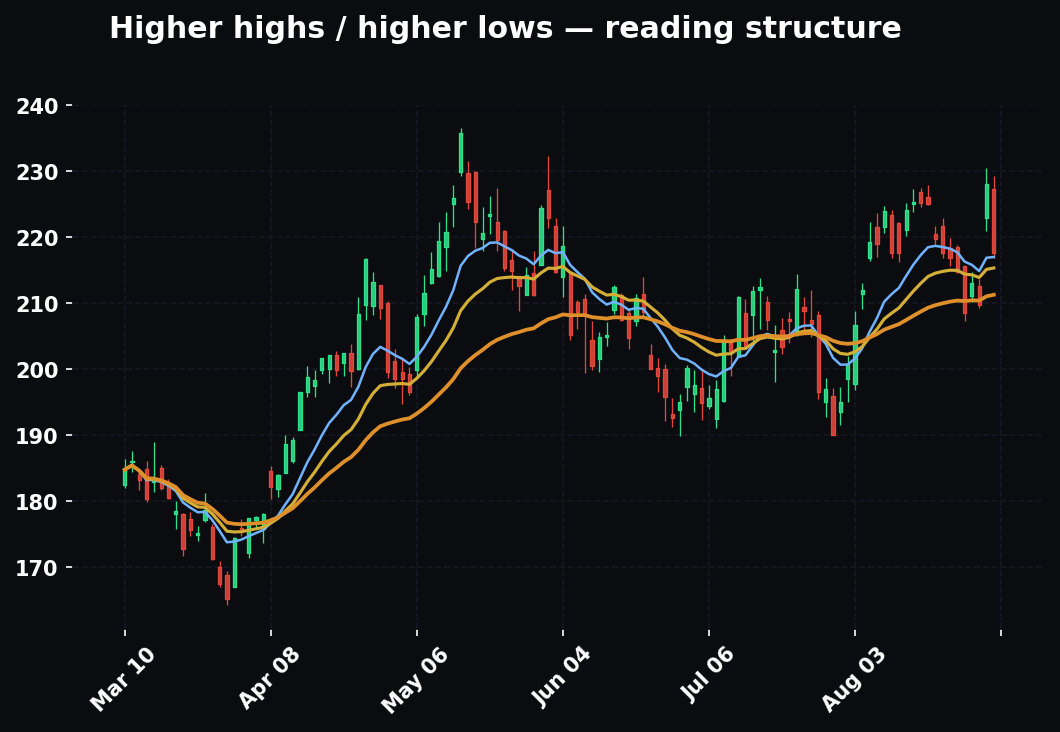
With the EMA 12/22/55 stack
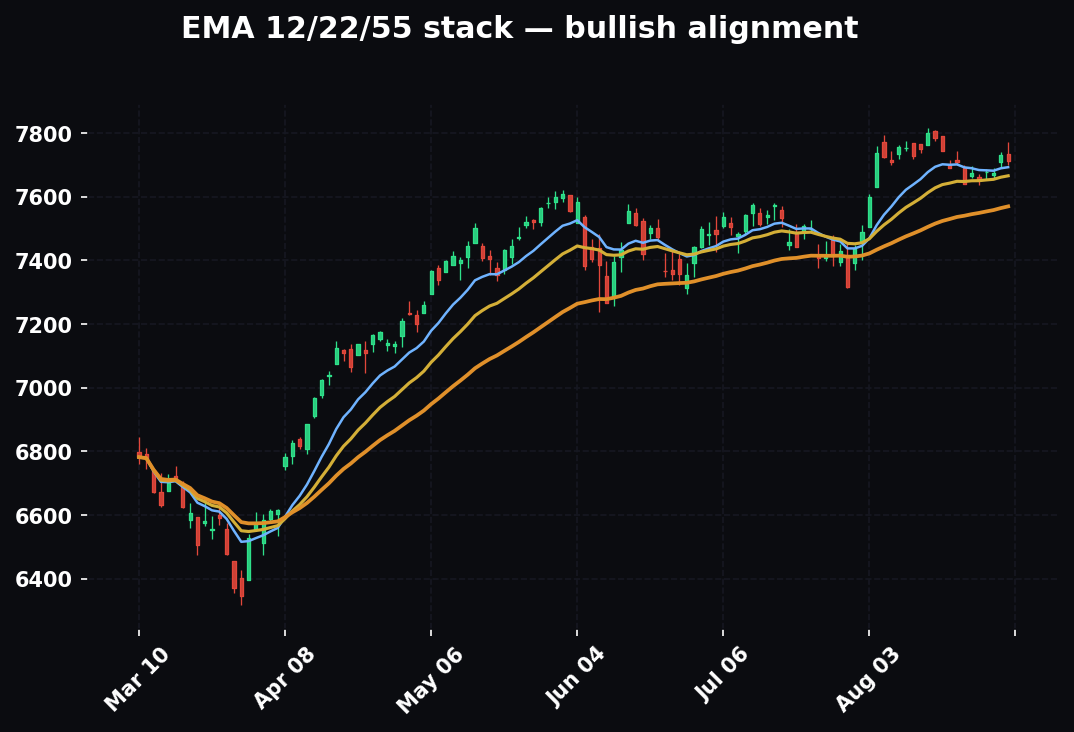
The stack defines trend and provides dynamic support/resistance. On a long in an uptrend, a pullback into the rising 22 or 55 EMA is a natural place to rest an entry limit — you let price come to the stack instead of chasing. The protective stop then belongs below the EMA that's holding the trend, with a cushion, because a decisive close through it is the invalidation. The order type serves the structure: rest the limit at the EMA, place the stop-market beyond it, and the stack has just told you both prices. When the daily 55 is the bias tell, a swing stop below it (cushioned) is often the cleanest structural invalidation you can find.
With VWAP and anchored VWAP
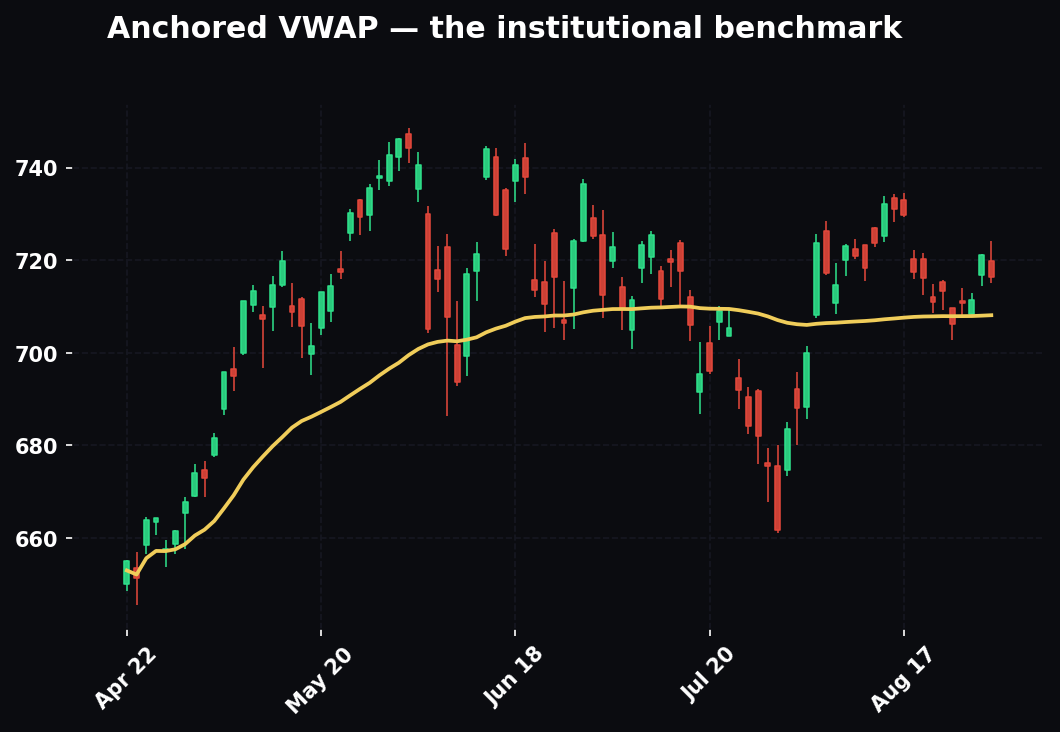
VWAP is where the day's average participant sits, and it acts as a magnet and a fair-value line. Marketable-limit entries near VWAP on a trend-day pullback fill well because VWAP tends to attract liquidity — the book is thicker there, so slippage is lower. Anchored VWAP from a significant swing or event gives you a line that institutions defend; resting orders and stops referenced to it inherit that significance. If you're long a trend day and price holds above a rising VWAP, that VWAP (cushioned) is a logical trailing-stop reference — the trade is intact as long as the average buyer is in profit.
With liquidity pools and prior-day levels
This is where order placement becomes a defensive weapon. Obvious levels — prior day high/low, round numbers, the visible swing low everyone can see — are where retail stops cluster, which makes them liquidity pools the market is drawn to run. The professional move is to place your protective stop beyond the pool, not on top of it. If the obvious swing low is $94.20 and every tidy stop sits at $94.00, your stop at $94.00 is fuel for a stop-run that tags $93.90 and reverses. Place it where the read actually breaks — below the pool, at the level that, if hit, genuinely invalidates you — and you stop donating your exit to the very sweep the market designed to shake you out. Conversely, when you're entering, a limit resting just beyond a liquidity pool can catch the overshoot of a stop-run and fill you at a better price than the crowd, right before the reversal you were waiting for.
The theme across all three: the order type is how you act, but confluence chooses where. A stop-market is only as good as the level you attach it to, and the level should come from the same top-down read that justified the trade — never from a round number that feels tidy.
How to Read and Use It: Worked Examples
Enough taxonomy. Here is how these choices play out on a real ticket, with real numbers and step-by-step reasoning. (All names and prices are illustrative.)
Example 1 — The entry: market vs. marketable-limit
Stock XYZ is $100.00 bid / $100.05 ask, trading a couple million shares a day. You want 300 shares long on a breakout.
Step 1 — read the tape. The breakout is why you're buying, so by definition the tape is about to be fast. That alone tells you a raw market order is the wrong tool.
Market order path: you click buy-market. It lifts the $100.05 ask. In a calm tape you fill 300 @ $100.05 and it's fine. But this is a breakout — in the 400 milliseconds between your click and the fill, the ask jumps to $100.18. You fill @ $100.18. That thirteen-cent surprise is $39 gone on 300 shares, and worse, your carefully-placed stop was sized off $100.05. Your entry just moved thirteen cents against your risk math before the trade did anything.
Marketable-limit path: you send buy-limit @ $100.10 (a nickel through the ask). Two outcomes, both acceptable: if the ask is still $100.05, you fill @ $100.05 — price improvement, a nickel better than your cap. If the tape ran to $100.18, your order fills only up to $100.10 and rests for the remainder or doesn't complete — and you've capped your slippage at a nickel by design. You chose your worst case in advance instead of discovering it after the fact.
HPT verdict: default to the marketable-limit. You keep control of the number your entire risk calculation depends on, and in the common case you often pay less than a market order would have.
Example 2 — The protective stop: stop-market vs. stop-limit
You're long XYZ from $100.05. Your thesis breaks below $97.50 — that's a structural level, the swing low your read depends on — so that's your stop zone.
Step 1 — place it beyond the pool. The obvious swing low is $97.50 and that's where tidy stops cluster. You place the trigger at $97.35, a cushion below the pool, so a stop-run that tags $97.45 and reverses doesn't eject you.
Stop-market @ $97.35: if $97.35 trades, you're out at market. On a normal drift lower you fill around $97.33. On an earnings-miss gap that opens at $94, you fill near $94. Ugly — but you are out, and you cannot be gapped into a bigger loss than the one the gap already handed you.
Stop-limit, stop $97.35 / limit $97.15: on the normal drift you fill around $97.25 — better than the stop-market by a few cents. But on the gap to $94, price blows through $97.15, your limit rests unfilled, and you're still long into a collapse, watching $94 become $91. The "better fill" order became no fill at the exact moment you needed one most.
HPT verdict: for a hard protective stop on a position you must exit, use stop-market and accept slippage as the cost of certainty. Use stop-limit for entries and profit-taking, where missing is acceptable and price control is the point.
Example 3 — Managing the runner: fixed vs. % trailing stop
XYZ breaks out and runs. You want to let it work but protect the gain.
A $1.50 fixed trail keeps your stop $1.50 under the high. At $100 that's a 1.5% leash — reasonable. But as the stock climbs from $100 to $130, a flat $1.50 becomes a tiny 1.15% leash, near-guaranteed to whip you out on normal noise, because a $130 stock's ordinary wiggle is bigger in dollar terms than a $100 stock's.
A 3% trail scales: at $100 it's $3 wide, at $130 it's $3.90 wide — the leash grows with the price and, roughly, with volatility, so it breathes as the trend matures.
An ATR trail scales even better: if daily ATR is $2.50 and you trail at 2.5x ATR, your leash is $6.25 and it widens automatically when the stock's actual volatility expands and tightens when it calms — the trail tracks the instrument's real behavior rather than a percentage guess.
HPT verdict: trail to volatility and timeframe, not to a number that feels tidy. On a trending swing, an ATR-based or percentage trail that respects the instrument's normal noise beats a tight fixed stop that ejects you at the first healthy pullback. Discipline is letting the winner run to its plan, not flinching it off at the first red candle.
Example 4 — The whole trade as one bracket (OTOCO)
You've done the top-down. Macro risk-on, sector leading, XYZ above its rising daily EMA stack. Entry on a pullback to $98.00 (into the rising 22 EMA), stop at $96.35 (just below the $96.50 swing pool, risk = $1.65), target at $103.00 (reward = $5.00) → better than 1:3.
Step 1 — arm it. You place an OTOCO: buy-limit entry @ $98.00, which on fill triggers an OCO of sell-limit @ $103.00 and sell-stop @ $96.35.
Step 2 — walk away. Price dips to $98.00, you're filled, protection and target go live automatically. If it rips to target, you bank better-than-1:3 and the stop cancels itself. If it fails, you eat exactly the 1 you budgeted and the target cancels itself. The plan executed itself — no hovering, no "let me give it a little more room," no emotional edits at the worst moment.
HPT verdict: this is the standard. The bracket is where HPT discipline stops being a slogan and becomes mechanical.
Example 5 — Scaling out with a multi-target bracket
Same setup, but you want to bank some and hold a runner. You arm a bracket that sells half at $101.30 (1:2), moves the stop to breakeven ($98.00) the moment that first target fills, and lets the remaining half aim for $104.50 (about 1:4) on a trailing stop.
Walk-through: price runs to $101.30 → half your position is banked at 1:2, and the OCO logic pulls your original stop and installs a breakeven stop on the remainder. Now the trade is risk-free — worst case you're flat at your entry on the back half — while a runner chases 1:4. If the trend continues, the trail rides it; if it rolls over, you're out at breakeven on the second half having already locked 1:2 on the first. You captured the certainty of a partial win and kept optionality on the trend, all armed at entry, all mechanical.
How the Pros Use It Differently From Beginners
The order types are the same for everyone. The difference is entirely in how they're wielded, and the gap is instructive.
Beginners reach for market orders; pros reach for limits. The beginner's instinct is "I want in now," and the market order delivers that feeling. The professional's instinct is "I want in at a price that keeps my edge," and the limit (or marketable limit) delivers that. Over thousands of trades, the beginner pays the spread every time and the pro often collects it — a structural difference that compounds into a meaningful chunk of annual return before either of them has picked a single better trade.
Beginners place stops on obvious levels; pros place them beyond the pool. The beginner puts a stop at the round number or the visible swing low — the same place everyone else does — and gets swept on the stop-run. The pro places the stop where the read actually breaks, cushioned beyond the crowd's cluster, and survives the sweep that ejects the amateurs right before the reversal.
Beginners manage exits by hand; pros arm brackets at entry. The beginner enters and then improvises the stop and target under emotional fire. The pro defines the entire trade — entry, stop, target — before entering, arms it as an OTOCO, and removes their own worst decision-maker (a stressed human in a live position) from the loop entirely.
Beginners think about order type last; pros think about it as part of the read. For a beginner, the order is a formality after the "real" analysis. For a pro, the choice of order — and the regime and timeframe it must survive — is part of the trade thesis. They know before they click whether this trade needs certainty of fill or certainty of price, because they named which one the situation demands.
Beginners ignore the regime; pros change tools with the weather. The beginner uses the same market order in a calm tape and a news spike. The pro widens the slippage cap, stands aside when the spread blows out, and never sends a raw market order into a thin book — the tool adapts to the conditions.
Beginners chase; pros let it go. The beginner's limit misses, price runs, and they panic-market into the worst price of the move. The pro treats a missed entry as free and a chased entry as expensive, and simply waits for the next setup. The discipline to let a good trade leave without you is, paradoxically, one of the highest-value skills on the ticket.
How It Fits the HPT Top-Down Process
At Hollow Point, the read is built top-down — macro → sector → stock, with trend defined by the EMA 12/22/55 stack and confluence weighted across timeframes. Order selection is the last mile of that process, and it should inherit the same discipline. Here's how the order ticket maps onto the framework.
The read tells you WHAT and WHERE. The order type is HOW you express it without leaking edge. A brilliant top-down that ends in a sloppy market fill is a brilliant argument delivered by throwing the paper out a car window. The order is not an afterthought — it's the enforcement mechanism for everything upstream. Every ounce of edge your analysis generated can be handed right back at the ticket if the last click is careless.
Entries express confluence, so they can be patient. When macro, sector, and the higher-timeframe EMA stack all agree and you're buying a pullback into support, you don't need to chase — you can rest a limit at your level and let price come to you. You collect the spread instead of paying it, and if it doesn't come, the trade simply never happens, which is fine, because the whole edge was in waiting for your price. Chasing with a market order is admitting your read wasn't confluent enough to be patient about.
The stop is defined by the invalidation, then the order type serves it. HPT thinking always ends at "the specific price that breaks this read." That price is your stop level — it's not negotiable and it's not a round number you picked for comfort. Once the level is fixed by structure, you choose the order type that best guarantees you honor it: stop-market for a hard protective exit, sized so that a normal fill still respects your risk, and placed with a cushion beyond the liquidity pool the crowd is stacked on. The order type is downstream of the invalidation, never the other way around.
1:3 gets enforced by the bracket, not by willpower. The reason HPT lives in bracket/OTOCO orders is that they make the 1:3 structural. You cannot arm the trade without stating target and stop, which means you cannot enter a sub-1:3 trade without staring the bad math in the face first. The machine holds the line so your amygdala doesn't get a vote at the exact moment it wants one — which is exactly the moment it's most dangerous.
Timeframe-weighting sets the order's clock and its trail. A scalp off the 1-minute uses tight, immediate orders (marketable limits, day time-in-force) because the whole thesis lives and dies in minutes. A multi-day swing off the higher-timeframe stack uses GTC resting limits to get positioned and a volatility-based trailing stop that breathes with the daily range. Same trader, same rules — the order changes because the timeframe weight changed.
Discipline over prediction — the order is where discipline is spent or squandered. The entire HPT ethos is that you don't have to be a fortune-teller; you have to follow rules. The order ticket is the most concentrated, highest-leverage place to either honor those rules or quietly break them. Bound by rules means the bracket is bound, and you along with it.
The Common Mistakes: Where Beginners Quietly Bleed
These are the leaks. None of them feel like a disaster in the moment. All of them compound into the difference between an edge and a slow donation.
1. Market orders as a default. The most expensive habit in retail trading. Every unnecessary market order pays the full spread plus whatever the market moved, on both the entry and the exit, on every trade, forever. In an illiquid name or a fast tape it's a massacre. Fix: make the marketable limit your default and reserve the raw market order for genuine "I must be out this instant regardless" moments.
2. Confusing stop-market and stop-limit protection. Beginners hear "stop-limit gives a better price" and use it as their protective stop — then get blown through on the one gap day it mattered and ride a catastrophe they thought they were protected from. A protective stop's job is to get you out, not to get you a nice price. Know which one you're placing and why, and reserve stop-limits for entries and profit-taking.
3. Stops that are round numbers instead of invalidation levels. Placing a stop at $95.00 because it's tidy, when the actual structure breaks at $94.20, means you get stopped on noise above your real invalidation — and everyone else's tidy $95.00 stop is a liquidity pool the market loves to run. Put the stop where the read breaks, then place it a sensible cushion beyond the obvious level, not on top of it.
4. Trailing stops set to a feeling, not to volatility. A trail tighter than the instrument's normal noise is a machine for ejecting you from good trends at the worst possible tick. Set the trail to ATR or a volatility-appropriate percentage for the timeframe, or trail off structure — never off a round number that feels comfortable.
5. Extended-hours market orders. Sending a market order into a pre-market book that's fifty cents wide and two hundred shares deep is how you fill a dollar away from the last print. In extended hours, limit only, always, and size for the thin liquidity. This is why most brokers won't even let you send a market order out there.
6. Zombie GTC orders. A GTC stop or limit you placed for a thesis that expired two weeks ago, still sitting in the market, ready to fire into conditions that have nothing to do with your current read. Audit your open orders regularly. A stale order is unmanaged risk you forgot you were carrying.
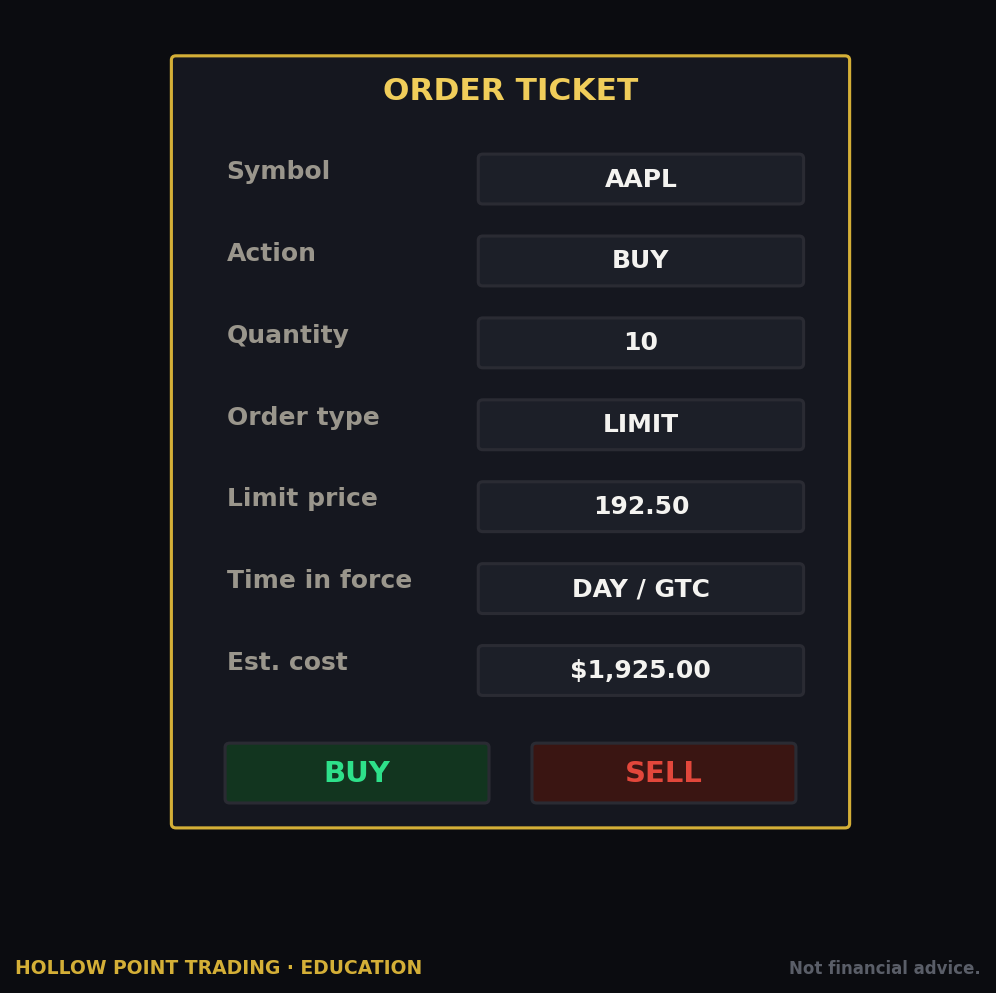
7. Fat-fingered size and price. Typing 1,000 instead of 100, or a limit that's actually a marketable order because you crossed the spread by a dollar without noticing. Read the ticket back before you send it — shares, price, side, time-in-force. Every time. The two seconds it costs is the cheapest insurance in trading.
8. No bracket — managing exits by hand and by nerves. The trader who enters first and "figures out the stop once I see how it acts" has already lost the discipline war. Without a pre-attached stop and target, every exit becomes an emotional decision made under fire — exactly the condition under which humans make their worst calls. Bracket the trade at entry or don't take it.
9. Not knowing which fill qualifier is toggled on. Leaving AON or FOK checked from a previous order and then wondering why your entry never fills, watching the move leave without you. Know your ticket's default state and check it.
10. Chasing a missed limit with a market order. Your limit didn't fill, price is running, and you panic-market into it at the worst price of the move — turning a clean missed trade into a bad chased one. A missed entry is free. A chased entry is where accounts go to die. Let it go; there's always another bus.
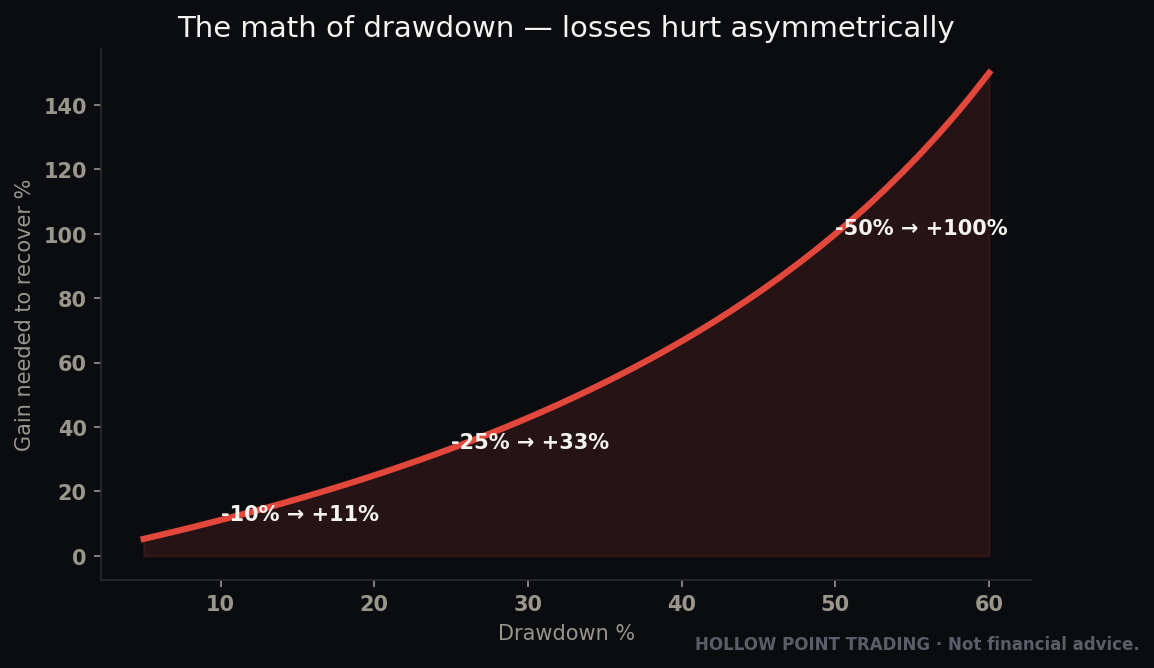
11. Moving the stop to avoid being stopped. The single most seductive mistake: price approaches your stop, and instead of honoring it, you widen it "just a little" to give the trade room. You've now abandoned your risk plan under the exact pressure it was built to resist, and turned a planned 1R loss into an unbounded one. The bracket exists precisely so this decision is never yours to make in the moment. If you find yourself dragging stops away from price, that is the tell your discipline is failing, not that the market is wrong.
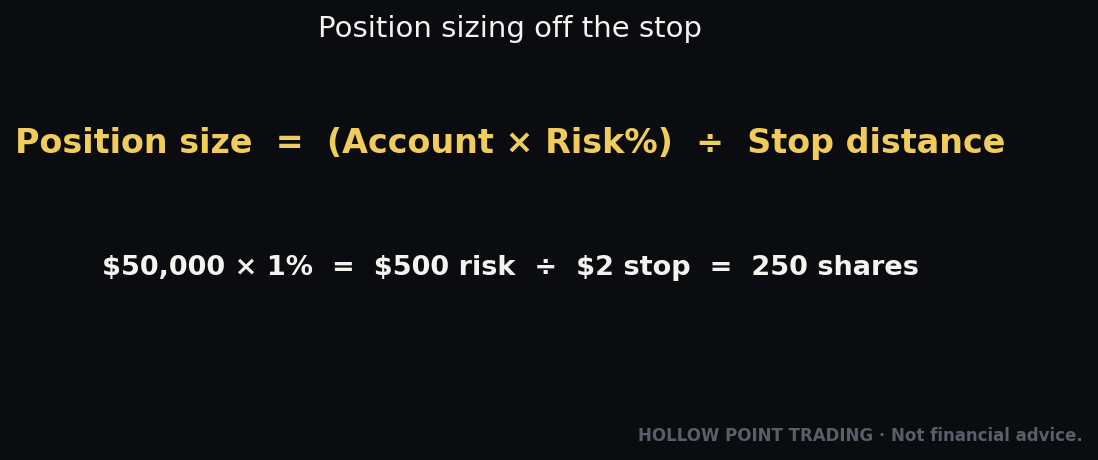
12. Ignoring the spread when sizing and setting targets. A target that looks like 1:3 on the mid-price can be 1:2.5 after you pay the spread to enter and pay it again to exit. In wide-spread names this quietly erodes every R/R calculation you make. Account for the round-trip spread when you set your target, or your real R/R is always worse than the number you talked yourself into.
Frequently Asked Questions
Should I ever use a plain market order? Yes — in three cases: a true emergency exit where you must be out at any price, a deeply liquid name (large-cap, major ETF, front-month e-mini) where the spread is a penny or a tick and speed matters, or a size so small the spread is trivial. Outside those, the marketable limit does the same job with a slippage cap and often gets you a better price.
Won't a marketable limit sometimes not fill? Only if the market moves past your cap in the instant your order arrives — which is exactly the runaway fill you wanted to avoid. In the common case it fills instantly, often with price improvement. Set the cap a few ticks through the market and it behaves like a market order 95% of the time and protects you the other 5%.
Where exactly should my stop go? Where the read breaks — the structural level that, if hit, invalidates your reason for being in the trade — and then a cushion beyond that level so a stop-run on the obvious price doesn't eject you before the real break. Never on a round number chosen for tidiness, and never so tight that normal noise triggers it.
Stop-market or stop-limit for protection? Stop-market, almost always, for a hard protective stop on a position you must exit. You accept slippage in exchange for the certainty of actually getting out. Save the stop-limit for entries and profit-taking, where missing the fill is acceptable and price control is the point.
How wide should a trailing stop be? Wide enough to survive the instrument's normal pullbacks on your timeframe — commonly 2–3x ATR, or a percentage that scales with volatility, or trailing off structure like prior swing lows. Never a tight fixed dollar amount that ignores how much the instrument actually moves.
What's the safest default time-in-force? Day. It expires at the close, so you never wake up to a forgotten order firing into a gap. Use GTC deliberately for resting limits at levels you're genuinely patient about, and audit your GTC orders regularly so none become zombies.
Do these order types work the same for futures, options, and crypto? The atoms and molecules are universal — every venue has market, limit, stop, and usually stop-limit and brackets. The details differ: futures and crypto trade nearly around the clock so "extended hours" behaves differently, options spreads are often wide enough that limits are mandatory not optional, and crypto liquidity can be shockingly thin off the major pairs. The principles — marketable limits over market orders, protective stops as stop-market, brackets to enforce R/R — carry across all of them.
Should I set my whole trade at once or leg in manually? Arm the whole trade as a bracket/OTOCO whenever you can. Legging in manually — enter now, add the stop later — is where discipline dies, because the "later" often never comes, or comes as a panicked decision under fire. The only good reason to leg is a deliberate scaling plan, which you can also pre-arm as a multi-target bracket.
What if the market gaps through my stop overnight? With a stop-market, you're filled at the open near wherever the gap landed — a worse price than your stop, but you're out and cannot be carried into a bigger loss. With a stop-limit, you may not fill at all and can be carried into a collapse. This gap risk is the single strongest argument for stop-market protection and for sizing so that even a bad gap fill is survivable.
The Cheat-Sheet
Pin this. It's the whole guide compressed to what you'll actually reach for on the ticket.
The two atoms
- Market — fills now, any price. Certainty of execution, zero price control. Pays the spread. Default only in the deepest names or true emergencies.
- Limit — fills at your price or better, or waits/never. Price control, zero execution certainty. Collects the spread.
The workhorses
- Marketable-limit — limit priced through the market. Market-order speed with a hard slippage cap, often with price improvement. Your default for entries and exits in liquid names.
- Stop-market — dormant market order above/below price; triggers to market. Your default protective stop. Guarantees exit, not price.
- Stop-limit — triggers to a limit. For entries and profit-taking. Can leave you unfilled in a gap — never your only protection.
Managing the runner
- Trailing stop (fixed) — stop trails a set $ distance below the high. Predictable; poor at high prices.
- Trailing stop (%/ATR) — trails a % or ATR multiple below the high; scales with price/volatility. Set to the instrument's real noise, never a round feeling.
The clocks
- Day — dies at the close. Sane default.
- GTC — lives until filled/canceled. Audit these or they become zombies.
- GTD — lives until a date you set. For a thesis with a shelf life.
- Extended-hours — pre/post market. Limit only. Thin, wide, dangerous.
The auction
- MOC / LOC — execute in the closing auction (market / limit). Deep liquidity, hard cutoff time. Miss the window and you're stuck.
The qualifiers
- FOK — all, now, or kill it.
- IOC — as much as possible now, cancel the rest.
- AON — all or none, but may wait.
The combinations (live here as a disciplined trader)
- OCO — one fills, the other cancels. Links your target and stop.
- OTO — parent fills → one child order fires.
- Bracket / OTOCO — entry fires → linked target + stop go live as OCO. This is the standard HPT structure — it makes 1:3 mechanical.
By regime
- Trend — aggressive orders are cheap; rest entry limits on pullbacks; ATR-trail the runner. Don't be so patient you miss it.
- Chop — fade the rails with limits; cushion stops beyond the range; expect breakout entries to fail.
- High-vol/news — marketable limits only; widen stops or size down; stand aside when the spread blows out; stop-limits can leave you exposed.
By timeframe
- Scalp (1–5m) — marketable limits, Day, tick-tight stops. Speed dominates.
- Intraday (15m–1H) — rest limits at levels, structural stops, Day/GTD.
- Swing (4H–D) — GTC limits to position, wide structural stops, volatility trails.
- Position (W) — widest stops, most patient limits, prune GTC zombies.
The master dial: every choice is certainty-of-execution vs. certainty-of-price. Name which one this trade actually needs before you pick the order.
The one-line rules:
- Default to marketable-limits, not market orders.
- Protective stops are stop-market. Accept slippage; buy certainty of exit.
- The stop goes where the read breaks, cushioned beyond the obvious level and its liquidity pool.
- Trail to volatility and structure, not to a number that feels nice.
- Match the order's clock and stop distance to the timeframe your confluence lives on.
- Read the regime before you pick the order; extended hours is limit-only.
- Bracket the trade at entry, or don't take it. Never widen a stop to avoid being hit.
- Read the ticket back before you send. Every time.
- A missed entry is free. A chased entry is expensive.
The read is the glory. The order is the discipline. You can be the best analyst in the room and still hand it all back at the checkout counter — or you can turn every clean read into the exact trade you designed, one armed bracket at a time. The market rewards the second trader. Be that one.
Bound by rules, feared by trade.