
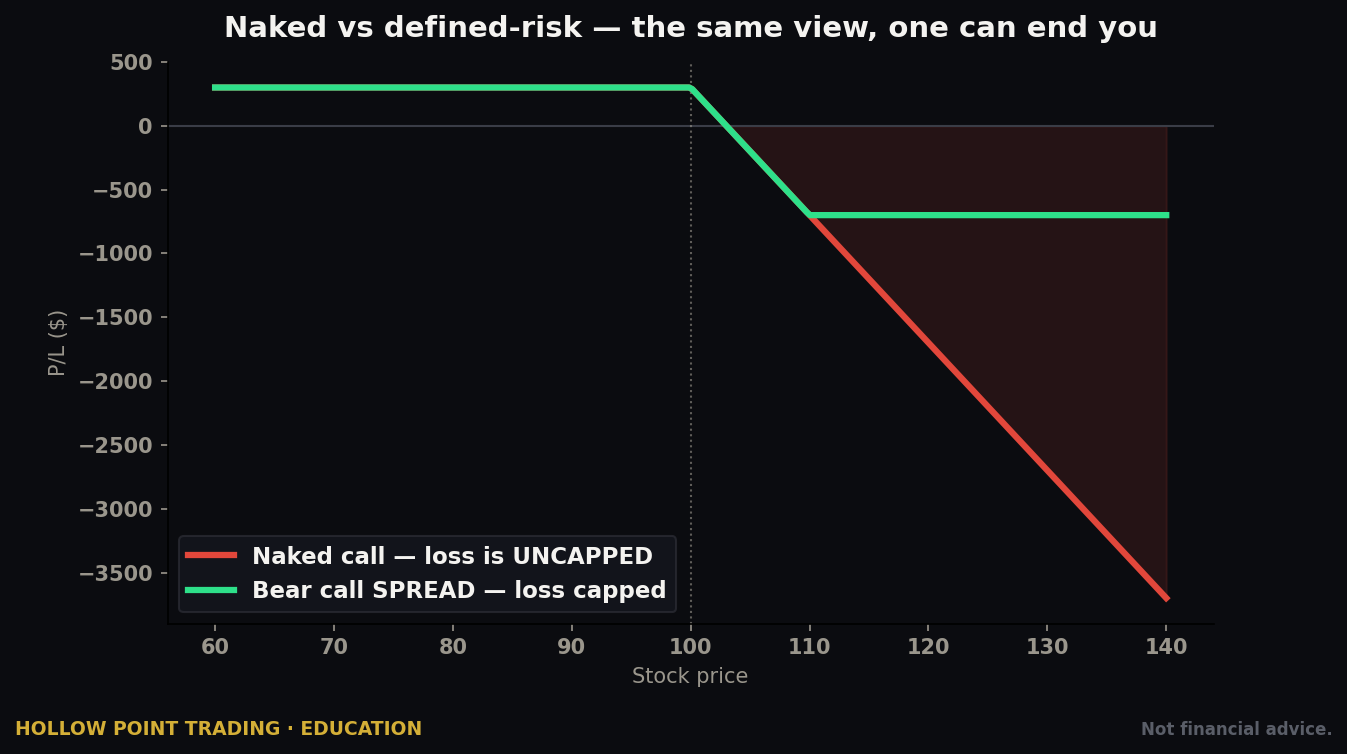
There's a particular seduction to selling options naked. You open the position and cash lands in your account the same minute. No stock to buy first. No long option decaying against you. Time is now on your side — every day that passes, the thing you sold gets a little cheaper to buy back, and the difference is yours. It feels less like trading and more like collecting rent.
That feeling is exactly why naked options destroy accounts. The premium is real and it shows up immediately. The risk is real too, but it's invisible until the day it arrives all at once. You spend weeks being paid to be roughly right, and then a single gap can hand you a loss larger than everything you collected over the entire year. This is the textbook definition of a negatively-skewed trade: small, frequent wins quietly financing a rare, enormous loss. The equity curve looks like a gentle staircase climbing to the right — until one bar punches straight through the floor.
Hollow Point doesn't tell you never to sell premium. Some of the most consistent traders alive are net sellers, and the edge they harvest is real and studied. We're telling you that if you do it, you do it with your eyes fully open — you understand the exact mechanism that hurts you, you size for the tail and not the average, and you know the defined-risk versions that keep almost all of the edge while cutting the catastrophe out. This is the guide we wish someone had forced on us before we learned it the expensive way, at 2 a.m., staring at a margin call on a name that gapped while we slept.
By the end you'll be able to read a naked position the way you read a chart: what it is, what it's worth, where it breaks, how it behaves in a trend versus a chop versus a volatility spike, and — most important — whether it belongs in your book at all. We're going to go deep. Slow down and read it twice; the money you keep is in the details most people skip.
The Concept: What "Naked" Actually Means
Every option is a contract. When you sell (or "write") one, you're taking on an obligation in exchange for a premium the buyer pays you up front. You are now short the option. The buyer has the right; you have the duty. That reversal of roles is the whole psychological trap — for your entire trading life you've been the one buying rights, and buying rights feels safe because your loss is capped at what you paid. Selling flips it. Now your loss is the open-ended side.
- Sell a call → you're obligated to deliver 100 shares at the strike price if the buyer exercises. You've promised to sell stock you may not own.
- Sell a put → you're obligated to buy 100 shares at the strike price if the buyer exercises. You've promised to buy stock, whether you want it or not, at a price you agreed to in advance.
The word naked (also called "uncovered") describes what backs that obligation. It means you're holding the short option without the offsetting position that would cap your risk.
Covered versus naked: it's about the collateral, not the contract
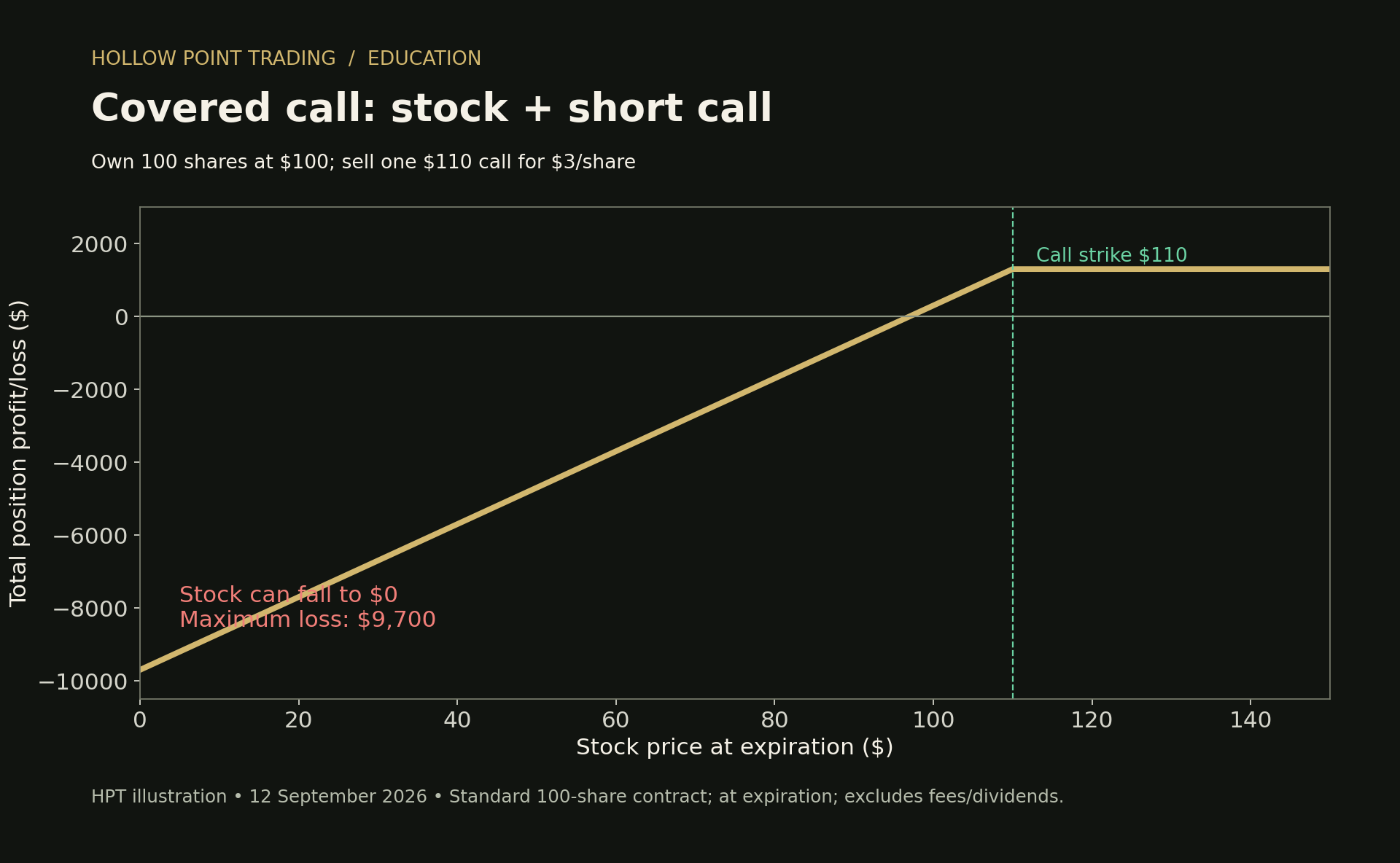
- A covered call is a short call with the 100 shares sitting in your account. If you get assigned, you already own the stock — you just hand it over. Your risk is defined because you own the underlying; the worst that happens is you sell your shares lower than you'd like.
- A naked call is a short call with no shares behind it. If you get assigned, you have to go buy 100 shares at whatever the market price is — which could be anything — and sell them at the strike. There is nothing capping how high that price can go.
Same logic on the put side:
- A cash-secured put (CSP) is a short put where you've set aside the full cash to buy the shares if assigned. The put is "secured" by cash you've already earmarked and are willing to spend.
- A naked put is a short put where you haven't set that cash aside. You're leaning on margin. If assigned, you owe money you may not readily have, and the broker will come looking for it immediately.
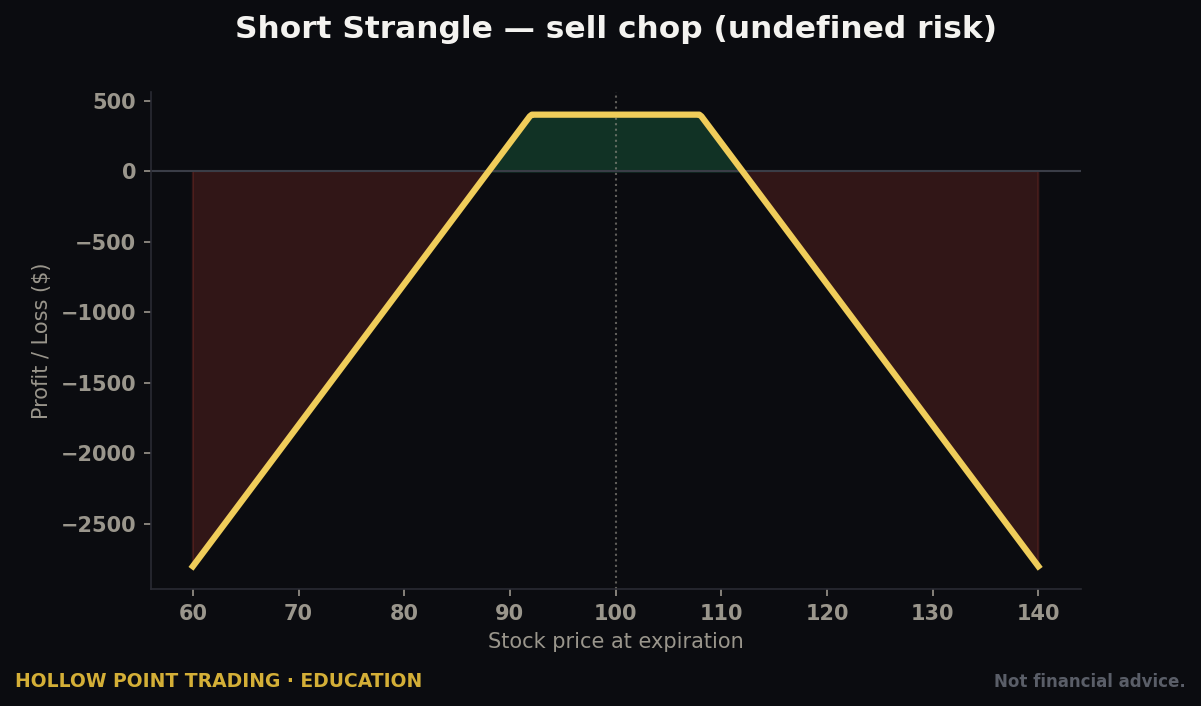
So "naked" isn't a different kind of option. It's the same short call or short put — stripped of the collateral that would have made the loss bounded and the assignment painless. Naked is a balance-sheet condition, not a contract type. This is the single most important reframe in the entire guide: you are not choosing a riskier instrument, you are choosing to hold the same instrument with less capital standing behind it. The option doesn't know or care whether you're covered. The market move is identical. Only your ability to survive it changes.
The nuance that unlocks everything
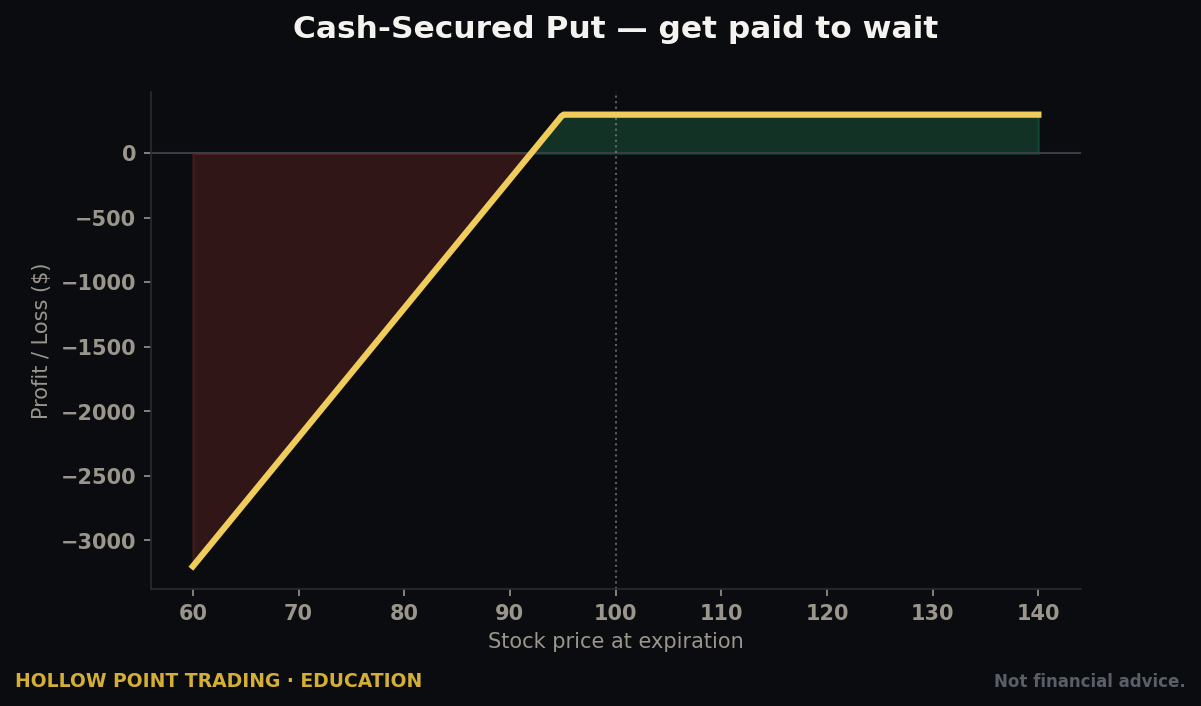
One point that trips up beginners constantly: a cash-secured put and a naked put have the identical risk profile at expiration. The profit-and-loss chart is exactly the same shape. If the stock goes to zero, both lose the same amount of money. The only difference is whether you've pre-committed the cash — whether, when assignment comes, you can honor the trade calmly or you get dragged into a forced liquidation.
That's why brokers and experienced traders often lump CSPs in with "selling puts" generally — the market risk is the same; the CSP just guarantees you can pay the bill without a margin call. Hold that thought, because it's the key that unlocks the whole risk conversation. Securing cash doesn't make you right. It makes you solvent. Those are two completely different forms of protection, and confusing them is where a lot of "conservative" put-sellers quietly take on far more risk than they think.
The Mechanism: How the Risk Is Actually Built
Let's get precise about where the money comes from and where it goes, because "unlimited risk" gets thrown around loosely and you need to feel the geometry in your gut, not just nod at it.
The payoff shape of a short option
When you sell an option, your best possible outcome is fixed: you keep the entire premium. Not a penny more. If you sell a call for $2.00 (that's $200, since one contract controls 100 shares), the absolute most you will ever make on that trade is $200. Your upside is a flat ceiling — a horizontal line that never rises no matter how right you are. Being more right doesn't pay you more. The stock can go exactly where you want and stay there; you still only collect the $200.
Your downside, though, is a slope. And the slope depends on which side you sold.
Naked call — the unlimited-risk one. You sold the right to buy stock from you at the strike. If the stock rips higher, the buyer exercises and you must deliver shares you don't own. To deliver them, you buy at the market. There is no ceiling on a stock price. A takeover bid, a short squeeze, a surprise drug approval, a viral product — a stock can double or triple overnight. Your loss is (market price − strike) × 100, minus the premium you collected. As the price climbs with no bound, so does your loss. This is the only common retail trade with genuinely uncapped, theoretically-infinite loss. That phrase is not marketing. It's the literal shape of the math: a straight line sloping down forever as price goes up.
Naked put — the catastrophic-but-not-infinite one. You sold the right to sell stock to you at the strike. If the stock craters, the buyer exercises and you must buy at the strike price while the market price is far below it. Your worst case is the stock going to zero: you're forced to buy at the strike and the shares are worthless. So your max loss is (strike − 0) × 100 − premium, i.e. strike price × 100 minus premium collected. Enormous, but bounded — a stock can't fall below zero. Selling a $50 put means your theoretical worst case is losing $5,000 per contract (minus premium). Not infinite, but plenty to wreck an undersized account, and gaps to zero (fraud, bankruptcy, a failed binary) happen more often than the tidy statistics suggest.
Notice the asymmetry in both cases: a fixed, small ceiling of reward sitting on top of a large or unbounded floor of risk. You are being paid a defined wage to underwrite an undefined liability. That is the shape of every insurance policy ever written — and it is a perfectly good business if and only if you price it, size it, and reserve for it like an insurer. Do it like a gambler and it's the shape of ruin.
Break-even, and the zone where you're quietly bleeding
There's a middle region people ignore. On a naked put sold at $45 for $1.20, your break-even at expiration is $43.80 (strike minus premium). Between $45 and $43.80 you're technically assigned but still net positive because the premium cushions you. Below $43.80 you're losing real money. On a naked call sold at $115 for $2.00, break-even is $117. The stock can push slightly past your strike and you're still fine — the premium is a buffer. Understanding this buffer is what lets you place strikes intelligently: you don't need to be right that the stock never touches your strike, only that it doesn't blow decisively through your break-even. That's a much easier bet to win, which is exactly why sellers win often. The trap is mistaking "wins often" for "wins big net of the losses."
Why time and volatility are on your side (usually)
The reason people sell these despite the risk is that options are decaying assets. Two forces work in the seller's favor, and you should know both by name.
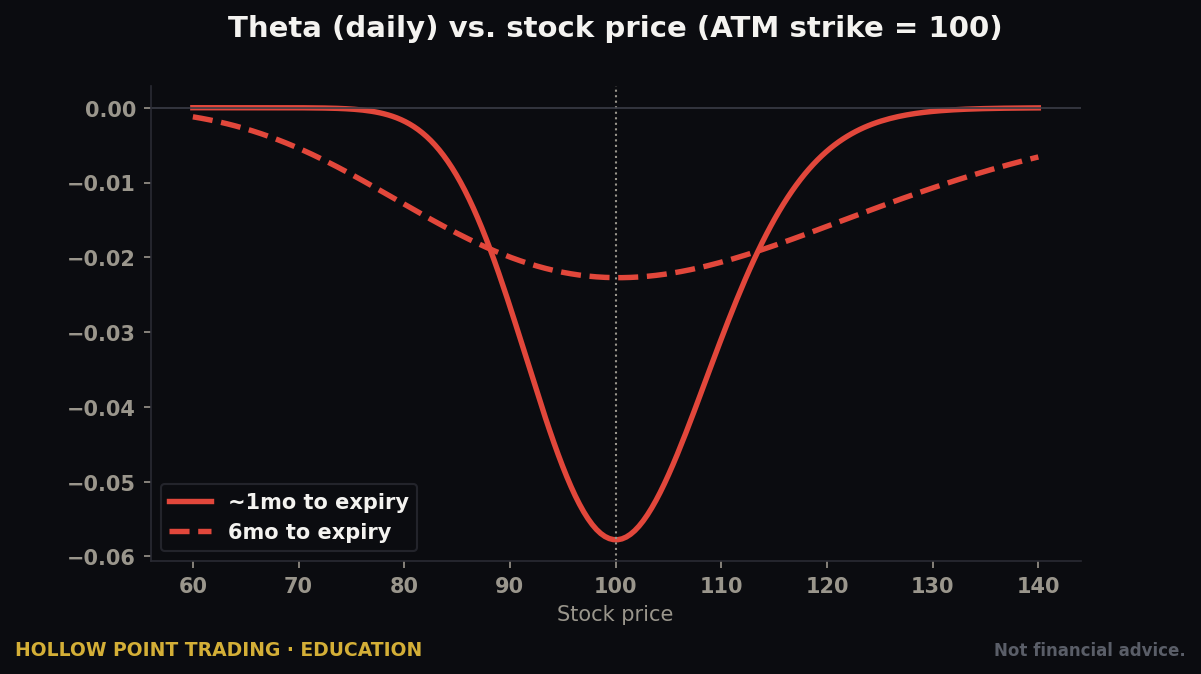
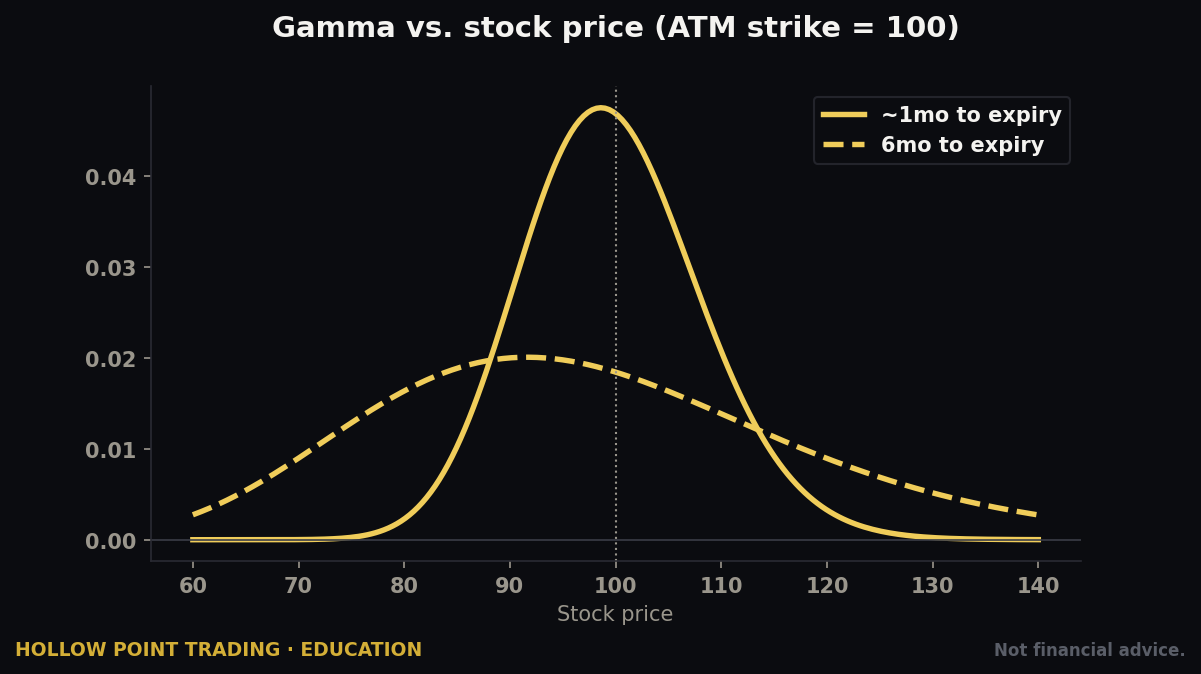
- Theta (time decay). An option is worth more when there's more time for the buyer to be right. Every day, all else equal, the option you sold loses a bit of value — and since you want to buy it back cheaper (or let it expire worthless), that decay is money flowing to you. Theta accelerates as expiration approaches; the last few weeks of an option's life is where decay is steepest. This is why premium sellers often cluster around the 30-to-45-days-to-expiration window: enough premium to be worth collecting, close enough to expiration that decay is meaningfully working, but not so close that gamma risk (the speed at which your losses accelerate near the strike) becomes a razor's edge.
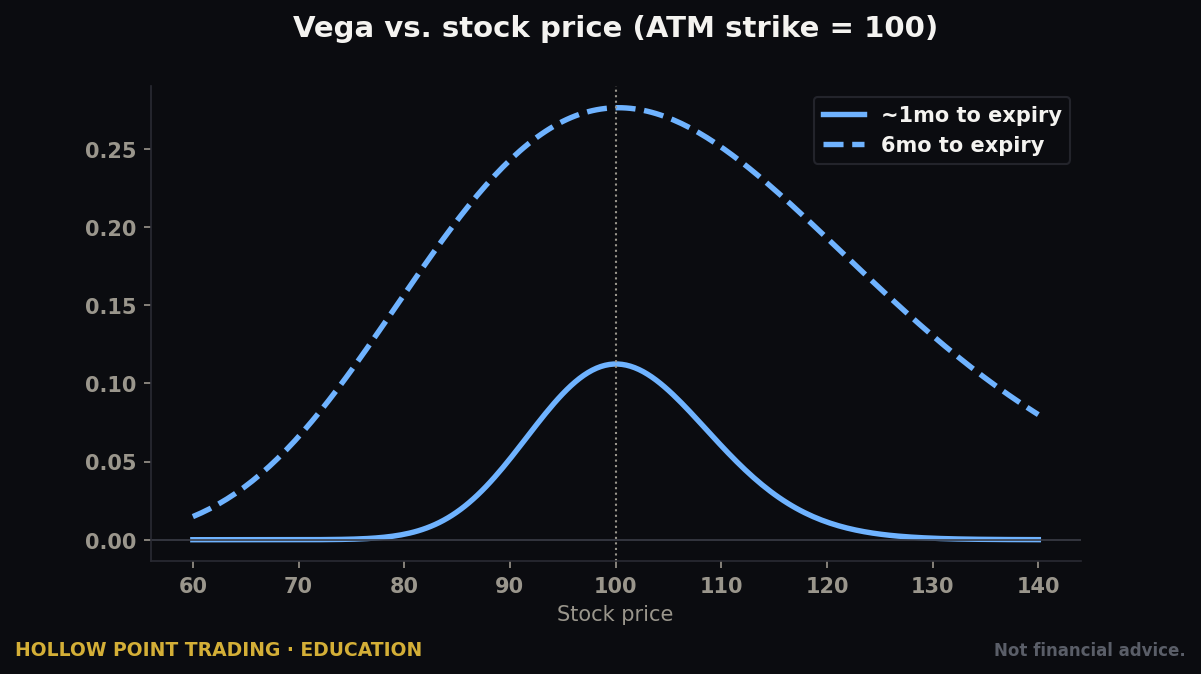
- Volatility (vega) and the variance risk premium. Options are usually priced with implied volatility higher than the volatility that actually gets realized. In plain English: the market tends to overpay for insurance. Sellers harvest that gap — the "variance risk premium" — and it is a real, studied, persistent edge across decades of data. But it is compensation for taking on tail risk, not a free lunch. You are the insurance company. You collect steady premiums and occasionally pay a giant claim. The edge exists precisely because the claim is real and painful enough that most people won't underwrite it.
That last framing is the whole game. A naked-options seller is running a tiny insurance company. Insurers are profitable across cycles precisely because they price carefully, diversify across uncorrelated policies, hold reserves against claims, and never write a single policy that can bankrupt them. Retail naked sellers blow up because they do the opposite — they concentrate in one or two names, under-reserve, chase the fattest premiums (the riskiest policies), and write positions far too large for their capital. The math of the edge is sound. The implementation is where fortunes die.
The Greeks a seller must actually watch
You don't need a PhD, but four numbers should never be a mystery to you when you're short premium.
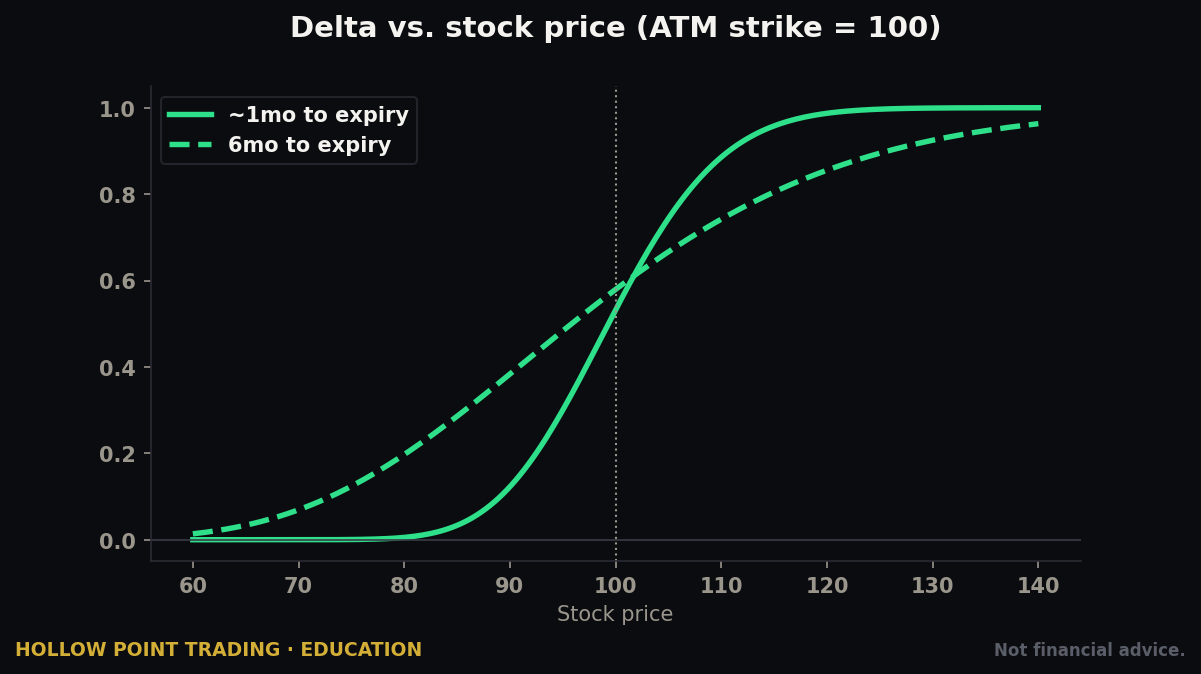
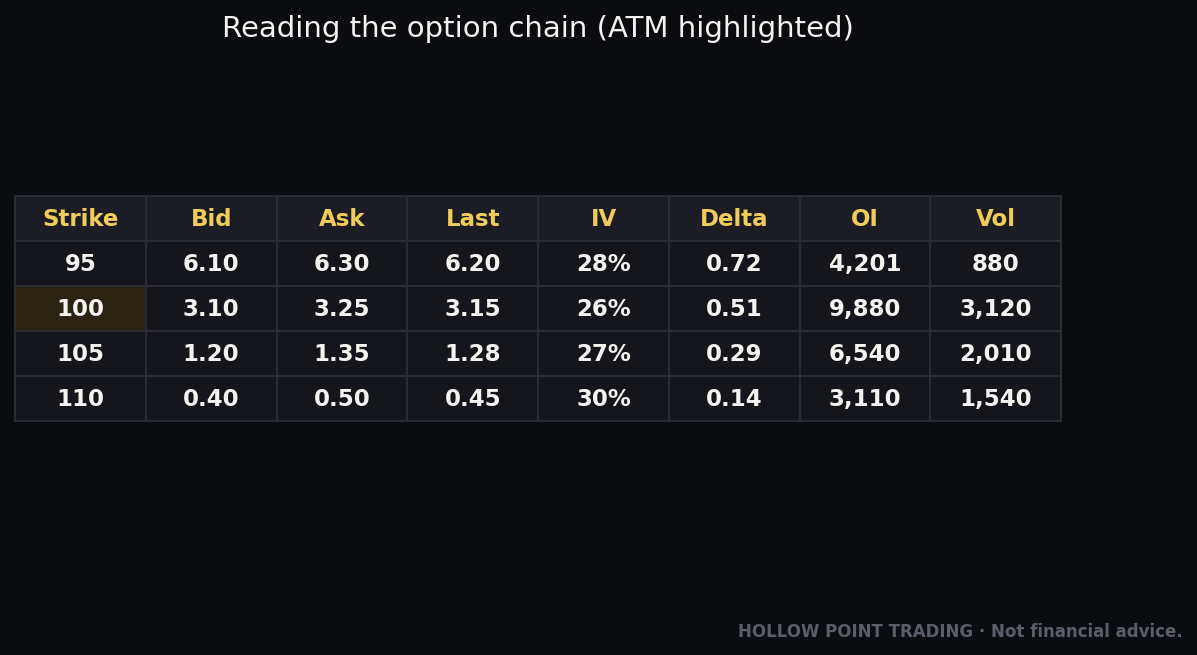
- Delta tells you your directional exposure and doubles as a rough probability. A short put with a delta of −0.30 behaves like being long about 30 shares and has roughly a 30% chance of finishing in-the-money. Sellers often target the 0.15–0.30 delta band: far enough out to win often, close enough in to collect real premium.
- Theta is your daily wage — the dollars of decay flowing to you each day if nothing else moves. It's the number that makes you feel smart in a quiet market.
- Vega is your exposure to a volatility spike. A short option is short vega: if implied volatility jumps (a market scare, an approaching event), the option you sold gets more expensive to buy back even if price hasn't moved against you. Sellers get hurt by vol expansion, helped by vol contraction.
- Gamma is the accelerator. As price approaches your strike near expiration, your delta changes fast — losses (and the pace of them) speed up. This is why a position that looked calm all month can go from "fine" to "screaming" in a single session close to expiry. Naked sellers who ignore gamma get run over in the final week.
The clean mental model: you are long theta, short vega, short gamma, and directionally exposed via delta. You get paid a little every day (theta) for holding a bomb that goes off when volatility spikes (vega) and accelerates as it nears your strike into expiration (gamma). Respect all four or one of them will find you.
Margin and buying power: how brokers gate the trade
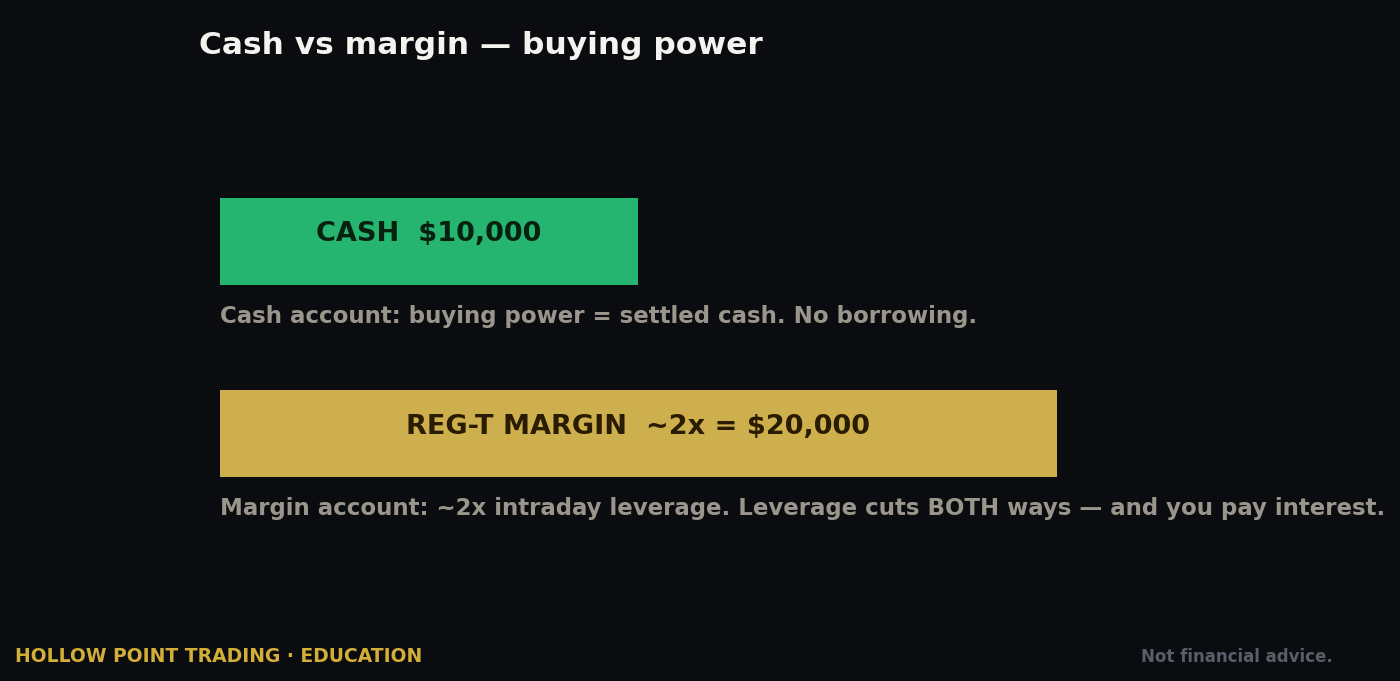
Because a naked call has unlimited risk, the broker won't let you post it against nothing. They require you to hold margin — collateral to cover a plausible adverse move. Under standard Reg-T rules, a naked equity option's margin requirement is roughly:
The greater of: 20% of the underlying stock value, minus the amount the option is out-of-the-money, plus the premium received — or 10% of the underlying value plus the premium (a floor). Index options use a 15% figure instead of 20%.
Numbers make it concrete. Stock trades at $100. You sell a naked call at the $110 strike for $1.50.
- 20% of underlying = $20/share = $2,000 per contract.
- Minus out-of-the-money amount ($110 − $100 = $10/share = $1,000).
- Plus premium ($1.50 × 100 = $150).
- = $2,000 − $1,000 + $150 = $1,150 held per contract.
That $1,150 is buying power reduction — capital frozen for as long as the position is open. Note what it is not: it is not your maximum loss. It's the broker's estimate of a near-term adverse move, and a fairly gentle one at that. If the stock jumps to $130, your actual loss dwarfs the margin that was held, and the broker issues a margin call demanding more collateral immediately — often forcing liquidation at the worst possible moment, at the worst possible price, with no say from you. The margin number lulls you; the payoff diagram is the truth.
Two more layers you must know:
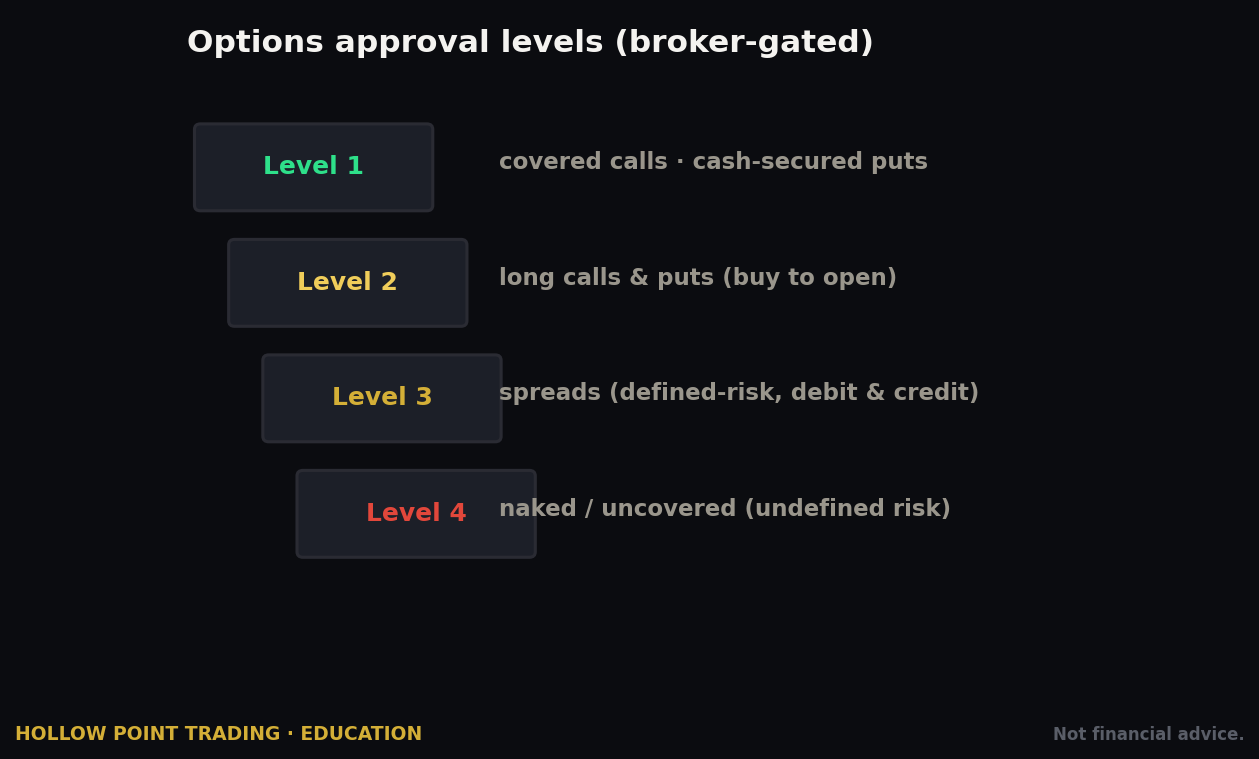
- Options approval levels. Brokers tier options permissions. Naked selling (especially naked calls) is typically the highest tier — Level 4 or 5 at most retail brokers — requiring the largest account, the most experience disclosed, and margin approval. Many brokers won't grant naked-call writing to retail at all, or only on cash-settled indexes. This gating isn't bureaucracy for its own sake; the firm is on the hook if you can't cover, so they've priced your recklessness into their rules.
- Portfolio margin vs Reg-T. Larger accounts (typically $125K+ minimum) can qualify for portfolio margin, which sizes the requirement on a risk model of your whole book rather than position-by-position. It can dramatically lower the capital held — which sounds great and is exactly how sophisticated traders get over-leveraged. Lower margin does not mean lower risk. It means the same tail can now hit an account holding far less reserve against it. Portfolio margin is a scalpel in a surgeon's hand and a chainsaw in an amateur's.
How to Read and Use It: Worked Examples
Let's run the actual trades, win and lose, so the mechanics live in your hands instead of your head.
Example 1 — The cash-secured put that works (and the naked put that's identical until it isn't)
You like a quality name — call it XYZ, trading at $50. You'd genuinely be happy to own it at $45. You sell the 30-day $45 put for $1.20.
- Premium collected: $1.20 × 100 = $120.
- If you're cash-secured, you set aside $45 × 100 = $4,500.
- Buying power used (CSP): the full $4,500. Buying power used (naked, on margin): roughly $900–$1,000 under Reg-T — a fraction.
Outcome A — stock stays above $45. The put expires worthless. You keep the $120. On the CSP, that's $120 / $4,500 = 2.7% in a month on the cash you tied up (~32% annualized if you could repeat it — you can't always, but the math is why people love it). On the naked version, it's $120 / ~$950 held = ~12.6% on capital used. See the leverage? The naked version looks four to five times more efficient. That efficiency is the trap: it's the same $120 of reward carrying the same catastrophe, just against a quarter of the reserve. The return-on-capital number flatters you into forgetting that the denominator is smaller because you removed the safety, not because you removed the risk.
Outcome B — stock falls to $40, you're assigned. You must buy 100 shares at $45 = $4,500. They're worth $4,000. Your unrealized loss is $500, offset by the $120 premium = net −$380, and you now own 100 shares of a stock you liked at a cost basis of $43.80. If you were cash-secured, this is fine — you had the $4,500, you wanted the stock, you're a long-term holder now, and you can even start selling covered calls against it (the Wheel — more on that below). If you were naked on margin, you just had $4,500 of buying power consumed instantly, and if you don't have it, you get a margin call and forced liquidation into the decline, crystallizing the loss at the ugliest moment. Same trade. Completely different survivability. That is the entire argument for cash-securing in one paragraph.
Outcome C — the blow-up. XYZ turns out to be a biotech, the drug fails, and it gaps from $50 to $8 overnight on a Wednesday. You're assigned at $45 on shares worth $8. Loss: ($45 − $8) × 100 − $120 = −$3,580 on a trade that could only ever have made you $120. That's a 30-to-1 loss-to-max-gain ratio realized on a single bad print. Cash-secured or not, the market loss is the same — securing the cash protects you from a margin call, not from being wrong about the drug. This is the number that should be tattooed on the inside of your eyelids: you risked $3,580 to make $120. No stop-loss would have saved you; the move happened while the market was closed.
Example 2 — The naked call, and why "unlimited" isn't hypothetical
ABC trades at $100. It's been range-bound for months, implied vol is juicy, and you sell the 30-day $115 call for $2.00 — collecting $200. Feels safe: the stock has to rally 15% just to reach your strike, and it hasn't moved 15% in a quarter.
- Margin held (from our formula): ~$1,150 per contract.
Outcome A — stock stays below $115. Call expires worthless, you keep $200. ~17% on capital held in a month. Beautiful. Do it a few times, watch it work every single time, and you feel invincible. This is the phase that builds the false confidence — the quiet, profitable months that teach you exactly the wrong lesson: that the tail isn't real because you haven't met it yet.
Outcome B — the squeeze. ABC gets a buyout offer at $150. It gaps overnight — no chance to react, no stop that fills at your price, no time to buy the stock cheaper first. You're assigned: obligated to sell 100 shares at $115. You don't own them, so you buy at $150. Loss: ($150 − $115) × 100 − $200 = −$3,300. On margin of $1,150. You're not just down — you're getting a call for capital you may not have, on a stock that could keep climbing if a competing bidder emerges and pushes the deal terms higher. The "unlimited" wasn't a figure of speech. It was a Tuesday, and it kept going Wednesday.
The asymmetry is the point. On the naked call you risked an unbounded loss to make $200. There is no version of this trade where the reward justifies the raw tail — you survive only because the tail is rare. Rare is not never, and "it's never happened to me" is the most dangerous sentence in a premium seller's vocabulary. Every blown-up seller said it, right up until the morning they couldn't anymore.
Example 3 — A defined-risk seller through the same buyout
Now run the identical ABC buyout, but you sold a bear call spread instead: short the $115 call for $2.00, long the $120 call for $1.00, net credit $100. ABC gaps to $150. You're assigned on the short $115, but you exercise your long $120 to buy the shares. Your loss is capped at the strike width minus credit: ($120 − $115) − $1.00 = $4.00 × 100 = $400. That's it. The $3,300 disaster became a $400 paper cut. Same catalyst, same gap, same overnight helplessness — a completely different outcome, because you spent $100 of your premium buying back the tail before you ever needed it. This is the entire argument of the guide compressed into one comparison, and we'll build it out fully in a moment.
Reading assignment and pin risk
Two mechanics you must understand cold before expiration Friday.
Assignment is when the option buyer exercises their right and you're on the hook. American-style equity options can be assigned any time before expiration, though early assignment mostly happens when an option is deep in-the-money or right before an ex-dividend date (call holders exercise early to capture the dividend, leaving you assigned and short the stock, now on the hook for the dividend too). You don't choose when you're assigned — it's random, allocated by the clearinghouse to someone holding the short side. Wake up, and you may already be long or short 100 shares per contract, with a new set of risks you didn't have when you went to sleep.
Pin risk is the nightmare of expiration when the stock closes right at your strike — say ABC settles at exactly $115.00. You genuinely don't know whether you'll be assigned; it depends on choices other people make after the close. If you assume you won't be and you are, you wake up Saturday unexpectedly short 100 shares, exposed to whatever the stock does Monday at the open — a weekend of naked directional risk you never intended to hold, over headlines you can't predict. The fix is simple and non-negotiable: close short options that are near-the-money before expiration. Don't gamble on the pin. Buy the thing back for a few cents and remove all doubt. The cost of closing is trivial; the cost of a surprise weekend position is not.
How Naked Selling Behaves in Different Market Regimes
The same trade is a different animal depending on the weather. This is the section most income-chasers never think about, and it's where the survivors separate from the statistics.
Trending markets
In a clean, sustained trend, one side of the premium trade is the wind at your back and the other is a windshield. Selling puts under a strong, orderly uptrend is selling insurance nobody collects on — the stock keeps drifting up and away from your strikes, and you print. Selling calls into that same uptrend is repeatedly getting run over as the stock grinds through your strikes; you keep getting "just barely" tagged. The lesson: in a trend, sell premium on the side the trend defends, and leave the other side alone. The classic beginner error is selling calls to "fade" a strong uptrend because the premium looks fat near resistance — you are standing in front of the freight train to pick up nickels.
Choppy, range-bound markets
Chop is the premium seller's paradise — for a while. When a stock oscillates in a defined range, both short puts (at range support) and short calls (at range resistance) decay in your favor because price keeps reverting to the middle. This is the ideal regime for iron condors: sell both sides, collect both premiums, let the range do the work. The danger is that ranges end, usually with a violent breakout in one direction, and the breakout tends to come right when the range has lulled everyone into maximum size. Sell the range, but keep your strikes outside the range's edges, keep size modest, and respect that the day the range breaks is the day you find out whether you were an insurer or a gambler.
High-volatility / crisis regimes
When volatility spikes — a market crash, a credit event, a geopolitical shock — three things happen to a naked seller at once, and they compound. First, your existing short options explode in value (short vega) even before price hits your strikes, showing you large paper losses. Second, correlations go to one: the diversification you thought you had across names evaporates as everything sells off together, so your "spread out" put book behaves like one giant concentrated bet. Third, margin requirements increase precisely when your buying power is already stressed, triggering calls. This trifecta is how leveraged put-sellers detonate in a single week during a crash. The counterintuitive truth: high-vol regimes offer the fattest premium and are the worst time to be naked-selling with size. The premium is fat because the danger is real. If you sell into a vol spike at all, you do it small, defined-risk, and with the explicit understanding that you're catching a falling knife for the premium.
The regime read isn't a footnote to the trade — it is the trade. The same $45 put is a rent check in a calm uptrend and a live grenade in a credit crisis. Know which one you're holding.
The Multi-Timeframe Read on a Short Option
A short option is a bet that price stays on one side of a level for a defined window. That makes it inherently a multi-timeframe question, and HPT's timeframe-weighted confluence applies directly — just inverted from a directional entry.
Match the timeframe to the expiration
Your holding period is the option's life. A 30-45 DTE short put is a multi-week bet, so the timeframes that matter are the daily and weekly — those define whether your strike sits under real, durable support. A weekly put-selling program has no business being managed off a 5-minute chart; the noise will shake you out of trades that the higher timeframe says are fine. Conversely, a 0-7 DTE short (an aggressive, gamma-heavy trade only advanced traders should touch) lives and dies on the intraday structure. Pick the chart that matches the clock on your option.
Stack the timeframes for confluence on the strike
For a short put you want the higher timeframes agreeing that your strike is defended. The ideal setup: the weekly says uptrend (higher highs, higher lows, price above a rising structure), the daily shows a clear support shelf or moving-average confluence sitting at or just above your strike, and the hourly shows buyers actually stepping in when price approaches that zone. Three timeframes pointing the same way at your strike is confluence backing your obligation. One timeframe screaming the other way — say the weekly rolled over even though the daily looks fine — is a veto, not a "we'll see."
For a short call, invert it: weekly downtrend or topping structure, daily resistance sitting at or just below your strike, hourly showing sellers appearing there. Your strike wants to live behind a wall that price has to break on multiple timeframes to hurt you.
The higher-timeframe trend is the tiebreaker
When timeframes disagree, weight the higher one. A stock can look bearish on the hourly inside a healthy weekly uptrend — that's a dip, and selling puts into it is often the trade. But a stock that looks bullish on the hourly inside a broken weekly downtrend is a bounce in a bear, and selling puts there is stepping in front of the dominant flow. The daily 55-EMA is your fastest read on which world you're in. Don't let a pretty intraday chart talk you out of what the weekly is telling you.
How It Fits the HPT Top-Down Process
Here's where Hollow Point diverges from the premium-selling crowd. Most naked-option content treats these as pure income mechanics — a yield machine you point at high-IV names and harvest. We don't. A short option is still a directional and volatility bet, and it goes through the same top-down filter as every other trade in the book: macro → sector → stock → timeframe-weighted confluence → risk.
Macro first. Selling puts is a bullish-to-neutral position; selling calls is bearish-to-neutral. You never put either on against the macro tide. If the Fed is hawkish, credit spreads are widening, and the broad tape is risk-off, selling naked puts on a high-beta name is selling insurance right as the storm rolls in — exactly when the tail you're short becomes most likely and most violent. Premium is fattest precisely when the environment is most dangerous, because the market is pricing that danger correctly. Getting paid more to sell is the market warning you, not rewarding you. Read the macro before you read the option chain, every time.
Sector second. Is the group in favor? A short put on a leader in a strong sector has the wind behind it. A short call on a laggard in a rolling-over sector aligns your obligation with the path of least resistance. If the sector's a coin flip, you have no business selling uncapped risk into it. Relative strength between sectors tells you where the flows are going; sell puts where money is rotating in, sell calls where it's rotating out.
Stock and structure third. Now the chart. The EMA 12/22/55 framework is your trend arbiter. Sell puts under rising, stacked EMAs (12 over 22 over 55, price above) where you'd be assigned into a genuine support zone you'd want to own. Sell calls below declining, stacked EMAs where your strike sits above clear resistance. The daily 55-EMA is the bias tell — don't sell puts on a stock living below a falling 55, and don't sell calls on one riding a rising one. Your strike should sit on the far side of real structure — a level the stock has to fight through to hurt you, not empty air where nothing stops the move.
Timeframe-weighted confluence. The discipline from the section above plugs in here: higher timeframes agreeing that your short strike is defended, with lower timeframes confirming buyers or sellers show up at the level. Confluence backing your obligation is the whole point — you are not "selling premium," you are selling premium at a level the tape defends.
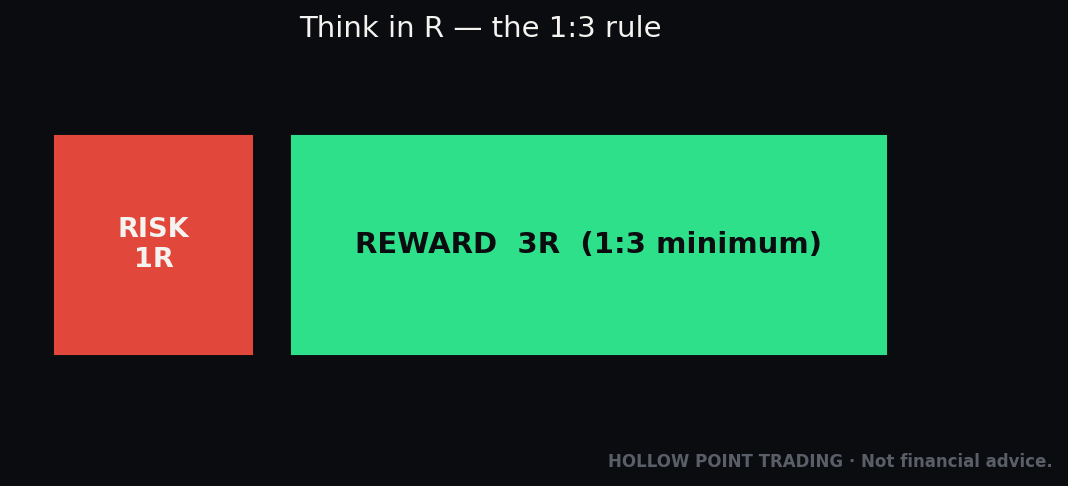
And then — the part almost nobody does — risk. This is where HPT's 1:3 R/R rule collides with naked selling and forces an honest reckoning. A naked option is structurally the opposite of 1:3. You're risking a large, sometimes unbounded number to make a small defined premium — often 1:3 the wrong way, or 30:1 the wrong way as Example 1 showed. You cannot make a raw naked call obey 1:3 R/R; the geometry forbids it. Which is precisely why HPT's answer is almost always the defined-risk version — the spread that converts the trade back into a bounded, measurable risk you can actually size to a rule. The top-down process doesn't just tell you whether to sell premium; it tells you the naked version usually fails our own risk mandate the moment it's on. That failure isn't a reason to abandon premium selling. It's a reason to structure it correctly.
Confluence: Combining Premium Selling With Other HPT Tools
A short strike placed in isolation is a guess. A short strike stacked with independent confirmations is a position. Here's how premium selling pairs with three tools you already run.
Confluence 1 — Fibonacci and the golden pocket
The 0.618–0.65 golden pocket of a healthy pullback is where trends resume. That makes it prime real estate for a short put strike in an uptrend: sell the put at or just below the golden pocket of the last impulse leg, so you're getting assigned exactly where dip-buyers historically reload. If the stock is retracing a move from $40 to $60, the golden pocket sits around $47.30–$47.60; a short put at the $45 or $46 strike sits just under it, defended by both the fib and the round number. Two independent reasons the stock should hold your strike is worth more than either alone.
Confluence 2 — Volume profile POC, VAH, and VAL
The volume profile tells you where the stock has accepted price — the fat part of the distribution. The Value Area Low (VAL) is a natural floor: sell puts at or below it and you're leaning on the price level the market has already agreed is cheap. The Value Area High (VAH) is the mirror for calls. The Point of Control (POC) is a magnet — you generally don't want a short strike sitting right at the POC, because price gravitates there and chops around it. Place strikes outside the value area, where acceptance thins out and the market has historically rejected. This single filter keeps you from selling premium into the exact zone price loves to revisit.
Confluence 3 — Options positioning (gamma walls and GEX)
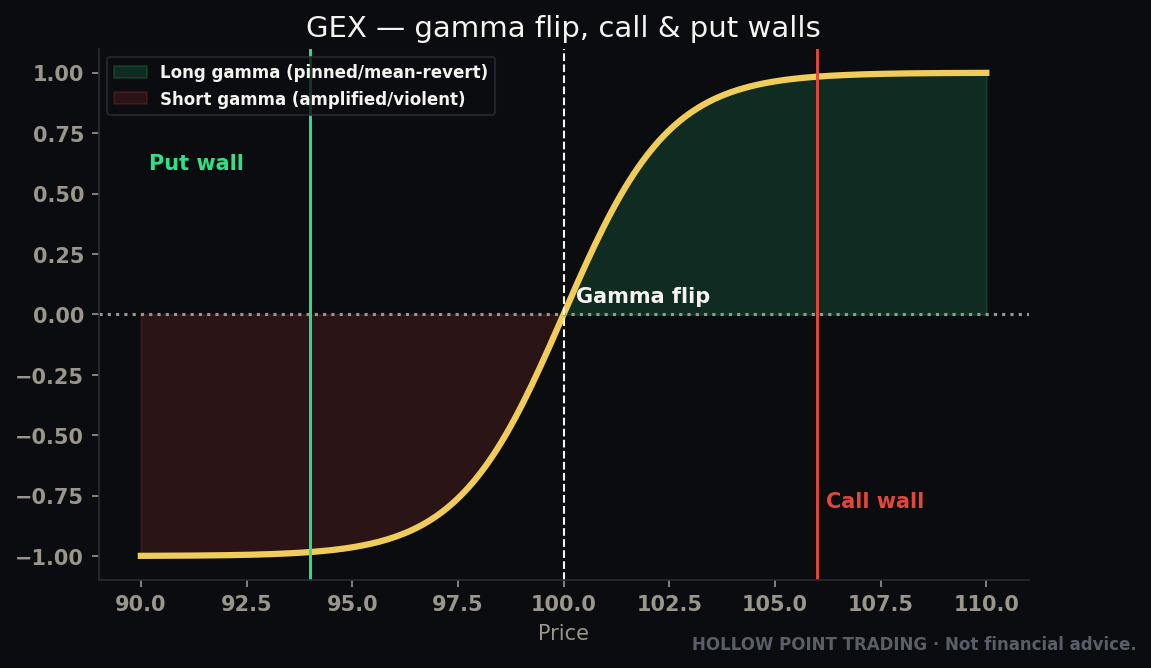
If you have gamma exposure data, it's a gift to a premium seller. Large call walls act as resistance ceilings — a short call spread with its short strike at or just below a heavy call wall is leaning on dealer hedging that tends to cap price there. Large put walls act as support floors for short puts. The gamma flip level tells you whether dealers are dampening moves (positive gamma, mean-reverting, good for range-selling) or amplifying them (negative gamma, trending and violent, dangerous for sellers). Selling a condor when the whole complex is in positive-gamma mean-reversion is playing with the house; doing it in negative gamma is playing against a casino that just turned the volatility up. When the walls, the fibs, and the volume profile all point to the same defended level, that's the strike. When they conflict, you don't have a trade — you have a hope.
The Defined-Risk Alternatives: Keep 90% of the Edge, Cut the Catastrophe
You almost never need to be naked. For a small, known cost, you can buy back the tail and keep most of the income. This is the single most important section for your survival, so slow down here and read every line.
The credit spread — the naked seller's seatbelt
Instead of selling a naked option alone, you sell your option and buy a cheaper, further-out option as protection. The bought leg caps your loss at a fixed, known number. That's the whole idea, and it changes everything.
Bull put spread (the defined-risk version of a short put): Sell the $45 put for $1.20, and buy the $40 put for $0.40. Net credit: $0.80 = $80. Your max loss is now the width of the strikes minus the credit: ($45 − $40) − $0.80 = $4.20 × 100 = $420, and not a dollar more. Compare to the naked put's $3,580 blow-up in Example 1 — the $40 long put you bought for $40 caps the entire catastrophe. You gave up $40 of the original $120 premium (kept 67% of the income) to eliminate a $3,000+ tail. On a risk-adjusted basis it isn't close, and it isn't even an argument.
Bear call spread (the defined-risk version of a short call): Sell the $115 call for $2.00, buy the $120 call for $1.00. Net credit $100. Max loss: ($120 − $115) − $1.00 = $4.00 × 100 = $400 capped. That buyout-to-$150 scenario that cost the naked seller $3,300? The spread seller loses exactly $400, as we saw in Example 3. The long $120 call delivers the shares. The unlimited risk is gone — converted into a number you chose in advance, before you ever put the trade on.
Yes, you collect less premium. But look at what the trade becomes:
- Loss is bounded and known before you enter — you can size it to the 1:3 rule and to a fixed percent of your account. A naked position can't be sized this way because its worst case is unknown or account-ending.
- Margin collapses. The broker only holds the spread width minus credit ($420, not $1,150+), because that's the true max loss. Your capital efficiency often improves versus naked, once you account for the buying power actually at risk.
- No margin-call surprise, no forced liquidation into a gap, no career-ending single trade. The worst Monday you can have is priced in and paid for. You will never get the 2 a.m. phone call.
- You sleep. Never underrate this. Positions you can't sleep on get closed at the worst possible moments, because fear makes decisions for you. A defined-risk trade you understand is a trade you can hold through noise.
Where the spread costs you, honestly
We won't pretend the spread is free. Three real trade-offs: you collect less premium (lower absolute income per trade); the long leg means an extra commission and a slightly worse fill on two legs instead of one; and near expiration a spread can carry "pin risk" of its own if price lands between the strikes (one leg assigned, one not) — though that's a manageable annoyance versus a naked blow-up. The point isn't that the spread is perfect. It's that the naked version's extra premium is rented against your entire account, and no sane accounting makes that rent worth it.
The iron condor and the wheel — where the defined-risk mindset goes next
Two structures worth knowing by name and having in your toolkit.
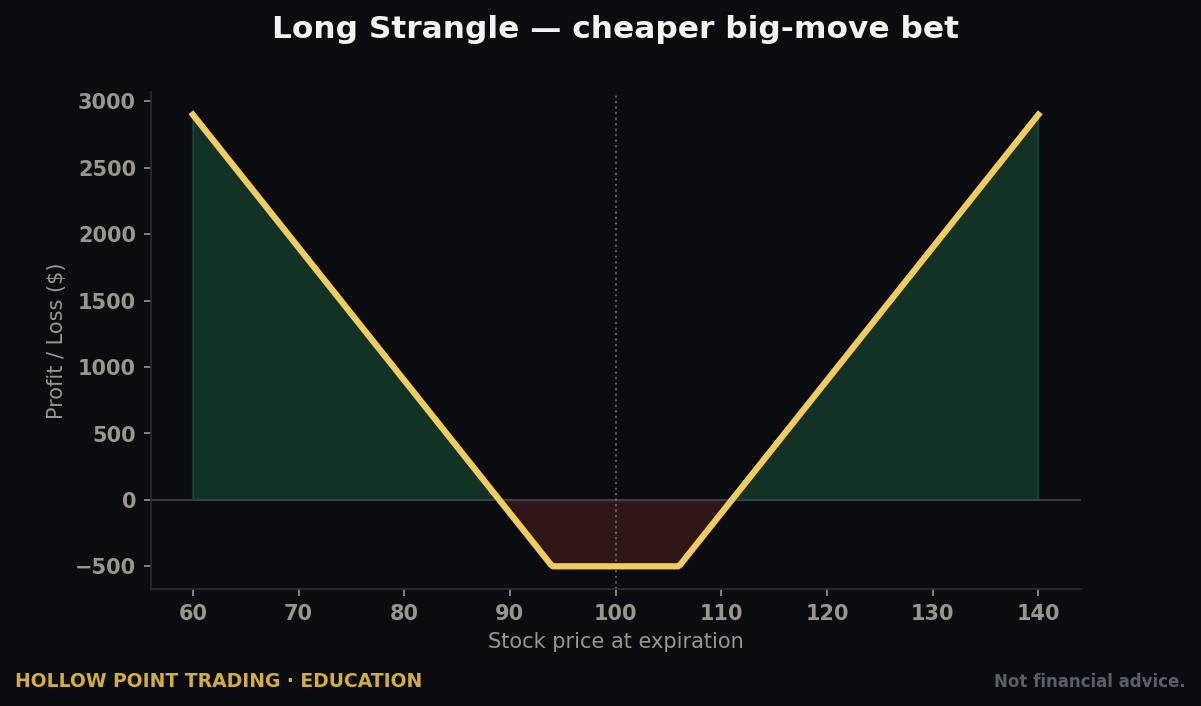
- Iron condor: a bull put spread and a bear call spread on the same name, same expiration. You profit if the stock stays in a range between your two short strikes. It's the fully-defined, non-directional way to harvest theta and IV — max loss known on both sides, collected credit from both. It's what a naked strangle should have been. Best deployed in the choppy, positive-gamma, range-bound regime described earlier, with the short strikes placed outside the value area and behind gamma walls.
- The Wheel: the cash-secured discipline turned into a repeatable system. Sell a CSP on a stock you genuinely want to own; if assigned, you own it at a discount to where it was; then sell covered calls against those shares for more income; if called away, you're flat, you booked the premium plus any appreciation, and you start again. Every leg is fully collateralized — this is naked selling's honest cousin, and for many traders it's the only "selling puts" they should ever do. The Wheel only works on names you'd be happy to hold through a drawdown; run it on a junk ticker and "getting assigned at a discount" just means bag-holding a falling knife.
How the Pros Sell Premium Differently From Beginners
The gap between a professional premium seller and a retail one isn't the strategy — they're often selling the exact same spreads. It's the behavior around the strategy. Here's where they diverge.
Beginners size to the premium; pros size to the loss. A beginner asks "how much can I collect?" and sells enough contracts to hit an income target. A pro asks "how much can I lose if this goes fully against me?" and works backwards from a fixed percent of the account (often 1-2% max loss per position). The pro's contract count is an output of the risk budget; the beginner's is an input driven by greed.
Beginners chase high IV; pros respect why it's high. A beginner's scanner sorts by premium, and the top of that list is always earnings plays, biotech binaries, and going-concern situations. A pro reads high IV as a warning label — sometimes worth selling, but only small, defined, and with full awareness of the event risk they're underwriting. They know IV rank/percentile matters more than raw IV: is this vol high for this stock's own history, or is the stock just structurally jumpy?
Beginners hold to expiration for "max profit"; pros take money off early. The pro closes at ~50% of max profit, banks the easy part of the decay curve, frees the capital, and redeploys — because the last 50% of profit takes disproportionately longer to earn and carries most of the remaining gamma risk. Squeezing the final nickels is a beginner's game that eventually gives back a dollar.
Beginners concentrate; pros diversify across uncorrelated underlyings and expirations. A pro running a put-selling book spreads it across sectors, names, and expiration dates so no single event and no single day can hurt the whole book. A beginner sells ten contracts of the one name they're sure about — which is a single undiversified bet dressed up as ten trades.
Beginners react; pros pre-commit. The pro writes down the exit — profit target, loss stop, and the price/technical level that invalidates the thesis — before entering, and executes it mechanically. The beginner decides how to feel about the trade while it's moving against them, which is the one time a human is guaranteed to decide badly.
Beginners think about return; pros think about drawdown and survival. The pro's mental math is "what sequence of losses would this book have to survive, and can it?" They're managing to still be trading in ten years. The beginner is managing to feel good this month. That single difference in time horizon explains almost everything else.
The Common Mistakes
The blow-ups aren't creative. They rhyme. Learn the pattern and you've learned most of the defense. Here are the twelve that account for nearly every dead premium-selling account.
1. Sizing to the average, not the tail. You sold ten contracts because nine times out of ten they expire worthless and the income's great. The tenth time takes back a year of profit plus your rent money. Size every naked position by asking: if this gaps to the worst plausible number, do I survive? If the answer is no, you're not trading, you're playing Russian roulette with a slow trigger and a full magazine.
2. Chasing the fattest premium. The highest IV — the richest premium — is on the names most likely to gap: earnings, biotech binaries, meme squeezes, going-concern risk. The premium is high because the danger is real and correctly priced. Selling the fattest premium is systematically selling the worst insurance policies. The market is not stupid; it's paying you extra for the exact risk that's about to show up.
3. Selling naked calls without a plan for a squeeze. The naked call's unlimited risk is not a rounding error. If you write naked calls, they must be spreads, on liquid names, sized tiny, and closed the instant your thesis breaks. Most retail traders should never write a truly naked call. Full stop, no asterisk.
4. No exit rule — "it'll come back." Premium sellers are chronically tempted to hold and hope because the position was profitable yesterday. Set a management rule before entry: close at 50% of max profit and cut the position at a 2x–3x credit loss (if you sold for $1.00 and it's now $2.50, you're out). Mechanical. No negotiation with a losing short option, ever.
5. Ignoring earnings and ex-dividend dates. Never be short an option through an event you didn't consciously choose. Earnings gaps are how naked sellers die; ex-dividend dates are how naked call sellers get early-assigned and blindsided. Check the calendar before every single entry — it takes ten seconds and saves careers.
6. Confusing margin held for max loss. The broker froze $1,150; you assume that's your risk. It is not. Margin is a deposit against a normal move, recalculated daily, and it balloons — or triggers a call — exactly when the trade goes against you. Your real risk is the payoff diagram, not the buying-power line.
7. Over-leveraging because the margin is low. Portfolio margin and naked selling's small buying-power reduction let you pile on far more contracts than a defined-risk book would allow. This feels like efficiency. It is the mechanism of ruin. Low margin requirement is not a green light; it's the broker's estimate of a normal* day, and normal days aren't what kill you.
8. Trading against the top-down read. Selling puts in a risk-off macro, selling calls into a ripping uptrend, writing premium on a name whose sector is rolling — you're placing an obligation against the path of least resistance while getting paid a pittance for the privilege. Direction didn't stop mattering because you got paid up front.
9. Selling premium on illiquid options. Wide bid-ask spreads mean you lose real money getting in and out, you can't roll or close efficiently in a panic, and a small position can move the market against you. Sell premium only on liquid, tight-market names where you can exit in one click at a fair price. Liquidity is a risk-management tool, not a convenience.
10. Legging into spreads and getting stuck naked. Traders sometimes sell the short leg first, planning to "buy the protection when it's cheaper," then never do — and now they're naked by accident, exposed to the exact tail they meant to cap. Enter spreads as a single order. Don't let a few dollars of optimization leave you uncovered.
11. Rolling losers forever to avoid taking the loss. "Rolling for a credit" to a later expiration to escape a losing short feels like management; often it's just adding time and size to a bad trade to postpone admitting it. Rolling is a legitimate tool when the thesis is intact and you're managing duration — not when it's a way to never be wrong. If the level broke, take the loss and move on.
12. Not accounting for correlation across the book. Ten short puts across ten "different" tech names is one giant bet on tech, not ten independent trades — and in a selloff they all go against you at once while margin requirements rise together. Measure your book's true concentration by how it behaves in a down-market, not by how many tickers are on the screen.
Frequently Asked Questions
Is selling puts safer than selling calls? In one narrow sense, yes: a put's loss is bounded (stock can't go below zero) while a call's is theoretically unlimited. But "bounded at strike × 100" is still enormous, and stocks gap to near-zero more often than calls get squeezed to infinity. Treat both with full respect; neither is "safe."
Can I just use stop-losses instead of spreads? No — and this is critical. Stops don't work on gap risk, which is the exact risk that kills naked sellers. If a stock gaps from $50 to $8 overnight, your stop doesn't fill at $45; it fills at $8, if at all. The catastrophe happens while the market is closed, where no stop can protect you. Only a long option (a spread) actually caps the tail.
What's a good delta to sell? Many programs target 0.15–0.30 delta on the short strike — roughly a 70–85% chance of expiring worthless. Lower delta = higher win rate but less premium and worse risk-reward per trade; higher delta = more premium but more frequent assignment. There's no magic number; it's a dial you set based on regime and your management plan, not a rule.
Should I sell weekly or monthly options? Monthlies (30–45 DTE) are the standard for a reason: a good balance of premium, decay, and manageable gamma. Weeklies decay faster but carry vicious gamma risk near the strike — small moves create large P&L swings in the final days. Weeklies reward precision and punish sloppiness; start with monthlies.
What happens if I get assigned and don't have the cash? You get a margin call. The broker can and will liquidate positions in your account — of their choosing, at market prices — to cover it, often at the worst possible moment. This is the entire reason cash-securing and defined-risk structures exist. Never sell a put you couldn't honor.
Is the Wheel actually safe? The Wheel is disciplined, not safe. It's fully collateralized, which removes margin-call risk, but you still own a stock that can fall hard. It only makes sense on quality names you'd genuinely hold through a drawdown. On a bad ticker, the Wheel just automates catching a falling knife.
How much of my account should be in short premium? Small enough that the worst plausible correlated drawdown across the whole book is survivable and doesn't change your life. For most, that means position-level max losses of 1–2% of the account and total short-premium exposure well under the level where a market shock would force liquidation. If a 20% market drop would blow you up, you're too big.
Does the variance risk premium mean I'll win over time? The edge is real on average and across a diversified, well-sized, disciplined book. It says nothing about your specific trade or your specific month, and it evaporates entirely if a single oversized position wipes you out before the average can play out. Edge without survival is worthless.
The Cheat-Sheet
Print this. Read it before every premium trade.
What "naked" means
- Short call/put with no offsetting stock (call) or reserved cash (put).
- Naked call = theoretically unlimited loss (stock has no ceiling).
- Naked put = max loss of strike × 100 − premium (stock floors at zero).
- CSP and naked put have the same market risk; the CSP just guarantees you can pay.
- Break-even: put = strike − premium; call = strike + premium.
The mechanism
- You collect premium up front; max profit = premium, full stop, no matter how right you are.
- Edge comes from theta decay + the variance risk premium (IV usually > realized vol).
- You are an insurance company: small steady wins, rare huge claim. Negative skew.
- Greeks: long theta, short vega, short gamma, directional via delta.
- Fattest premium = most dangerous underlying. The market prices risk correctly.
Regime read
- Trend: sell the side the trend defends; never fade a strong trend for fat premium.
- Chop / positive gamma: condor territory; strikes outside the value area.
- High-vol / crisis: fattest premium, worst time to size up; correlations go to 1.
Margin & gating (Reg-T naked equity option)
- Held = greater of [20% underlying − OTM amount + premium] or [10% underlying + premium]. Index: 15%.
- Margin held ≠ max loss. It's recalculated daily and triggers calls against you.
- Naked selling = highest options approval tier (Level 4/5); many brokers restrict it.
- Portfolio margin lowers the requirement, not the risk. Low margin ≠ safe.
Assignment & pin risk
- American options assigned any time; watch deep-ITM and ex-dividend dates.
- Assignment is random and can hit overnight — wake up long/short 100 shares/contract.
- Pin risk: strike-close on expiration = coin-flip assignment. Close near-the-money shorts before expiration.
- Stops don't fix gap risk. Only a long option (spread) caps the tail.
The HPT filter (run every time)
- Macro → sector → stock → confluence → risk. Puts = bullish/neutral; calls = bearish/neutral.
- Match the timeframe to the expiration; stack weekly/daily/hourly on the strike.
- Trend by EMA 12/22/55; daily 55 = the bias tell. Strike on the far side of real structure.
- Stack confluence: golden pocket, VAL/VAH (avoid POC), gamma walls.
- Naked structurally violates 1:3 R/R → default to the defined-risk spread.
Defined-risk defaults (keep ~90% of edge)
- Short put → bull put spread (buy a lower put). Loss capped at width − credit.
- Short call → bear call spread (buy a higher call). Kills the unlimited tail.
- Range view → iron condor. Own-it view → the Wheel (fully cash-secured).
Ironclad discipline if you ever run naked
- Size to the tail, not the average: survive the worst plausible gap or don't put it on.
- Never naked calls without a spread cap; most traders: never at all.
- No trades through earnings/ex-div you didn't choose.
- Liquid names only. Enter spreads as one order — never leg into an accidental naked.
- Take profit at ~50% of max; cut at 2–3x credit. Mechanical exits, no hoping.
- Diversify across uncorrelated names/expirations; measure the book by its down-day behavior.
- Close near-the-money shorts before expiration to kill pin/assignment risk.
- Trade with the top-down read, never against it.
The honest summary is this: naked options pay you to be approximately right, over and over, until the one time you're catastrophically wrong erases all of it and then some. The premium is a wage for holding a risk most people can't see and don't size for — and the market will always, cheerfully, offer you a bigger wage to take off your seatbelt. That extra premium is not a gift. It is the exact, fair, market-calculated measure of the risk you'd be running unprotected.
You can harvest the same underlying edge — theta, the variance risk premium, your directional read, the level the tape defends — with defined-risk spreads that cost a slice of the premium and buy back the entire catastrophe. That trade you can size to a rule, sleep on, hold through noise, and survive a bad Monday inside of. The traders still standing in ten years aren't the ones who collected the most premium in any single month. They're the ones who never once wrote the policy that could end them.
Bound by rules, feared by trade.